What Your Employer Owes You When You Leave
Gratuity is thirty days wages for each completed year, and over six months rounds up. A matching provident fund can replace it entirely.
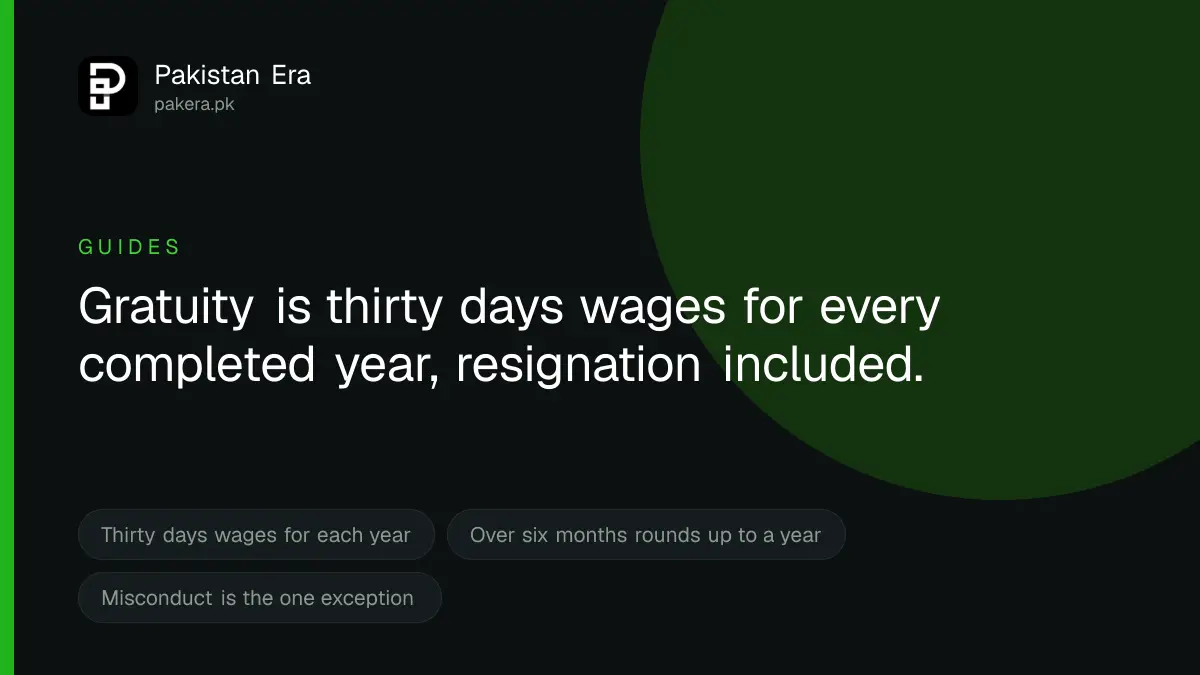
The law sets gratuity at thirty days wages for every completed year of service, and it is payable when you resign as well as when you are let go. The condition is that you were not dismissed for misconduct.
We read the text of the Industrial and Commercial Employment (Standing Orders) Ordinance, 1968 on 29 August 2026 in the copy held in the International Labour Organization's NATLEX database of national labour law. It is the statute itself rather than a summary of it, and the figures below are quoted from Standing Order 12.
What the ordinance says you are owed
Standing Order 12(6) is the operative clause. Where a workman resigns from service, or his services are ended by the employer for any reason other than misconduct, he is to be paid gratuity equivalent to thirty days wages for every completed year of service.
| Question | What the clause says |
|---|---|
| How much | Thirty days wages for each completed year |
| Part years | Any part in excess of six months counts |
| If you resign | Still payable, resignation is named in the clause |
| If you are dismissed for misconduct | Not payable |
| Which wages | The last month of service, for a fixed rated workman |
Two details in that clause are worth slowing down for. The first is the wage base: for a fixed rated workman it is the wages admissible in the last month of service, and for a piece rated workman it is the highest pay drawn during the last twelve months. The second is that thirty days was not always the figure. The clause originally said twenty days, and it was substituted by an amendment act in 1994.
Seven months counts as a full year
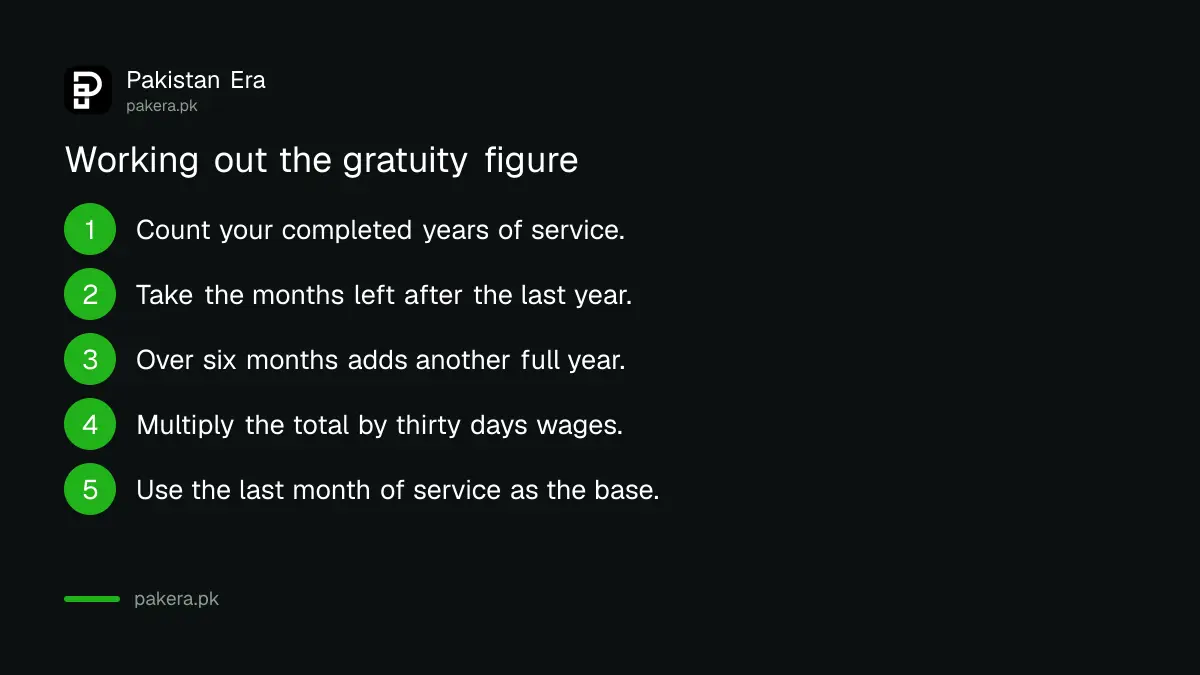
The clause says for every completed year of service or any part thereof in excess of six months. That rounding rule is the part people give away without knowing it.
- Count your completed years of service.
- Take the leftover months after the last full year.
- If that remainder is more than six months, add another year.
- Multiply the total by thirty days wages.
- Use the last month of service as the wage base.
So four years and seven months is counted as five, not four. If you are close to that line and choosing a resignation date, the difference is a full month of pay.
A provident fund can cancel the gratuity
This is the proviso that causes most of the arguments, and it is written into the same clause. Where the employer has established a provident fund to which the workman contributes, and the employer's contribution to it is not less than the workman's own, no gratuity is payable for the period during which that fund has been in existence.
A second proviso does the same for an approved pension fund under the Income Tax Ordinance, 2001, where the employer contributes not less than fifteen per cent of the prescribed limit and the workman contributes the remaining half or less.
So it is normally one or the other, not both. If your employer runs a matching provident fund, that is the benefit, and the gratuity does not stack on top of it for the years the fund was running.
Your provident fund balance survives a dismissal
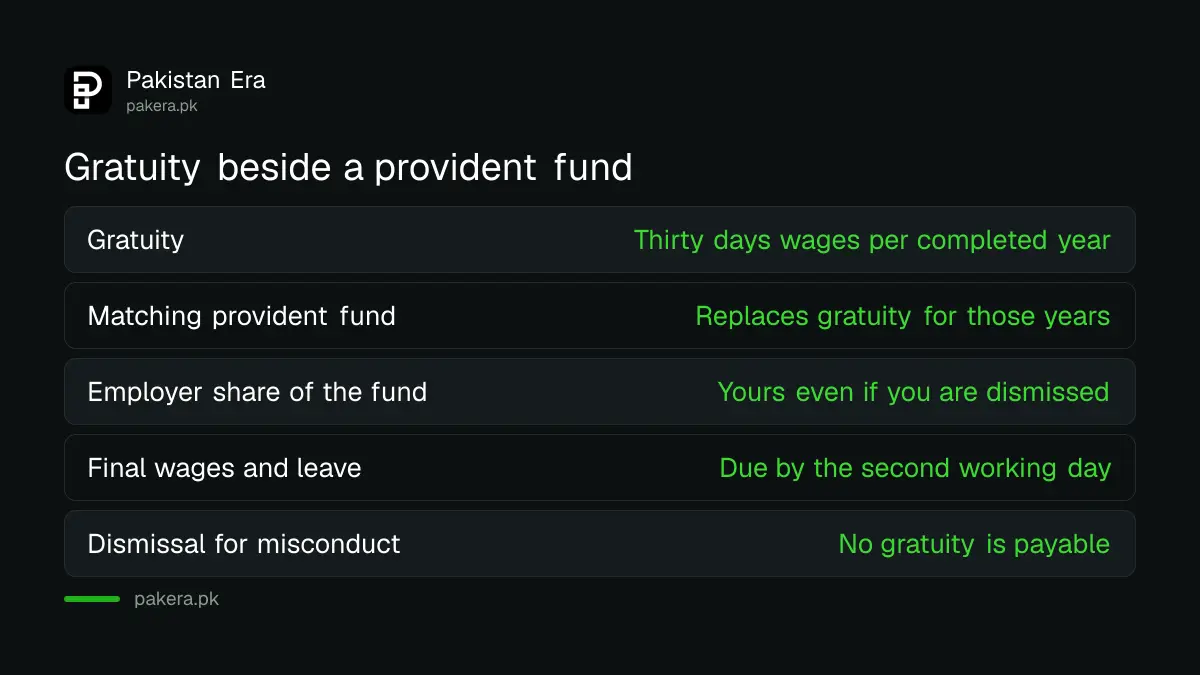
Standing Order 12(7) is short and it settles a common workplace belief. A workman is entitled to receive the amount standing to his credit in the provident fund, including the contributions of the employer to that fund, even if he resigns or is dismissed from service.
That word dismissed is doing real work. The employer's share of a provident fund is not a reward for leaving on good terms and is not forfeited by a bad exit. If you are told otherwise, the clause is the answer.
Final dues have a deadline of two working days
Standing Order 12(4) sets a deadline almost nobody quotes. Where the services of a workman are ended, the wages he has earned and other dues, including payment for unavailed leave, are to be paid before the expiry of the second working day from the day his services ended.
That is a much shorter window than the next payroll cycle, which is what most people are told to wait for. Unavailed leave is named in the clause, so accumulated leave is part of the final settlement rather than something that lapses.
If the worker dies in service
Standing Order 12(8) covers it. Where a workman dies while in the employer's service, the dependant is to be paid gratuity under the same clause 6, but the payment cannot be made directly. It has to be deposited with the Commissioner, who allocates it to the dependants under section 8 of the Workmen's Compensation Act, 1923.
Clause 9 then gives the family a route if nothing arrives: if the employer fails to deposit the gratuity, the dependant may apply to the Commissioner to recover it. Our guides to how inheritance shares are worked out and to applying for a death certificate cover the documents a family will need alongside this.
Which jobs this covers, and which province
The ordinance applies to industrial and commercial establishments as it defines them, so it does not reach every job in the country. Government service, most domestic work and many small establishments sit under different rules or outside it.
Labour is also a provincial subject since the eighteenth amendment, and each province now administers its own version of this ordinance. The copy we read refers to the Punjab Industrial Relations Act, 2010, which places it in the Punjab line of descent. Check the version applied in your province before relying on a section number, and read your appointment letter as well, because a contract can promise more than the statute but not less.
Common questions about gratuity in Pakistan
Do I get gratuity if I resign?
The clause names resignation directly. Gratuity is payable where a workman resigns or where services end for any reason other than misconduct.
How is the amount worked out?
Thirty days wages for every completed year, with any remaining part over six months counted as a further year, on the last month of service for a fixed rated workman.
Can my employer give a provident fund instead?
Yes. Where a matching provident fund exists, the proviso says no gratuity is payable for the period that fund has been running.
Do I lose the employer share of the provident fund if I am dismissed?
Clause 7 says the balance including the employer's contributions is payable even if the workman resigns or is dismissed.
When must my final salary be paid?
Before the expiry of the second working day from the day service ended, and that includes payment for unavailed leave.
How we verified this
What we checked, where we read it, and what we could not confirm.
Last checked 29 August 2026. Every clause quoted here was read by us in the text of the Industrial and Commercial Employment (Standing Orders) Ordinance, 1968 as held in the ILO NATLEX database of national labour legislation, document PAK86160. That is the statute rather than a government of Pakistan web page, and we did not read it on a provincial labour department site. The thirty days figure, the six month rounding, the last month and highest twelve month wage bases, the provident fund and approved pension fund provisos, clause 7 on the employer contribution surviving dismissal, clause 4 on the second working day deadline and clauses 8 and 9 on death in service are all taken from that text. The copy we read cites the Punjab Industrial Relations Act, 2010, so it sits in the Punjab line. Labour became a provincial subject after the eighteenth amendment and the version applied in your province may differ, so confirm the section numbering with your provincial labour department before acting on it. No amount in rupees is quoted here, because gratuity is calculated from your own wages.
About the author

Public Services and Education Journalist
Fajr Riaz is a journalist and content writer at Pakistan Era, based in Lahore. She covers the questions people meet in everyday life in Pakistan: how a public service works, what a change in the rules means, and where to find a reliable answer.