How to Get IBCC Equivalence for a GED in Pakistan: Approved Centre and a Two Year Gap After SSC
IBCC gives HSSC equivalence for a GED only if you sat at an approved centre in Pakistan with two years after SSC. See the documents and what to check first.
Short answer: IBCC gives an HSSC equivalence certificate for a GED only if you sat the exam through an approved study centre in Pakistan and left at least two years between your SSC and the GED diploma. You need the original GED diploma, the official transcript, your SSC document and your GED ID and password.
The GED looks like a shortcut to an inter certificate. For a Pakistani student it can be one, but only if the rules are followed from day one. A student who sits the exam at the wrong centre may find the result does not count.
We read IBCC's FAQ page on international qualifications, its list of registered foreign boards and its public notice on GED test preparation partners on 13 October 2026. The notice carries its list as an image, so we could not read the centre names and do not repeat them.
IBCC has registered the GED Testing Service
IBCC's list of registered foreign boards shows GED Testing Service LLC of the USA, registered on 7 May 2026 and valid until 6 May 2030. The list files the GED High School Diploma under the American high school programme as an HSSC relevant group.
Registration is not the same as automatic equivalence. IBCC says registering a board does not mean all its qualifications get equivalence. For the GED, the extra conditions are on its FAQ page and are listed below.
The wider list of boards is in the page on checking an exam board with IBCC.
The two conditions are an approved centre and a two year gap
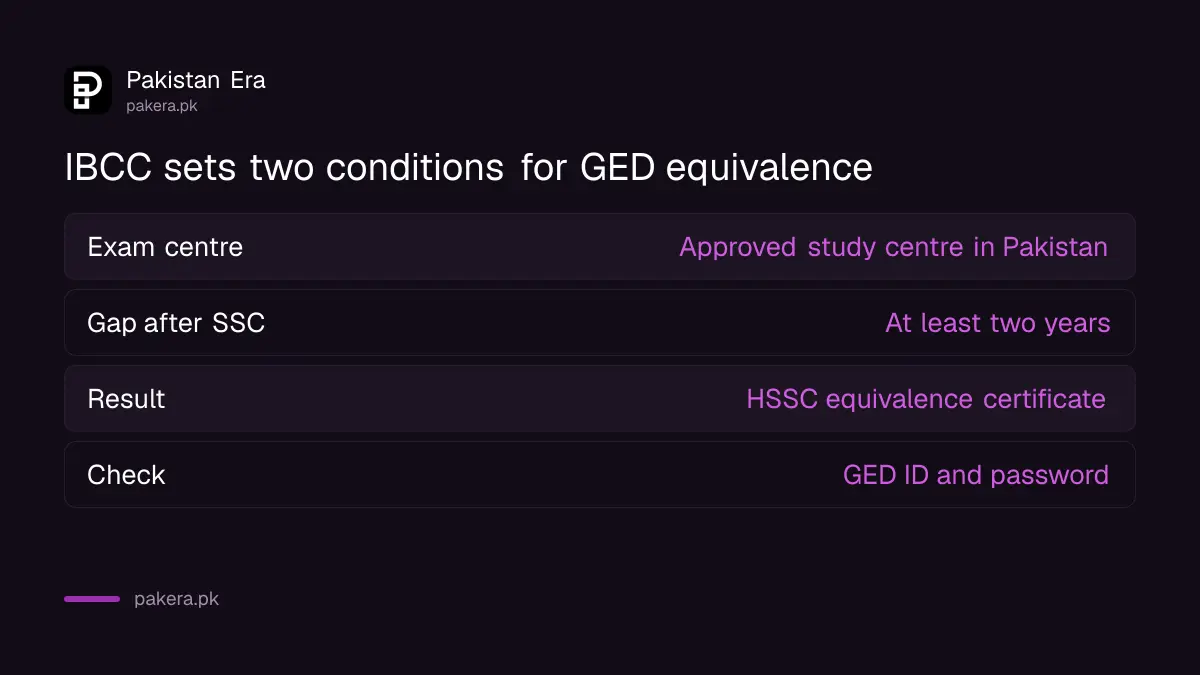
IBCC says the student must have appeared for the GED through an approved study centre in Pakistan. It also says there must be at least two years between the SSC or equivalent and the GED diploma. If either condition fails, equivalence is not guaranteed.
| Condition | What IBCC says |
|---|---|
| Where you sit the exam | Through an approved study centre in Pakistan |
| Gap after SSC | At least two years before the GED diploma |
| Level you get | HSSC equivalence certificate |
| Online check | You give your GED ID and password |
Check the centre before you pay for classes
IBCC published a public notice on 17 March 2026 about GED authorised test preparation partners, with an updated list of GED centres dated 7 April 2026 on its site. Read that list on IBCC's own notifications page, not on a centre's poster.
The notice is an image, so open it on IBCC's website and compare the centre's exact name. A centre that says "approved" in an advertisement may or may not be on the list. A sentence from a salesperson is not proof.
- Open the notifications page of ibcc.edu.pk.
- Find the public notice on GED authorised test preparation partners.
- Look for the centre's full name and city in the updated list.
- If the centre is not there, email IBCC before you register for classes.
Ask for the reply in writing and keep it with your papers. We have not checked any centre.
Your SSC date decides whether the gap rule is met
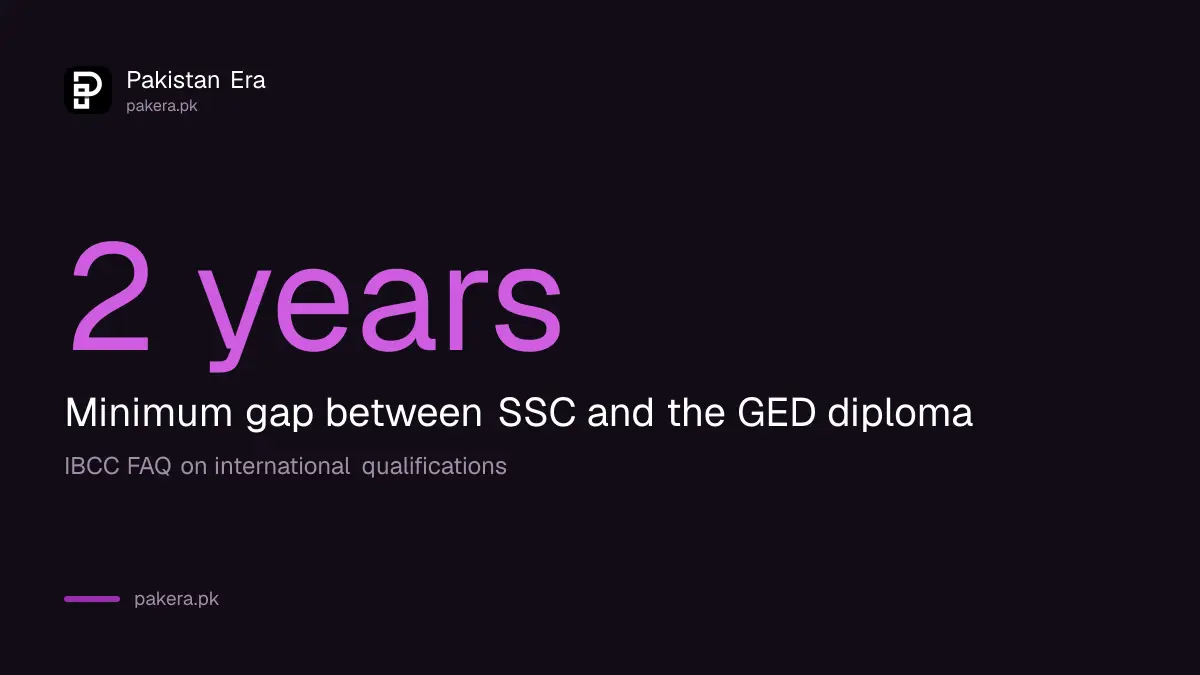
The two year gap runs between your SSC, or equivalent, and the GED diploma. A student who passes SSC in 2025 and takes the GED in 2026 would not meet the gap on IBCC's wording. Count from the date on your SSC document.
That rule shapes who this route suits. It fits a student who left school after matric and returned to study later. It does not fit a student who wants to skip two years of inter right away.
If you are still in school, the ordinary route is better. The steps for the regular inter certificate appear in the page on IBCC attestation of matric and inter certificates.
Gather these documents for the equivalence application
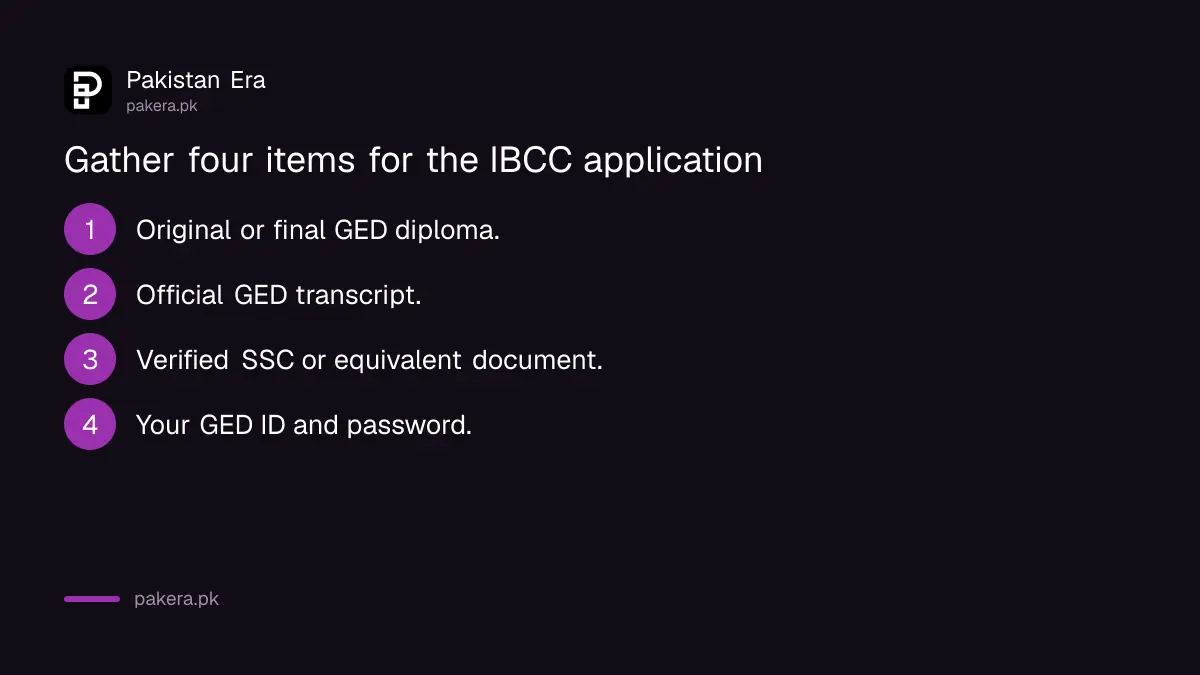
IBCC lists the original or final GED diploma with its official transcript, a verified SSC or equivalent document, and your GED ID and password so IBCC can verify the result online. Keep your ID and password safe, because IBCC asks for them directly.
We could not find a fee or a processing time for the GED route on the pages we read. Do not trust a figure quoted by a centre. Ask IBCC and get it in writing.
Once you receive the certificate, the QR code can be verified online by a university. The method is explained in the page on checking an IBCC QR equivalence certificate.
A GED is not the same as a US high school diploma
Many people mix the two. A US high school diploma means four years at an American school, with transcripts for Grades 9 to 12. A GED is a test based high school equivalency. IBCC treats them on separate pages with separate documents.
If you studied at an American school, read the page on IBCC equivalence for a US high school diploma instead. Pakistani students on that route must also pass Urdu, Islamiyat and Pakistan Studies at SSC level, which the IBCC page for that diploma states.
Common questions
Does IBCC recognise the GED in Pakistan?
Yes, for equivalence, if you meet its conditions. IBCC's FAQ says the GED is recognised for equivalency purposes.
What certificate do I get from a GED?
An HSSC equivalence certificate, according to IBCC's FAQ page.
Can I take the GED right after matric?
Not for equivalence. IBCC says there must be at least two years between your SSC and the GED diploma.
Must I use an approved centre?
Yes. IBCC says you must have appeared for the GED through an approved study centre in Pakistan.
When was the GED Testing Service registered?
IBCC's list shows 7 May 2026, valid until 6 May 2030.
What is the fee for GED equivalence?
We could not find it on IBCC's pages. Ask IBCC before you pay anyone.
How we verified this
What we checked, where we read it, and what we could not confirm.
Last checked on 13 October 2026, Pakistan time. We read IBCC's international qualification FAQs, its registered foreign boards page and the notice on GED test preparation partners. The centre list in that notice is an image that we could not read, and we found no fee or processing time. We did not apply for a certificate.
About the author

Public Services and Education Journalist
Fajr Riaz is a journalist and content writer at Pakistan Era, based in Lahore. She covers the questions people meet in everyday life in Pakistan: how a public service works, what a change in the rules means, and where to find a reliable answer.