Report Court Staff Bribery or Delay in Pakistan: LHC WhatsApp 0300-0348050 and Supreme Court Hotline
Report bribery, delay or record tampering by court staff in Pakistan: the LHC WhatsApp and email, the Supreme Court anti-corruption hotline and what to send.
If court staff in Pakistan ask for a bribe, delay your file or tamper with records, report it in writing. For the Lahore High Court, use WhatsApp 0300-0348050 or complaints@lhc.gov.pk. For the Supreme Court, use the Anti-Corruption Hotline on WhatsApp 0329-0266663, messages to 0326-4442444, or the complaint portal at scp.gov.pk/Complaints.aspx. The Supreme Court says reports can be anonymous. Both channels are free.
We read both courts' complaint pages on 4 November 2026. This guide is about court staff and court processes, such as clerks, copy branches and case fixing. A complaint against a judge's conduct follows a different route, which we link below.
Two courts publish dedicated complaint lines
| Court | Other channels | |
|---|---|---|
| Lahore High Court | 0300-0348050 | complaints@lhc.gov.pk |
| Supreme Court of Pakistan | 0329-0266663 | 0326-4442444 (messages), scp.gov.pk/Complaints.aspx |
| Supreme Court, overseas litigants | None listed | scp.gov.pk/OSComplaints.aspx |
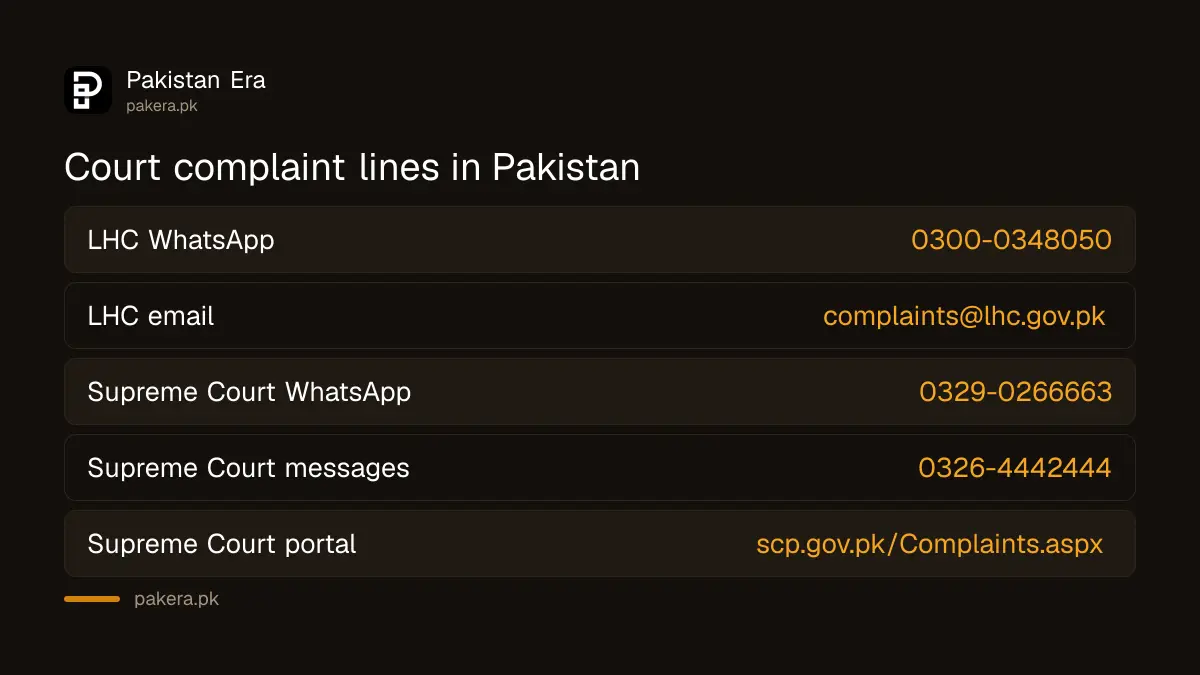
The Lahore High Court's complaints page lists only the email and WhatsApp number. It does not say what types of complaint it takes or how fast it replies. The main LHC switchboard, +92 42 99212951 to 66, can tell you which branch handles your issue.
The Supreme Court hotline takes six kinds of misconduct
The Supreme Court's Anti-Corruption Hotline page names what it covers. It handles complaints about corrupt practices involving Supreme Court officials, administrative processes, case fixation, certified copies and other institutional matters. It lists these as reportable:
- Bribery.
- Misconduct.
- Deliberate delays.
- Tampering with records.
- Favouritism.
- Unauthorised access to confidential information.
The page is firm about its limits. Its numbers take "Messages Only Related Supreme Court of Pakistan", and it says complaints beyond its mandate will not be entertained. A problem in a district court or a High Court goes to that court, not to the Supreme Court hotline.
Six steps make a complaint that gets acted on
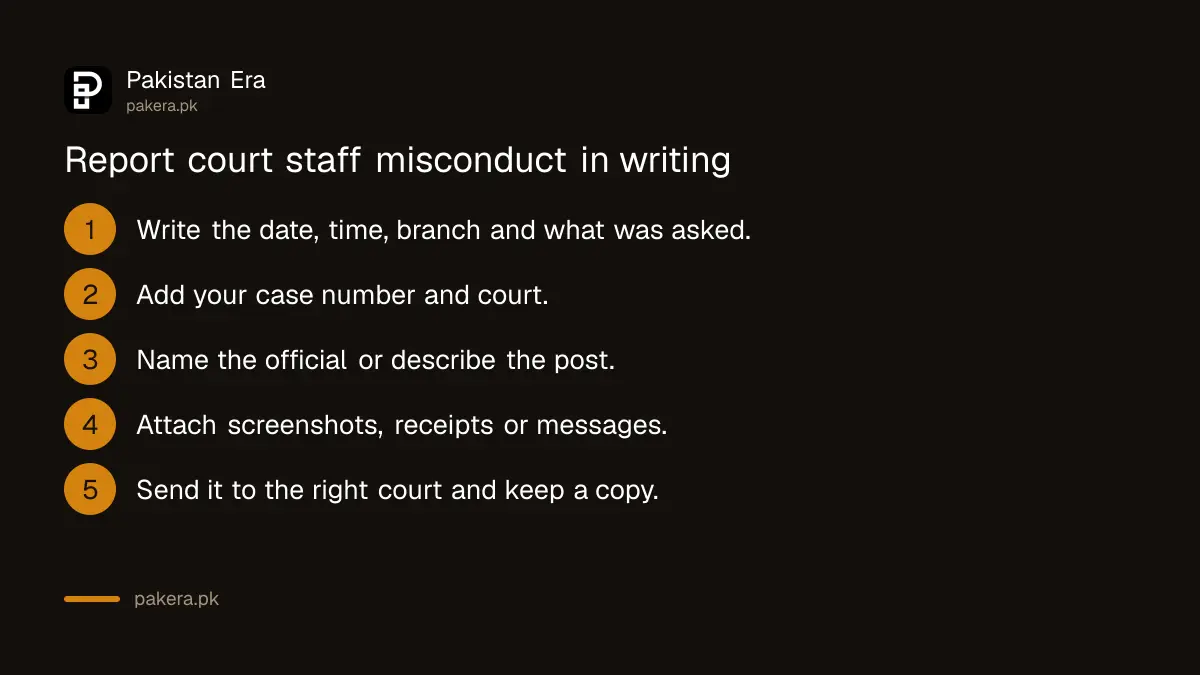
- Write down what happened: date, time, branch or room, and what was said or asked.
- Add your case number and court. Without it, nobody can trace the file.
- Name the official if you know the name, or describe the post, such as copy branch clerk.
- Attach any proof: a screenshot, a receipt, a message, or the dates your file was delayed.
- Send it to the right court: LHC matters to 0300-0348050 or the email, Supreme Court matters to the hotline or portal.
- Keep a copy of what you sent and the date. Follow up in writing if you hear nothing.
Stick to facts. Say what happened, not what you think of the person. A short, dated complaint with a case number is far easier to act on than a long angry one.
Check the facts before you call it a delay
Not every slow file is misconduct. A case can be adjourned by the judge, held on an office objection, or waiting for the other side. Before you complain, check what the court record says.
- Lahore High Court: use Last Hearing Status and the Diary Objection Cases list. Our LHC case status guide shows how.
- Certified copies in Punjab: the LHC's Certified Copy Status page tracks a copy request by petition number. See our guide on certified copies in Punjab.
- Supreme Court: use Online Case Information and the weekly cause lists. Our Supreme Court case status guide covers both.
Write down each date you visited the branch and what you were told. A list of five visits over three weeks, each with the same excuse, shows a pattern. That list is often the strongest proof you will have, because a bribe request is rarely written down.
If the record shows your file has been ready for weeks and someone still wants money to release it, that is exactly what these lines are for.
Complaints about a judge go to a different body
These lines are for staff and court processes. A complaint about a judge's own conduct goes to the Supreme Judicial Council for High Court and Supreme Court judges, or to the High Court for district judges. Our guide on complaining against a judge in Pakistan explains that route.
Overseas Pakistanis with a stuck case in Punjab have a separate helper: the LHC Overseas Pakistanis Cell.
Never pay a caller who claims to be from the court
Fraudsters call litigants, quote their case number from the public cause list, and ask for money to "fix" a date or release a copy. Court lists are public, so knowing your case number proves nothing. Real courts do not take fees by mobile wallet transfer to a private number. Report such a call to the same complaint line, with the caller's number and the time.
Common questions
What is the Lahore High Court complaint WhatsApp number?
0300-0348050. The LHC also lists complaints@lhc.gov.pk for complaints.
Can I complain anonymously to the Supreme Court hotline?
Yes. The Supreme Court says reports to its Anti-Corruption Hotline can be made anonymously.
Can I use the Supreme Court hotline for a district court problem?
No. The hotline takes messages related to the Supreme Court only. Complain to the High Court that supervises that district court.
Is 1818 the Supreme Court complaint number?
1818 is the Supreme Court's public helpline. Corruption reports go to the hotline numbers and the complaint portal.
Do I need a lawyer to complain about court staff?
No. You can send the complaint yourself by WhatsApp, email or the online portal.
How we verified this
What we checked, where we read it, and what we could not confirm.
We read the Lahore High Court complaints page, the LHC contact page, the Supreme Court Anti-Corruption Hotline page and the Supreme Court home page on 4 November 2026. Neither court publishes a reply time for these complaints, and we did not send a test complaint.
About the author

Public Services and Education Journalist
Fajr Riaz is a journalist and content writer at Pakistan Era, based in Lahore. She covers the questions people meet in everyday life in Pakistan: how a public service works, what a change in the rules means, and where to find a reliable answer.