Complaint Against a Judge in Pakistan: Supreme Judicial Council or High Court, Every Level
File a complaint against a judge in Pakistan: the Supreme Judicial Council for superior judges, the High Court for district judges, with forms and grounds.
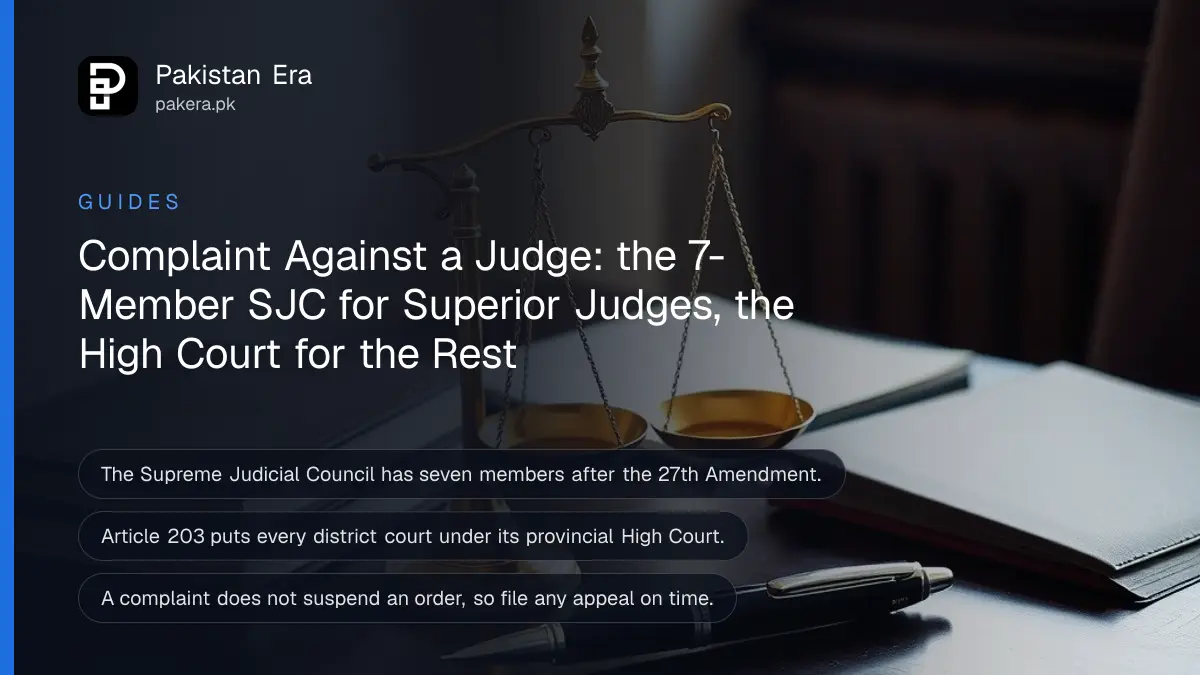
A complaint against a judge in Pakistan goes to one of two places. For a judge of a High Court, the Supreme Court or the Federal Constitutional Court, it goes to the Supreme Judicial Council under Article 209 of the Constitution. For a civil judge, magistrate or sessions judge, it goes to the High Court of that province.
Most people get this wrong in one of two ways. They send a complaint about a district judge to the wrong office, or they file a complaint when what they really need is an appeal. Below we set out which body handles which judge, the grounds the law accepts, the online and email routes the High Courts publish, and what a complaint cannot do for your case.
Two bodies decide complaints, depending on the judge's court
Judges of the superior courts can only be removed through the Supreme Judicial Council. Judges of the district courts are supervised by their High Court under Article 203 of the Constitution, which says each High Court "shall supervise and control all courts subordinate to it".
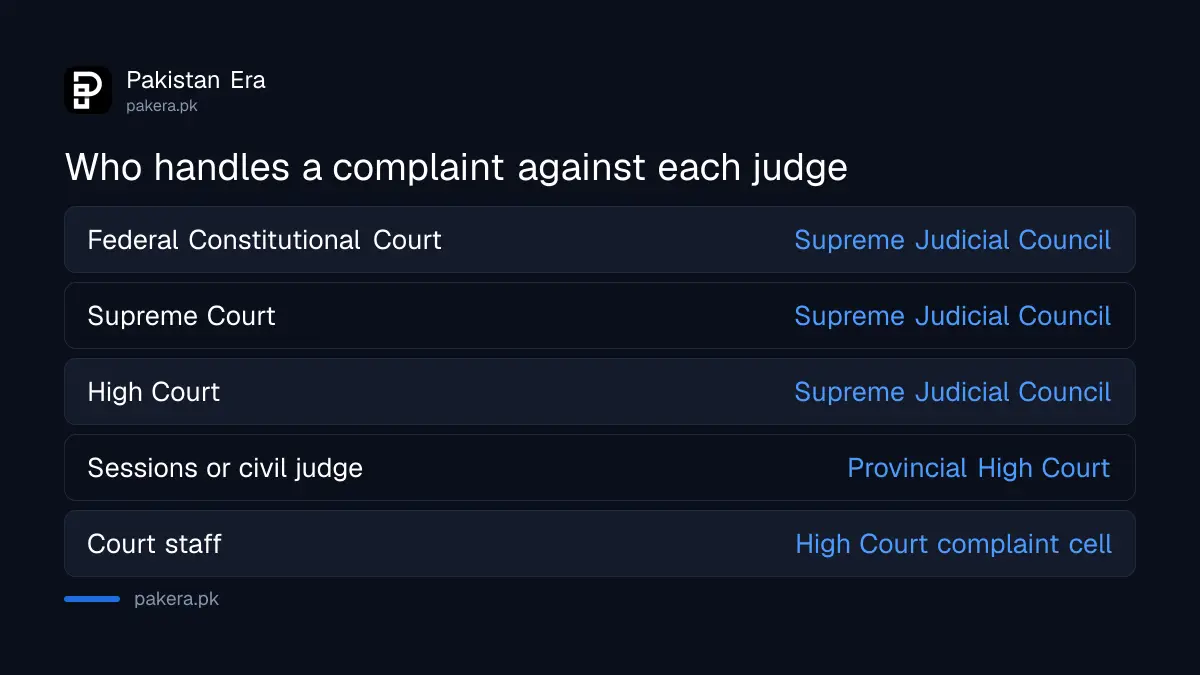
| Judge you want to complain about | Who handles it | Legal basis |
|---|---|---|
| Federal Constitutional Court judge | Supreme Judicial Council | Article 209 |
| Supreme Court judge | Supreme Judicial Council | Article 209 |
| High Court judge | Supreme Judicial Council | Article 209 |
| Sessions judge, civil judge or magistrate | High Court of the province | Article 203 |
| Court staff, reader or clerk | High Court or the district judge | Court complaint cell |
The Supreme Judicial Council looks at four grounds only
Article 209 lets the Council inquire when a superior court judge may be physically or mentally incapable, may be inefficient, may be guilty of misconduct, or does not accept a transfer under Article 200. It can act on information from any source, so a citizen's complaint is one way in.
We read the current text of the Constitution on Pakistan Code. After the 27th Amendment of 2025, the Council has seven members. They are the Chief Justice of the Federal Constitutional Court, the Chief Justice of the Supreme Court, the next senior judge of each of those two courts, one more judge nominated jointly for two years, and the two most senior High Court Chief Justices.
If the Council finds against a judge, it reports to the President, who may remove the judge. Where the matter came by report or by a direction of the President, the Council must report within six months. Article 211 says its proceedings cannot be challenged in any court.
Article 209(10) told the Council to make new rules for its procedure within sixty days of the 27th Amendment. The Council's own website did not open from our connection on 27 October 2026, so we could not confirm the current complaint format or address. Check with the Supreme Court registry before you send anything.
District judges are reported to the High Court of the province
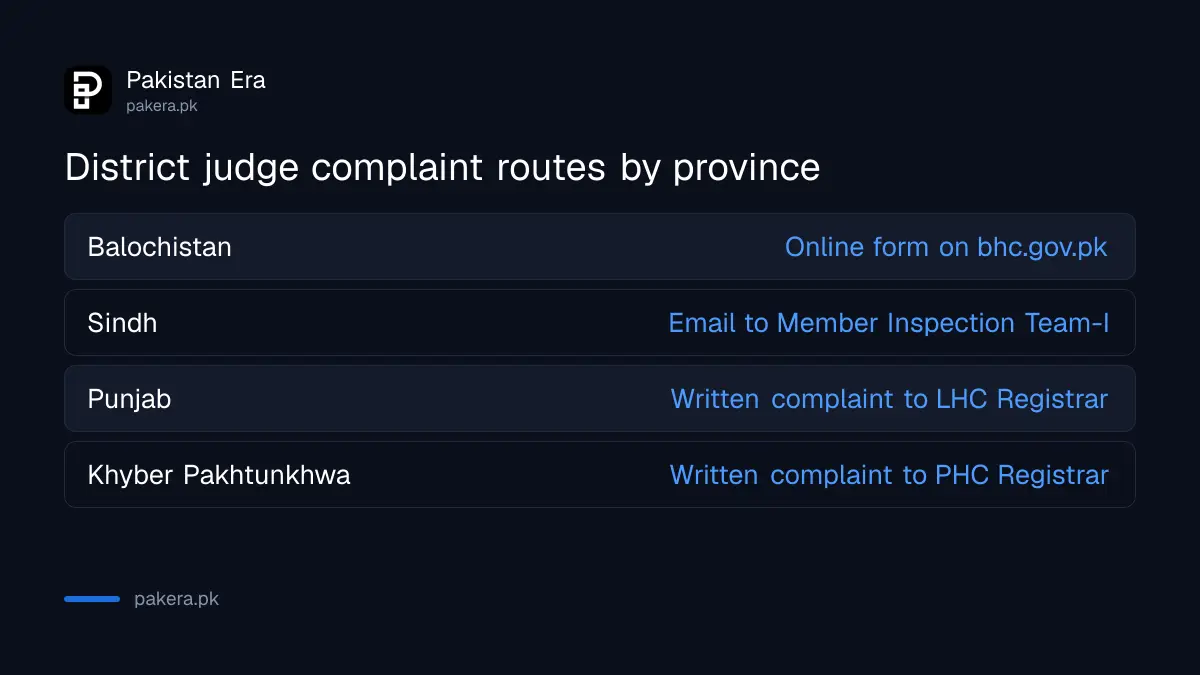
For a civil judge, a judicial magistrate or a district and sessions judge, write to the High Court that supervises that district. Sindh and Balochistan publish the route clearly on their websites. We could not open the Lahore High Court site, and the Peshawar High Court site returned an empty page.
- Balochistan: an online form at bhc.gov.pk under Public Desk, Complaints. Pick the category Subordinate Courts Judicial Officers / Judges. Other categories are High Court Officers and Staff, Subordinate Courts Staff, and Other.
- Sindh: the High Court's Complaint page says complaints against judicial officers of the district courts go to Member Inspection Team-I by email at mit1shc@sindhhighcourt.gov.pk.
- Punjab and Khyber Pakhtunkhwa: address a written complaint to the Registrar of the Lahore High Court or the Peshawar High Court. We could not read either court's complaint page, so we cannot give a form or email.
The Balochistan form asks for your name, father's name, CNIC, contact number, address and email, then the category, a subject, a description and an optional attachment. The Telephone Directory lists the Additional Registrar Admin and Complaints on 081-9202124.
A complaint does not change the order in your case
A complaint is about the judge's conduct, not about whether the judgment was right. If you lost a case or a bail plea, the remedy is an appeal or a revision within the time limit. A complaint will not suspend the order, and time keeps running while it is examined.
So file the appeal first if you have grounds. Losing a case is not misconduct. For civil cases, the appeal against a civil court decree has limits of 30 to 90 days. Criminal orders can be challenged through a revision petition.
Write the complaint with dates, facts and proof
A complaint is read by senior judges or inspection teams who see many vague letters. One that names the court, the case number, the date and what happened, with copies attached, gets examined. One that only says the judge is unfair does not.
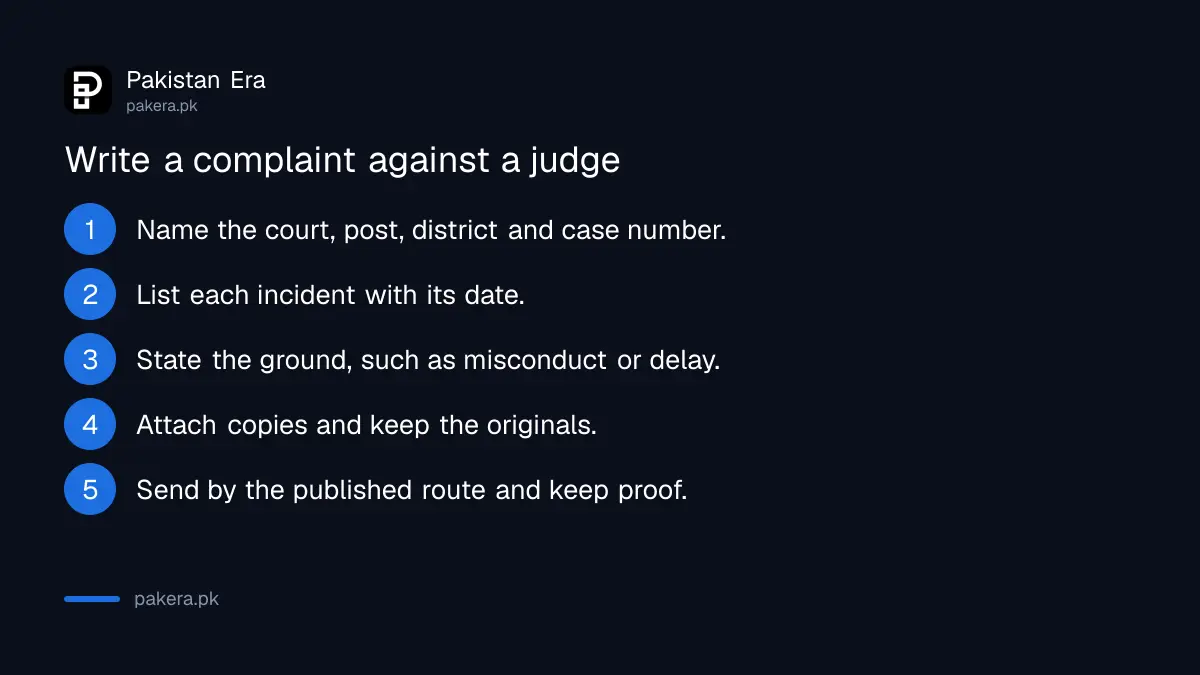
- Name the judge's court and post, the district, and the case number and title.
- Give each incident with its date, in order, in short plain sentences.
- Say which ground you rely on: misconduct, delay, rudeness, a demand for money, or something else.
- Attach copies of order sheets, the cause list or any message you received. Keep the originals.
- Add your CNIC, address and a phone number. Anonymous letters are hard to act on.
- Send it through the published route, and keep proof of sending.
Be careful with what you write. A complaint that makes false allegations, or that uses abusive words about a judge, can expose you to legal action, including contempt of court under Article 204. State facts you can prove and leave out opinions about the judge's character.
Lawyers and police are complained about elsewhere
Judicial complaint routes cover judges and court staff only. A complaint about your own advocate goes to the provincial bar council, and the steps for a complaint against a lawyer in Pakistan are separate. Police conduct in a case goes to senior police officers or, for FIR problems, through the court.
Common questions
Can I complain against a High Court judge to the Chief Justice of that High Court?
Only the Supreme Judicial Council can inquire into the conduct of a High Court judge for removal. A letter to the Chief Justice may be noted, but the constitutional route is Article 209.
Is there a fee to complain against a judge?
We found no fee on the Balochistan form or the Sindh complaint page. Nothing we read in Article 209 sets a fee either.
Can I complain about a delay in my case?
Yes, but a delay complaint needs a pattern. Inefficiency is one of the Article 209 grounds for superior judges, and supervising district courts is the High Court's job under Article 203. Give the date of each adjournment and who asked for it.
Will the judge know who complained?
Assume so. Neither complaint page we read promises to keep a complainant's name secret, and a fair inquiry has to put the facts to the judge for a reply. That is one more reason to write only what you can prove.
Can overseas Pakistanis complain?
Yes. Balochistan has an Overseas Complaints tab on the same form, and Sindh runs a separate cell for overseas Pakistanis. The routes are set out for overseas Pakistanis complaining to a High Court.
What happens after the Council finds misconduct?
It reports to the President that the judge should be removed, and the President may remove the judge. Article 211 bars any court from questioning that process.
How we verified this
What we checked, where we read it, and what we could not confirm.
We read Articles 203, 204, 209, 210 and 211 in the current Constitution on Pakistan Code, which shows the 26th and 27th Amendment changes, on 27 October 2026. The same day we read the Balochistan High Court complaint form and its Telephone Directory, and the Sindh High Court Complaint page. The Supreme Judicial Council website, the Lahore High Court site and the Peshawar High Court site did not load for us, so we have not confirmed their complaint formats.
About the author

Tax, Bills and Technology Writer
Ali Akhtar is a young and curious voice here at Pakistan Era. He is currently pursuing his A-Levels and has a growing interest in Pakistan’s changing industrial landscape and educational trends. Ali likes to write in a way that helps him explain and explore the world around him. His writing reflects the perspective of the new generation navigating the evolving trends of Pakistan where technology, youth innovation, and shifting opportunities are reshaping the country’s future.