Complain Against a Lawyer in Pakistan Through the Bar Council
Complain against a lawyer in Pakistan to the bar council: where to file, the Rs 5,000 Supreme Court fee, the affidavit, the Tribunal, penalties and appeals.
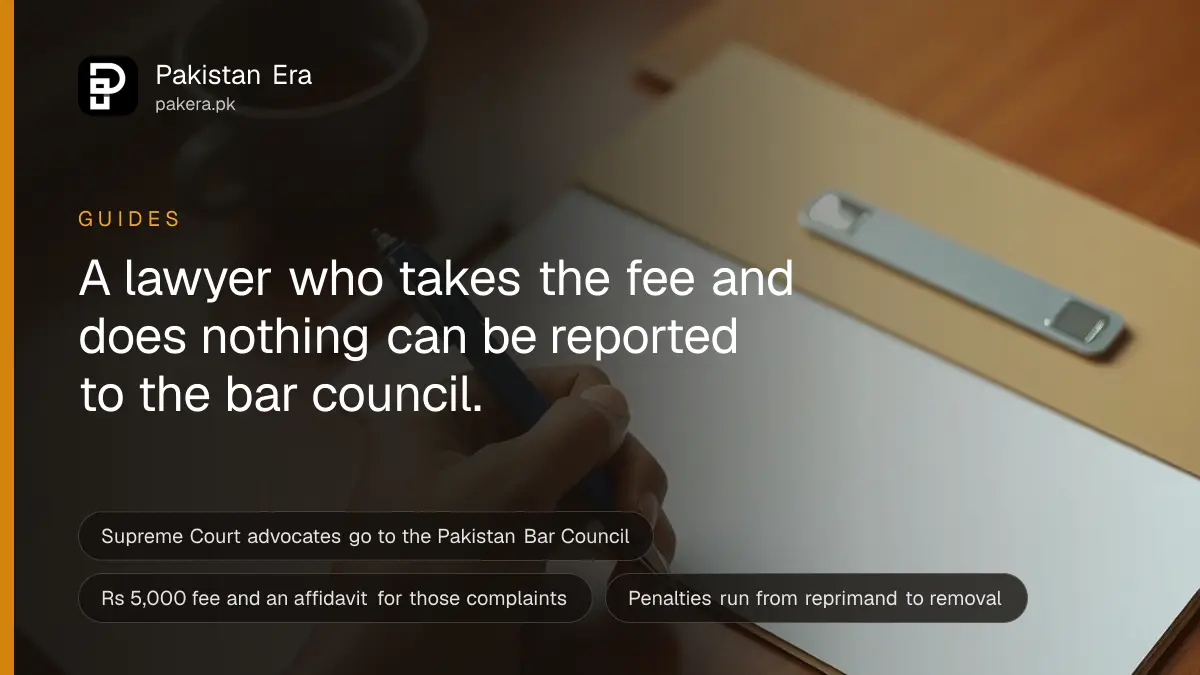
To complain against a lawyer in Pakistan, write to the bar council where the lawyer is enrolled: the provincial bar council or the Islamabad Bar Council for most lawyers, and the Pakistan Bar Council for Supreme Court advocates. A Supreme Court complaint needs a Rs 5,000 fee and a supporting affidavit.
A lawyer who takes the fee and misses every hearing, loses your documents or lies about the case can be punished. The punishment does not come from the police or the court where your case sits. It comes from the bar council, under the Legal Practitioners and Bar Councils Act 1973. We read the Act and the Pakistan Bar Council's rules on 2 October 2026.
The bar council decides complaints against lawyers
Section 41 of the 1973 Act lets any court or person complain that an advocate is guilty of misconduct. A Supreme Court advocate is reported to the Pakistan Bar Council. Every other advocate is reported to the provincial bar council or the Islamabad Bar Council.
So first find out where your lawyer is enrolled. In Punjab that is the Punjab Bar Council at 9 Fane Road, Lahore. You can verify the lawyer's licence on the bar council's site, which also tells you the level he is enrolled at.
| Lawyer enrolled as | Complain to | Fee |
|---|---|---|
| Advocate of the Supreme Court | Chairman, Pakistan Bar Council, Islamabad | Rs 5,000 receipt, under rule 117(2) |
| Advocate of a High Court or lower courts in a province | That provincial bar council | Set by the council's rules; ask its office |
| Advocate enrolled in Islamabad | Islamabad Bar Council | Set by the council's rules; ask its office |
| Complaint made by a court | The same bar council | No fee under section 41(3) |
The Act says a complaint "shall be accompanied by such fee as may be prescribed", except when a court makes it. We found the Pakistan Bar Council's figure in its rules. We did not find the Punjab Bar Council's figure published online, so confirm it with the council before you go.
What a complaint must contain
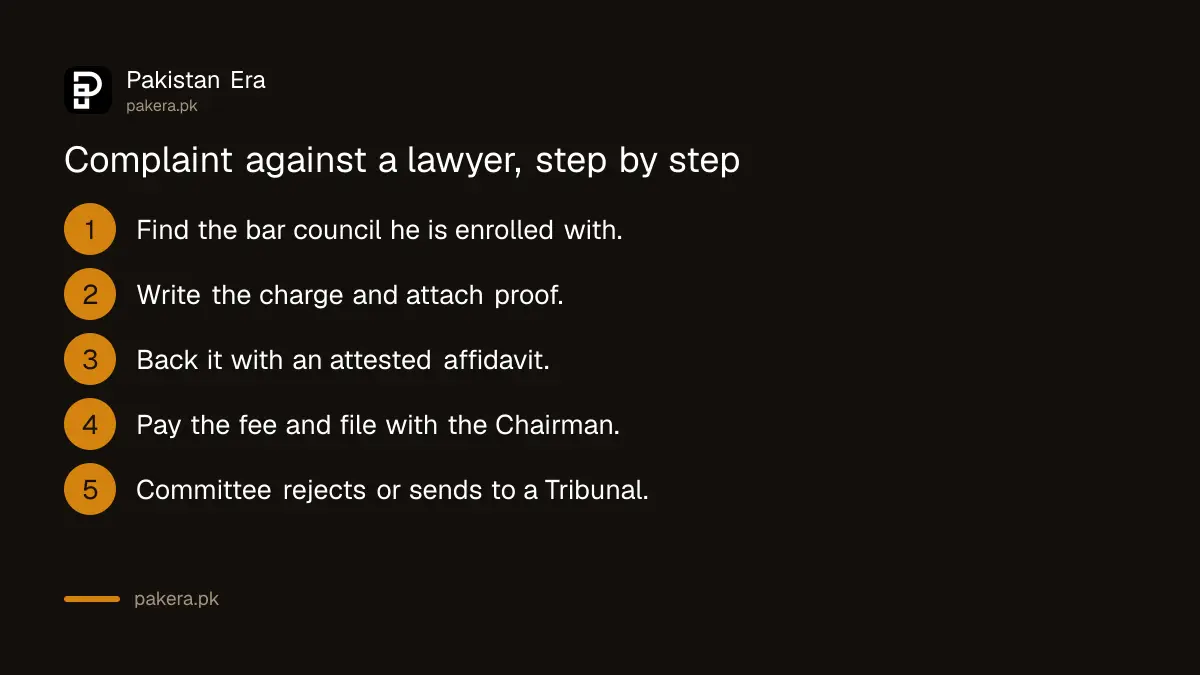
Under the Pakistan Bar Council's rules, a complaint must state each charge clearly, attach every document you have, and be backed by an affidavit on the facts. The bar council can waive the affidavit. Provincial councils have their own rules, which we did not find online.
Rule 117 of the Pakistan Legal Practitioners and Bar Councils Rules 1976 is the clearest model we found. The complaint is addressed to the Chairman. It "shall contain clearly the charge or charges". It includes "all documents or copies of documents that are available to the complainant". And, unless a court or public officer is complaining, it is "supported by an Affidavit as to the facts alleged".
- Write down what happened, in date order. When you hired the lawyer, what you paid, what he promised, and what he did or failed to do.
- Collect your proof. Fee receipts, bank transfer slips, the wakalatnama, WhatsApp messages and the order sheets of your case.
- Name the charge. For example: took the fee and did not appear on five dates; kept the original documents and will not return them.
- Swear an affidavit on the facts. An oath commissioner or notary can attest the affidavit in Punjab.
- Pay the fee and file it. Address it to the Chairman of the right bar council, attach the fee receipt, and keep a stamped copy.
Stick to facts you can prove. A complaint that is only anger will be read as anger. The Disciplinary Committee looks for documents.
What happens after you file
The bar council's Disciplinary Committee reads the complaint. It can reject it at once, or call the lawyer to reply, hear both sides and send it to a Tribunal. The Tribunal has two council members and a High Court judge as chairman.
Section 42 sets out the Tribunal. For a provincial bar council, it has two of its elected members and a High Court judge picked by the Chief Justice of that court, who chairs it. For the Pakistan Bar Council, the judge comes from the Supreme Court. Under rule 118 of the Pakistan Bar Council's 1976 rules, the province's Advocate General conducts the case against the lawyer before the Tribunal. You appear in person and can bring your own lawyer.
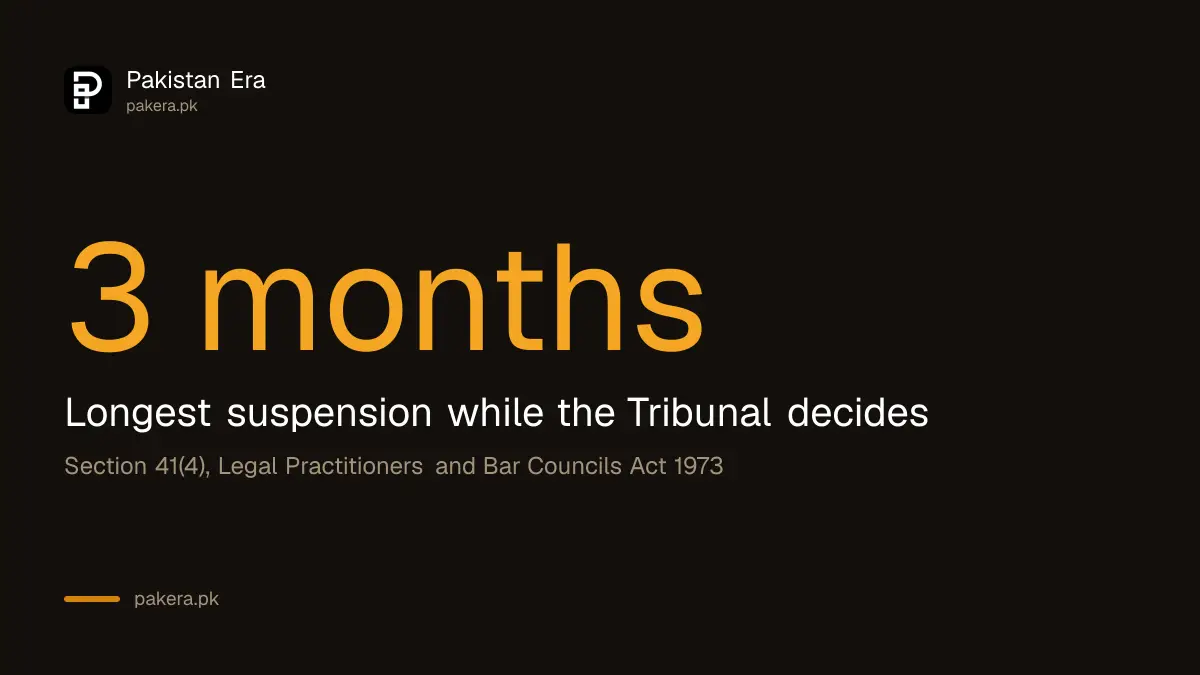
For serious misconduct, the Disciplinary Committee can suspend the lawyer for up to three months while the Tribunal decides. In that case, the Act gives the Tribunal three months to decide.
Punishments and appeals under the 1973 Act
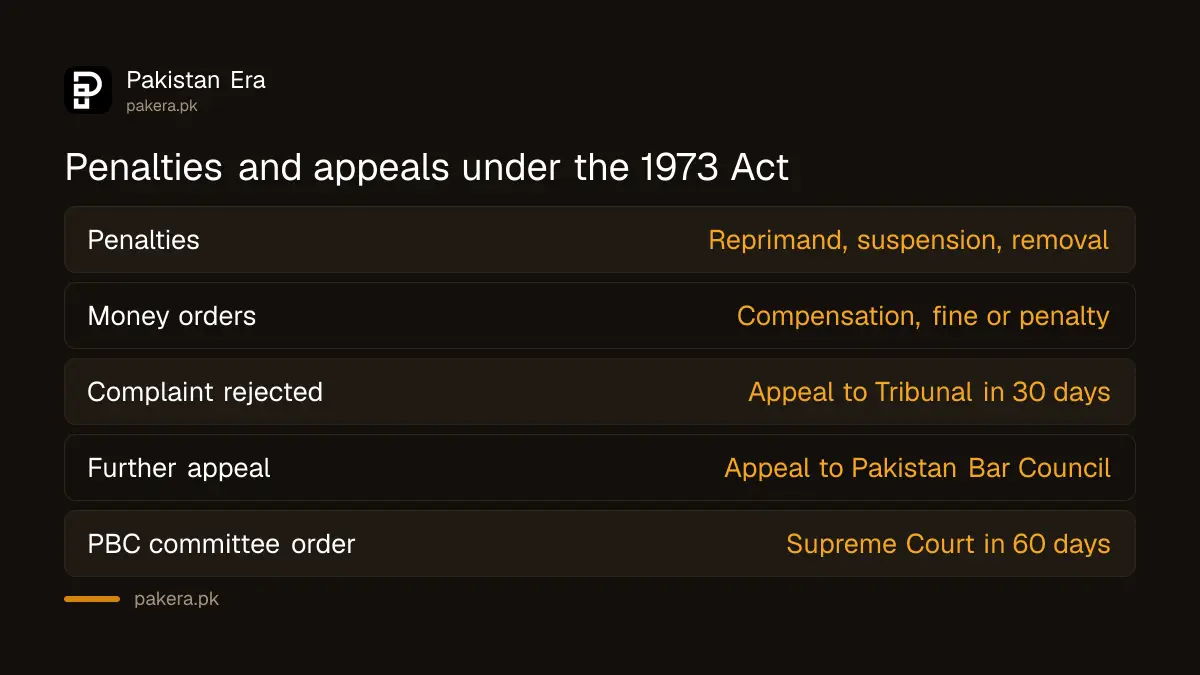
A lawyer found guilty can be reprimanded, suspended, removed from practice, or ordered to pay compensation, a fine or a penalty. If the committee rejects your complaint, you have 30 days to appeal to the Tribunal.
- Section 41(1) penalties: reprimand, suspension, removal from practice, compensation, fine or penalty.
- Section 41(5): if the Disciplinary Committee rejects your complaint, you can appeal to the Tribunal within 30 days of being told. That Tribunal decision is final.
- Section 47: gives a further appeal to the Pakistan Bar Council, heard by its Disciplinary Committee.
- Section 48: an order of the Pakistan Bar Council's Disciplinary Committee can be appealed to the Supreme Court within 60 days.
Compensation is the part most clients care about. The Act allows it, but the Tribunal decides the amount. Do not expect your full fee back by default.
A fake lawyer is a police matter, not a bar council one
The bar council disciplines its own advocates. If the person was never enrolled, the 1973 Act makes practising law a crime, so report it to the police. A suspended advocate who keeps practising faces up to one year in jail.
Section 58 covers both cases. And if a court has listed someone as a tout and he keeps working, section 59 allows up to three years in jail. If money was taken by fraud, you can also check whether an FIR has already been lodged with the online FIR check.
Common questions
Where do I complain against a lawyer in Punjab?
To the Punjab Bar Council, 9 Fane Road, Lahore. Its phone numbers are 042 99214245 to 49. A Supreme Court advocate is reported to the Pakistan Bar Council instead.
How much is the fee to complain against a lawyer?
Rs 5,000 for a complaint against a Supreme Court advocate, under the Pakistan Bar Council's rules. Provincial councils set their own fee. We did not find Punjab's published online.
Can a lawyer be made to return my fee?
Possibly. Section 41 lets the bar council order compensation. The Tribunal decides whether to order it and how much.
Do I need a lawyer to file a complaint?
No. Any person can complain under section 41. You may bring a lawyer to the Tribunal hearing if you want one.
Can I appeal if my complaint is rejected?
Yes. You can appeal to the Tribunal within 30 days of being told the complaint was rejected.
How we verified this
What we checked, where we read it, and what we could not confirm.
Last checked on 2 October 2026. We read sections 41, 42, 47, 48, 58 and 59 of the Legal Practitioners and Bar Councils Act 1973 and rules 117 and 118 of the Pakistan Legal Practitioners and Bar Councils Rules 1976, both as published by the Pakistan Bar Council. The Rs 5,000 fee comes from rule 117(2), amended by a Pakistan Bar Council notification of 31 October 2023, and applies to complaints against Supreme Court advocates. The Punjab Bar Council's address and phone numbers are from its own contact page. The Punjab and Islamabad complaint fees and their own complaint rules were not found online.
About the author

Tax, Bills and Technology Writer
Ali Akhtar is a young and curious voice here at Pakistan Era. He is currently pursuing his A-Levels and has a growing interest in Pakistan’s changing industrial landscape and educational trends. Ali likes to write in a way that helps him explain and explore the world around him. His writing reflects the perspective of the new generation navigating the evolving trends of Pakistan where technology, youth innovation, and shifting opportunities are reshaping the country’s future.