Get an Affidavit Attested in Punjab: Rs 300 Stamp, Oath Commissioner or Notary
Get an affidavit attested in Punjab: the Rs 300 stamp duty, the court exemption, who can attest it, oath commissioner or notary, and the false oath risk.
To get an affidavit attested in Punjab, type it on a Rs 300 stamp paper, then sign it in front of an oath commissioner or a notary public, who attests it. An affidavit made only to be filed in a court needs no stamp duty at all.
Universities, banks, NADRA, employers and courts ask for affidavits all the time. Most people pay whatever the man at the kachehri gate asks and never learn the rules. We read the Punjab Stamp Act schedule, the Code of Civil Procedure and the Notaries Ordinance on the Punjab Code site on 2 October 2026. Here is what the law actually says.
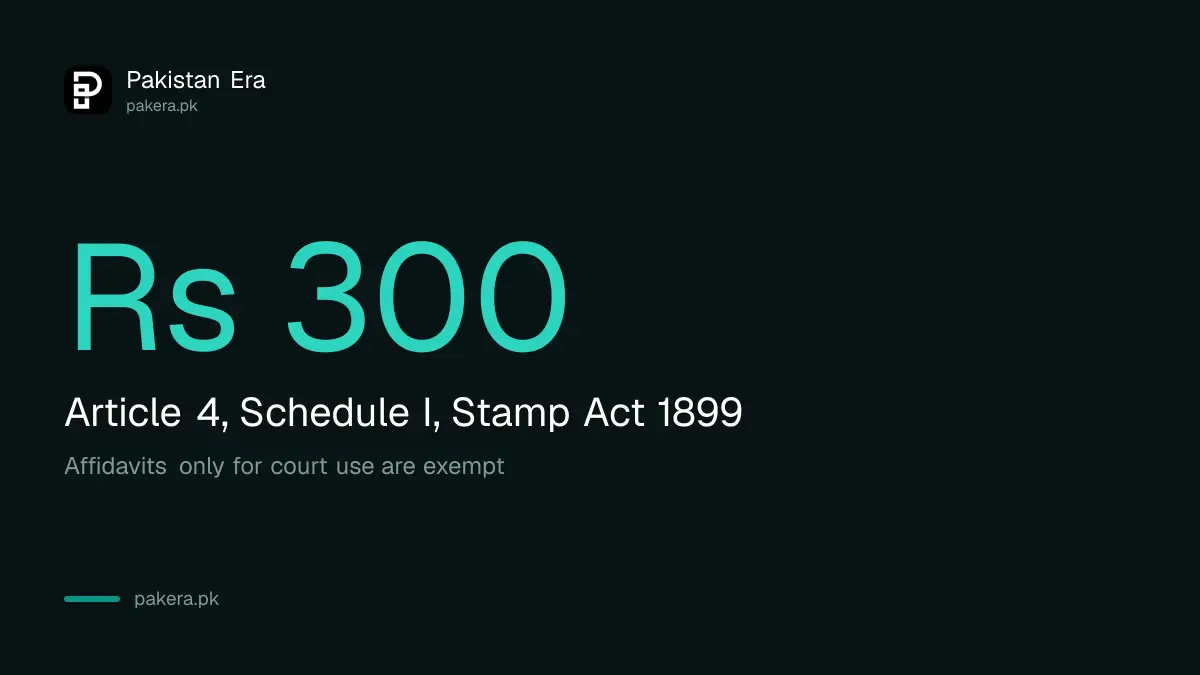
The stamp duty on an affidavit in Punjab is Rs 300
Article 4 of Schedule I to the Stamp Act 1899, as it applies in Punjab, puts a duty of Rs 300 on an affidavit. The Punjab Finance Act 2024 raised it from Rs 100. Three kinds of affidavit are exempt.
The Punjab Code text says the earlier word "One" was replaced by "Three" through the Punjab Finance Act 2024, published on 27 June 2024. So a stamp paper of Rs 300 is the legal minimum for an ordinary affidavit. Paying for a higher value stamp is not wrong, but it is not required.
| Affidavit made | Stamp duty in Punjab |
|---|---|
| For a university, bank, employer, NADRA or other office | Rs 300 |
| Only to be filed or used in a court, or before an officer of a court | Exempt |
| Only to receive a pension or charitable allowance | Exempt |
| As a condition of enrolment under the Pakistan Army Act or Pakistan Air Force Act | Exempt |
The court exemption is the one people miss. If your affidavit is "for the immediate purpose of being filed or used in any Court", the schedule says no duty is charged. Many court affidavits are still typed on stamp paper out of habit.
Where to buy the stamp paper
The Board of Revenue Punjab calls stamp papers above Rs 1,000 "high-value". Those are issued through its e-stamp system and printed at a bank counter. A Rs 300 affidavit stamp is below that line and is sold by licensed stamp vendors.
We read the Board of Revenue's e-stamping page on 2 October 2026. It describes only the bank route for high value stamps. The vendor route for small values is reported, not set out on that page. The e-stamp paper bank process is for larger amounts such as property deeds.
For an affidavit, check that the stamp shows your name as the buyer and the right value before you leave the vendor. If he also types the affidavit for you, read every line before you sign. You are the one swearing to it.
Who can attest an affidavit
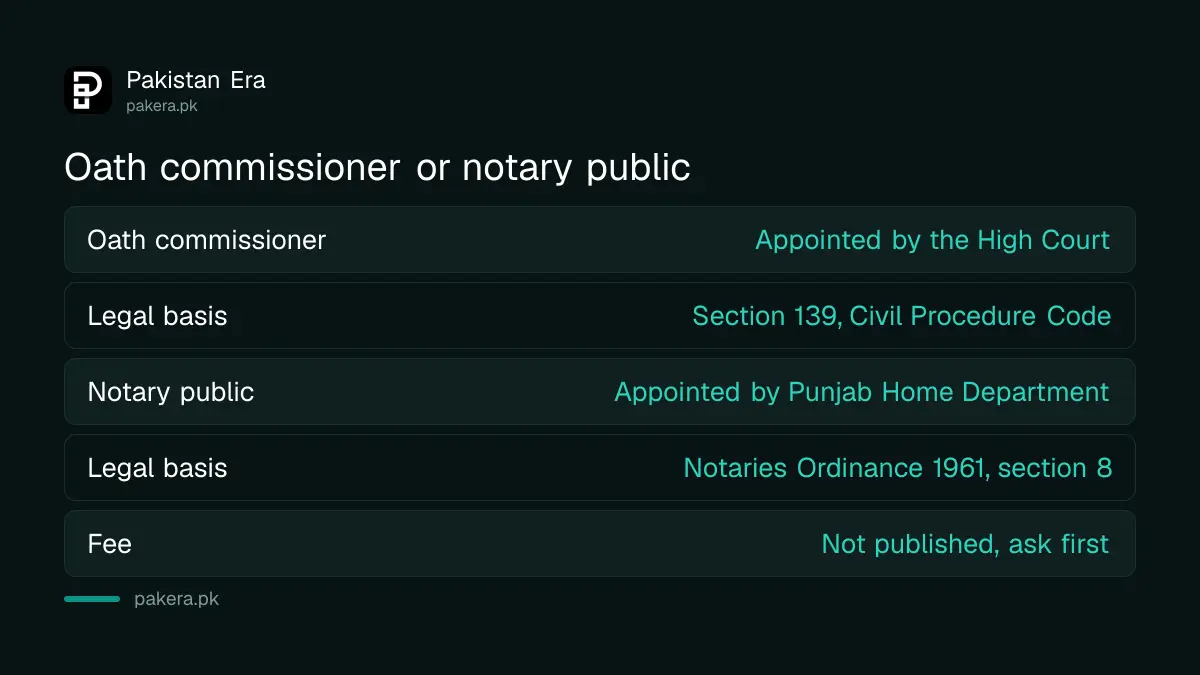
Under section 139 of the Code of Civil Procedure, a court or magistrate, or an officer or person appointed by the High Court, can give the oath on an affidavit. These are the oath commissioners. A notary public can also take an affidavit under the Notaries Ordinance 1961.
Section 139 names three groups for affidavits under the Code: "any Court or Magistrate", "any officer or other person whom a High Court may appoint in this behalf", and an officer appointed by another court that the provincial government has empowered. Oath commissioners are appointed under that second power.
Section 8 of the Notaries Ordinance 1961 lets a notary "administer oath to, or take affidavit from, any person". In Punjab, the Notaries (Amendment) Act 2025 moved notary appointments to the Secretary of the Home Department. A notary is often the choice for a document going abroad. For papers you need to sign from outside Pakistan, the route is different and is set out under power of attorney from abroad.
How to get your affidavit attested, step by step
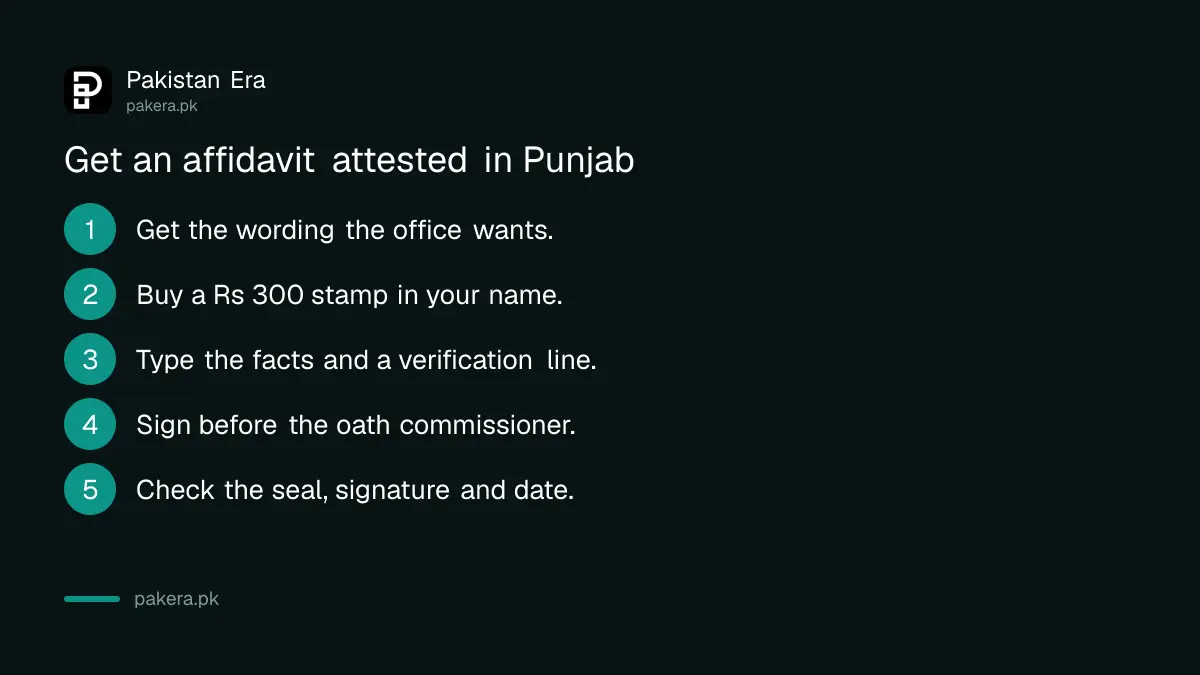
Write the affidavit on the stamp paper and add a verification line at the end. Then sign it in front of the oath commissioner or notary, who gives the oath and adds a seal and signature. Take your original CNIC with you.
- Know exactly what the office wants. Ask for their sample wording if they have one. A wrong affidavit is a wasted stamp.
- Buy a Rs 300 stamp paper in your own name. Skip this if the affidavit is only for a court case.
- Type the affidavit. Your name, father's or husband's name, CNIC number and address at the top, then numbered facts, one per line.
- Add the verification. A closing line saying the contents are true to your knowledge and nothing has been hidden.
- Go in person with your original CNIC. Do not sign at home. Sign in front of the oath commissioner or notary.
- Collect it with the seal. Check the stamp, signature and date are on every page that needs them.
We did not find a published fee for oath commissioners or notaries online. Ask the price before the attestation, not after.
A false affidavit can mean jail
An affidavit is sworn evidence. Under section 193 of the Pakistan Penal Code, false evidence in a court case can bring up to seven years in jail and a fine, and up to three years in other cases. Section 199 covers false statements in declarations the law accepts as evidence.
So never sign an affidavit with a fact you are not sure of, such as a date of birth "rounded" to fit a form. And never let anyone attest one without you there. An affidavit attested in your absence is the kind of document that turns up later in property fraud.
If a lawyer or tout pushes you to sign something false, you can complain against the lawyer to the bar council.
Common questions
What is the stamp paper value for an affidavit in Punjab?
Rs 300, under Article 4 of the Stamp Act schedule as amended by the Punjab Finance Act 2024. Affidavits made only for a court case are exempt.
Can an oath commissioner attest any affidavit?
Section 139 of the Code of Civil Procedure covers affidavits under the Code, made by persons the High Court appoints. Offices that need another kind may ask for a notary instead, so check with them.
Is a notary the same as an oath commissioner?
No. An oath commissioner is appointed under the High Court's power in section 139. A notary is appointed under the Notaries Ordinance 1961, now by the Punjab Home Department.
Can someone else sign my affidavit for me?
No. You are the one swearing to the facts. Sign it yourself, in front of the person who attests it.
Do I need an affidavit on stamp paper for a court case?
No duty is payable on an affidavit made only to be filed or used in a court, under the exemption in Article 4.
How we verified this
What we checked, where we read it, and what we could not confirm.
Last checked on 2 October 2026. We read Article 4 of Schedule I to the Stamp Act 1899 on the Punjab Code site, with its footnotes on the Punjab Finance Act 2024; section 139 of the Code of Civil Procedure 1908; section 8 of the Notaries Ordinance 1961 and the Notaries (Amendment) Act 2025; and sections 193 and 199 of the Pakistan Penal Code, all on the Punjab Code site. The Rs 1,000 high value line is from the Board of Revenue Punjab's e-stamping page; the vendor route for lower values is reported, not on that page. We found no published fee for oath commissioners or notaries. The amounts in this page apply to Punjab only; other provinces set their own stamp duty.
About the author

Tax, Bills and Technology Writer
Ali Akhtar is a young and curious voice here at Pakistan Era. He is currently pursuing his A-Levels and has a growing interest in Pakistan’s changing industrial landscape and educational trends. Ali likes to write in a way that helps him explain and explore the world around him. His writing reflects the perspective of the new generation navigating the evolving trends of Pakistan where technology, youth innovation, and shifting opportunities are reshaping the country’s future.