How to Issue an E-Stamp Paper in Pakistan
Generate Challan 32-A online, pay at NBP, Bank of Punjab or Sindh Bank, and the counter prints your e-stamp paper. Punjab, Sindh, KP and ICT.
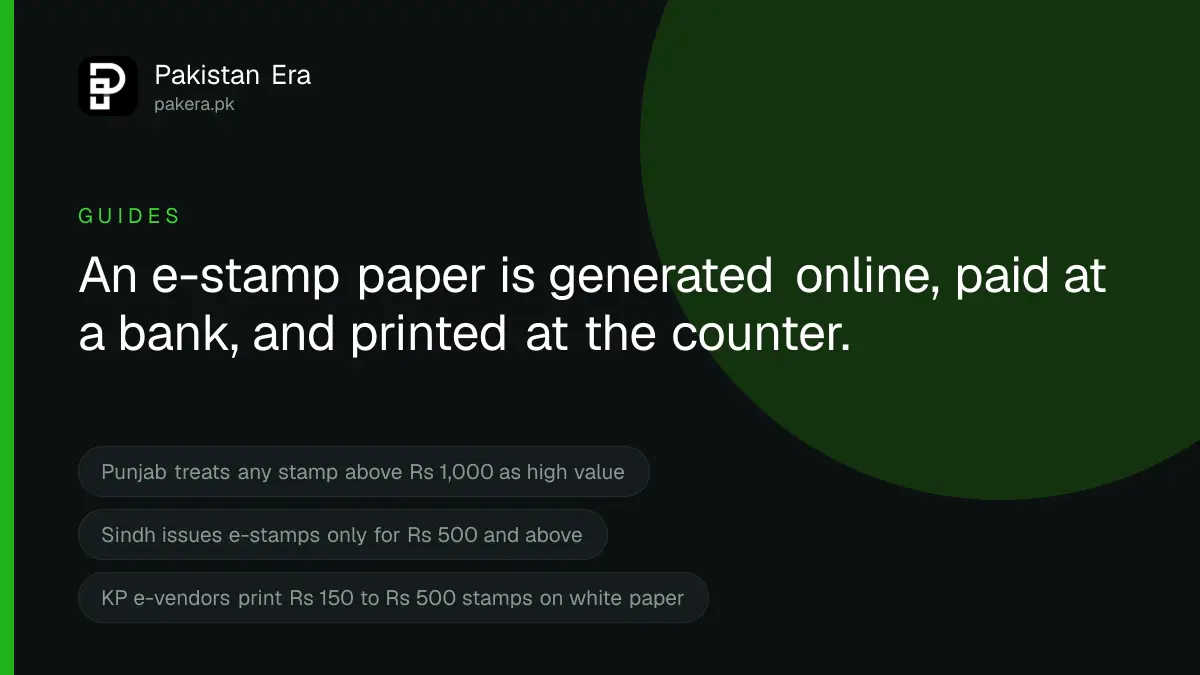
An e-stamp paper is issued in three moves: you generate Challan Form 32-A on your province's e-stamping portal, you pay it at a designated bank, and the bank counter prints the stamp with a unique number and a QR code. Punjab, Sindh and Khyber Pakhtunkhwa each run their own portal, and Islamabad joined in February 2026. The cut-off values differ, so the first thing to check is which system you are in.
The stamp vendor outside the kachehri used to be the only way to get a stamp paper, and the price was whatever he said it was. That is the problem the e stamp paper was built to end. The Board of Revenue Punjab says on its own e-stamping page that the aim is to stop "paper and process related fraudulent practices" and the leakage of government revenue, and that once a stamp is used the database marks a red strike against it so it cannot be used twice.
We read the Punjab, Sindh and KP official pages on 17 September 2026. What follows is what they say, province by province, and where a claim comes from reporting rather than an official page we say so.
What is an e-stamp paper and who issues it?
An e-stamp paper is a stamp duty receipt generated through a provincial Board of Revenue system instead of a pre-printed sheet. It carries a unique identification number and a QR code, and the office that receives your deed checks it against the central database. Stamp duty is a provincial tax, so each province issues its own.
Two kinds exist. Judicial stamps are used for court matters. Non-judicial stamps go on property transfers, agreements, affidavits and commercial documents. The Punjab Board of Revenue page describes both, and says the duty is worked out from the details you enter, such as land area, location and whether it is residential or commercial, against the DC valuation tables built into the system.
A stamp is a tax instrument, not a contract. Registration of the deed is a separate step, and a lease written on the correct stamp paper is still an unregistered lease. The distinction matters most for tenancy, where the stamp value and the registration rules for a rent agreement on stamp paper are provincial and change by budget.
Which e-stamp portal do you use in each province?
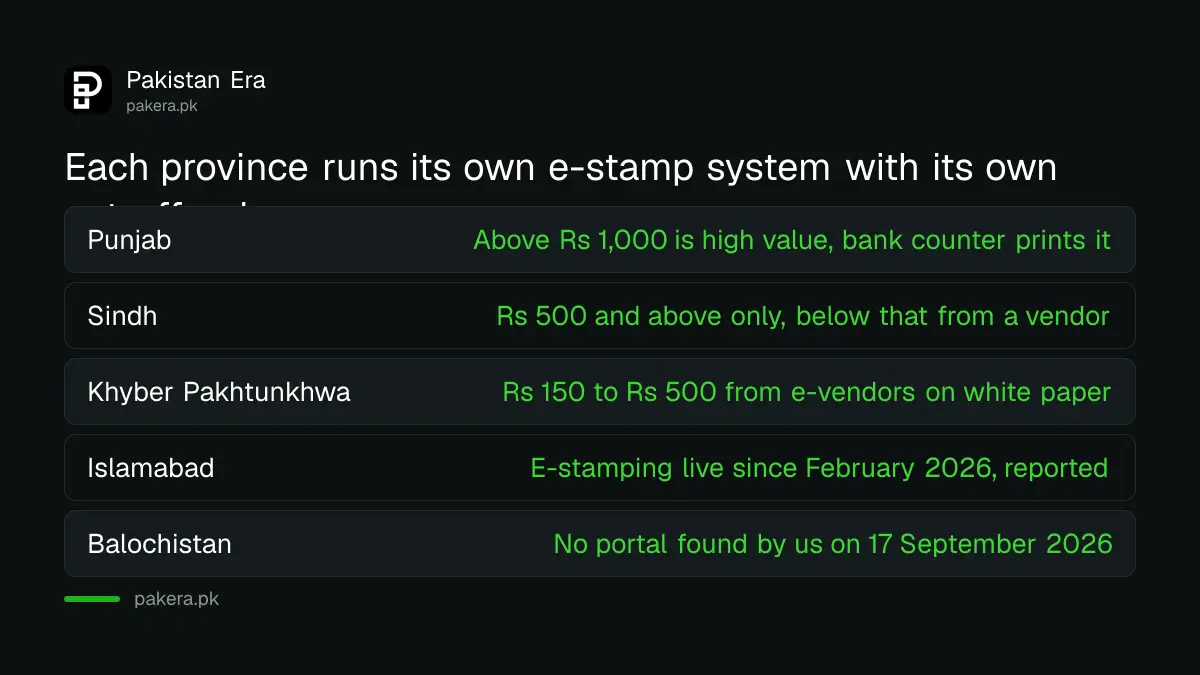
Use the portal of the province where the property or the transaction sits. Punjab uses es.punjab.gov.pk, Sindh uses estamps.gos.pk and Khyber Pakhtunkhwa uses estamping.kp.gov.pk. Islamabad runs on a system built with the Punjab Land Records Authority. Balochistan had no portal we could find on 17 September 2026.
| Province | Portal | What the system issues | Where it is paid and printed |
|---|---|---|---|
| Punjab | es.punjab.gov.pk | High value stamps, defined as above Rs 1,000 | National Bank, Bank of Punjab, scheduled banks, bank counters in sub-registrar offices |
| Sindh | estamps.gos.pk | Judicial and non-judicial stamps of Rs 500 and above | National Bank, Sindh Bank, Bank of Punjab branches |
| Khyber Pakhtunkhwa | estamping.kp.gov.pk | Challan 32-A stamps, plus Rs 150 to Rs 500 stamps through e-vendors | Bank branch for challans, licensed e-vendor for low values |
| Islamabad | Through the ICT Administration and PLRA | Non-judicial first, judicial in a later phase | Reported: Pakistan Khidmat Centre, G-9 |
The Punjab rows come from the Board of Revenue and the Inspectorate of Treasuries pages, not from the portal itself. That is because es.punjab.gov.pk refused every connection we made on 17 September 2026, directly and through a third party reader. It may simply be blocking automated access. If it will not open for you either, the Board of Revenue's service is also listed as "E-Stamping" on Dastak, Punjab's one window app, which we confirmed on the Dastak services list the same day. The same Board of Revenue section of that list carries the domicile certificate and its duplicate and modification services.
The Sindh portal states plainly that mobile devices are not recommended and asks you to use a laptop or PC. Plan for that before you start.
How do you generate Challan Form 32-A for an e-stamp?
Challan 32-A is the payment form for stamp duty. You fill it on the portal, print it, sign it and pay it at a designated bank. The bank then prints the e-stamp certificate. The Sindh FAQ says you get the certificate "on the spot from the same branch", and the Punjab page describes the same counter printing.
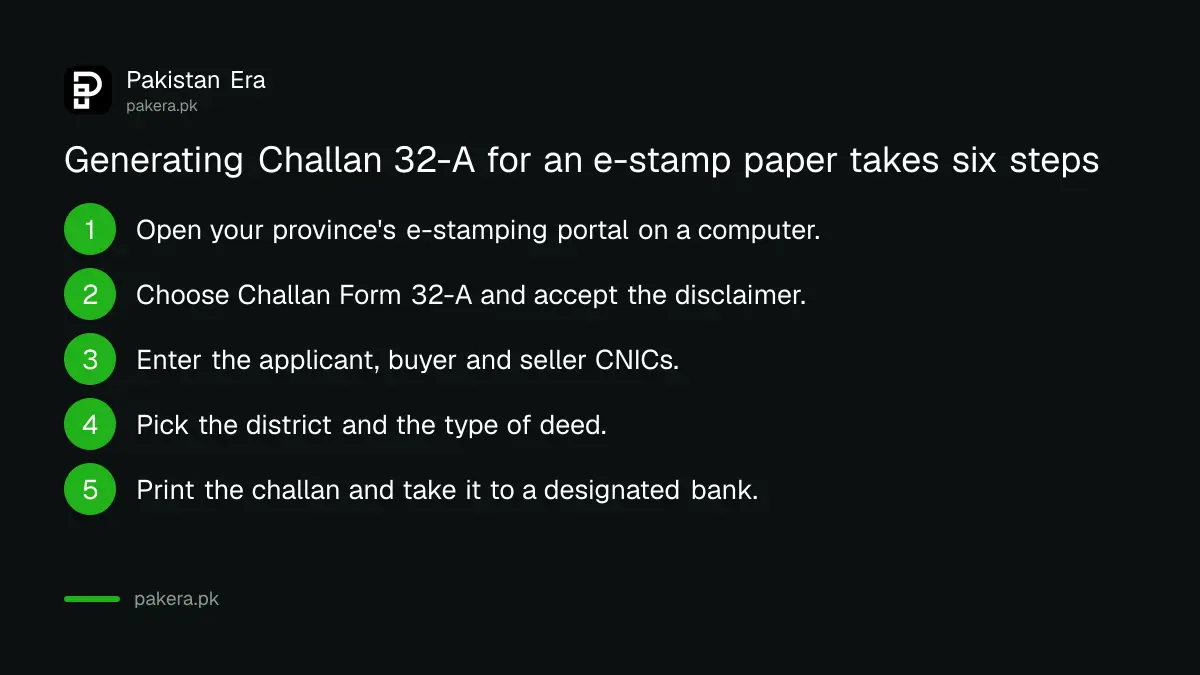
- Open the portal on a computer and choose "Challan Form No. 32-A", which on all three portals is the tile for paying stamp duty.
- Accept the disclaimer. The KP form asks for the applicant's district, name, CNIC and contact number, and makes you certify that the details match the CNICs.
- Enter the buyer, the seller and the person buying the stamp, each with a CNIC. The Sindh FAQ says any number of buyers or sellers can be added, and "and others" is printed automatically after the first name.
- Select the district, the tehsil or taluka, and the type of deed. The system calculates the duty from the valuation tables.
- Print the challan. The Sindh portal lets you verify or reprint an existing challan if you lose it.
- Take it to a designated branch, pay, and collect the printed e-stamp. In Punjab the same challan can also carry capital value tax, registration fee and mutation fee, according to the Treasuries page.
One rule to know before you press submit. The Sindh FAQ says an unpaid challan can simply be regenerated, but a paid challan cannot be corrected at all. The only route after payment is a refund application under the Stamp Act 1899 and the Stamp Rules. Check the CNICs twice.
The Inspectorate of Treasuries page describes stamp duty on a property transaction as 3 per cent of the value. We are attributing that to the page rather than stating it as today's rate, because the rate sits in the Stamp Act schedule and changes with the budget. The challan the portal generates is the figure that binds.
What if the stamp you need is below the cut-off?
Low value stamps do not come from the bank counter at all. Each province routes them to stamp vendors, and here the provinces differ the most.
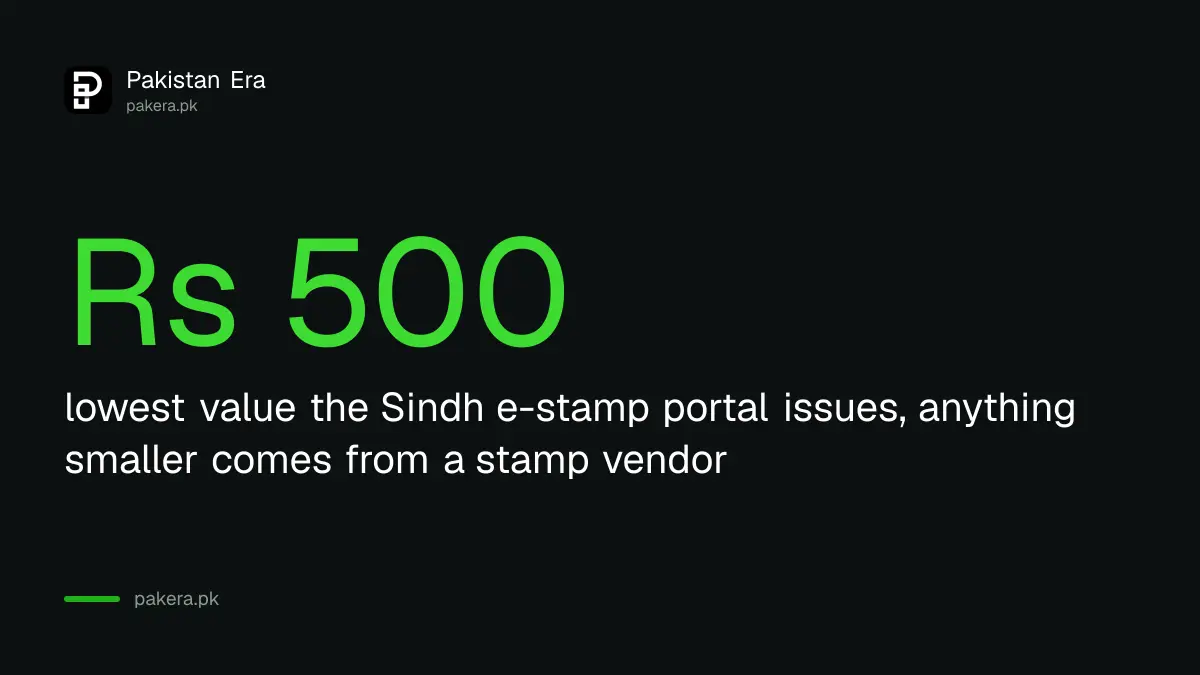
Sindh. The portal FAQ answers this directly: non-judicial stamp papers of less than Rs 500 "can be obtained from stamp vendors as these are not being issued from e-Stamping system". The portal publishes a list of vendors.
Punjab. The Board of Revenue calls anything above Rs 1,000 a high value stamp. Below that, vendors issue stamps. The Express Tribune reported on 7 January 2022 that Punjab replaced its physical papers with four online denominations, Rs 100, Rs 200, Rs 600 and Rs 1,200, and abolished the Rs 50 stamp, with vendors printing the papers from the finance department's system. Those denominations are reported, not read on a government page, and the same report quoted the vendors' union warning that a Rs 100 stamp would cost Rs 400 to Rs 500 once vendors added their own costs.
Khyber Pakhtunkhwa. The Revenue and Estate Department launched an E-Vendor Module in Peshawar on 28 January 2026 under which licensed vendors issue e-stamps of Rs 150 to Rs 500 on plain white paper, with QR code verification, and the department says they are "legally valid for all legal, registration, and evidentiary purposes, subject to system verification". It then went to Haripur on 3 February, Swat on 4 February, Mardan on 6 February and Nowshera on 10 February 2026, after earlier launches in Bannu, D.I. Khan, Kohat, Abbottabad and Charsadda.
The white paper point is why the old advice to "print it at home on plain paper" is wrong in Punjab and Sindh. There the bank prints the certificate on security paper, and in Sindh the portal specifies "legal sized yellow security featured paper". Only the KP vendor stamps, and reportedly the Islamabad ones, are meant to come out on ordinary white paper.
How do you verify an e-stamp paper before you rely on it?
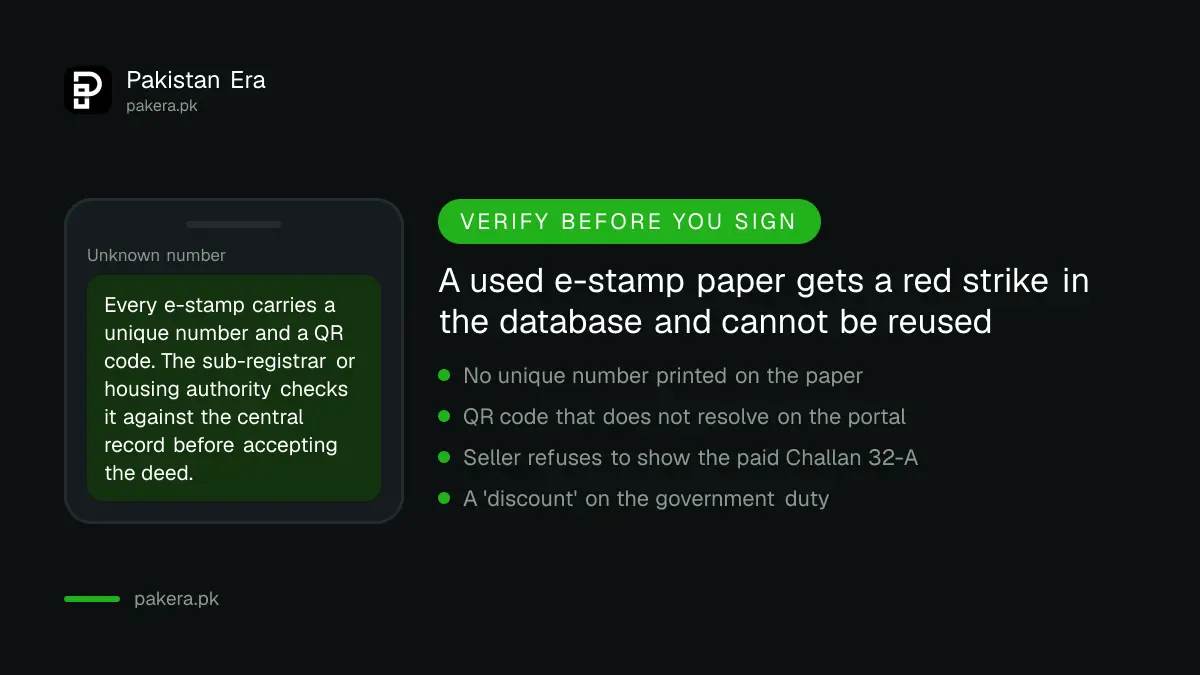
Verification is the whole point of the system, and it is public. Type the stamp number into the portal, or scan the QR code, and the record shows whether the stamp is genuine, paid and unused.
- Sindh: the home page tile "Verification Through Web" checks an e-stamp, and a separate tile verifies or reprints a Challan 32-A. The FAQ says authenticity can be checked "through Web and SMS".
- Khyber Pakhtunkhwa: the "E-Verify" tile asks only for the stamp paper number. Vendor issued stamps carry a QR code for the same purpose.
- Punjab: the Treasuries page names a separate verification portal for special treasury officers, and the Board of Revenue says sub-registrars, housing societies and land developers get access to verify. A public check is available on the citizen portal, which we could not open on the day.
After the deed is registered, the database marks the stamp with a red strike. That is what stops a genuine stamp being lifted from one document and pasted on another. If a seller hands you a stamp with no number, or a number the portal does not recognise, stop.
What did Islamabad change in 2026?
Islamabad moved to e-stamping in February 2026, under an agreement the ICT Administration signed with the Punjab Land Records Authority on 28 October 2025. The CDA's own record of a review meeting on 8 and 9 December 2025 says the system was integrated with OneLink, and that non-judicial stamps would launch first with judicial stamps in a later phase.
The dates after that are reported. Legalise.pk reports that manual stamp papers stopped being issued in ICT on 26 January 2026, that the service launched on 1 February 2026, and that e-stamping became mandatory in ICT courts from 13 February 2026. The Express Tribune reported on 14 February 2026 that the Deputy Commissioner visited the stamp shops at F-8 Katchery to review the change. Access is reported to run through the Pakistan Khidmat Centre in G-9. We found no e-stamp page on ictadministration.gov.pk, so for Islamabad the Khidmat Centre counter is the practical starting point.
The Punjab connection also explains a naming trap. The PLRA is a Punjab body building Islamabad's system; it is not the operator of Punjab's own e-stamp portal, which belongs to the Board of Revenue and PITB. And Dastak, which carries Punjab's e-stamping tile, is a different thing from the KP portal that shares the Dastak name and handles arms licences.
What can go wrong, and what to do
- The duty was short. Both Punjab and Sindh let you pay a deficiency against the original e-stamp ID rather than buying a new stamp. The Sindh FAQ says only the applicant details can be changed on a deficiency challan, and KP has a "Pay Stamp Duty Deficiency" tile.
- You paid the wrong details. A paid challan is frozen. File a refund application. KP has a "Generate Refund Application" tile and Sindh refers you to the Stamp Act 1899.
- The deed needs more pages. KP sells "additional continuation sheets" against an existing e-stamp through its own tile, so you do not buy a second stamp.
- Sindh stamp duty paid before 21 July 2026. The Sindh portal now has a tile to generate an Immovable Property Tax challan against a duty challan paid before that date. If your registration is pending from earlier in the year, that is the tile to look for.
- The portal will not load. Sindh's helpline is 021-38892347. Punjab's published contact is info.es@punjab.gov.pk. For Punjab, the Dastak app lists the same service.
Common questions about e-stamp paper in Pakistan
Can I print an e-stamp paper at home?
Not in Punjab or Sindh. The bank counter prints the certificate on security paper after you pay Challan 32-A. KP vendor stamps of Rs 150 to Rs 500 are printed on white paper by the vendor, and Islamabad's are reported to be printed by the applicant.
What is Challan 32-A?
It is the stamp duty payment form. You generate it on the portal with the buyer, seller and deed details, sign it, and pay it at a designated bank. The e-stamp is printed against it.
Which banks accept e-stamp payments?
Sindh's portal lists National Bank, Sindh Bank and Bank of Punjab. Punjab's Treasuries page names National Bank, Bank of Punjab and scheduled banks, plus bank counters in sub-registrar offices. KP's collecting bank is reported to be the Bank of Khyber.
Is there a minimum value for an e-stamp?
Sindh issues e-stamps of Rs 500 and above and sends smaller stamps to vendors. Punjab treats above Rs 1,000 as high value. KP's e-vendors cover Rs 150 to Rs 500.
How do I check an e-stamp is genuine?
Enter the stamp number on the portal's verify tile or scan the QR code. A used stamp shows a red strike in the database and cannot be used again.
Can a paid challan be corrected?
No. The Sindh FAQ says a paid Challan 32-A cannot be changed and the route is a refund application under the Stamp Act 1899. An unpaid challan can simply be regenerated.
How we verified this
What we checked, where we read it, and what we could not confirm.
Last checked 17 September 2026. We read the Board of Revenue Punjab e-stamping page at bor.punjab.gov.pk, which gives the judicial and non-judicial split, the Rs 1,000 high value threshold, Challan 32-A, counter printing on specially designed legal sized paper and the red strike after use; the Inspectorate of Treasuries and Accounts e-stamping page at iota.punjab.gov.pk, which names National Bank, Bank of Punjab and scheduled banks, the bank counters in sub-registrar offices, the collection of capital value tax, registration fee and mutation fee on the same challan, the deficiency mechanism against the same ID, and the contact info.es@punjab.gov.pk; the Dastak services list at dastak.punjab.gov.pk, which shows E-Stamping under Board of Revenue; the Government of Sindh eStamping Citizen Portal at estamps.gos.pk, its About Us page and its FAQs, for the Rs 500 threshold, the vendor route below it, the partner banks, the helpline 021-38892347, yellow security paper, the deficiency and refund rules, the mobile device warning, the IPT challan tile for duty paid before 21 July 2026, and web and SMS verification; the Khyber Pakhtunkhwa e-stamping portal at estamping.kp.gov.pk for its service tiles; and the Revenue and Estate Department's E-Vendor Module notices at revenue.kp.gov.pk for the Rs 150 to Rs 500 denominations, white paper, QR verification and the district launch dates from 28 January to 10 February 2026. We also read the CDA's records of the ICT and PLRA agreement of 28 October 2025 and the review meeting of 8 and 9 December 2025 at cda.gov.pk. We could not open es.punjab.gov.pk from any route on the day, so the Punjab facts rest on the two department pages. Reported rather than read at source: Punjab's Rs 100, 200, 600 and 1,200 denominations and the end of the Rs 50 stamp, Express Tribune, 7 January 2022; the Bank of Khyber as KP's collecting bank, landsolvedin.com and chakorventures.com; Islamabad's dates of 26 January, 1 February and 13 February 2026 and access through the Pakistan Khidmat Centre in G-9, legalise.pk; and the Deputy Commissioner's visit to F-8 Katchery, Express Tribune, 14 February 2026. Stamp duty rates are set in each province's Stamp Act schedule and change with the budget, so take the amount from the challan the portal generates.
About the author

Tax, Bills and Technology Writer
Ali Akhtar is a young and curious voice here at Pakistan Era. He is currently pursuing his A-Levels and has a growing interest in Pakistan’s changing industrial landscape and educational trends. Ali likes to write in a way that helps him explain and explore the world around him. His writing reflects the perspective of the new generation navigating the evolving trends of Pakistan where technology, youth innovation, and shifting opportunities are reshaping the country’s future.