How to Apply for a Domicile Certificate Online in Pakistan
Online domicile apply routes for Punjab, Sindh, KP and Islamabad: the portals, documents, fees and days each district publishes, and its uses.
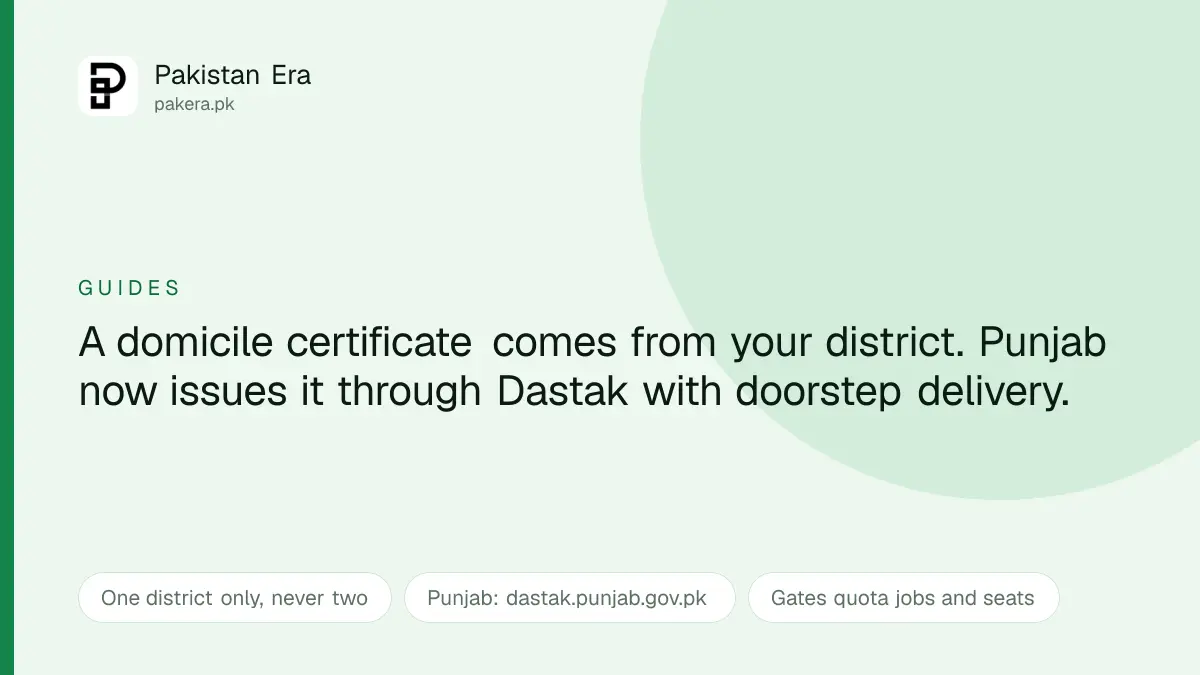
A domicile certificate is issued by your district, not by Pakistan, so the online domicile apply route depends on where you live. Punjab takes applications through e-Khidmat centres and the Dastak app for a Rs 200 service charge and delivers in 16 working days. Karachi South charges Rs 600 and promises three working days in person. KP runs applications through the KP Citizen's Portal app, and Islamabad processes them in seven days at the Citizen Facilitation Centre in G-11/4.
Update, 10 October 2026: Balochistan has abolished its Rs 200 domicile fee and plans to issue domiciles at NADRA centres. Read the update.
Most people meet the domicile certificate at the worst possible moment: a job advertisement closes in a week, or a university seat is reserved for a district, and the certificate is the one document missing. That is a bad week to discover that the process in Lahore, Karachi, Peshawar and Islamabad is four different processes.
The numbers show how much of this now runs online. KP's E-Services Citizens Facilitation Portal displayed 1,057,077 applications on 17 September 2026, 769,799 of them through the citizen portal and 275,848 through the mobile app, against 11,429 at a physical centre. We read that page and the Punjab, Karachi and Islamabad pages the same day. Here is each route as the responsible office publishes it.
What is a domicile certificate used for?
It proves you are a permanent resident of one district in one province. Public sector posts are allocated on provincial and district quotas, and medical, engineering and many other admissions reserve seats the same way. The ICT Administration's page puts it plainly: "you may require domicile certificate for a job or for seeking admission in the university", and cites the Pakistan Citizenship Act 1951 as the governing law.
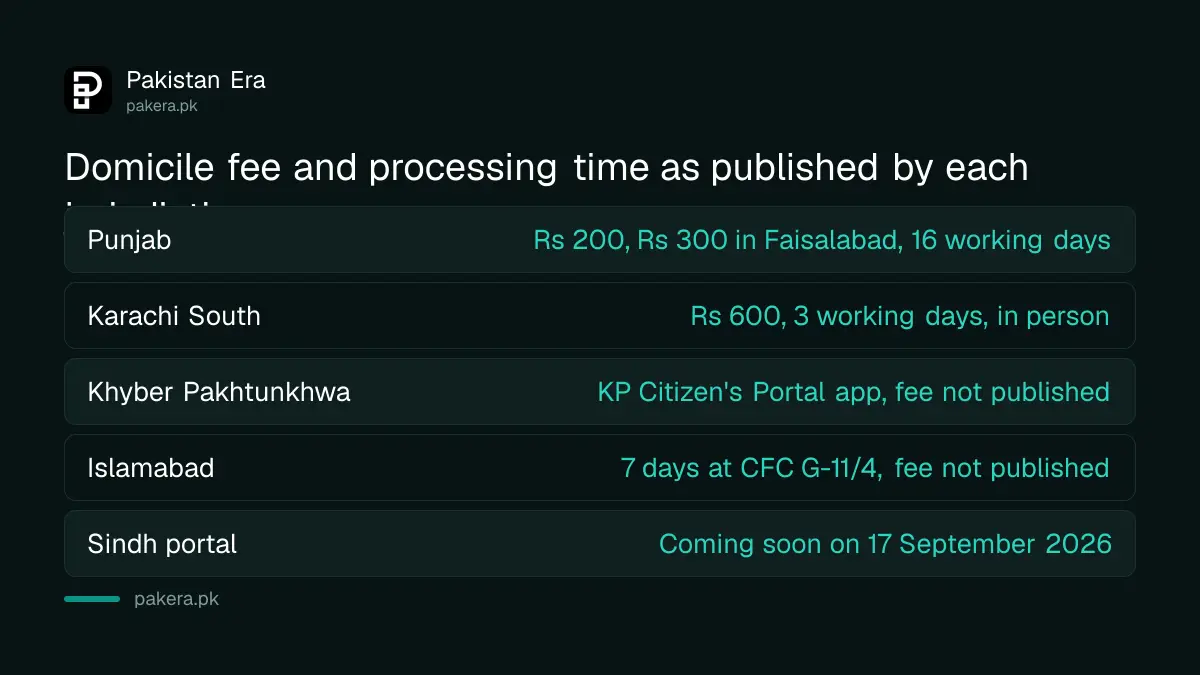
| Jurisdiction | Where to apply | Published fee | Published time | Issued by |
|---|---|---|---|---|
| Punjab | e-Khidmat centre or Dastak | Rs 200 service charge, Rs 300 in Faisalabad | 16 working days | Assistant Commissioner of your area |
| Karachi South | Deputy Commissioner's office, in person | Rs 600 | 3 working days | Deputy Commissioner South |
| Khyber Pakhtunkhwa | KP Citizen's Portal app or cfc.kp.gov.pk | Not published on the pages we read | Not published | Deputy Commissioner's office |
| Islamabad | Citizen Facilitation Centre, G-11/4 | Shown on the e-receipt at the counter | 7 days | Assistant Commissioner, Saddar |
Notice what that table does not contain: a national fee or a national portal. NADRA does not issue domiciles. The federal government does not either, except in Islamabad, where the ICT Administration acts as the district. Anyone quoting one fee for the whole country has not read the district pages.
How do you apply for a domicile online in Punjab?
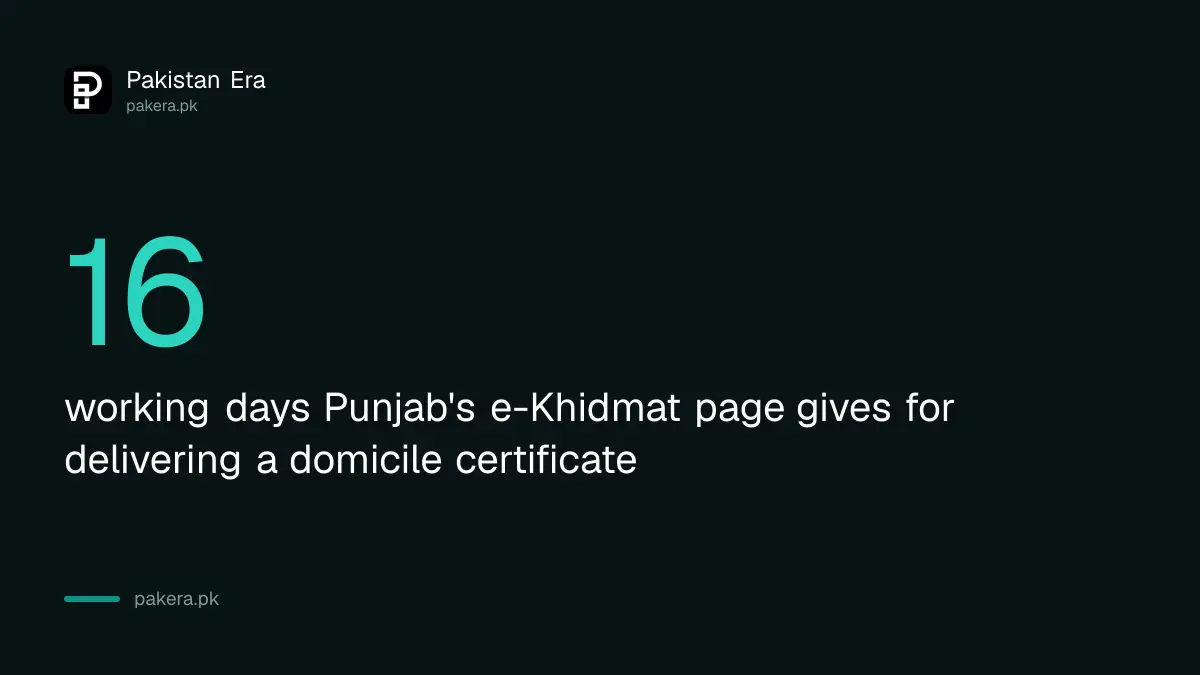
Through the Punjab e-Khidmat service, which lists the domicile certificate with a Rs 200 service charge, or through Dastak, the province's one window platform, whose services list shows "Domicile Certificate" under the Board of Revenue. The certificate is issued by the Assistant Commissioner of your area and, according to the e-Khidmat page, "will be delivered within 16 working days".
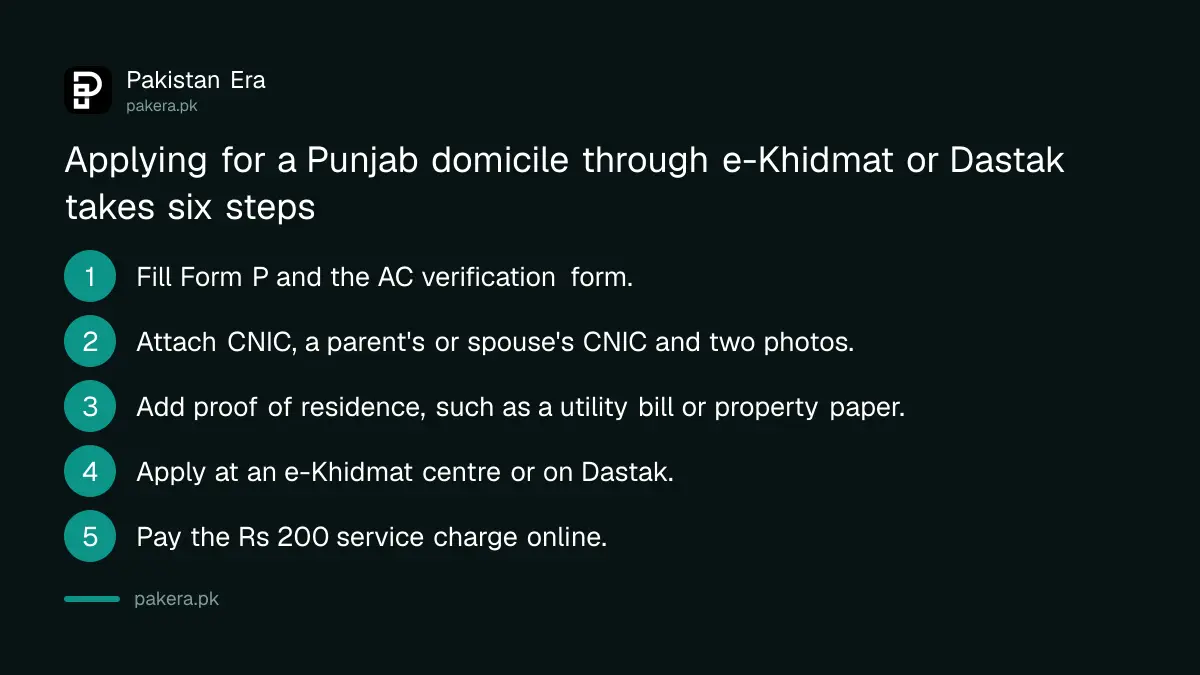
The e-Khidmat page lists the documents, and it is a longer list than most guides admit:
- The AC Verification Form and Form P.
- Your CNIC, plus a father's, mother's or spouse's CNIC, or a B Form or birth certificate for a minor.
- An affidavit, except in Faisalabad, where the page says it has been exempted since 1 October 2019.
- Two fresh passport size photographs.
- Proof of residence: property documents, utility bills, a resident certificate, an education document or the voter list.
Payment is "online only", in the page's words, and the service charge is Rs 200 everywhere except Faisalabad district, where it is Rs 300. The affidavit goes on stamp paper, and if your district still asks for one the e-stamp paper is now the way to buy it.
Dastak adds three related services under the same department: a duplicate domicile, a modification, and an NOC for domicile transfer, which is the document you need before another district will issue you a new one. How the Dastak app handles payment and doorstep delivery is the same across every service on it. Be careful with the name, though, because KP's Dastak is a different portal for arms licences and will not take a domicile application.
How do you get a domicile in Karachi and the rest of Sindh?
In person, at the Deputy Commissioner's office of your district, for now. The Commissioner Karachi's page for District South says the domicile and PRC can be had "within three working days", that "the total charges for a Domicile Certificate are only Rs. 600", and describes the counter process: pay the fee, hand over originals to be scanned, and have your photograph and biometrics taken.
Sindh pairs the domicile with a PRC, a Permanent Residence Certificate, and the two are usually applied for together. The document list on the District South page is the longest of the four: your CNIC and that of the family head or spouse, a computerised nikah nama for married applicants, birth certificate, educational certificates, a voter list entry certified by the Election Commission, a residence certificate or rental agreement, utility bills, and anything else that proves permanent residence in the district.
Update, 29 September 2026: the Sindh Domicile and PRC Portal at sindhdomicileportal.gos.pk is now live. It read "Coming Soon" when we first checked on 17 September. It now takes domicile and PRC applications online, with NADRA verification, Deputy Commissioner approval and a QR-coded certificate, and a "Sindh Domicile" app is on Google Play. See our guide to the Sindh PRC certificate for the steps. You can still apply at the DC office of your district, and the Rs 600 and three day figures are District South's, so other districts may differ. The District South contact on the page is 021-99202822.
How does the KP Citizen's Portal handle domicile?
KP's e-domicile system takes the application on the KP Citizen's Portal app, issues a tracking code, and has you collect the printed certificate from the DC office once it is verified. The province's Performance Management and Reforms Unit says the system "is implemented in all DC offices of Khyber Pakhtunkhwa where actual applications are received and domiciles are issued".
- Install the KP Citizen's Portal app from the Play Store or App Store and register.
- Open the e-Citizen tab and choose the domicile application.
- Submit the form and note the automatic tracking code.
- Track the application in the app until you are told the decision.
- Collect the certificate from the DC office, or check it later through Domicile Online Verification on cfc.kp.gov.pk.
The web portal at cfc.kp.gov.pk lists the domicile certificate under DC Office with Apply Online, a checklist and a verification tool, and gives 091-9225484 for technical support only. What neither KP page publishes in the text we read is a fee or a processing time. Other sites report the service as free and around ten working days; treat that as reported until the checklist in your own district's application shows it.
What does Islamabad require, and why is the CNIC age checked?
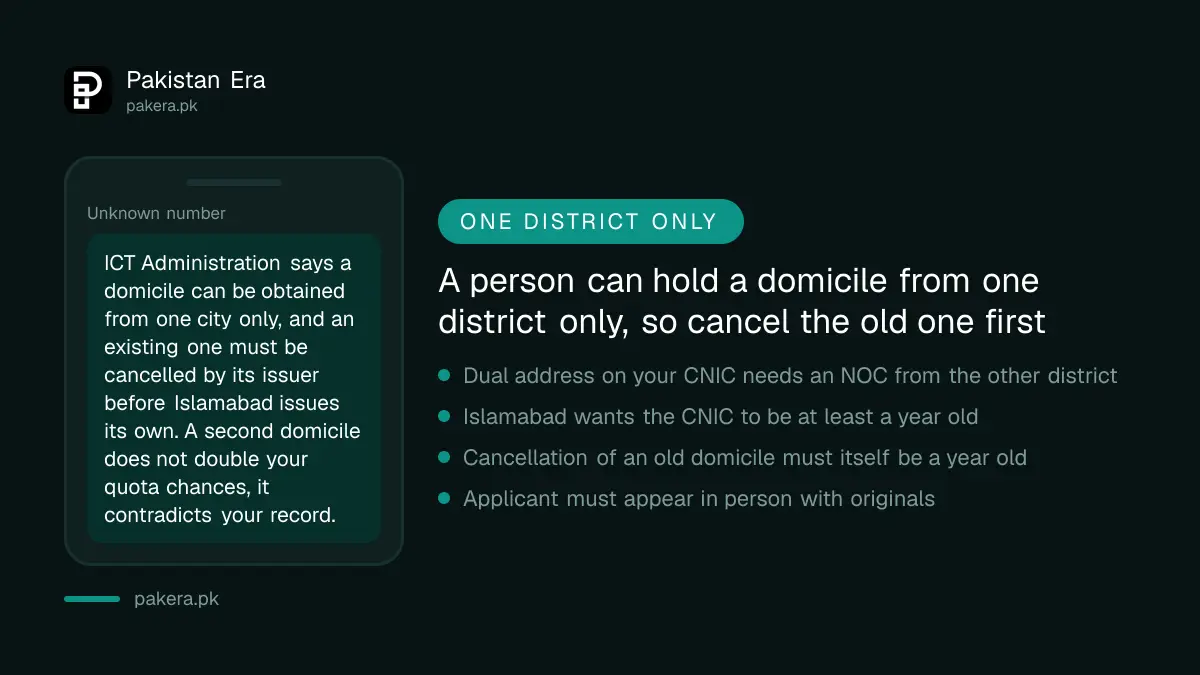
Islamabad issues the domicile through the Assistant Commissioner Saddar at the Citizen Facilitation Centre in G-11/4, Monday to Friday from 9 am to 6 pm with a Friday break, and gives seven days as the processing time. You take a token, go through data entry, pay the fee shown on the information box, get an e-receipt, and collect on the date printed on it. The ICT page insists that the "applicant must appear himself/herself along with original documents".
The document list for applicants aged 21 and over has one condition that catches people. The copy of your CNIC "must be 01-year old". Islamabad wants a year of recorded residence before it accepts you as a permanent resident. The rest of the list is a father's or husband's CNIC, an allotment letter or lease agreement as proof of residence, one original electricity or gas bill, and Form B if you have children. If your CNIC carries two addresses, you also need an NOC from your native district. Verification afterwards is by CNIC in the City Islamabad App.
Can you hold a domicile from two districts?
No, and the ICT Administration's FAQ answers the question in three words: "It is not allowed under the law." If you already hold a domicile from another city and are now a permanent resident of Islamabad, you must get the old one cancelled by its issuing authority first, and Islamabad wants that cancellation to be a year old as well. Punjab's NOC for domicile transfer on Dastak exists for the same reason.
People apply twice because they think a second district doubles their chances at a quota. It does the opposite. Two domiciles on record is a contradiction that a selection board can hold against you, and the cancellation step exists so that the record shows one district at a time.
Practice on a married woman's domicile varies between districts, and some follow the husband's district while others keep her own. Ask the office rather than assuming, because the Sindh list asks for a nikah nama and the Punjab list accepts a spouse's CNIC, which suggests both provinces are prepared for either answer.
Do you need an agent?
An agent cannot make you eligible, and the Punjab charge is Rs 200. Domicile has an unusually busy middleman trade because it gates jobs and seats, and anxious applicants pay. What an agent actually sells is queue management and form filling, and Punjab's e-Khidmat counters, Dastak's doorstep option and KP's app have removed most of the queue. Karachi and Islamabad still need a personal visit, but that visit is for your own biometrics and signature, which nobody can do for you.
Common questions about applying for a domicile online
Can I apply for a domicile certificate online in Pakistan?
In Punjab through e-Khidmat and Dastak, and in KP through the KP Citizen's Portal app. Sindh's online portal is now live at sindhdomicileportal.gos.pk, and Islamabad takes applications in person at the CFC in G-11/4.
How much does a domicile certificate cost?
Punjab publishes Rs 200, or Rs 300 in Faisalabad. Karachi South publishes Rs 600. KP and Islamabad do not publish a fee on the pages we read.
How long does a domicile take?
Punjab says 16 working days, Karachi South says three working days, Islamabad says seven days. KP does not publish a time.
Which documents do I need?
Your CNIC, a parent's or spouse's CNIC, photographs, proof of residence such as a utility bill or property paper, and in Punjab Form P and the AC verification form. Sindh also asks for a nikah nama and a certified voter list entry.
Does a domicile certificate expire?
No published page sets an expiry. It is issued once, which is why districts check the residence evidence carefully at issue.
Who issues a domicile certificate?
The district administration: an Assistant Commissioner in Punjab and Islamabad, the Deputy Commissioner's office in Sindh and KP. NADRA does not issue domiciles.
How we verified this
What we checked, where we read it, and what we could not confirm.
Last checked 17 September 2026. We read the Punjab e-Khidmat domicile certificate service page at ekhidmat.punjab.gov.pk for the document list, the Rs 200 service charge and Rs 300 in Faisalabad, the 16 working day delivery, the Assistant Commissioner as issuer, the online only payment rule and the Faisalabad affidavit exemption dated 1 October 2019; the Dastak services list at dastak.punjab.gov.pk, which shows Domicile Certificate, Duplicate Domicile, Modification Domicile and NOC for Domicile Transfer under the Board of Revenue; the Commissioner Karachi page for domicile and PRC in District South at commissionerkarachi.gos.pk for the three working days, the Rs 600 charge, the document list, the counter steps and the contact number; the Sindh Domicile and PRC Portal at sindhdomicileportal.gos.pk, which read Coming Soon; the KP Performance Management and Reforms Unit's E-Domicile System page at pmru.kp.gov.pk for the KP Citizen's Portal app flow and the statement that it runs in all DC offices; the KP E-Services Citizens Facilitation Portal at cfc.kp.gov.pk for the domicile service, the verification tool, the application statistics and the support number; and the ICT Administration domicile certificate page at ictadministration.gov.pk for the CFC address and hours, the seven day processing time, the document rules including the one year old CNIC, the NOC for a dual address, the cancellation rules, the one city rule and the City Islamabad App verification. We could not find a published fee for Islamabad or KP on those pages; other sites report Rs 1,000 for Islamabad and a free service in KP, and we have not relied on either. Fees and times are published by each office and change, so take the figure from the receipt or challan your own office issues.
About the author

Public Services and Education Journalist
Fajr Riaz is a journalist and content writer at Pakistan Era, based in Lahore. She covers the questions people meet in everyday life in Pakistan: how a public service works, what a change in the rules means, and where to find a reliable answer.