How to Apply for a Sindh PRC Certificate Online: Documents, Fee and Time
Sindh's PRC now has an online portal and Android app. The six documents, PRC-C versus PRC-D, how the Deputy Commissioner approves it, and what the fee shows.
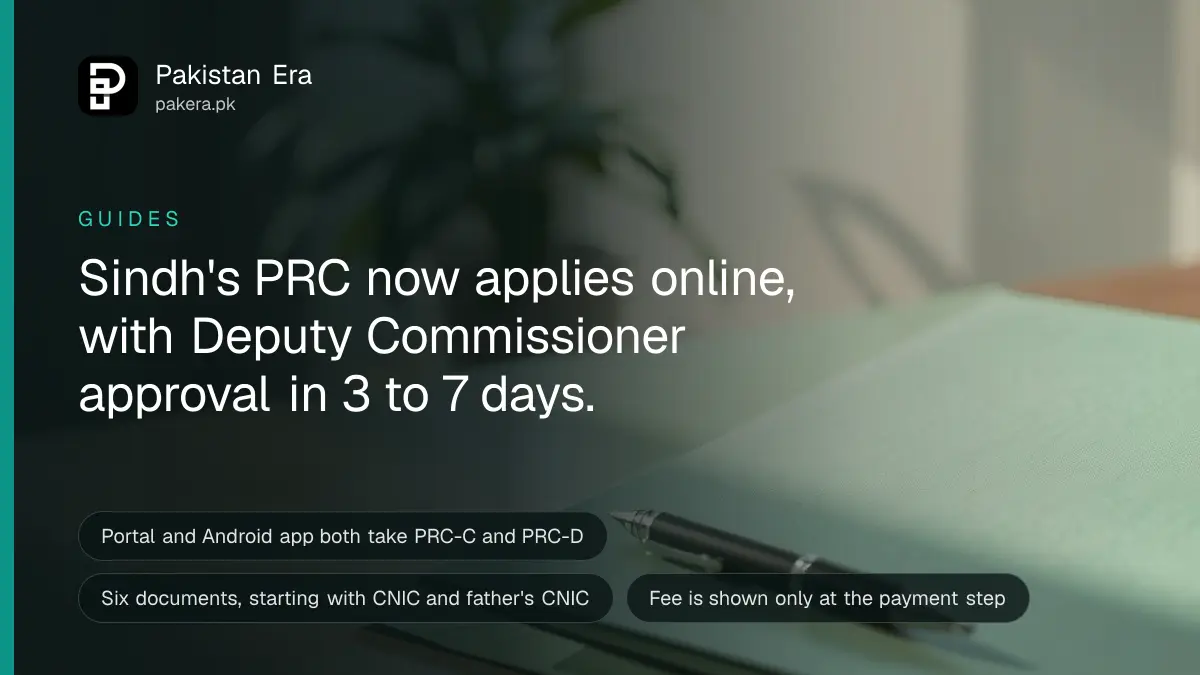
A Sindh PRC, the Permanent Residence Certificate, is issued with the Deputy Commissioner's approval and now has an online route at sindhdomicileportal.gos.pk and the Sindh Domicile Android app. The portal lists six documents, promises 3 to 7 working days, and shows the fee only at payment.
Most people in Sindh meet the PRC the week a form asks for it. A university admission, a provincial job under the Sindh quota, or a Sindh PMS application wants both a domicile and a PRC, and the two are usually made together. The PRC is the one that proves you live permanently in Sindh.
We read the Sindh Domicile and PRC Portal, its app listing on Google Play and the Commissioner Karachi's service pages on 29 September 2026. We did not create an account or file an application, so the steps below are what the portal itself describes.
The PRC proves permanent residence in Sindh
The PRC confirms that you, and your family, permanently live in the Province of Sindh. The portal describes it as a document that "confirms permanent address and family record for legal documentation". It is separate from the domicile, which ties you to one district.
Put simply, the domicile answers "which district are you from?" and the PRC answers "do you really live in Sindh?". Offices in Sindh ask for both because provincial quotas depend on it. For how domicile works in every province, see the domicile certificate process across Pakistan.
The affidavit on the portal gives the formal name: a "Certificate of Permanent Residence in the Province of Sindh". The applicant swears that the information in application Form "A" is true.
Sindh offers two PRC types, PRC-C and PRC-D
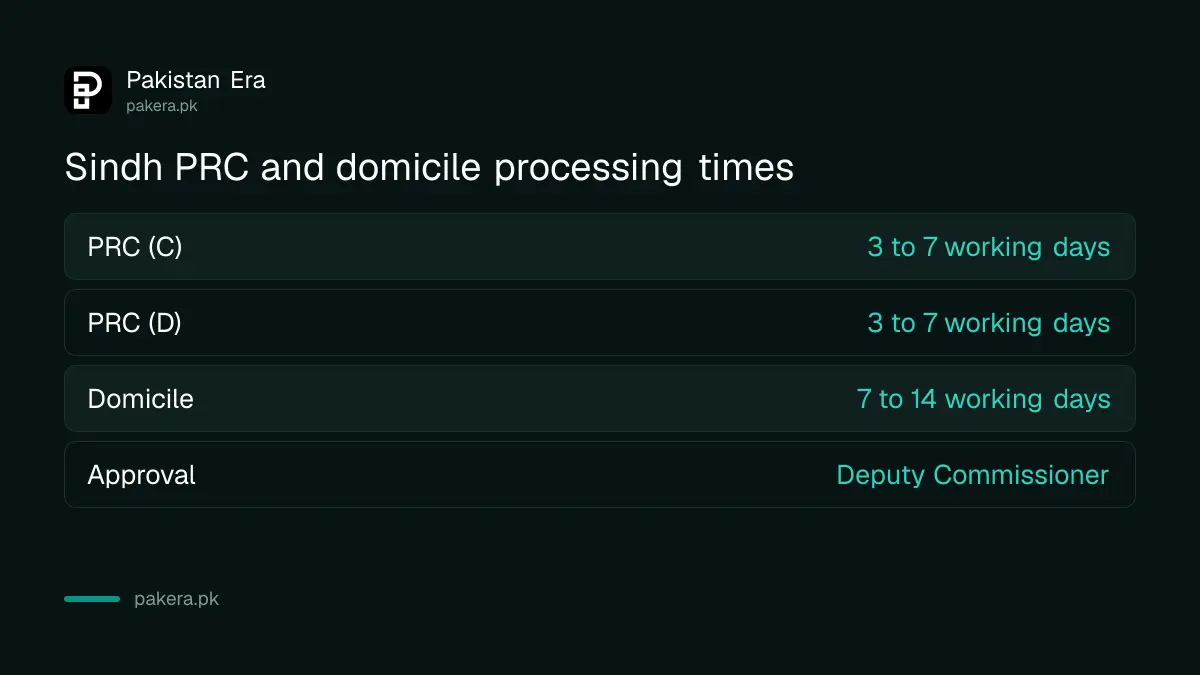
The portal and the app list two PRC services: PRC-C and PRC-D. The portal describes PRC-C as "PRC by certificate" and PRC-D as the version "for district verification". Both take 3 to 7 working days and ask for the same documents.
| Service | Portal's description | Processing time shown |
|---|---|---|
| PRC (C) | Permanent address and family record, "PRC by certificate" | 3 to 7 working days |
| PRC (D) | Permanent address and family record, "for district verification" | 3 to 7 working days |
| Domicile Certificate | For government jobs, admissions and scholarships | 7 to 14 working days |
| NOC | No objection certificate, listed in the fee table | Not shown |
The portal does not explain the difference further. If the office asking for your PRC names a type, apply for that one. If it does not, ask them before you pay, because a wrong type means a second application.
These documents are needed for a Sindh PRC
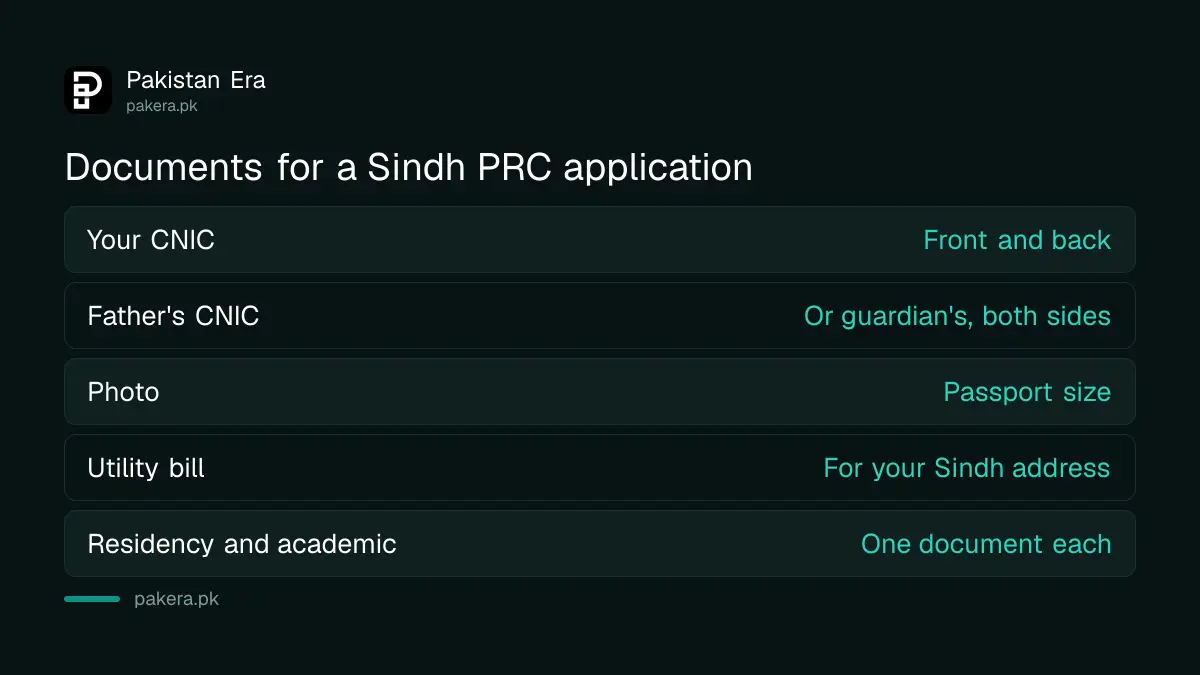
The portal lists six uploads for the PRC: your CNIC, your father's or guardian's CNIC, a passport-size photo, a utility bill, a residency certificate and an academic document. Its upload screens also name an affidavit, a Family Registration Certificate and an applicant domicile.
- CNIC: front and back, as separate images.
- Father's or guardian's CNIC: front and back.
- Passport-size photo: a recent one.
- Utility bill: a recent bill for your Sindh address.
- Residency certificate: proof that you live at the address. The portal does not say who should issue it, so ask your DC office.
- Academic document: an educational certificate.
- Affidavit: accepted on the portal by ticking a box, not a paper stamp.
- Family Registration Certificate: listed among upload types, from NADRA.
A NADRA Family Registration Certificate is worth getting first if you do not have one, since it proves the family link the PRC records. Scan everything clearly before you start. A blurred CNIC is the easiest way to get rejected.
How to apply for a PRC on the Sindh portal
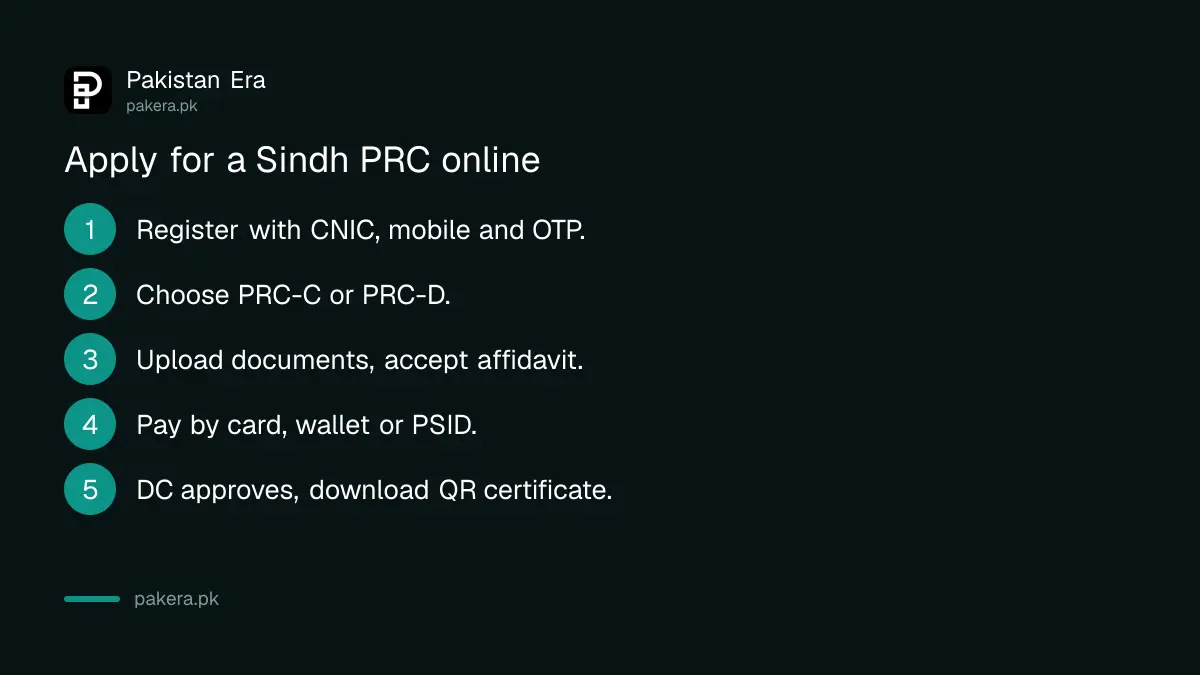
The portal sets out five steps: register with your CNIC and mobile number, fill the form with data pulled from NADRA, pay the fee, wait for verification and the Deputy Commissioner's approval, then download a digitally signed certificate with a QR code.
- Register on sindhdomicileportal.gos.pk or the Sindh Domicile app with your CNIC and mobile number, and enter the OTP.
- Choose "Apply for PRC-C" or "Apply for PRC-D". Your details are filled from NADRA.
- Upload the documents and accept the affidavit.
- Pay by card or digital wallet, or generate a PSID, a government payment slip you pay at a bank.
- Track the application. After NADRA, document and address checks, the Deputy Commissioner approves and you download the certificate.
The Android app, "Sindh Domicile", was last updated on 10 June 2026 on Google Play and says it handles "Domicile, PRC-D and PRC-C certificates". The iPhone app is marked "coming soon". Edits are allowed during initial review, the FAQ says, and only limited edits once verification starts.
If your application is rejected, the portal says it will give the reason and you may resubmit with corrected information or documents.
The PRC fee is shown only at payment
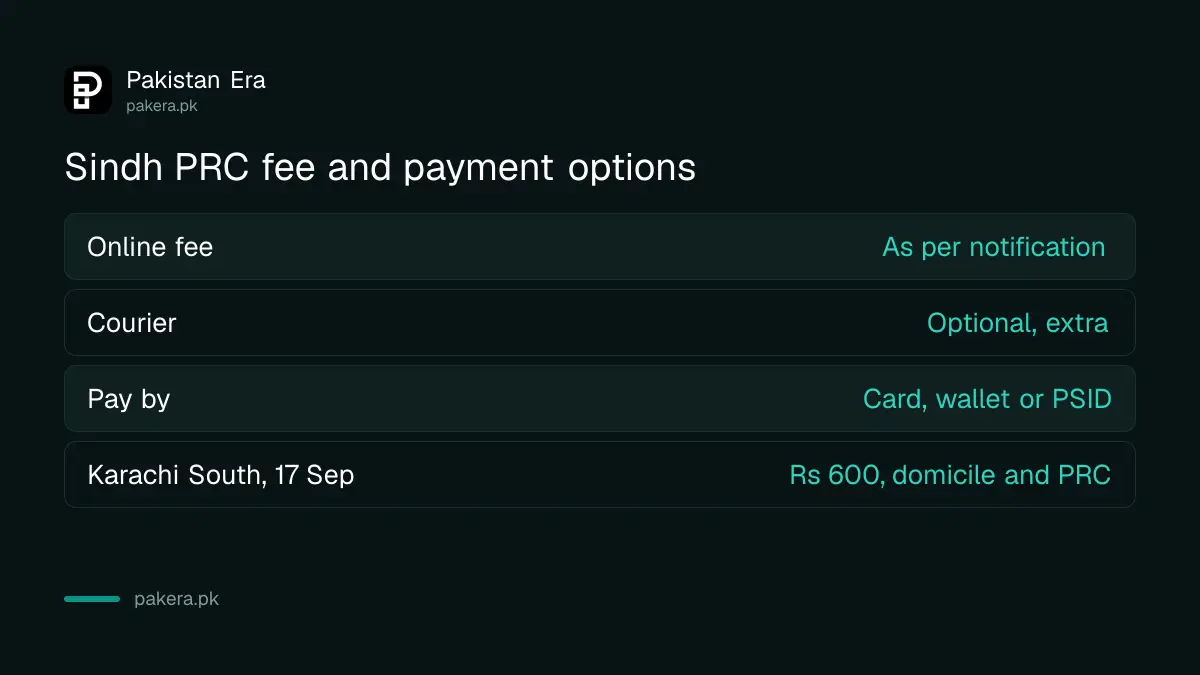
The portal's fee table lists the PRC, domicile and NOC as "As per Govt. Notification" and courier delivery as an optional extra. It gives no rupee figure, and says the official fee appears during payment. We could not see it without applying.
That is less helpful than it sounds, because fees have differed by district. When we read the District South page on the Commissioner Karachi's site on 17 September 2026, it quoted total charges of Rs 600 and three working days for the domicile and PRC together, in person. On 29 September we could no longer find that page on the site, so treat Rs 600 as a Karachi South figure from that date, not a Sindh-wide fee.
| Item | What we found | Source |
|---|---|---|
| PRC fee online | "As per Govt. Notification", shown at payment | Sindh Domicile and PRC Portal |
| Courier delivery | Optional, additional charge | Sindh Domicile and PRC Portal |
| Payment methods | Card or digital wallet, or PSID slip | Sindh Domicile and PRC Portal |
| Karachi South, in person | Rs 600 total, domicile and PRC, 3 working days | District South page, read 17 September 2026 |
Pay only through the portal, the app or a PSID. Anyone offering to "arrange" a PRC for a larger sum is charging you for something the portal already does.
You can still apply at the Deputy Commissioner's office
The PRC is approved by the Deputy Commissioner of your district, and the in-person route runs through the DC office. Take the same documents with you. The Commissioner Karachi's DC South online services page still lists "Domicile" among its services.
The office route suits anyone without a smartphone, or whose NADRA record has a problem the portal cannot fix. The portal checks your CNIC with NADRA, so a mismatch in your father's name or address will stop you online and needs a NADRA visit first.
Every certificate issued online carries a QR code and a serial number. An employer or university can scan it to check it is genuine. Ask for that check if someone hands you a PRC you doubt.
Common questions
Who issues the PRC in Sindh?
The Deputy Commissioner of your district approves it. Online applications go through the Sindh Domicile and PRC Portal, which checks your CNIC with NADRA before the DC's approval.
How long does a Sindh PRC take?
The portal shows 3 to 7 working days for both PRC-C and PRC-D. Its FAQ adds that time depends on verification stages.
What is the fee for a PRC in Sindh?
The portal does not print it. It says the fee is "as per Govt. Notification" and appears at payment. Karachi South quoted Rs 600 for domicile and PRC together on 17 September 2026.
Is the PRC the same as a domicile?
No. The domicile ties you to a district. The PRC confirms permanent residence in Sindh. Many Sindh forms ask for both.
How do I check if a Sindh PRC is genuine?
Scan the QR code or check the serial number printed on it. The portal says every certificate it issues carries both for online verification.
How we verified this
What we checked, where we read it, and what we could not confirm.
We read the Sindh Domicile and PRC Portal at sindhdomicileportal.gos.pk, including its process, document, fee and FAQ sections, the Sindh Domicile app listing on Google Play, and the Commissioner Karachi's service pages on 29 September 2026. The Karachi South fee is from that district's page as read on 17 September 2026. We did not register or apply, so the fee shown at payment was not seen.
About the author

Public Services and Education Journalist
Fajr Riaz is a journalist and content writer at Pakistan Era, based in Lahore. She covers the questions people meet in everyday life in Pakistan: how a public service works, what a change in the rules means, and where to find a reliable answer.