Reduce the Sanctioned Load on Your Electricity Meter in Pakistan: 5 Documents, 30 Days, Deposit Difference Back
Reduce the sanctioned load on an electricity connection in Pakistan: the form, test report and 4 other papers, the 30 day NEPRA time frame, the deposit refund.
To reduce the sanctioned load on your electricity connection, apply to your electricity company on the standard application form, tick "Reduction of load", and attach a wiring test report, your last paid bill, an attested CNIC copy and the power supply contract. NEPRA's Consumer Service Manual lets you reduce to any lower limit the test report supports. The security deposit is then worked out again, and the difference is refunded to you.
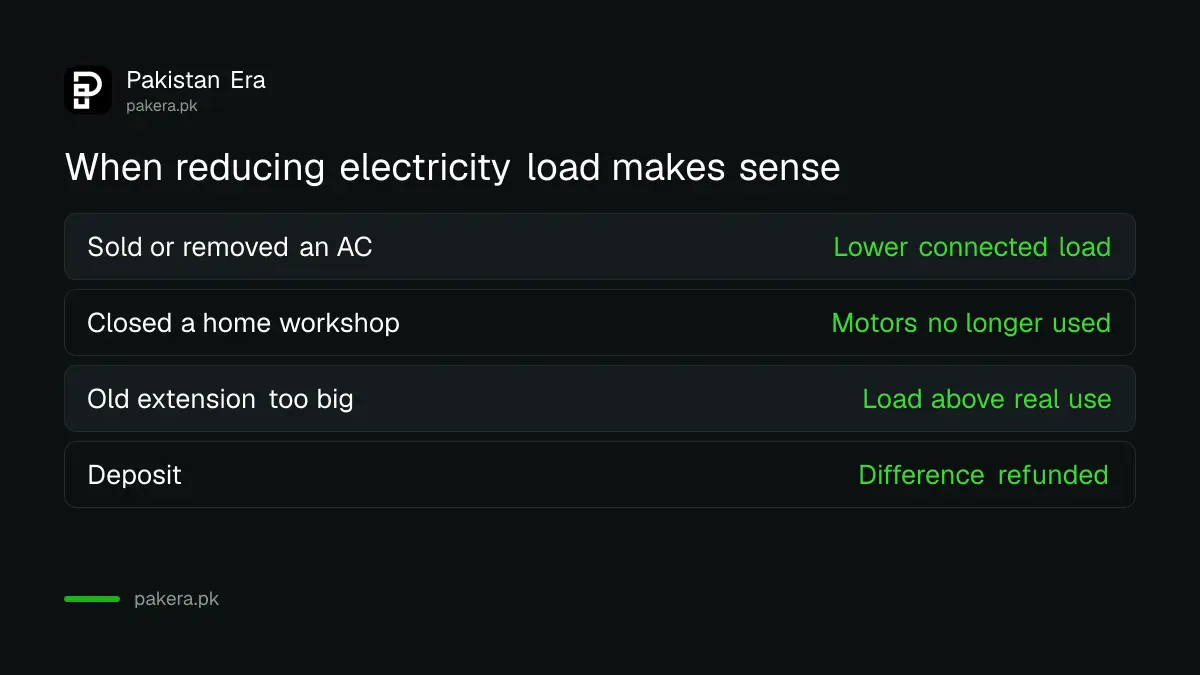
People reduce load after selling an AC, closing a home workshop, splitting a house, or when a past extension was bigger than they needed. The rule covers every ex-WAPDA company: LESCO, IESCO, MEPCO, FESCO, GEPCO, PESCO, HESCO, SEPCO, QESCO and TESCO. For loads up to 15 kW, the manual's time frame for the whole process is 30 days.
Sanctioned load is the kW your company approved, and you can lower it
Sanctioned load is the load in kilowatts (kW) your company approved for the connection, and it is printed on your bill. NEPRA's manual treats a reduction as a formal change, like an extension, handled by the same sanctioning officer on the same application form. There is no minimum, as long as the test report supports it.
The manual's exact words are that reduction of load "may be applied for any lower limit as per the test report". So the test report is the key document. It lists what is actually installed in the house and adds up the kW. If you have removed appliances, the report should show the smaller total.
Five documents go with a load reduction application
NEPRA's manual lists the same documents for extension and reduction of load. The application form (Annexure-I) has a "Reduction of load" box and a table where you list each appliance and its watts. The paid bill must have no arrears, deferred amount or pending instalments.
| Document | Note |
|---|---|
| Application form (Annexure-I), "Reduction of load" ticked | List lights, fans, ACs, heaters, motors and plugs with watts |
| Wiring test report | From the Electric Inspector or an authorised wiring contractor |
| Copy of last paid bill | No arrears, deferred amount or instalments pending |
| Attested copy of CNIC | Of the applicant |
| Power supply contract | Listed by NEPRA for every load change |
The applicant should be the person named on the bill. If the connection is still in a previous owner's or a dead parent's name, the name on the electricity bill has to be changed first, because the deposit refund goes to the account holder.
Apply in six steps
Get the test report, fill the form with your real appliance list, and submit it with the documents at your sub-division office. The company checks the test report and site, updates the deposit, and changes the load on your record.
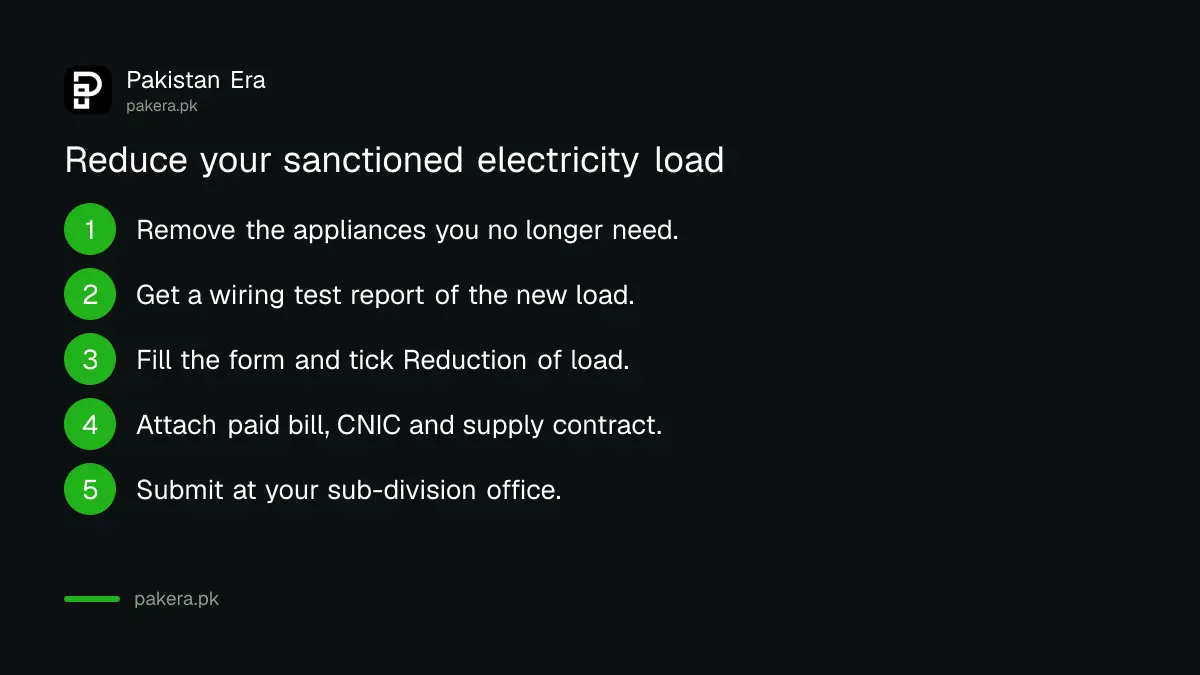
- Remove or stop using the appliances you no longer need.
- Get a wiring test report showing the new, lower connected load.
- Fill the application form, tick "Reduction of load" and list each appliance with watts.
- Attach your last paid bill, attested CNIC copy and the power supply contract.
- Submit at your sub-division office and keep the receipt or tracking number.
- Check that the next bill shows the new sanctioned load and the deposit credit.
Load extensions can also be filed online on the ENC portal, as set out in how to extend electricity load. For a reduction, ask your sub-division office whether it takes the request online or only at the counter. If you get an ENC tracking ID, follow the case with the ENC status check.
The deposit difference is refunded
NEPRA's manual says that on a reduction of load, the security deposit is updated at prevailing rates, and the difference is refunded or charged, as the case may be. For a simple reduction on a home, the new deposit is for fewer kW, so the difference comes back to you.
There is a catch. The deposit is recalculated at today's rate per kW, and your old deposit may have been paid years ago at a much lower rate. If the new, smaller load at today's rate still costs more than you paid then, you may be asked to pay the difference instead. Ask the office for the calculation before you sign. The rate per kW is explained in the security deposit on your electricity bill rules.
- Fractions of a kW of half or more count as one full kW; smaller fractions are ignored.
- The deposit refund is separate from the full refund you get when you close a connection for good.
The company has 30 days for loads up to 15 kW
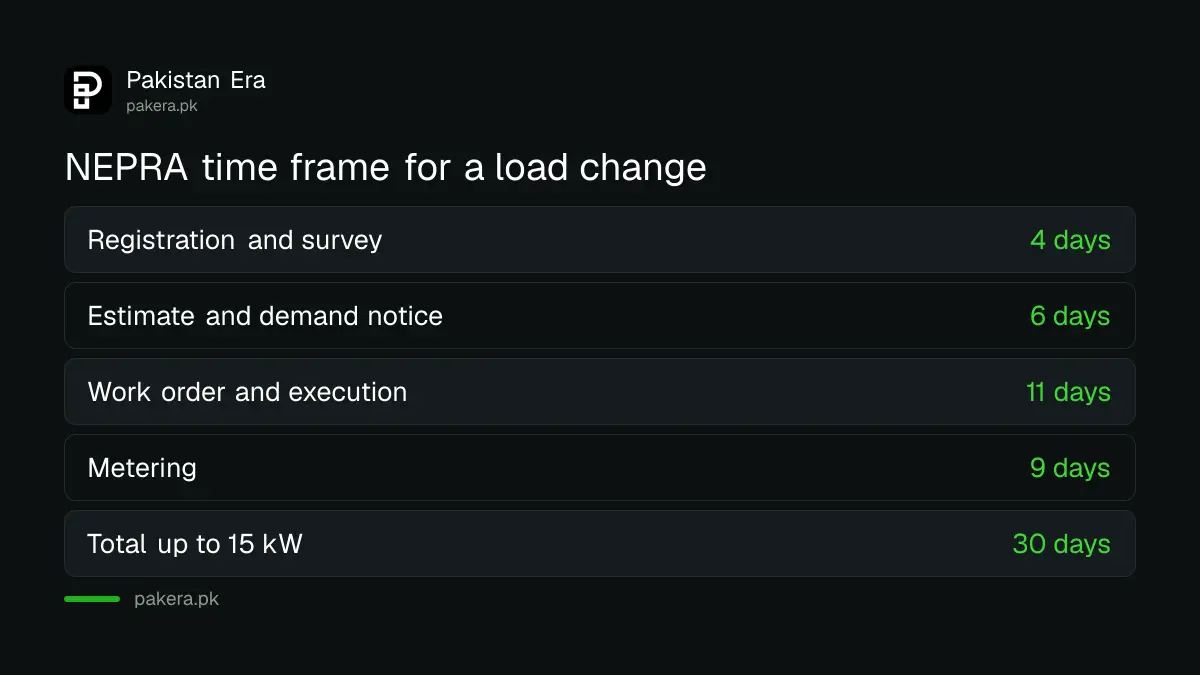
NEPRA's manual gives one time frame for new connections, extension and reduction of load. For category 1, which is loads up to 15 kW at 400 volts and covers most homes and shops, the steps add up to 30 days. For loads above 15 kW up to 70 kW, the total is 44 days.
| Step, loads up to 15 kW | Days |
|---|---|
| Registration, test report submission, site survey and verification | 4 |
| Cost estimate and demand notice | 6 |
| Work order, material and execution | 11 |
| Metering installation | 9 |
| Total | 30 |
Two cases where a reduction is refused or limited
A reduction will not be accepted where the test report does not support it, or where the connection is a separate ToU connection given to one portion of a house. NEPRA's manual says that in that portion case, no reduction request is entertained, so the ToU tariff stays applicable.
The manual ties the ToU, or time of use, tariff to connections of 5 kW and above. If your load is near that line, ask the office how the reduction will change your meter and tariff before you apply. And remember that reducing on paper does not change what you use. If your meter later records a demand above the new sanctioned load, the company can send a load extension notice again.
Common questions
Can I reduce my sanctioned electricity load?
Yes. NEPRA's Consumer Service Manual allows a reduction to any lower limit supported by a wiring test report.
Will I get money back after reducing load?
The deposit is recalculated at the current rate and the difference is refunded or charged. For most homes reducing load, it is a refund, but check the calculation.
What documents do I need?
The application form, wiring test report, last paid bill with no arrears, attested CNIC copy and the power supply contract.
How long does a load reduction take?
NEPRA's time frame for loads up to 15 kW is 30 days, and 44 days for loads above 15 kW up to 70 kW.
Can a tenant reduce the load?
The application should come from the person named on the connection. A tenant should ask the owner to apply, or have the name changed first.
How we verified this
What we checked and where we read it.
We checked these rules on 15 November 2026 in the NEPRA Consumer Service Manual, November 2025 edition, published on LESCO's website: clause 2.14 on extension and reduction of load and its document list, clause 5.2.4 and 5.2.5 on updating the security deposit, clause 2.8(b) on separate ToU connections for a portion, Annexure-I for the application form, and Annexure-III for the 30 and 44 day time frames. NEPRA's own site is nepra.org.pk.
About the author

Tax, Bills and Technology Writer
Ali Akhtar is a young and curious voice here at Pakistan Era. He is currently pursuing his A-Levels and has a growing interest in Pakistan’s changing industrial landscape and educational trends. Ali likes to write in a way that helps him explain and explore the world around him. His writing reflects the perspective of the new generation navigating the evolving trends of Pakistan where technology, youth innovation, and shifting opportunities are reshaping the country’s future.