Security Deposit on Your Electricity Bill in Pakistan: The 5 Times NEPRA Lets Your Company Raise It, and the Rs 1,220 per kW Rate
Why a security deposit is added to your electricity bill in Pakistan: NEPRA's 5 cases, Rs 1,220 per kW home rate, 3 to 6 bill instalments and refunds.
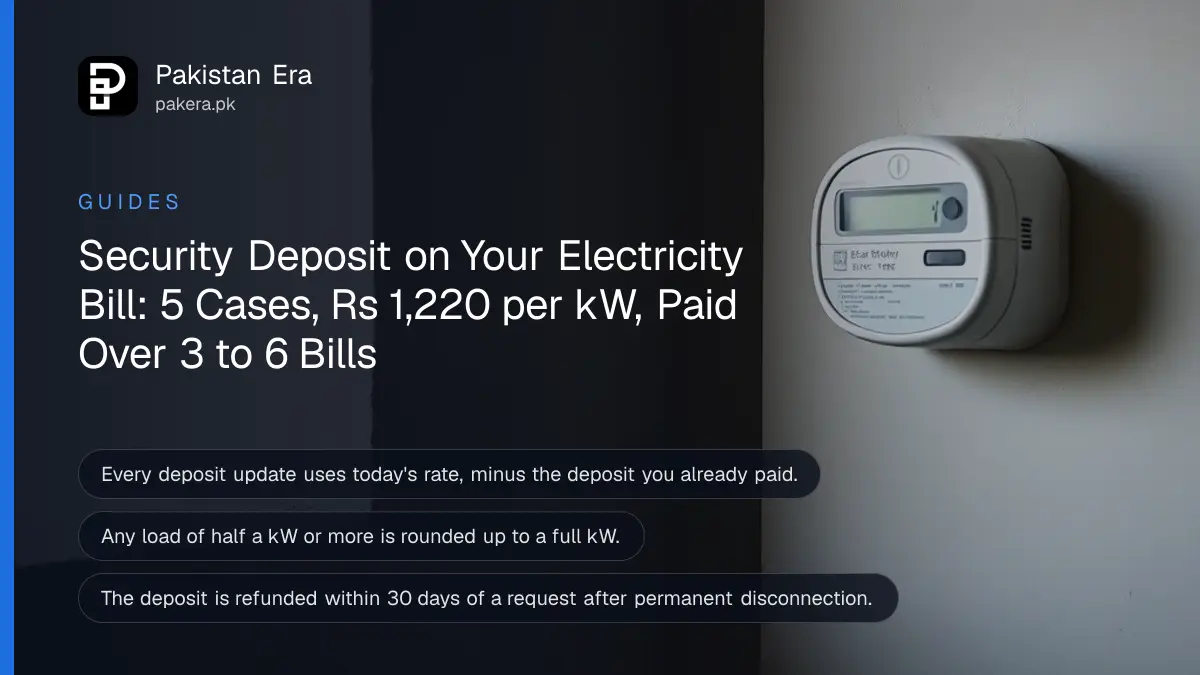
A security deposit charge on your electricity bill in Pakistan usually means your company has updated your deposit to today's rate, most often because your meter shows more load than you were sanctioned. NEPRA's rule book lets companies do this in five situations, and for extra load on a meter up to 8 kW it recovers the difference through 3 to 6 bills. Today's home rate is Rs 1,220 per kW in towns and Rs 610 in villages.
We read the security deposit chapter and the load rules of NEPRA's Consumer Service Manual, the rule book NEPRA sent to all 11 government power companies and K-Electric on 26 November 2025, on 12 November 2026. Here is when the deposit can change, how the new amount is worked out, and how to check yours.
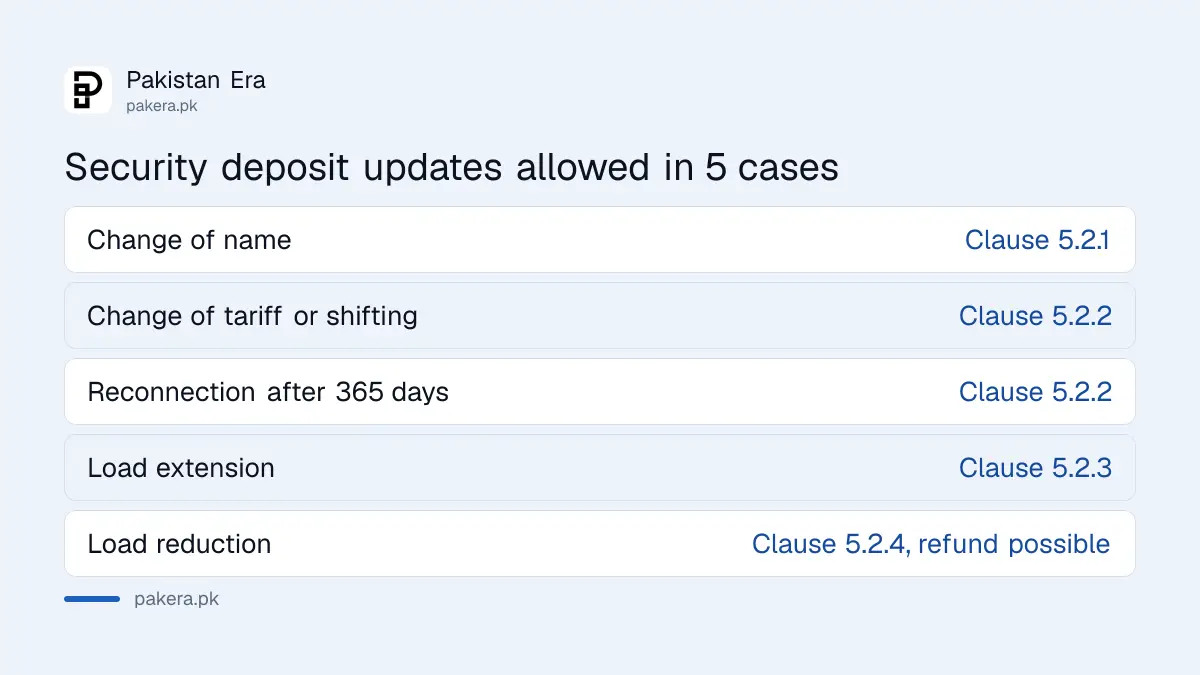
NEPRA allows a deposit update in five situations
Clause 5.2 of the manual lists them. In every case the deposit is worked out at the rate in force today, and the deposit you already paid is subtracted. You pay only the difference, and on a load reduction you can get money back.
| Situation | Clause | What happens to your deposit |
|---|---|---|
| Change of name on the connection | 5.2.1 | Updated to today's rate, old deposit adjusted |
| Change of tariff, or shifting the connection | 5.2.2 | Updated to today's rate, old deposit adjusted |
| Reconnection after more than 365 days off | 5.2.2 | Updated to today's rate, old deposit adjusted |
| Extension of load | 5.2.3 | Worked out on the whole new load, old deposit adjusted |
| Reduction of load | 5.2.4 | Recalculated; the difference is refunded or charged |
Older connections often paid a small flat deposit years ago. So when one of these five events happens, the jump can look large, even though the company is only applying today's rate.
Extra load on your meter is the most common reason
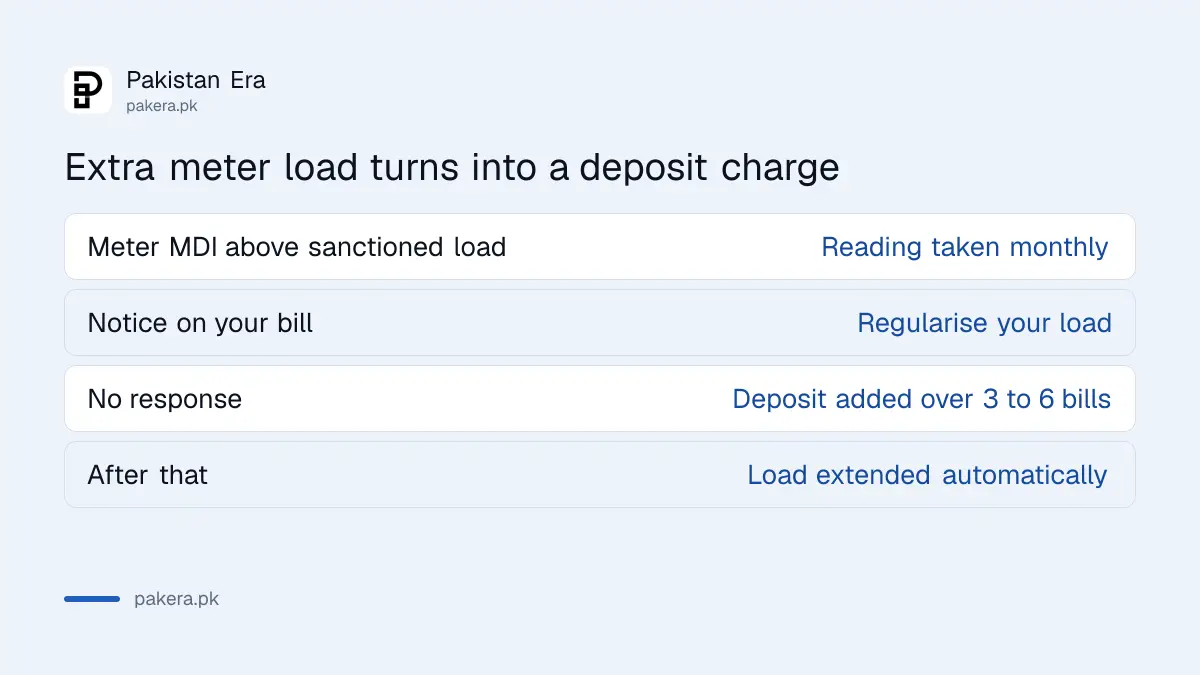
Meters record the MDI, the maximum demand indicator, which is the highest load in kW you drew in the month. Clause 2.14 says that on static or digital meters with load up to 8 kW, the meter reader records the MDI every month. If it is above your sanctioned load, the company prints a notice on your bill asking you to regularise the load.
- Your meter's MDI shows more kW than the sanctioned load printed on your bill.
- The company prints a notice on the bill asking you to regularise the load.
- If you do not respond, the extra security deposit is added to your bills in 3 to 6 instalments.
- Your sanctioned load is then extended automatically to match.
- If a single phase meter's load nears 5 kW, you get a further notice and a time of use (ToU) meter is installed.
So a "security deposit" line that appears for a few months in a row is usually this process at work. Check the sanctioned load and the MDI on your bill to confirm. If you think the reading is wrong, complain quickly, within the limits in our bill complaint deadlines guide.
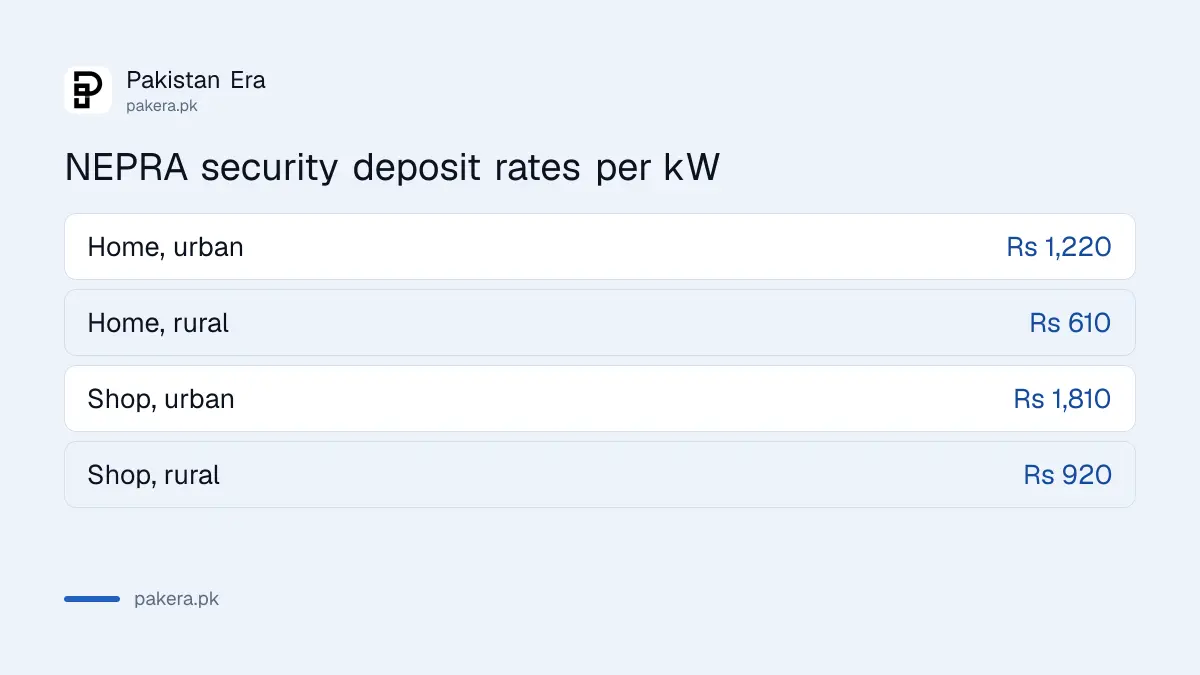
Today's deposit rate is Rs 1,220 per kW for a town home
Annexure IV of the manual sets the deposit per kW of sanctioned load. Homes and shops in rural areas pay about half the urban rate. Loads are rounded: any fraction of half a kW or more counts as a full kW, and a smaller fraction is ignored.
| Connection | Urban, per kW | Rural, per kW |
|---|---|---|
| Home (A-1) | Rs 1,220 | Rs 610 |
| Shop or commercial (A-2) | Rs 1,810 | Rs 920 |
Rounding matters. A load of 4.4 kW counts as 4 kW, but 4.5 kW counts as 5 kW. That half kilowatt can add a full Rs 1,220 to an urban home's deposit.
A worked example: from 2 kW to 5 kW in a town home
Say your town home was sanctioned at 2 kW and you paid Rs 1,000 as a deposit long ago. Your MDI now shows 4.6 kW, which rounds to 5 kW. The new deposit on the whole load is 5 times Rs 1,220, so Rs 6,100.
| Step | Amount |
|---|---|
| New load after rounding | 5 kW |
| Deposit at today's rate (5 x Rs 1,220) | Rs 6,100 |
| Less deposit already paid | Rs 1,000 |
| Extra deposit to pay | Rs 5,100 |
| Over 3 bills | Rs 1,700 a bill |
| Over 6 bills | Rs 850 a bill |
These numbers are our example, not a company's quote; your own old deposit may be higher or lower. If you really need less load, you can ask for a load reduction instead, and the deposit is then recalculated downwards. Our guides to extending load and reducing sanctioned load give the paperwork.
Your deposit comes back when the connection closes
The deposit is not a fee. Clause 5.2.6 says it is refunded when the connection is permanently disconnected, if you apply and have no dues. The refund must be processed within 30 days of your request.
That is why it is worth keeping the receipts of every deposit you pay, including the instalments on your bills. Our deposit refund guide walks through the claim. Big industrial users on B-3 and B-4 tariffs can give a bank guarantee instead of cash, as our page on the bank guarantee option explains.
Selling or inheriting a house? A name change also triggers an update, so budget for it. See our guide to changing the name on an electricity bill.
Common questions
Why is a security deposit added to my electricity bill?
Usually because your meter's maximum demand is above your sanctioned load. NEPRA's manual lets the company recover the extra deposit through 3 to 6 bills and extend your load automatically.
What is the security deposit per kW for a house?
Rs 1,220 per kW in urban areas and Rs 610 per kW in rural areas, under Annexure IV of NEPRA's 2025 manual.
Do I pay the full new deposit or only the difference?
Only the difference. Every update is at today's rate, with the deposit you already paid adjusted.
Is the security deposit refundable?
Yes, when the connection is permanently disconnected, if you apply and owe nothing. The refund is due within 30 days of the request.
Does a change of name raise the security deposit?
Yes. Clause 5.2.1 says the deposit is updated at today's rate on a change of name, with the old deposit adjusted.
How is a load of 4.5 kW counted for the deposit?
As 5 kW. A fraction of half a kW or more counts as one kW, and less than half is ignored.
What we checked and sources
We read NEPRA's updated Consumer Service Manual, sent under a NEPRA letter dated 26 November 2025, on 12 November 2026: clauses 2.14, 5.1, 5.2 and Annexure IV. The 2 kW to 5 kW example, including the Rs 1,000 old deposit, is our own illustration. We did not test a meter or apply for a load change. Last checked 12 November 2026.
About the author

Tax, Bills and Technology Writer
Ali Akhtar is a young and curious voice here at Pakistan Era. He is currently pursuing his A-Levels and has a growing interest in Pakistan’s changing industrial landscape and educational trends. Ali likes to write in a way that helps him explain and explore the world around him. His writing reflects the perspective of the new generation navigating the evolving trends of Pakistan where technology, youth innovation, and shifting opportunities are reshaping the country’s future.