Replace Your Industrial Electricity Security Deposit With a Bank Guarantee in Pakistan
B-3 and B-4 industrial users can give a bank guarantee instead of a cash electricity deposit. See the 3 year validity, the 30 day renewal and the cut-off risk.
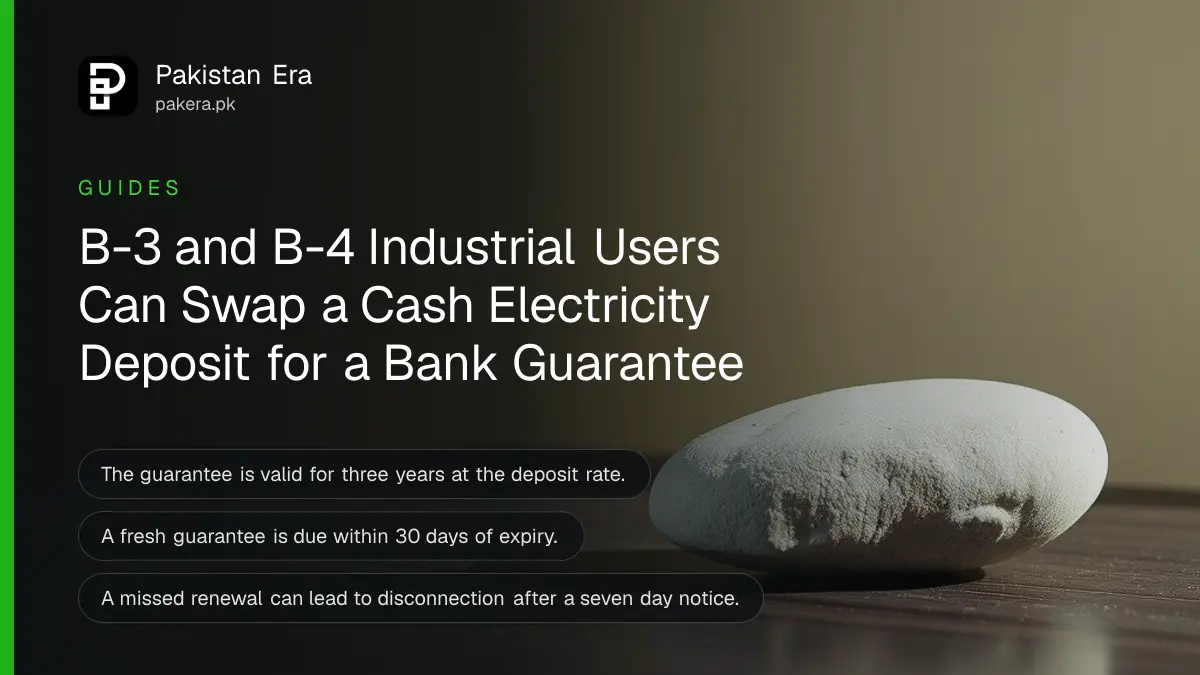
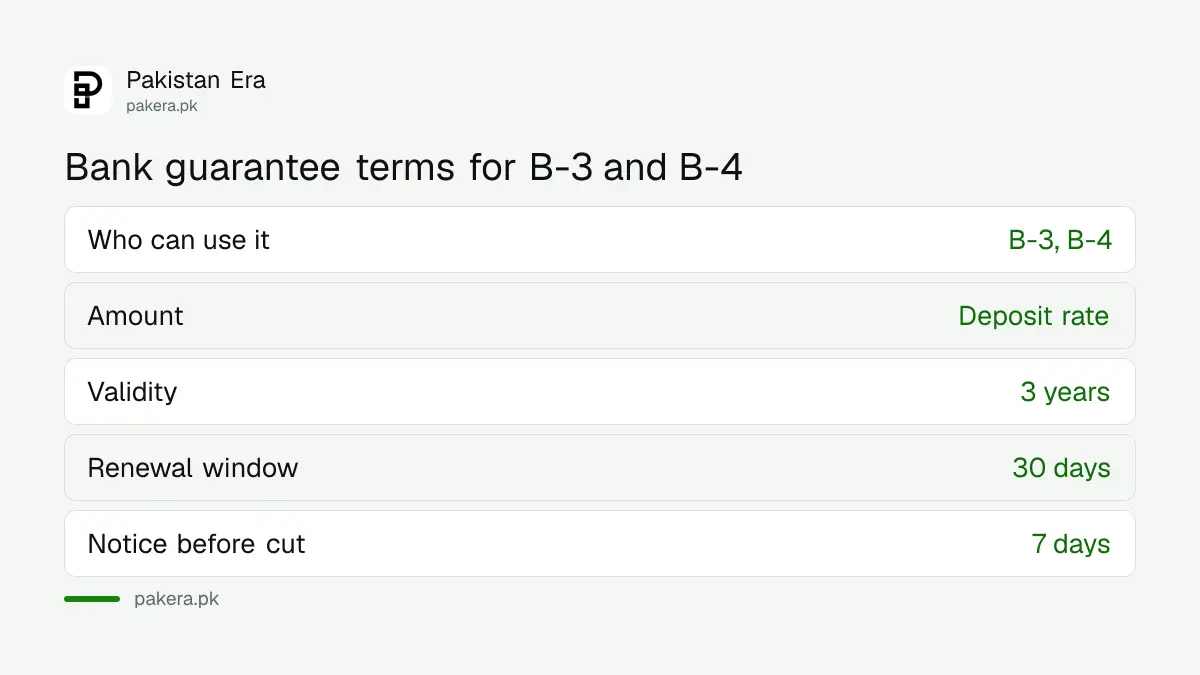
A B-3 or B-4 industrial electricity consumer can give the distribution company a bank guarantee instead of a cash security deposit. NEPRA's Consumer Service Manual sets the guarantee at the same amount as the deposit, valid for three years, and renewed within 30 days of expiry or the supply can be cut after a seven day notice. No other category has this option.
For a mill or factory, the security deposit is cash locked in a company account for years. The manual lets the largest industrial users free that cash. We read clauses 5.1 to 5.4 of the revised 2025 manual on NEPRA's website on 21 October 2026, and the rules below are taken from them.
Only B-3 and B-4 industrial consumers can use a bank guarantee
Clause 5.3 says the bank guarantee option is available to industrial consumers under B-3 and B-4 only. Domestic, commercial, small industrial (B-1 and B-2) and agricultural connections must pay the security deposit in cash through the demand notice.
B-3 covers loads up to 5,000 kW at 11 or 33 kV, and B-4 covers loads at 66 kV, 132 kV and above, as set out in the B-1, B-2, B-3 and B-4 industrial tariff categories. The manual itself points to the tariff terms and conditions for the definitions, so check your category on your bill first.
The guarantee matches the deposit rate and lasts three years
The manual says the guarantee must satisfy the company, be on the rate of the security deposit, and be valid for three years. It does not give a different formula, so the amount is what your cash deposit would have been.
The security deposit rates themselves sit in Annexure IV of the manual and are set by NEPRA, per clause 5.1.1. We did not extract the rate table, so ask your company for the figure on your demand notice. The loads in kW are rounded: half a kilowatt or more counts as one, and less than half is ignored, under clause 5.2.5.
| Item | What the manual says | Clause |
|---|---|---|
| Who can use it | B-3 and B-4 industrial consumers only | 5.3 |
| Amount | On the rate of the security deposit | 5.3 |
| Validity | Three years | 5.3 |
| Renewal | Fresh guarantee within 30 days of expiry | 5.3.2 |
| If you miss the renewal | Supply can be cut after a clear seven days' notice | 5.3.2 |
| Existing consumers | Can withdraw the old deposit and submit a guarantee | 5.3 |
Existing B-3 and B-4 consumers can swap their cash deposit
You do not need a new connection to use this. Clause 5.3 says existing B-3 and B-4 consumers can withdraw their previous security deposit from the company and submit a bank guarantee in its place, to the company's satisfaction.
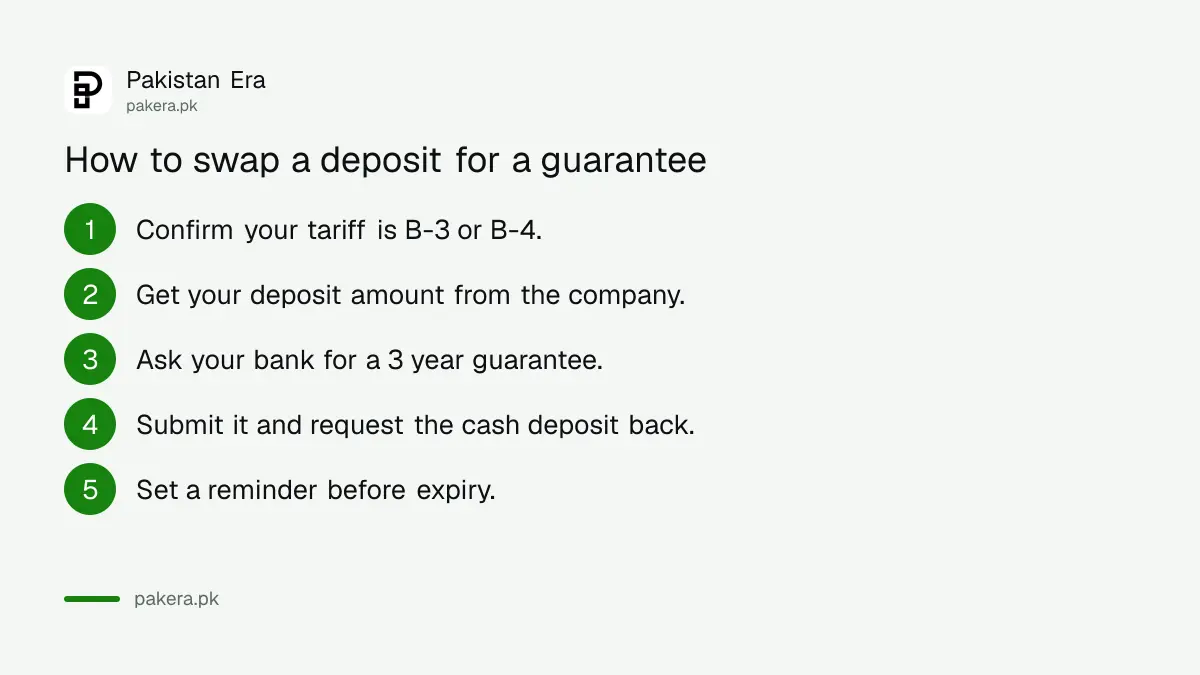
The sequence below is our reading of the clause, not a form the manual prescribes. Ask the company which officer signs off and which banks it accepts.
- Confirm your tariff category is B-3 or B-4 on your latest bill.
- Ask the company for the security deposit amount recorded against your reference number.
- Ask your bank to issue a guarantee for that amount, valid for three years.
- Submit the guarantee to the company and request withdrawal of the cash deposit.
- Note the expiry date and set a reminder well before it.
Banks charge a commission on guarantees. The manual says nothing about that cost, so compare it with what your cash deposit would earn before you switch.
Missing the renewal can end in disconnection
Clause 5.3.2 says the guarantee must be renewed after every three years. You must hand in a fresh guarantee within 30 days of the expiry of the old one. If you fail, the company may disconnect supply after serving a clear seven days' notice.
Seven clear days is the same notice period used for unpaid bills. How that notice works in practice is in the guide to disconnection after a seven day notice. A mill that loses supply over paperwork loses production, so treat the renewal date like a tax deadline.
Cash deposits sit in a separate account and earn a benefit for consumers
If you keep a cash deposit, clause 5.4 says the company must hold deposits in a separate bank account under section 217 of the Companies Act 2017 and may not use the money for its own purposes. Profit earned on that account goes into the tariff petition for the benefit of consumers.
That benefit goes to consumers as a group through the tariff, not to you as interest. It is worth weighing against the bank's guarantee commission. If you later close the connection, deposits are refunded within 30 days of a request with no dues outstanding, as covered in the guide to getting your electricity security deposit back.
Common questions
Can a shop or home use a bank guarantee instead of a deposit?
No. Clause 5.3 limits the option to B-3 and B-4 industrial consumers.
How long is the bank guarantee valid?
Three years. It must be renewed after every three years.
How long do I have to renew it?
You must submit a fresh guarantee within 30 days of the previous one expiring, under clause 5.3.2.
What happens if I miss the renewal?
The company may disconnect supply after a clear seven days' notice. Reconnection rules then apply.
Does the company pay interest on my cash deposit?
The manual says profit from the deposit account is passed on through the tariff petition. It does not promise interest to individual consumers.
Is the deposit amount the same for a guarantee?
Yes. The manual says the guarantee is submitted on the rate of the security deposit.
How we verified this
What we checked, where we read it, and what we could not confirm.
Last checked 21 October 2026. We read clauses 5.1, 5.2.5, 5.3, 5.3.2 and 5.4 of the NEPRA Consumer Service Manual, revised 2025. We did not read Annexure IV, so we state no deposit rate. We did not verify how each company accepts guarantees in practice or what banks charge. The five step sequence is our reading of the clause, not an official form. K-Electric is not covered by our reading.
About the author

Global Affairs & Political Economy Writer
Muhammad Hatim is a book lover who started writing because he enjoys it. At Pakistan Era he writes about international relations, geopolitics and the global economy, with a particular interest in South Asia and the forces behind current events.