Industrial Electricity Tariff in Pakistan 2026: B-1 to B-4 Unit Rates and Fixed Charges
Industrial electricity in Pakistan is Rs 26.23 a unit on B-1 and Rs 26.16 to Rs 27.00 on B-2 to B-4 in 2026. See peak rates and the Rs 1,250 per kW charge.
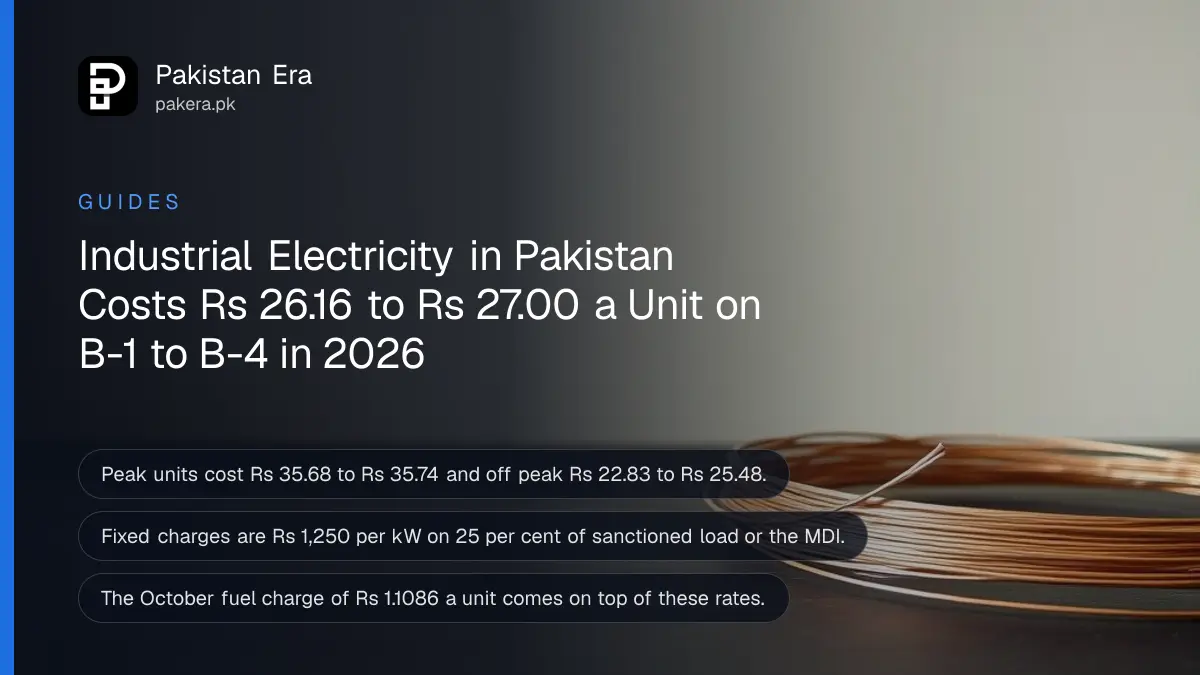
A factory or workshop in Pakistan pays Rs 26.23 a unit on the small B-1 industrial tariff and Rs 26.16 to Rs 27.00 a unit on B-2, B-3 and B-4, before the monthly fuel charge and quarterly adjustment. Fixed charges are Rs 1,000 a month on B-1 and Rs 1,250 per kW a month on the larger categories. Time of use meters pay Rs 35.68 to Rs 35.74 in peak hours and Rs 22.83 to Rs 25.48 off peak. These are the government applicable rates in S.R.O. 279(I)/2026 of 12 February 2026, which we read on 19 October 2026.
Pakistan has one uniform industrial tariff for every distribution company, from PESCO to K-Electric. NEPRA determines a cost based rate for each company, and the Federal Government then notifies a single applicable rate with the difference carried by subsidy and cross subsidy. The applicable rate is the one printed on your bill.
Industrial consumers fall into five B categories by load and voltage
B-1 covers loads up to 25 kW at 400 or 230 volts. B-2 covers loads above 25 kW and up to 500 kW at 400 volts. B-3 covers all loads up to 5,000 kW supplied at 11 or 33 kV. B-4 covers supply at 66 kV, 132 kV and above, and B-5 is 220 kV and above.
Your category depends on your sanctioned load and the voltage at which the company supplies you, not on what you make. A small workshop with a 15 kW connection is B-1. A mill with its own 11 kV feeder is B-3. The category is printed on the bill next to the tariff code, and it decides both the unit rate and the fixed charge.
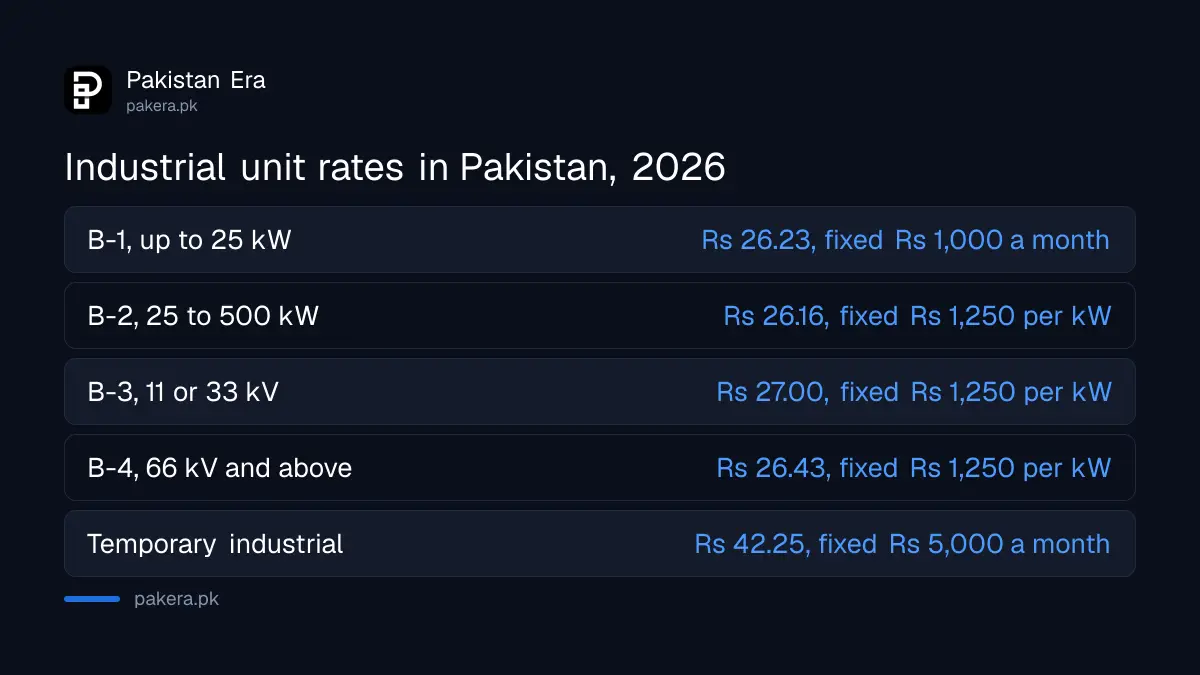
The applicable unit rate is Rs 26.16 to Rs 27.00 on flat industrial tariffs
On the flat, non time of use rate, B-1 pays Rs 26.23 a unit, B-2 pays Rs 26.16, B-3 pays Rs 27.00 and B-4 pays Rs 26.43. The NEPRA determined rates behind them are higher, Rs 32.55 for B-1 and Rs 37.87 for B-2, and the gap is what the government covers.
| Category | Load and voltage | Fixed charge | Applicable rate, Rs a unit |
|---|---|---|---|
| B-1 | Up to 25 kW at 400/230 V | Rs 1,000 a month | 26.23 |
| B-2 | Above 25 kW to 500 kW at 400 V | Rs 1,250 per kW a month | 26.16 |
| B-3 | All loads up to 5,000 kW at 11 or 33 kV | Rs 1,250 per kW a month | 27.00 |
| B-4 | All loads at 66 kV, 132 kV and above | Rs 1,250 per kW a month | 26.43 |
| Temporary industrial | Any | Rs 5,000 a month | 42.25 |
| Prepaid industrial | Any | Rs 1,250 per kW a month | 38.72 |
Industrial rates are lower than what a shop pays. The commercial A-2 rate is Rs 37.44 a unit under 5 kW, as set out in the guide to the shop electricity rate in Pakistan. Homes above 700 units pay Rs 47.20, per the home slab rates. The industrial discount is deliberate policy, and it is why misusing a home or shop meter for a workshop invites a back bill.
Time of use meters pay Rs 35.68 at peak and Rs 22.83 to Rs 25.48 off peak
Every industrial category has a time of use option, and above 25 kW it is the normal arrangement. B-1 pays Rs 35.74 in peak hours and Rs 25.48 off peak. B-2 pays Rs 35.68 and Rs 22.83. B-3 pays Rs 35.68 and Rs 23.67, and B-4 pays Rs 35.68 and Rs 23.38. B-5 at 220 kV pays Rs 35.68 and Rs 23.13.
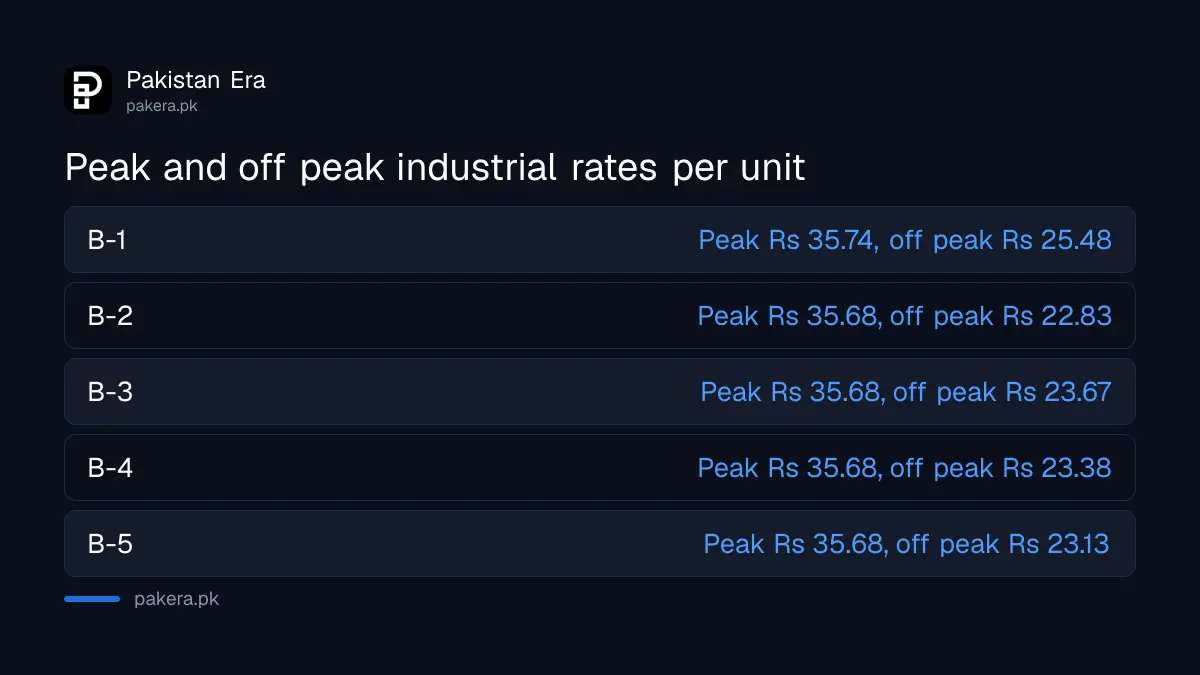
The off peak discount against the flat rate is Rs 3.33 a unit on B-2 and Rs 3.33 on B-3, by our arithmetic, while the peak premium is about Rs 9. A factory that runs most of its load outside the evening peak comes out ahead. The peak window runs 6 pm to 10 pm now and moves to 5 pm to 9 pm from 1 December, as the guide to electricity peak hours in Pakistan explains.
There is a separate concessionary rate for factories and farms that use more than they did in the same month last year. NEPRA is reviewing that Rs 22.98 a unit package, which we covered in the report on the incremental consumption package review. The package is time limited and applies only to incremental units.
Fixed charges are billed on 25 per cent of sanctioned load or the MDI
Where the fixed charge is Rs 1,250 per kW a month, the notification says it is billed on 25 per cent of sanctioned load or the actual maximum demand indicator for the month, whichever is higher. A 100 kW B-2 connection therefore pays at least Rs 31,250 a month in fixed charges, and more if the MDI goes above 25 kW.
| Example, B-2 at 100 kW sanctioned load | Rs a month |
|---|---|
| Fixed charge, 25 kW minimum at Rs 1,250 | 31,250 |
| Fixed charge if MDI reaches 60 kW | 75,000 |
| Energy, 20,000 units at Rs 26.16 flat | 523,200 |
| Energy, 5,000 peak at 35.68 plus 15,000 off peak at 22.83 | 520,850 |
These examples are our arithmetic from the notified rates and leave out the fuel charge, quarterly adjustment, taxes and duty. The practical lesson is that sanctioned load you do not use still costs money, so a factory that has cut production can ask to reduce it. Equally, a unit that trips the MDI above its sanction gets a notice, and the steps to extend electricity load apply.
The fuel charge, quarterly adjustment and power factor penalty sit on top
The notified rate is only the base. Each month NEPRA sets a fuel charge adjustment on the units used two months earlier; the one on October bills is Rs 1.1086 a unit. A quarterly adjustment and taxes follow, and a factory with a poor power factor pays extra fixed charges. Together they can add 10 to 20 per cent.
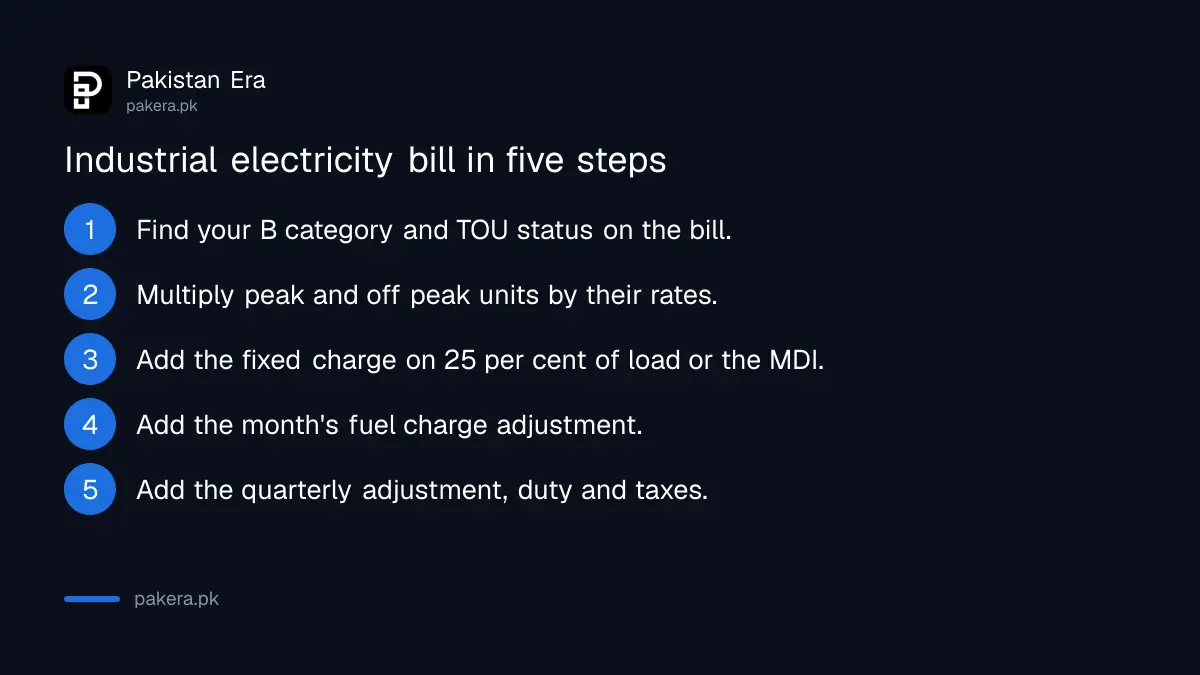
- Find your tariff code on the bill, B-1 to B-4, and whether it says TOU.
- Multiply peak and off peak units by their rates, or all units by the flat rate.
- Add the fixed charge: Rs 1,000 on B-1, or Rs 1,250 per kW on 25 per cent of sanctioned load or the MDI.
- Add the month's fuel charge adjustment. The October figure is worked through in the fuel charge calculation.
- Add the quarterly adjustment, electricity duty, sales tax and any income tax line.
- Check the power factor line. The power factor penalty is 2 per cent more fixed charges for every 1 per cent below 90.
Factories that buy power from a private supplier over the grid pay a separate use of system charge, now uniform across the country, which we covered in the report on NEPRA's one grid charge. That is a different bill from the one described here.
Common questions about industrial electricity rates
What is the industrial electricity rate per unit in Pakistan in 2026?
Rs 26.23 on B-1, Rs 26.16 on B-2, Rs 27.00 on B-3 and Rs 26.43 on B-4, before the fuel charge, quarterly adjustment and taxes, under S.R.O. 279(I)/2026.
What are the peak and off peak industrial rates?
Peak is Rs 35.74 on B-1 and Rs 35.68 on B-2 to B-5. Off peak is Rs 25.48, Rs 22.83, Rs 23.67, Rs 23.38 and Rs 23.13 for B-1 to B-5 in turn.
How is the Rs 1,250 per kW fixed charge calculated?
On 25 per cent of your sanctioned load or your actual MDI for the month, whichever is higher. A 100 kW connection pays on at least 25 kW, which is Rs 31,250.
Is the industrial rate the same for K-Electric and the other companies?
Yes. The government applicable schedule is uniform, and the K-Electric annex to the same notification carries the same B category figures.
What does a temporary industrial connection cost?
Rs 42.25 a unit with a fixed charge of Rs 5,000 a month. The process is in the guide to a temporary electricity connection.
Do these rates include the fuel charge?
No. The fuel charge adjustment is added each month on top, and it changes with the generation mix. NEPRA announces it separately.
How we verified this
What we checked, where we read it, and what we could not confirm.
Last checked 19 October 2026. All category definitions, fixed charges and unit rates come from S.R.O. 279(I)/2026 dated 12 February 2026, the Ministry of Energy notification of NEPRA's 11 February 2026 decision on rationalisation of tariff, which we opened from NEPRA's distribution tariff page on 19 October 2026. We read Annex A-1, the schedule for the ex-WAPDA companies, and confirmed each figure against the clearer Annex C schedule for K-Electric, which carries the same applicable rates. NEPRA's page listed no later consumer end schedule as of that date. The fuel charge of Rs 1.1086 is from NEPRA's decision of 7 October 2026 on the August adjustment. Worked examples and the differences between rates are our own arithmetic. We did not check any single company's own tariff page.
About the author

Senior Writer, Public Services and Technology
Shahid joined us in 2024 as an author. He is a senior contributor to Pakistan's leading technology websites. He writes detailed articles, mostly covering his expertise in the latest tech, mobiles, apps, gadgets, and step-by-step guides. His ideology is to help people understand the latest trends and explain complex methods through very easy-to-understand guides.