Power Factor Penalty on Electricity Bills in Pakistan: 2% More Fixed Charges for Every 1% Below 90
Below a 90% power factor, Pakistan's tariff rules add 2% to fixed charges for every 1% drop. See how billing demand works, a worked example and how to fix it.
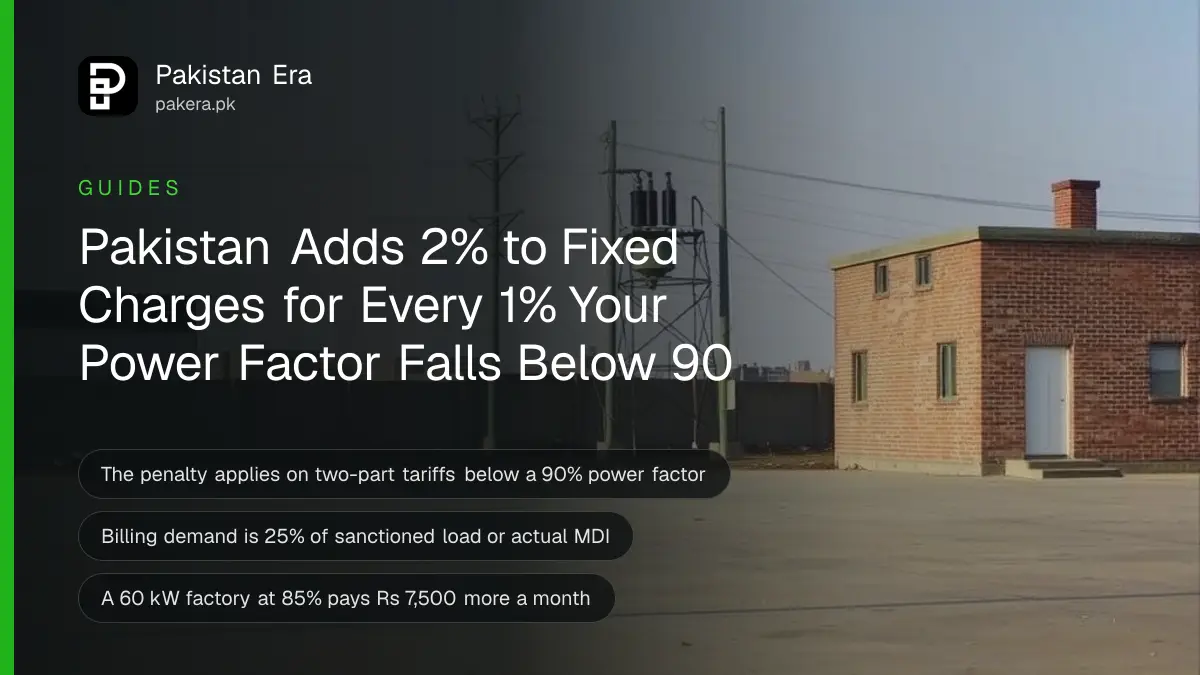
If your power factor falls below 90%, Pakistan's tariff rules raise your fixed charges by 2% for every 1% it drops. A factory at 85% pays 10% more in fixed charges every month, and the penalty is avoidable.
This rule hits factories, large shops, cold stores and offices on two-part tariffs. Those are bills with a fixed charge per kilowatt as well as a charge per unit. Many owners only notice it when the bill shows a line they do not understand.
We read the terms and conditions NEPRA attaches to the state companies' tariffs, and the fixed charge rates the government notified in February 2026. Here is how the penalty and the billing demand behind it are worked out.
The penalty is 2% for each 1% below 90
NEPRA's general conditions say that on a two-part tariff, a consumer's average power factor must not be less than 90%. Below that, the consumer pays a penalty of a 2% increase in fixed charges for each 1% the power factor falls below 90%.
| Average power factor | Points below 90 | Increase in fixed charges |
|---|---|---|
| 90% or above | 0 | None |
| 88% | 2 | 4% |
| 85% | 5 | 10% |
| 80% | 10 | 20% |
| 75% | 15 | 30% |
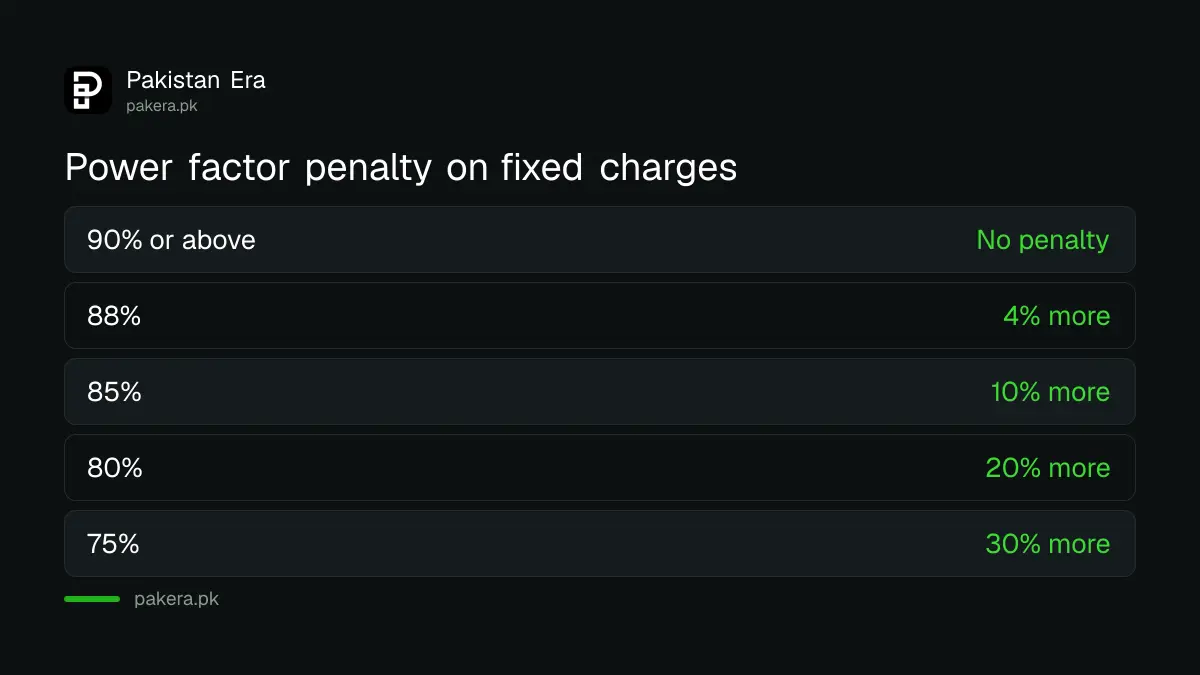
The penalty is worked on the fixed charges for your maximum demand that month. It does not touch your per unit energy charge. That is the only good news here.
Power factor means how much of your supply does useful work
Power factor is a number between 0 and 1, usually shown as a percentage. It compares the power that does real work with the total power the line has to carry. Motors, compressors, welding sets and old fluorescent fittings pull extra current that does no useful work. That pushes the power factor down.
The tariff terms define it in two ways. It is the ratio of kWh to kVAh recorded in the month. Or, where the meter records reactive units, kWh divided by the square root of kWh squared plus kVArh squared. You do not need to do that sum. The meter records the units, and the company works out the figure for your bill.
A house with lights and fans rarely has a problem. A workshop full of motors often does.
Billing demand decides how big the penalty is
Fixed charges are billed on billing demand. For commercial and industrial connections that means 25% of the sanctioned load or the actual maximum demand recorded in the month, whichever is higher. Maximum demand is the highest load the meter records over any 30 minute period in the month.
There is a catch most owners miss. The terms say that, for fixed charges, sanctioned load means the maximum demand recorded during the preceding 60 months. So one very high month can shape your fixed charge floor for years.
New connections, and consumers who have renewed or revised their sanctioned load, are charged on 25% of sanctioned load or actual maximum demand until a maximum demand is established. The company then adjusts within six months. Consumers with another power source, such as captive power or net metering, stay on 25% of sanctioned load or actual maximum demand.
The rate per kW matters too. Shops of 5 kW and above pay Rs 1,250 per kW a month in fixed charges, as set out in Pakistan's 2026 commercial electricity rates. The industrial B2 category, for 25 to 500 kW at 400 volts, also carries Rs 1,250 per kW a month.
A 60 kW factory at 85% pays Rs 7,500 extra
Here is a worked example for a small factory on the B2 tariff. It has a sanctioned load of 100 kW and recorded a maximum demand of 60 kW this month.
- Billing demand is the higher of 25 kW and 60 kW, so 60 kW.
- Fixed charges are 60 times Rs 1,250, which is Rs 75,000.
- At a power factor of 85%, the penalty is 10% of that, Rs 7,500.
- At 80%, it doubles to Rs 15,000 a month.
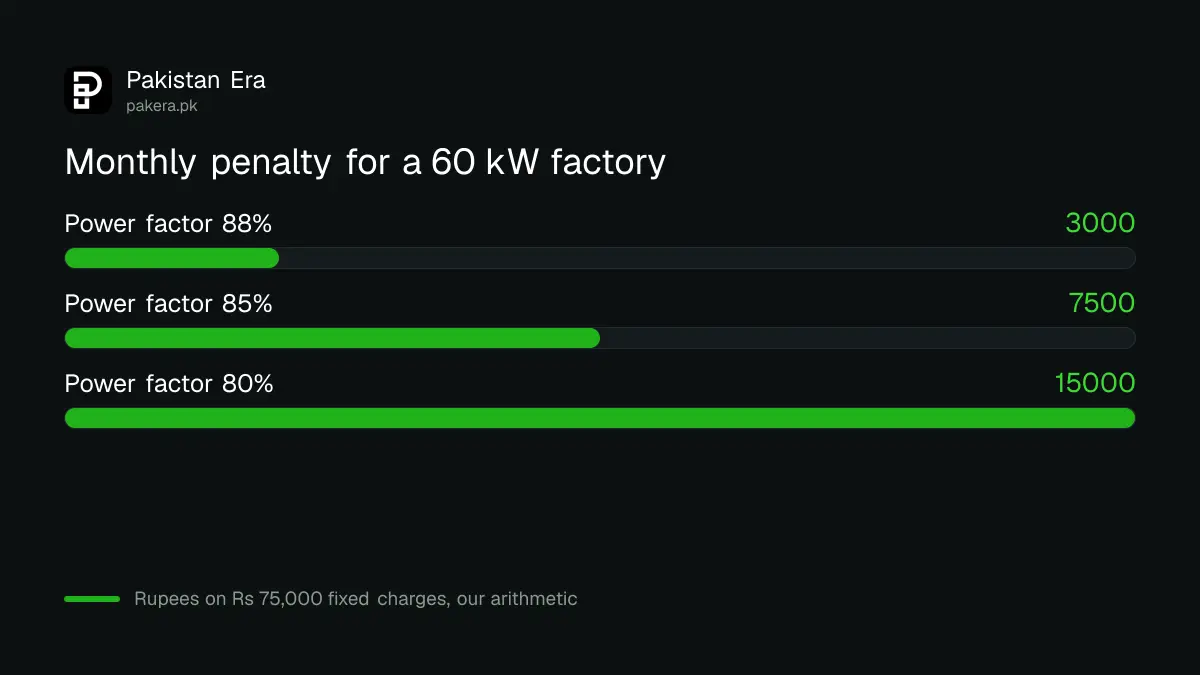
Over a year, an 80% power factor costs this factory Rs 180,000 for nothing. Factory owners watching NEPRA's review of the Rs 22.98 industrial rate should look at this line first. It is often easier to fix.
Fix a low power factor in five steps
The usual cure is power factor correction, normally a capacitor bank sized for your load. A qualified electrician or electrical contractor should size and fit it, because a wrongly sized bank can cause its own trouble.
- Find the power factor figure on your last six bills and note the lowest month.
- Check the maximum demand on the same bills, so you know the size of the fixed charge being penalised.
- Ask a qualified electrical contractor to measure your load and size a correction capacitor bank.
- After it is fitted, compare the power factor on the next two bills.
- If the bill still shows a low figure that your own readings do not support, ask the company to check the meter.
If a meter test or a dispute goes nowhere, NEPRA handles billing complaints once the company has had its chance. The route is set out in how to complain about a wrong electricity bill. And if your load has grown since you connected, extending your sanctioned load keeps the paperwork in line with what you actually draw.
Common questions
What is the power factor penalty in Pakistan?
A 2% increase in fixed charges for every 1% your average power factor falls below 90%, on two-part tariffs.
Does the penalty apply to normal homes?
The rule is written for two-part tariffs, which mainly means commercial and industrial connections with fixed charges per kW. We could not confirm on an official page whether any company applies it to homes.
Does the penalty raise my per unit rate?
No. It increases the fixed charges worked out on your maximum demand for that month, not the energy charge.
What is billing demand?
For commercial and industrial connections, 25% of sanctioned load or the actual maximum demand in the month, whichever is higher.
How do I raise my power factor?
Usually with a correctly sized capacitor bank, fitted by a qualified electrical contractor after measuring your load.
How we verified this
What we checked, where we read it, and what we could not confirm.
Last checked on 9 October 2026. The 90% threshold, the 2% penalty, the power factor and maximum demand definitions and the billing demand rules are from the terms and conditions of tariff, Annex V of NEPRA's LESCO decision of 23 June 2025. The fixed charge rates are from the Ministry of Energy's S.R.O. 279(I)/2026 of 12 February 2026. The worked example is our own arithmetic.
About the author

Global Affairs & Political Economy Writer
Muhammad Hatim is a book lover who started writing because he enjoys it. At Pakistan Era he writes about international relations, geopolitics and the global economy, with a particular interest in South Asia and the forces behind current events.