Electricity Unit Price in Pakistan 2026: Home Slab Rates and Fixed Charges
Pakistan's 2026 home electricity rates run from Rs 3.95 to Rs 47.20 a unit, plus fixed charges per kW. Check your slab and work out your bill in four steps.
A home electricity unit in Pakistan costs from Rs 3.95 for the smallest lifeline users to Rs 47.20 above 700 units, before taxes and fuel adjustments. Most homes pay between Rs 22.44 and Rs 38.95 a unit, plus a fixed charge of Rs 275 to Rs 675 for each kilowatt of sanctioned load.
These are the rates the federal government notified on 12 February 2026, and they apply the same way across LESCO, IESCO, FESCO, GEPCO, MEPCO, PESCO, HESCO, SEPCO, QESCO, TESCO and K-Electric. We read the notification itself, page by page, so you can check your own bill against it.
The residential slab rates for 2026
NEPRA's schedule has twelve residential slabs. Protected homes pay Rs 10.54 for the first 100 units and Rs 13.01 for 101 to 200. Everyone else starts at Rs 22.44 and climbs to Rs 47.20 a unit above 700 units.
| Units in the month | Rate per unit (Rs) | Fixed charge (Rs per kW a month) |
|---|---|---|
| Up to 50 (lifeline) | 3.95 | None |
| 51 to 100 (lifeline) | 7.74 | None |
| 1 to 100 (protected) | 10.54 | 200 |
| 101 to 200 (protected) | 13.01 | 300 |
| 1 to 100 | 22.44 | 275 |
| 101 to 200 | 28.91 | 300 |
| 201 to 300 | 33.10 | 350 |
| 301 to 400 | 36.46 | 400 |
| 401 to 500 | 38.95 | 500 |
| 501 to 600 | 40.22 | 675 |
| 601 to 700 | 41.85 | 675 |
| Above 700 | 47.20 | 675 |
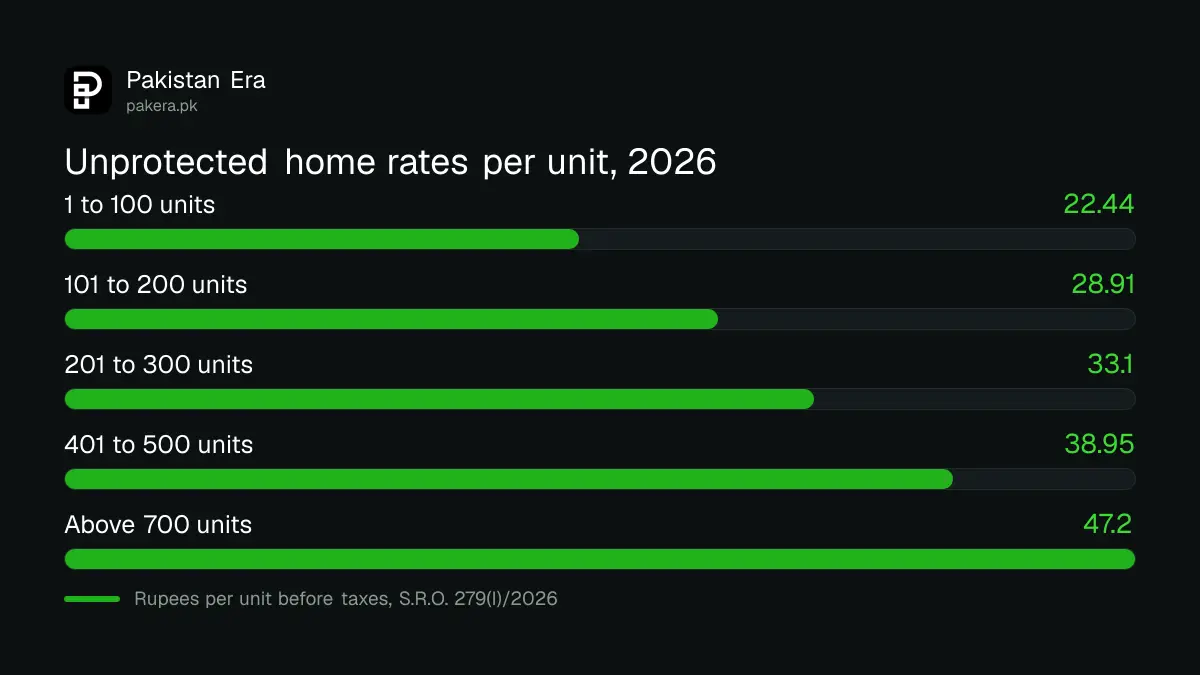
Lifeline is the lowest category, for very small users of up to 100 units a month. A protected consumer is a home that has stayed at or below 200 units a month for the previous six months. How that status is won and lost is explained in the 200 unit rule for protected electricity consumers.
Only protected homes get the benefit of the previous slab
The notification says that "only protected residential consumers will be given the benefit of one previous slab". So a protected home pays its first 100 units at the cheaper rate. An unprotected home pays every unit at the rate of the slab it lands in.
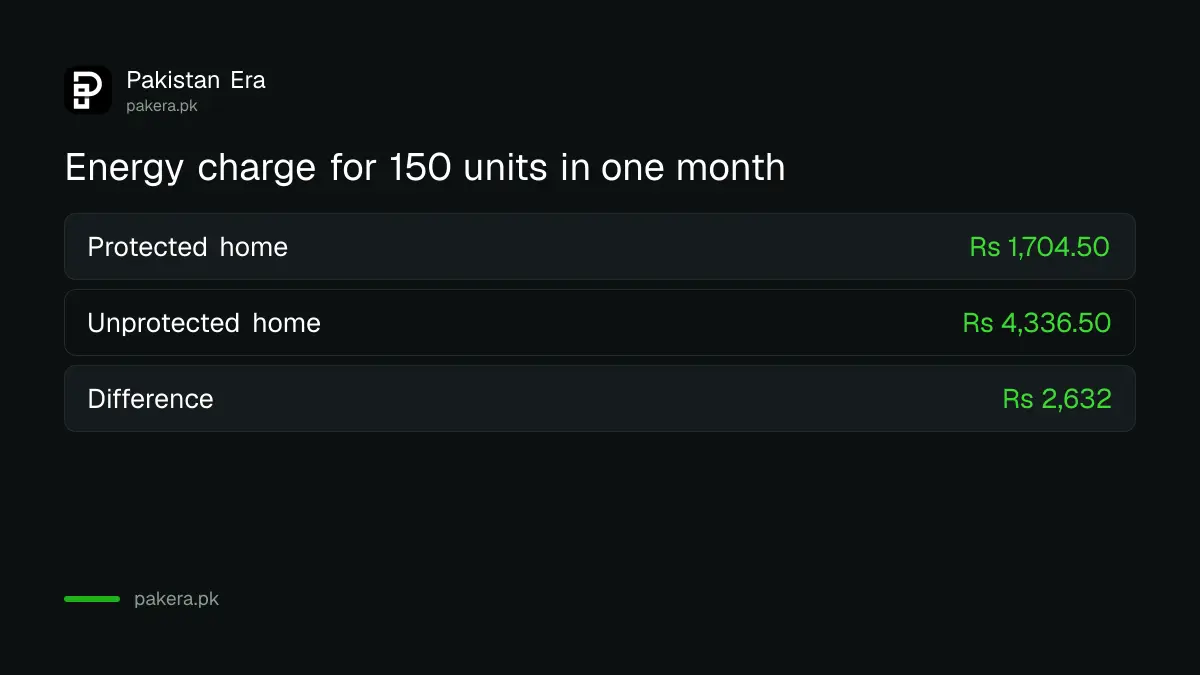
That one sentence explains why a bill can jump so sharply. Take 150 units in a month:
- Protected: 100 units at Rs 10.54 plus 50 units at Rs 13.01, which is Rs 1,704.50 in energy charges.
- Unprotected: all 150 units at Rs 28.91, which is Rs 4,336.50.
Lifeline consumers get no slab benefit at all, the same notice adds. Their rates are already the lowest in the schedule.
Fixed charges are billed on your sanctioned load
Under the 2026 schedule, homes on the normal slabs also pay a monthly fixed charge for each kilowatt of sanctioned load, from Rs 200 for protected users to Rs 675 above 500 units. Lifeline homes pay no fixed charge.
Sanctioned load is the load your connection was approved for, printed on your bill in kilowatts (kW). A home with 3 kW sanctioned and 250 units in a month pays 3 times Rs 350, or Rs 1,050, in fixed charges, whatever the units.
That makes your sanctioned load worth checking. If your house has 5 kW on paper but rarely runs more than one air conditioner, a lower load means lower fixed charges. A reduction uses the same application route as an extension, which is set out in changing your electricity load.
Where no fixed charge applies, the notification sets a minimum monthly charge of Rs 75 for a single phase connection and Rs 150 for a three phase connection, even if no units are used.
Homes with 5 kW or more pay Time of Use rates
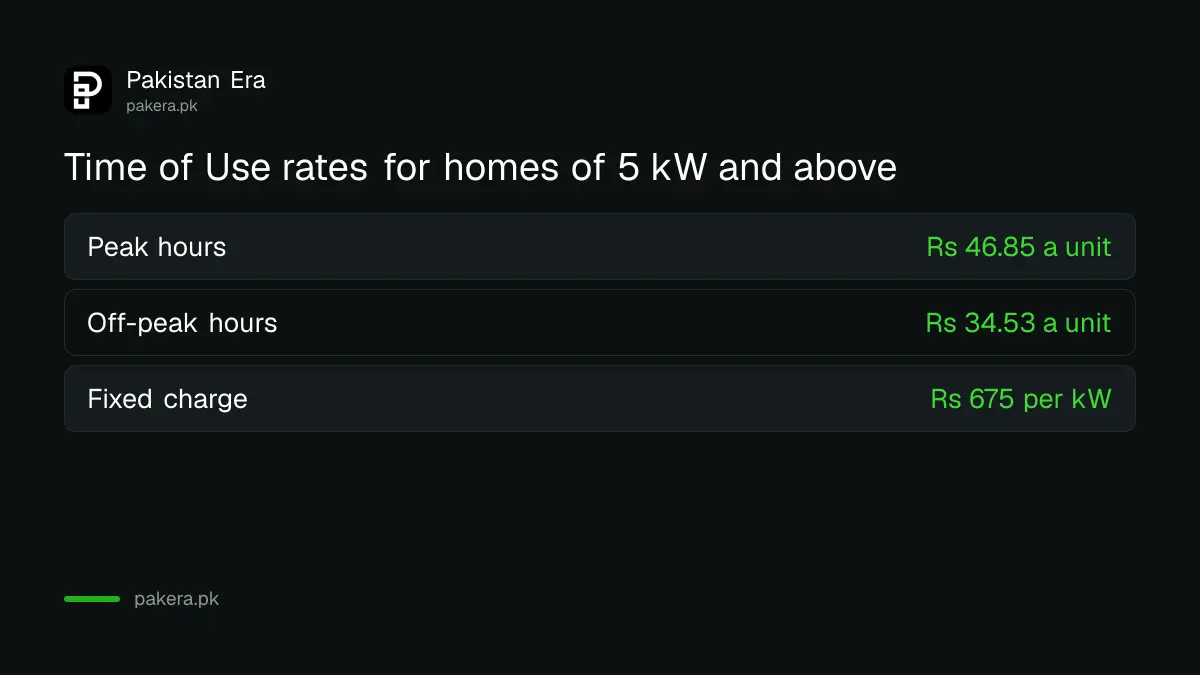
A home with a sanctioned load of 5 kW or more is billed on a Time of Use meter: Rs 46.85 a unit in the evening peak hours and Rs 34.53 at other times, with a fixed charge of Rs 675 per kW.
For these homes, the fixed charge is worked out on 50% of the sanctioned load or the actual maximum demand recorded by the meter, whichever is higher. Moving heavy use, such as washing machines and water pumps, out of the peak hours is the simplest saving.
Work out your own bill in four steps
The slab rate and the fixed charge are only the base. Fuel adjustments, quarterly adjustments and taxes are added on top as separate lines on your bill.
- Find your units and sanctioned load on the bill.
- Check whether you are protected, lifeline or neither.
- Multiply your units by your slab rate, or by two rates if you are protected and above 100 units.
- Add the fixed charge: your sanctioned kW times the figure for your slab.
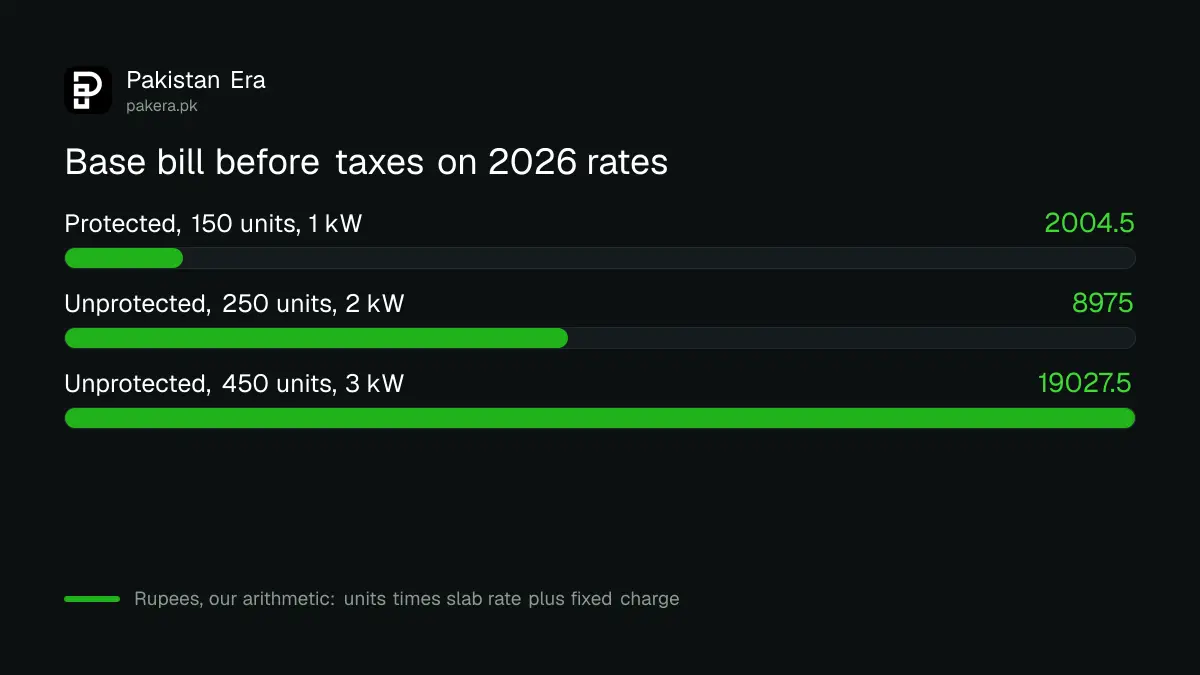
Here are three worked examples on the 2026 rates, before taxes and adjustments:
| Home | Energy charge (Rs) | Fixed charge (Rs) | Base bill (Rs) |
|---|---|---|---|
| Protected, 150 units, 1 kW | 1,704.50 | 300 | 2,004.50 |
| Unprotected, 250 units, 2 kW | 8,275 | 700 | 8,975 |
| Unprotected, 450 units, 3 kW | 17,527.50 | 1,500 | 19,027.50 |
For October bills, NEPRA added a fuel charge of Rs 1.1086 a unit, set out in the fuel charge decision for October bills. What each tax and surcharge line means is explained in the line items on an electricity bill.
Common questions
What is the per unit price of electricity in Pakistan in 2026?
For homes it ranges from Rs 3.95 for lifeline users to Rs 47.20 above 700 units. Most unprotected homes pay Rs 22.44 to Rs 38.95 a unit, before taxes.
Are LESCO and K-Electric rates the same?
Yes. The government applies one uniform schedule to all ten state companies and K-Electric, so the slab rates match.
Do unprotected consumers get the previous slab benefit?
No. The February 2026 notification gives the one previous slab benefit only to protected residential consumers.
Why is there a fixed charge on my home bill?
The 2026 schedule sets fixed charges per kilowatt of sanctioned load for homes on the normal slabs. Lifeline homes are exempt.
Do these rates include tax?
No. Sales tax, electricity duty, the fuel charge and quarterly adjustments are added separately on the bill.
How we verified this
What we checked, where we read it, and what we could not confirm.
Last checked on 9 October 2026. The rates, fixed charges, slab benefit rule, minimum charges and Time of Use rules are from the Ministry of Energy's S.R.O. 279(I)/2026 of 12 February 2026, which notifies NEPRA's decision of 11 February 2026, posted on NEPRA's website. We read the uniform residential schedule for the state companies and the matching schedule for K-Electric. NEPRA's list of later decisions up to 7 October 2026 shows fuel and quarterly adjustments but no new base schedule. Every worked example is our own arithmetic.
About the author

Tax, Bills and Technology Writer
Ali Akhtar is a young and curious voice here at Pakistan Era. He is currently pursuing his A-Levels and has a growing interest in Pakistan’s changing industrial landscape and educational trends. Ali likes to write in a way that helps him explain and explore the world around him. His writing reflects the perspective of the new generation navigating the evolving trends of Pakistan where technology, youth innovation, and shifting opportunities are reshaping the country’s future.