Pakistan May End the Six Month Penalty for Crossing 200 Electricity Units
Cross 200 units once and you pay unprotected rates for six months. A proposal would cut that to one month, but it still needs IMF approval.
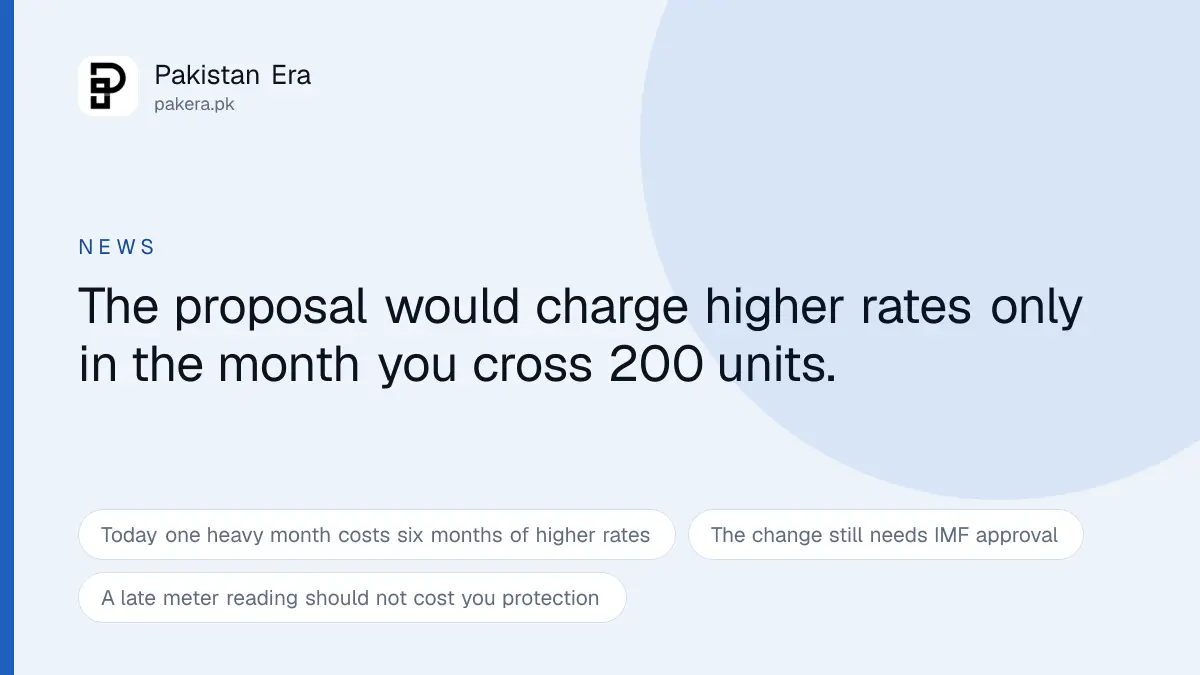
The Power Division is considering a change to the 200 unit electricity rule. Today, a household that uses more than 200 units in a single month loses its protected status and pays higher rates for that month and the next five. Under the proposal, the higher rate would apply only in the month you cross 200 units. Nothing has been approved yet, and the change needs the IMF's agreement.
Update, 10 October 2026: Slab subsidies are due to move to a BISP based targeted subsidy from January 2027. Read the update.
The proposal was reported on 21 September 2026 by ProPakistani and Dunya News. Dunya reported that the government has so far been unable to get the International Monetary Fund's approval, and that the proposal will be raised in the Pakistan and IMF talks starting on 22 September for the fourth review of the $7 billion loan programme. On 17 September, The Nation reported that the National Assembly Standing Committee on Power, chaired by MNA Muhammad Idrees, had endorsed removing the six month limit.
We read NEPRA's own tariff decisions and its Consumer Service Manual on 21 September 2026 to work out what the rule costs a household today, and found one protection that most people do not know about.
How the 200 unit rule works now
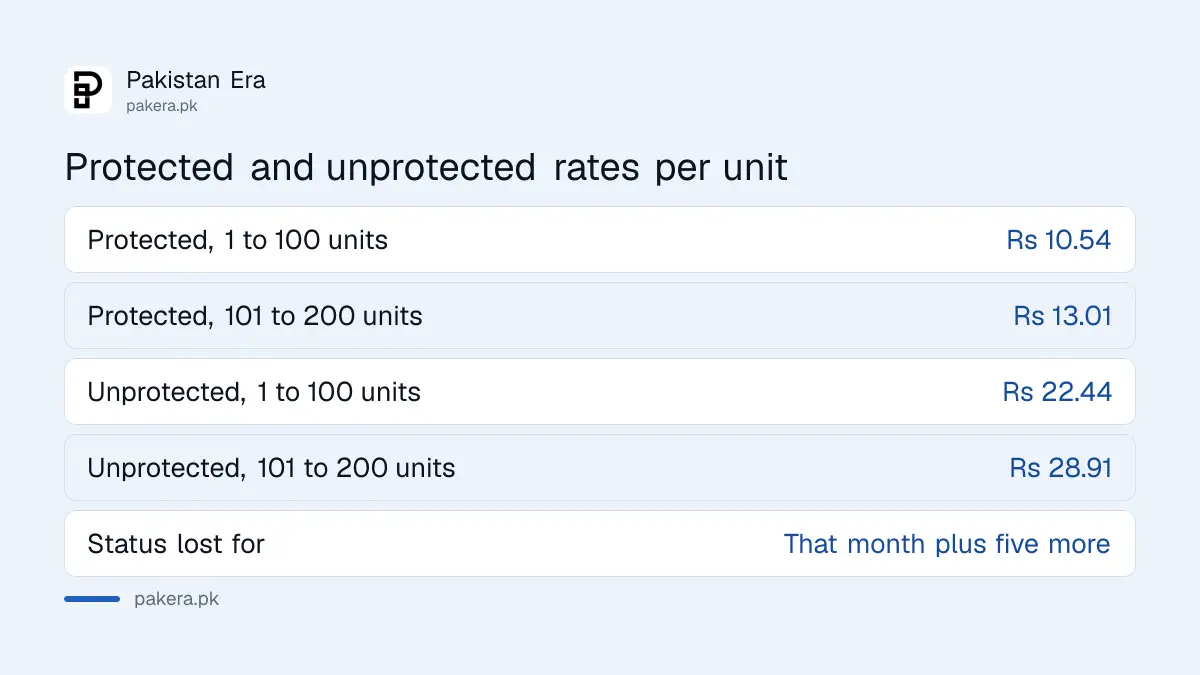
A protected consumer is a household that has used 200 units or less in each of the last six months. Protected households pay much lower rates for their first 200 units than everyone else.
The problem is what happens after one heavy month. Use 201 units once, in a hot June or when guests stay, and you lose protected status. You are then billed at unprotected rates for that month and for the following five months, even if you go back to 150 units a month. You only get protection back after six straight months at 200 units or less.
These are the per unit rates for households using up to 200 units in the government applicable schedule set out in NEPRA's decisions of January and February 2026:
| Units in the month | Protected rate | Unprotected rate |
|---|---|---|
| 1 to 100 units | Rs 10.54 | Rs 22.44 |
| 101 to 200 units | Rs 13.01 | Rs 28.91 |
So losing protection more than doubles the rate on the same units. These are energy charges only, before taxes, fuel adjustments and other charges on the bill. Your own bill may show later adjustments, so check the rates printed on it.
The rule reaches a lot of homes. The Ministry of Energy's figures, recorded in NEPRA's decision of 11 February 2026, put protected households at about 20.2 million in 2026, up from about 7.9 million in 2022. The same table counts about 2.4 million households using 200 units or less that are still billed as unprotected.
What one heavy month costs a household today
Take a household that normally uses 150 units a month and is protected. In one summer month it uses 210 units. Here is what the next five months cost at 150 units, on the rates above. Only protected consumers get the benefit of one previous slab, so an unprotected bill charges every unit at the rate of the slab the month falls in:
- As a protected consumer: 100 units at Rs 10.54 plus 50 units at Rs 13.01, about Rs 1,705 a month.
- As an unprotected consumer: all 150 units at Rs 28.91, about Rs 4,337 a month.
- The difference is about Rs 2,632 a month.
- Over the five months after the heavy month, that is about Rs 13,160 more in energy charges alone, for the same electricity.
These are our estimates from NEPRA's rates. They leave out taxes, fuel adjustments and fixed charges, which make the real bill higher. Under the proposal, that household would pay the higher rate only for the 210 unit month and go back to protected rates straight away.
What the proposal would change
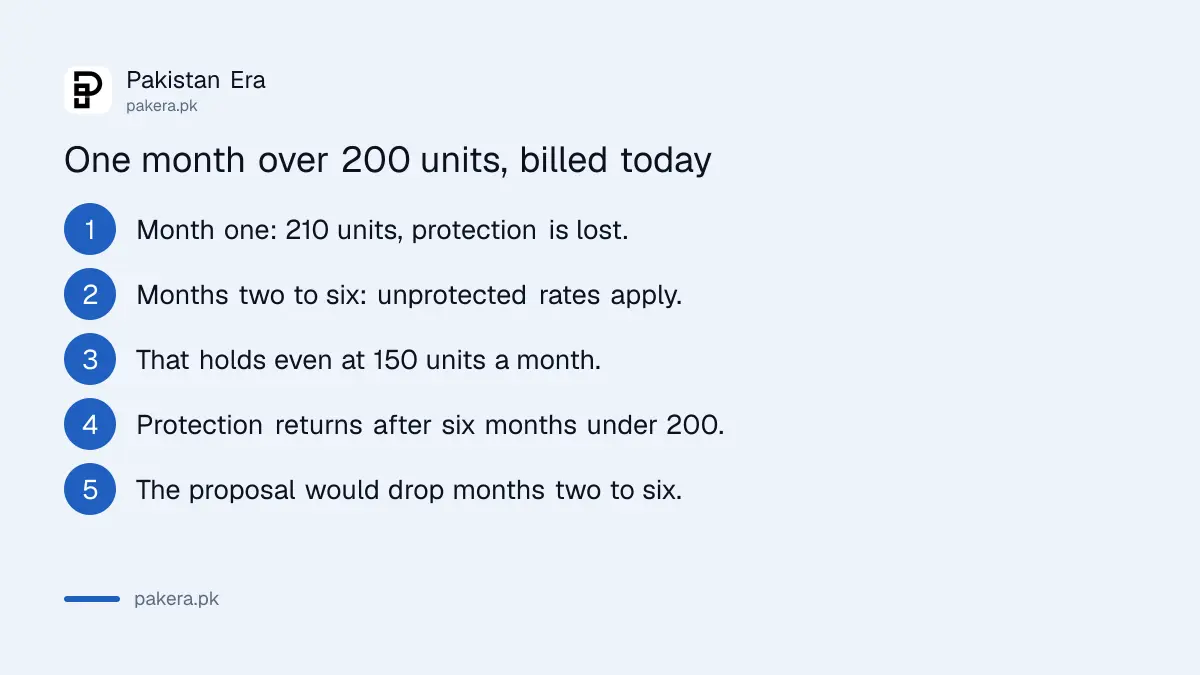
The change is narrow. As reported, it would not change the protected rates, the 200 unit limit, or what you pay in the month you go over. It would only remove the five further months at unprotected rates.
That matters most to households that sit just under 200 units most of the year and cross it now and then, usually in summer. It does little for households that use more than 200 units every month, since they are unprotected either way.
It is a proposal, not a rule. We found no Power Division notification, no NEPRA decision and no cabinet approval for it as of 21 September 2026. The Standing Committee's endorsement is a recommendation to the ministry and does not change your bill. Until a notification is issued, the six month rule still applies.
If a late meter reading pushed you over 200 units
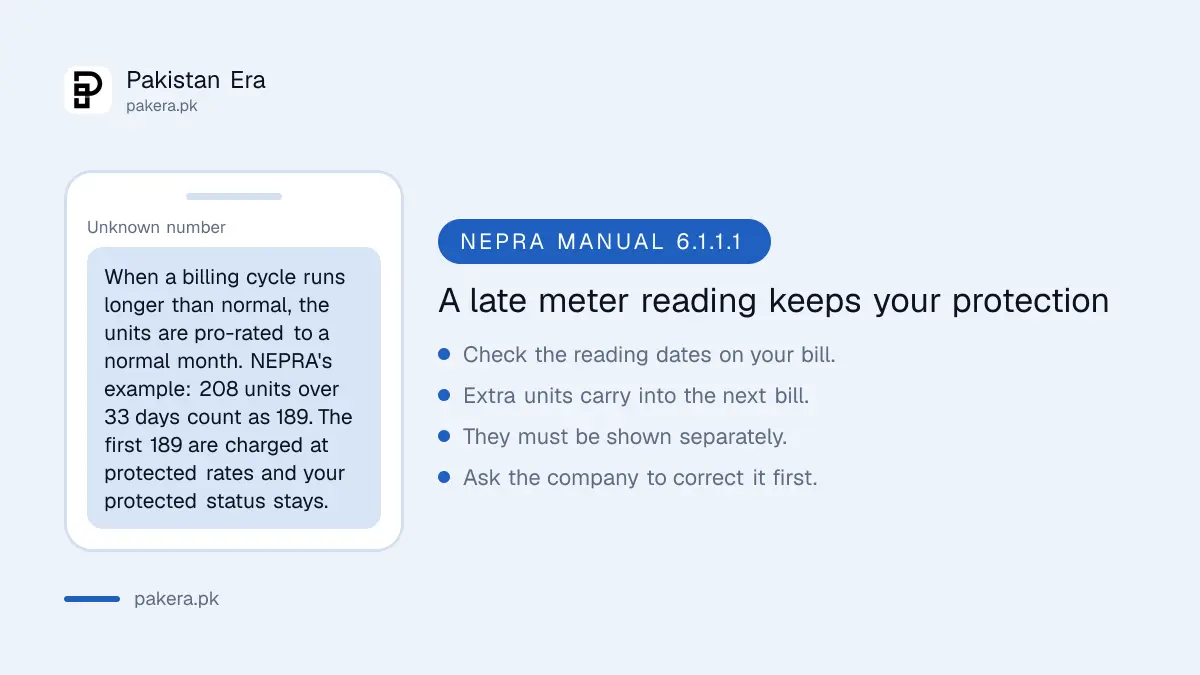
This part already applies, and it can save a household from losing protection unfairly.
Section 6.1.1.1 of NEPRA's Consumer Service Manual, revised in 2025 and sent to every distribution company on 26 November 2025, covers a billing cycle that runs longer than normal. The units are pro-rated to a normal month. NEPRA's own example: 208 units read over 33 days count as 189 units for a 30 day month.
Because 189 is under 200, the first 189 units are charged at protected rates, the extra 19 units are carried into the next bill, and your protected status stays intact. Section 6.1.1.2 says the carried units must be shown separately on the bill.
So if your bill covers more than a normal month and that alone took you over 200 units, you have a case. Check the reading dates on your bill, which you can do on each company's online bill portal. If the company billed you as unprotected anyway, ask it to correct the bill, and if it will not, complain about the wrong bill.
What happens next
Three things have to happen before the change reaches your bill. The government has to agree it with the IMF, which Dunya reported has not yet happened. The Power Division has to approve it. And the change has to be notified, the way every tariff change is.
Until then, the practical advice is the same as before. If you are close to 200 units, keep an eye on the reading in summer. A single month at 201 units still costs you six months of unprotected rates today.
Common questions
Who is a protected electricity consumer?
A household that has used 200 units or less in each of the last six months. It pays lower rates on its first 200 units.
What happens if I use more than 200 units in one month?
Under the current rule you lose protected status and pay unprotected rates for that month and the next five, even if your use falls again.
What is the government proposing?
That the higher rate apply only in the month you go over 200 units, so you go back to protected rates the next month.
Has the six month rule been removed?
No. As of 21 September 2026 it is a proposal under consideration, and it needs IMF agreement and a notification before it changes any bill.
How much more do unprotected consumers pay?
On NEPRA's rates from early 2026, Rs 22.44 a unit against Rs 10.54 for the first 100 units, and Rs 28.91 against Rs 13.01 for the next 100.
Can a late meter reading make me lose protection?
It should not. NEPRA's Consumer Service Manual pro-rates a longer billing cycle to a normal month, and if that brings you under 200 units your protected status stays.
How we verified this
What we checked, where we read it, and what we could not confirm.
Last checked 21 September 2026. The proposal that the higher rate apply only in the month consumption crosses 200 units, and that the Power Division is considering it, is as reported by ProPakistani and Dunya News on 21 September 2026. Dunya reported that IMF approval has not yet been secured and that the proposal will be raised in the talks beginning 22 September for the fourth review of the Extended Fund Facility. The National Assembly Standing Committee on Power's endorsement of removing the six month limit, and its chair, are as reported by The Nation on 17 September 2026. We found no notification, NEPRA decision or cabinet approval of the change. The description of the current six month rule is as reported in the same coverage; we did not find it worded in the NEPRA documents we read. The per unit rates of Rs 10.54 and Rs 13.01 for protected consumers and Rs 22.44 and Rs 28.91 for unprotected consumers are read from the government applicable residential schedule in NEPRA's decision of 12 January 2026 on the federal government's motion and its decision of 11 February 2026 on rationalization of tariff; both are scanned, and the rates appear in the same order in each. The household counts are from the Ministry of Energy's table recorded in the 11 February 2026 decision. The pro-rating of a longer billing cycle and the retention of protected status are read from sections 6.1.1.1 and 6.1.1.2 of NEPRA's Consumer Service Manual revised 2025, circulated on 26 November 2025. The worked example is our own arithmetic. Nothing here is advice on a particular bill.
About the author

Senior Writer, Public Services and Technology
Shahid joined us in 2024 as an author. He is a senior contributor to Pakistan's leading technology websites. He writes detailed articles, mostly covering his expertise in the latest tech, mobiles, apps, gadgets, and step-by-step guides. His ideology is to help people understand the latest trends and explain complex methods through very easy-to-understand guides.