Pakistan to Replace Electricity Slab Subsidy With BISP Support by January 2027
Pakistan has told the IMF it will swap the electricity slab subsidy for BISP-linked support by January 2027. See what is confirmed and what is only reported.
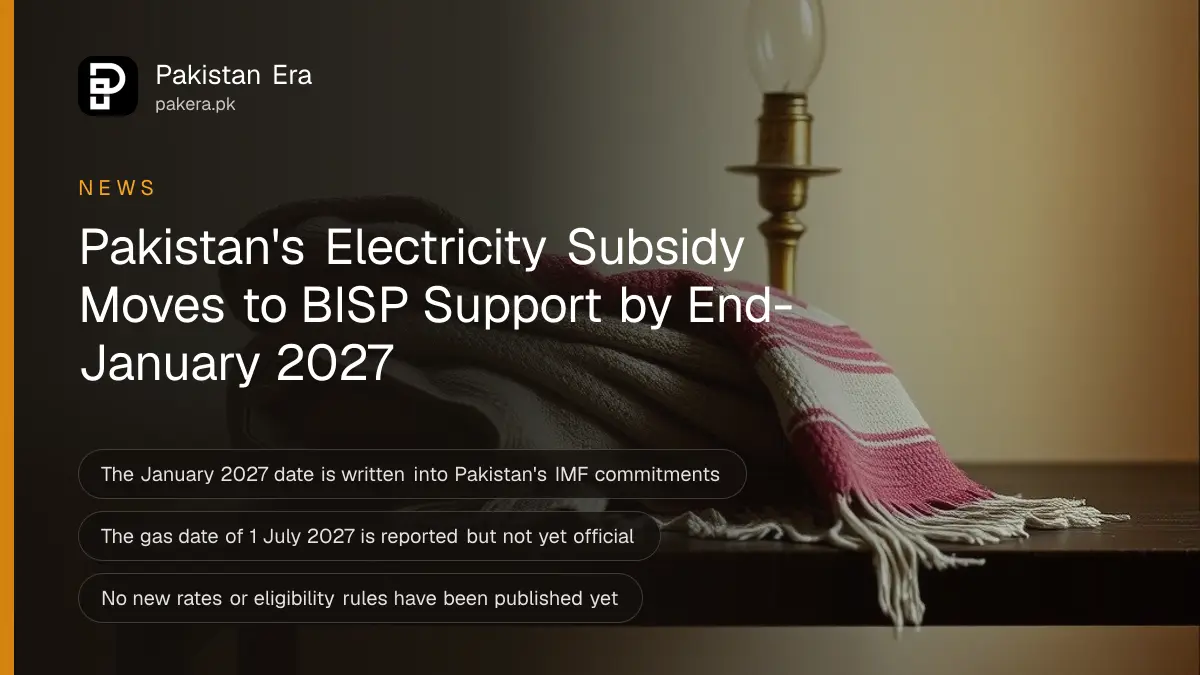
Pakistan plans to end the electricity subsidy built into today's slab tariffs and pay support only to low-income households through the Benazir Income Support Programme (BISP), with a target date of end-January 2027. The date is a written commitment to the IMF. A gas version from 1 July 2027 has been reported but is not yet confirmed.
The plan resurfaced on 9 October 2026, when reports said the government would register eligible electricity consumers by November and link them to BISP data. We went back to the government's own commitment in its IMF programme papers to separate what is promised in writing from what is only reported.
The government has promised the IMF a targeted subsidy by end-January 2027
In its policy letter to the IMF, the government says it will replace the electricity tariff differential subsidy and cross-subsidy with "a targeted budgeted subsidy framework for low-income consumers via BISP". The deadline is end-January 2027.
That letter is the Memorandum of Economic and Financial Policies (MEFP), published with the IMF's December 2025 staff report on Pakistan's $7 billion Extended Fund Facility. The Finance Division hosts a copy. The reform is listed as reform measure 12, or RM12, under the separate Resilience and Sustainability Facility. Its wording: the subsidy system is "replaced with targeted subsidy framework for low-income consumers, with BISP disbursements through new system by end-January 2027".
Two terms need explaining. The tariff differential subsidy is the money the federal government pays to cover the gap between what NEPRA says power costs and the lower uniform rate notified for consumers. The cross-subsidy is the part of the bill paid by bigger users and industry so that small users can be charged less.
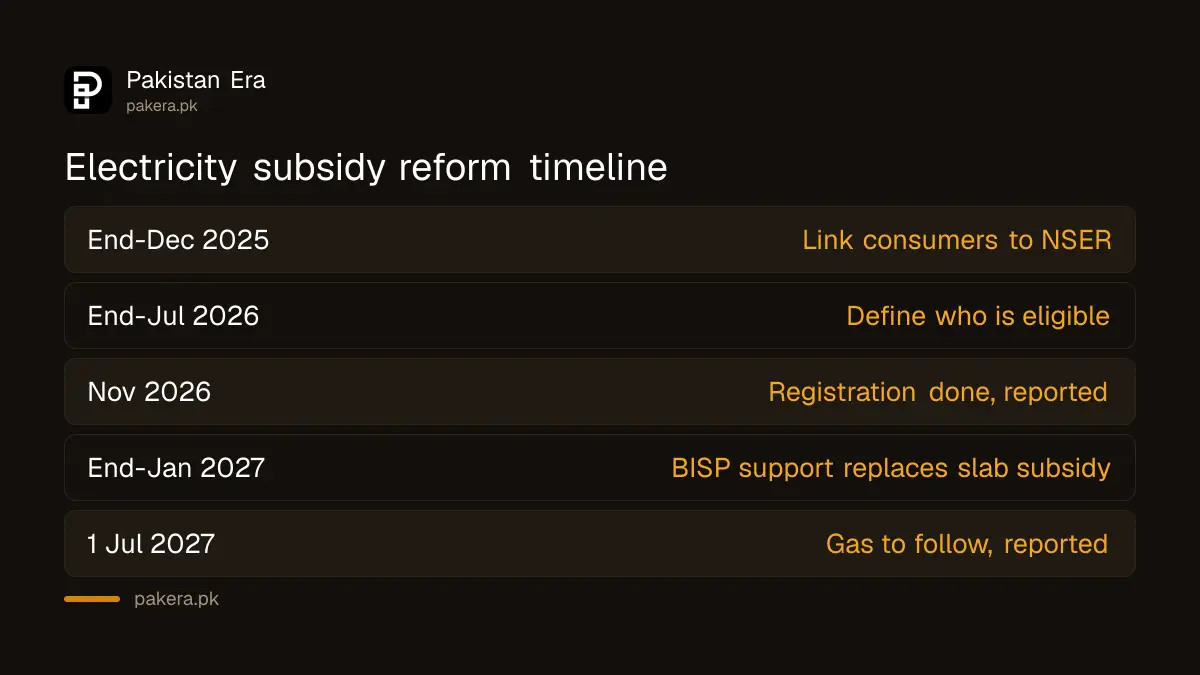
The timeline runs from NSER linking to BISP payments
The government's own steps were to link electricity consumers to the National Socioeconomic Registry (NSER) by end-December 2025, then set eligibility rules by end-July 2026. The switch to BISP payments is due by end-January 2027.
The NSER is the household survey database BISP uses to decide who gets cash support. The MEFP says the government is working with the World Bank on the link. Here is each step in order.
- End-December 2025: link electricity consumers with the NSER database, in the government's words.
- After that: launch a national campaign to explain the reform to consumers.
- End-July 2026: analysis to define who is eligible.
- November 2026: registration of eligible consumers to finish, as reported on 9 October. This date is not in the MEFP.
- End-January 2027: the old subsidy system replaced, with BISP paying support through the new system.
- 1 July 2027: a similar system for gas consumers, as reported. The MEFP says only that work has started to link gas consumer data with the NSER.
We could not find a public notice saying whether the July 2026 eligibility rules were finalised. Neither the Power Division nor BISP has published the criteria that we could find.
Some of the 9 October claims are confirmed and some are not
The January 2027 electricity date and the BISP route are in the government's written IMF commitments. The November registration target and the 1 July 2027 gas date come only from press reports so far, and no notification has been issued.
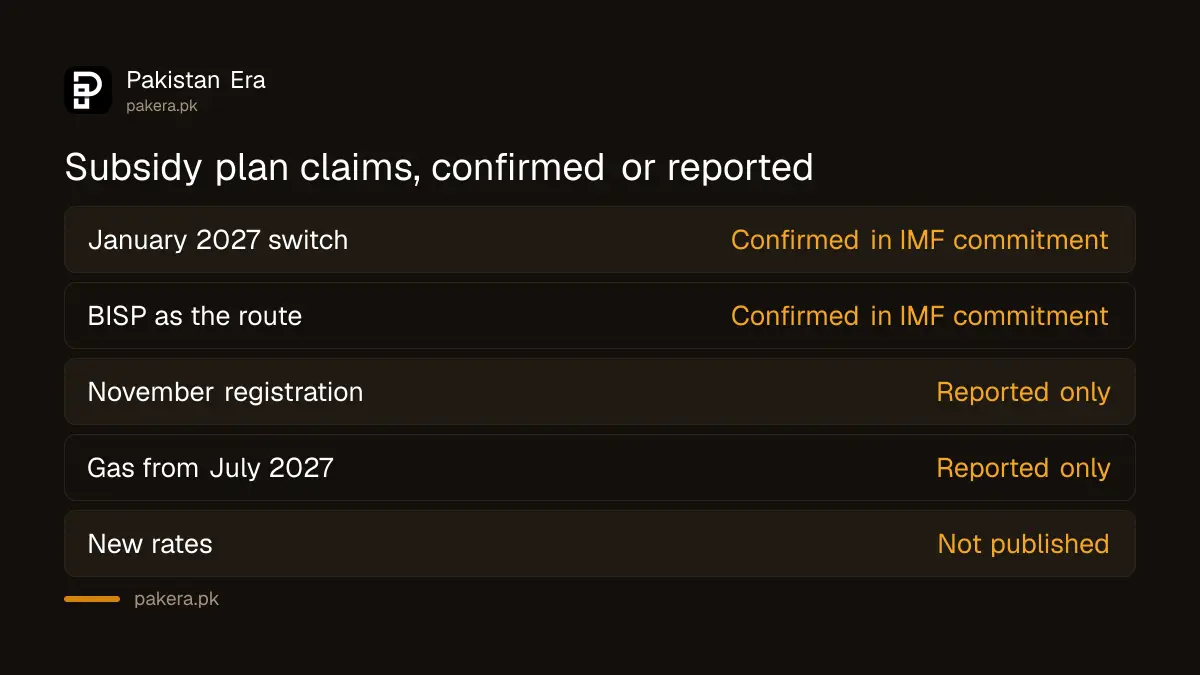
| Claim | Status on 10 October 2026 |
|---|---|
| Electricity subsidy moves to a targeted BISP system by end-January 2027 | Confirmed in the government's IMF commitment |
| Consumers linked to the NSER with World Bank help | Confirmed as a plan in the same document |
| Registration of eligible consumers done by November 2026 | Reported only |
| Gas subsidy moves to the same system from 1 July 2027 | Reported only; official papers say linking work has begun |
| Who qualifies and how much support each home gets | Not published |
None of this is in force. A change to the rates on your bill needs a NEPRA determination and a government notification, the same as any tariff change. We found neither for this reform.
Protected households face the biggest change
Homes that now pay the low protected rates, usually those using up to 200 units a month, would be most affected. Under a targeted system, the cheap rate inside the tariff is meant to give way to direct support for households that qualify.
Today the discount sits inside the tariff itself. The current slabs, and the gap between protected and unprotected rates, are in the electricity unit price slab rates for 2026. A separate proposal to soften the six month penalty for crossing 200 units was covered in the 200 unit rule relief plan.
What the new rates would be, and whether a household outside BISP's list keeps any discount, has not been announced. Anyone who tells you a figure today is guessing. The IMF document says the aim is to cut the incentive for richer users to overconsume and to reduce theft among lower-income users.
You can check your NSER record now
Because eligibility is to run through BISP's registry, the one practical step today is to make sure your household's NSER survey record is correct. How exactly an electricity connection will be matched to a household has not been published.
- Check your BISP and NSER status, and request a resurvey if your details changed. The process is in updating your NSER survey record.
- If your connection is still in a previous owner's name, it is worth moving it to yours. The steps are in changing the name on an electricity bill.
- Ignore anyone asking for money to "register" you for the new subsidy. No registration channel for the public has been announced.
Common questions
Will the 200 unit protected tariff end in January 2027?
The government has committed to replacing the subsidy inside the tariff by end-January 2027. The new rates have not been announced or notified, so no bill changes yet.
Do I need to register for the new electricity subsidy?
No public registration has been announced. Eligibility is expected to run through BISP's NSER data, so keep that record up to date.
Will gas bills change the same way?
Reports say gas follows from 1 July 2027. The official document only says work has started to link gas consumer data with the NSER.
Is this an IMF condition?
Yes. It is reform measure RM12 under the Resilience and Sustainability Facility, tied to the fifth review of the loan programme.
Who decides the new tariff?
NEPRA determines electricity tariffs and the federal government notifies them. Both steps are needed before any new rate reaches your bill.
How we verified this
What we checked, where we read it, and what we could not confirm.
Last checked 10 October 2026. The commitment and its wording are from the government's MEFP and the RM12 table in IMF Country Report No. 25/332 (December 2025), read in the copy hosted by the Finance Division. The November 2026 registration target and the 1 July 2027 gas date were reported on 9 October 2026 and are not in an official document we could find. We could not open the IMF's later 2026 review papers, so any change made in them is not reflected here.
About the author

Global Affairs & Political Economy Writer
Muhammad Hatim is a book lover who started writing because he enjoys it. At Pakistan Era he writes about international relations, geopolitics and the global economy, with a particular interest in South Asia and the forces behind current events.