ECNEC Approves 11 Projects in Pakistan, Including Gwadar Water and Koto Hydropower
ECNEC approved 11 projects on 10 October 2026: Koto hydropower, Gwadar water from Mirani Dam, GB solar and a Tarlai hospital. The full list, by province.
ECNEC approved 11 development projects across Pakistan on 10 October 2026. They include a 40.8 MW hydropower plant in Lower Dir, a Mirani Dam water supply scheme for Gwadar, 100 MW of solar power in Gilgit-Baltistan and a new King Salman hospital in Tarlai, Islamabad. Deputy Prime Minister Ishaq Dar chaired the meeting.
The Executive Committee of the National Economic Council, or ECNEC, is the highest body that clears large public projects in Pakistan. Its approval lets a project move forward. It does not mean work starts tomorrow.
We read the government's press release on the meeting. Below is every project it names, grouped by province, and what approval actually means for people who live near them.
ECNEC cleared 11 projects in six sectors
The committee approved projects in energy, roads, water, health, urban development and forensic science. The release names each one but does not give the cost of any of them, or a total.
| Project | Where | Sector |
|---|---|---|
| Koto Hydropower Project, 40.8 MW | Lower Dir, Khyber Pakhtunkhwa | Energy |
| Rehabilitation and remodelling of Lasbela Canal | Balochistan | Water |
| Water supply scheme for Gwadar from Mirani Dam | Gwadar, Balochistan | Water |
| Buleda to Proom road | Balochistan | Roads |
| Proom to Chedgai road | Balochistan | Roads |
| 100 MW distributed solar plants | Gilgit-Baltistan | Energy |
| Reactive power compensation devices | NGC national grid | Energy |
| Punjab Urban Land Systems Enhancement Project (PULSE) | Punjab | Urban development |
| Dirgi to Shahbozai to Taunsa Sharif road | Road ending at Taunsa Sharif | Roads |
| King Salman bin Abdulaziz Al Saud Hospital | Tarlai, Islamabad | Health |
| Purpose-built laboratory for the National Forensic Agency | Not stated | Forensic science |
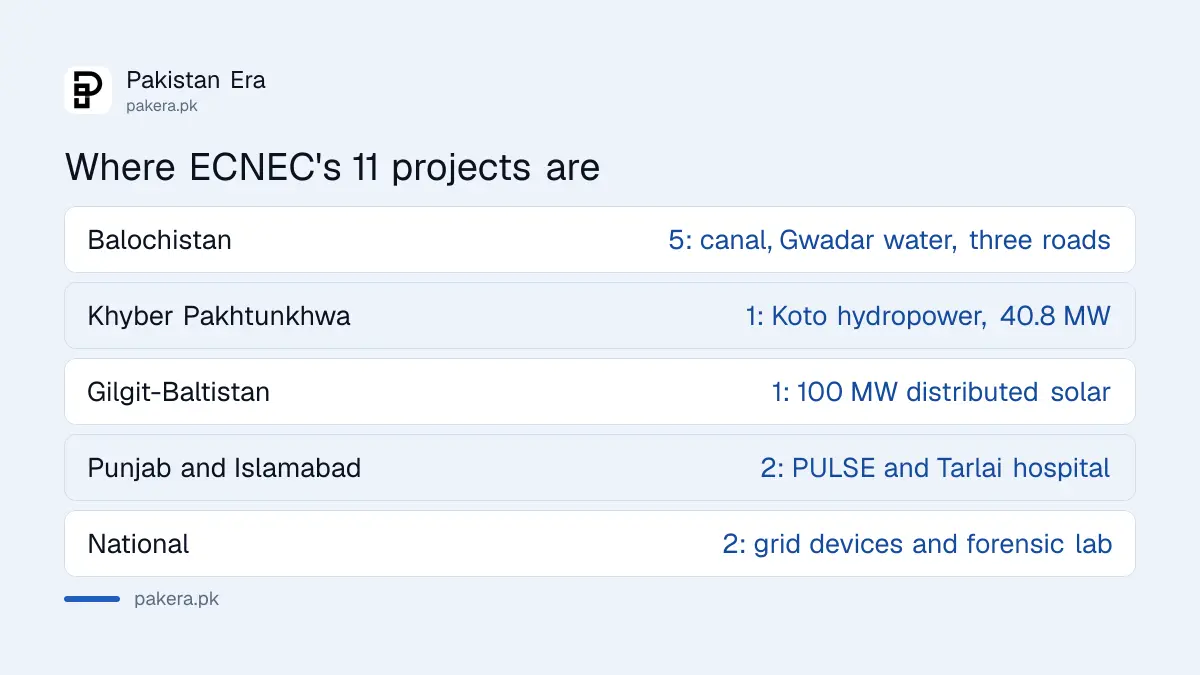
Balochistan gets five of the 11 projects
Balochistan has the largest share. Two are about water and two are new roads. The fifth, the Dirgi to Shahbozai to Taunsa Sharif road, links towards Taunsa Sharif in Punjab.
The Gwadar scheme is the one most residents will watch. The plan is to bring water to the port city from Mirani Dam. The Lasbela Canal work is a repair and redesign of an existing canal, which matters for farms that rely on it.
The release gives no length or timeline for the Buleda to Proom and Proom to Chedgai roads.
Three energy projects, from a dam to solar panels
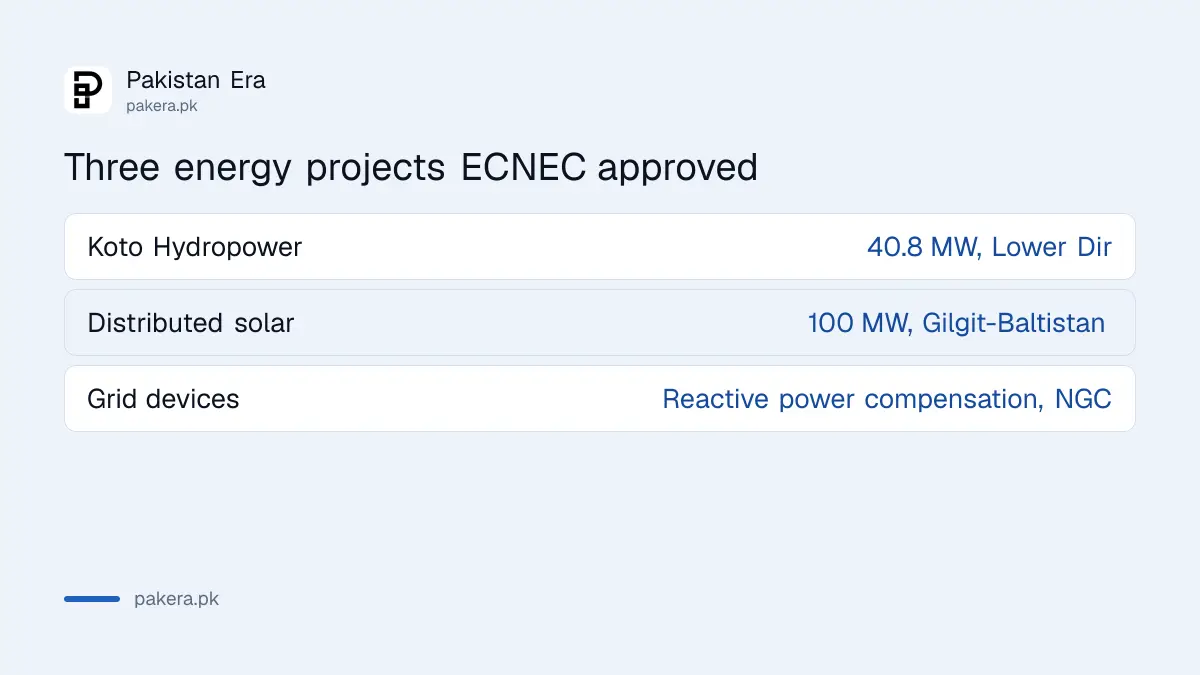
Energy accounts for three approvals.
- Koto Hydropower Project, Lower Dir. A 40.8 MW hydropower plant in Khyber Pakhtunkhwa.
- 100 MW distributed solar in Gilgit-Baltistan. "Distributed" means many smaller solar plants spread across the region rather than one big one.
- Reactive power compensation in the NGC network. NGC is the National Grid Company. These devices keep voltage steady on long lines, which cuts losses and helps avoid trips.
Solar adds supply in daylight hours only, so it works alongside hydropower rather than replacing it. The region's own spending plans for the year are in the Gilgit-Baltistan budget for 2026-27.
A new hospital in Tarlai and a forensic lab
The King Salman bin Abdulaziz Al Saud Hospital will be built in Tarlai, Islamabad. The release does not give its number of beds, its cost or when it would open.
The National Forensic Agency gets a purpose-built laboratory. The release does not say where. Forensic labs test evidence such as DNA, fingerprints and documents for criminal cases, so better capacity can shorten the wait for results.
In Punjab, the PULSE project is about urban land systems. The release does not describe it beyond its name. If you own a plot in a Punjab city, the steps to verify land records before you pay still apply while any new system is built.
Approval is not the same as money or a start date
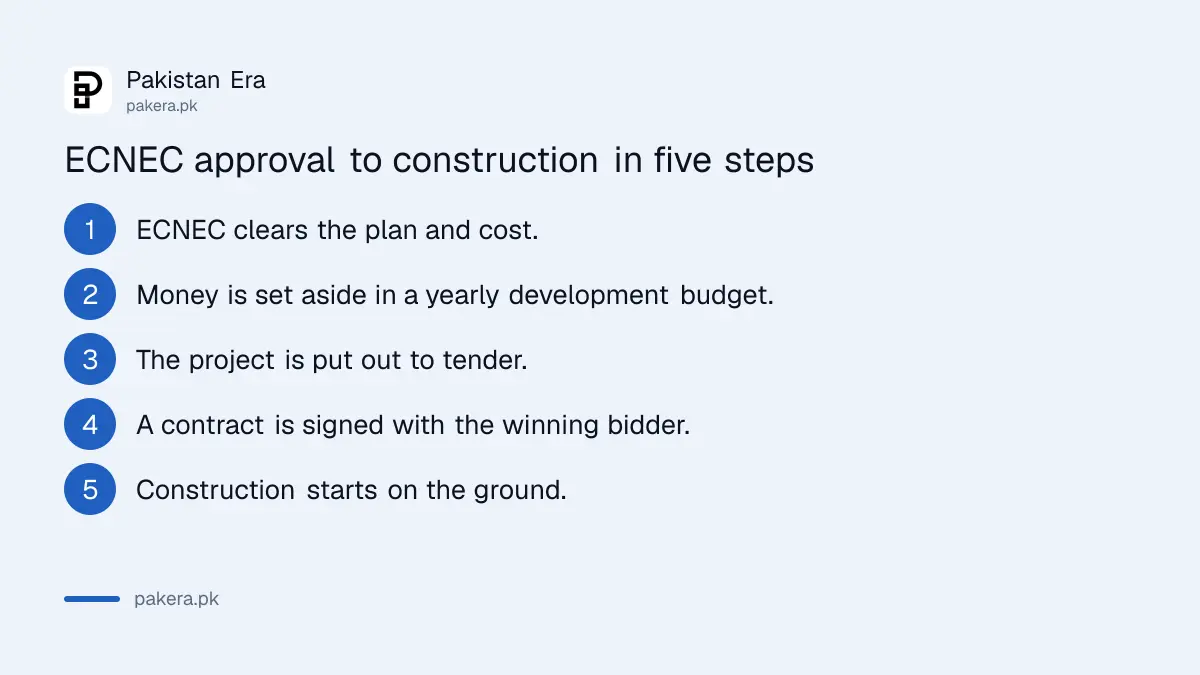
An ECNEC approval clears a project's plan and cost. The project then needs money each year through the federal or provincial development budget. It also has to go through tenders before any work begins on the ground.
Mr Dar told officials to finish projects on time and without cost overruns. He asked for financial discipline and the removal of procedural bottlenecks. Those are instructions, not deadlines. The release sets no completion date for any of the 11 projects.
The missing costs matter too. Without a cost, nobody outside government can tell later whether a project ran over budget. When a project is listed in the next development budget, its cost and the money set aside for that year usually appear there. That is the place to check, and we will add the figures once they are published by the Planning Ministry.
The meeting was attended by the Planning Minister, Punjab's Senior Minister, Balochistan's Minister for Planning and Development, the Prime Minister's adviser Tariq Bajwa, the Secretaries of Cabinet, Planning and Economic Affairs, the Chairman of the CDA and provincial officials.
Common questions
How many projects did ECNEC approve on 10 October 2026?
Eleven, across energy, roads, water, health, urban development and forensic science.
What is the Gwadar Mirani Dam project?
A water supply scheme to bring water to Gwadar from Mirani Dam. ECNEC approved it on 10 October 2026. No cost or timeline was published.
Where will the King Salman hospital be built?
In Tarlai, Islamabad. The release does not give its size or opening date.
How much do the 11 projects cost?
The government's release does not give any cost. We will add figures if the Planning Ministry publishes them.
Does ECNEC approval mean construction has started?
No. Each project still needs yearly budget money and a tender before work begins.
How we verified this
What we checked, where we read it, and what we could not confirm.
Last checked on 10 October 2026. The list of projects, the attendees and Mr Dar's instructions are from the Press Information Department's release No. 124 of 10 October 2026 on pid.gov.pk. Costs and timelines were not in the release, and we could not find them on the Planning Ministry's website. The explanations of distributed solar, reactive power devices and the approval stages are our own.
About the author
Senior Writer, Public Services and Technology
Shahid joined us in 2024 as an author. He is a senior contributor to Pakistan's leading technology websites. He writes detailed articles, mostly covering his expertise in the latest tech, mobiles, apps, gadgets, and step-by-step guides. His ideology is to help people understand the latest trends and explain complex methods through very easy-to-understand guides.