Pakistan Reports 17 Suspected HIV and 46 Gonorrhoea Cases in a Week
NIH's week 38 bulletin counts 17 suspected HIV, 46 gonorrhoea and 5 syphilis cases in Pakistan. See the lab results by province and how HIV testing works.
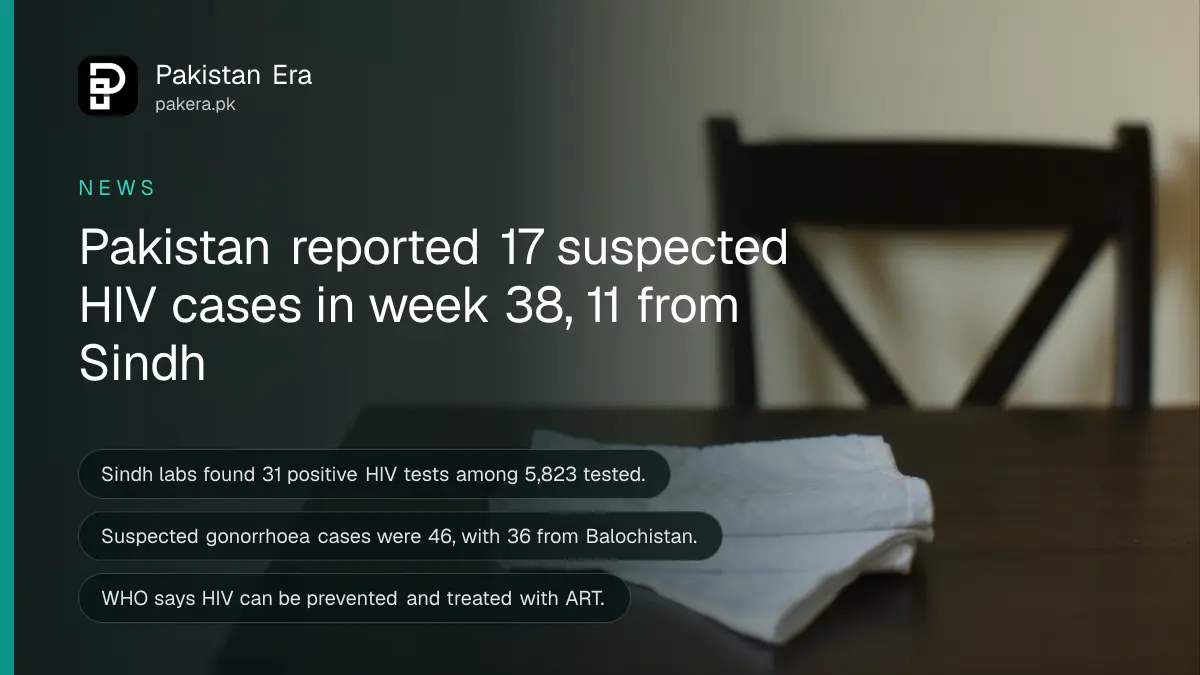
Short answer: Pakistan reported 17 suspected HIV/AIDS cases, 46 gonorrhoea cases and 5 syphilis cases in week 38 of 2026, the National Institutes of Health (NIH) says. HIV reports fell from 18. Sindh's public labs found 31 positive HIV tests among 5,823 tests. A test is a private, simple way to know your status.
The NIH put the bulletin online on Friday 9 October 2026. We read the week 38 and week 37 tables ourselves. These are suspected cases reported by clinics, not confirmed diagnoses. Punjab did not report in either week, so the national count leaves out the largest province.
HIV reports fell to 17, with 11 from Sindh
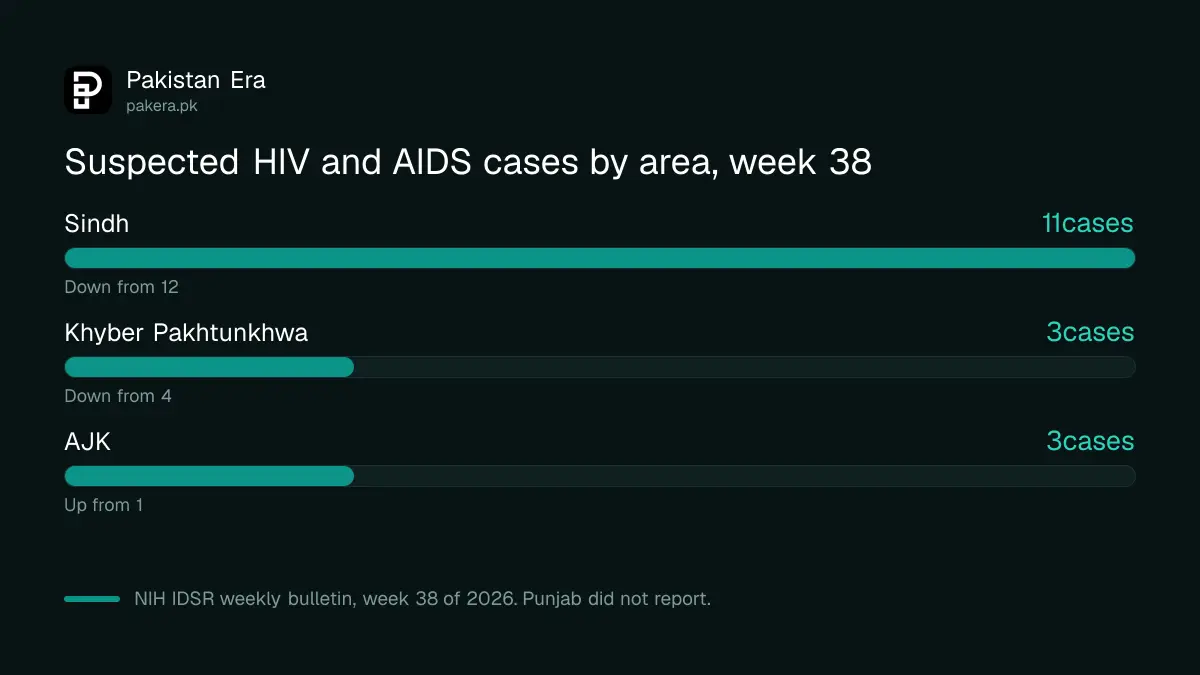
Suspected HIV/AIDS cases in Pakistan fell from 18 to 17 in week 38. Sindh reported 11, down from 12. Khyber Pakhtunkhwa reported 3, down from 4. AJK reported 3, up from 1. Gilgit-Baltistan, which reported 1 in week 37, reported none.
The NIH counts these cases through its Integrated Disease Surveillance and Response system, called IDSR. Clinics in 158 districts send weekly forms. The bulletin says these cases need field investigation to confirm them. It lists HIV/AIDS among the diseases that declined in Sindh and Khyber Pakhtunkhwa this week.
| Area | Week 37 | Week 38 |
|---|---|---|
| Sindh | 12 | 11 |
| Khyber Pakhtunkhwa | 4 | 3 |
| AJK | 1 | 3 |
| Gilgit-Baltistan | 1 | 0 |
| Balochistan | 0 | 0 |
| Punjab | NR | NR |
| Pakistan | 18 | 17 |
NR means not reported. The bulletin does not explain why Punjab is missing.
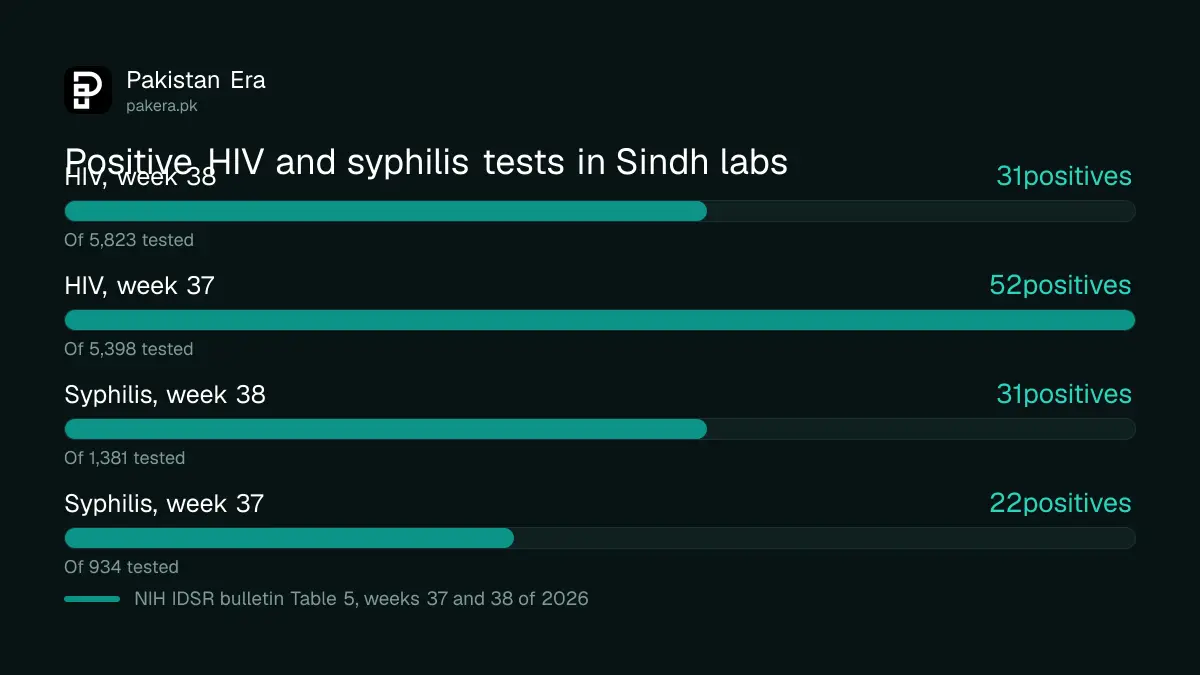
Sindh labs found 31 HIV positives among 5,823 tests
The NIH's laboratory table for week 38 lists 5,823 HIV tests in Sindh's public health laboratories and 31 positives, about 0.5 per cent. A week earlier it was 52 positives among 5,398 tests. Balochistan tested 586 people and Gilgit-Baltistan 170, with no positives in either.
The lab positives (31) are more than the suspected cases (11) for Sindh. The two come from different parts of the system, and the bulletin does not explain the gap. A likely reason is that laboratories test many people who are not sick, but we are guessing, and the NIH does not say so. Do not add the two figures together.
Gonorrhoea stayed at 46, with 36 in Balochistan
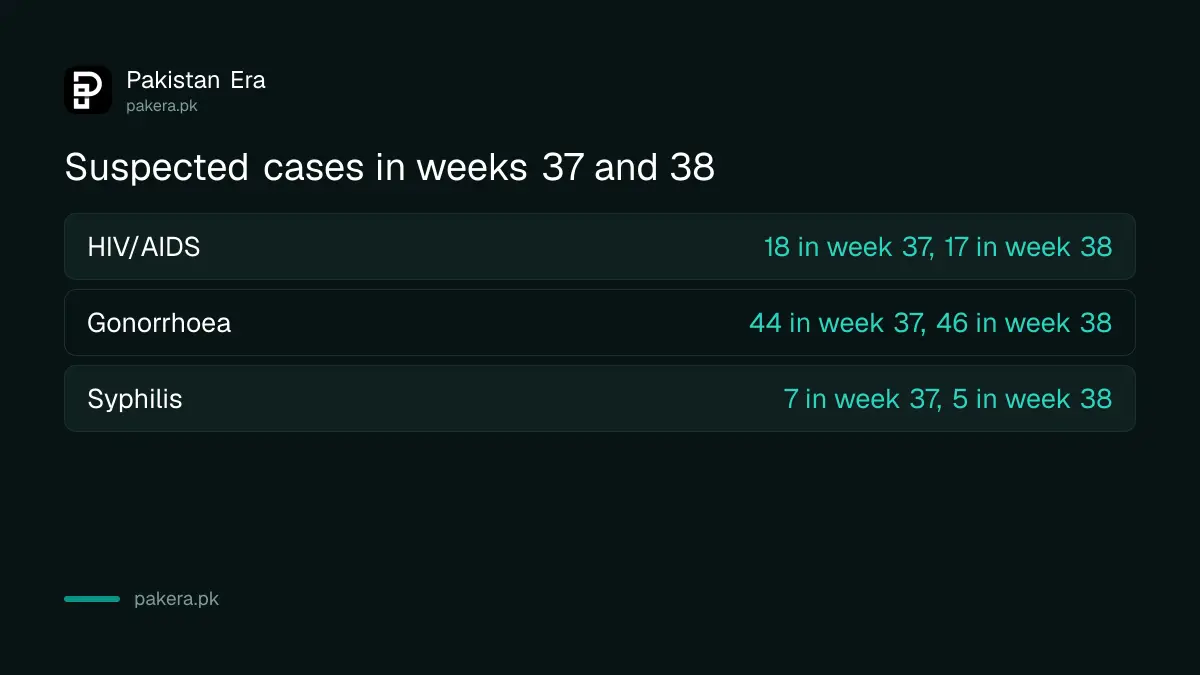
Suspected gonorrhoea cases rose from 44 to 46 in week 38. Balochistan reported 36, the same as the week before. Sindh reported 10, up from 6. Khyber Pakhtunkhwa reported 2 in week 37 and none in week 38. Suspected syphilis cases fell from 7 to 5, with 4 from Sindh and 1 from Khyber Pakhtunkhwa.
For syphilis, Sindh's labs found 31 positives among 1,381 tests in week 38, up from 22 among 934. Balochistan found none in 202 tests, and Gilgit-Baltistan none in 154. In week 37 Gilgit-Baltistan had found 4 positives among 197 tests.
| Condition | Suspected, week 37 | Suspected, week 38 |
|---|---|---|
| HIV/AIDS | 18 | 17 |
| Gonorrhoea | 44 | 46 |
| Syphilis | 7 | 5 |
A test is the only way to know, and treatment works
The World Health Organization (WHO) says HIV can be diagnosed with rapid tests that give same-day results, and that confirmatory testing is needed after a first positive result. HIV is spread through body fluids, not by kissing, hugging, shaking hands or sharing food.
WHO says HIV can be prevented and treated with antiretroviral therapy, called ART. It says people on ART with no virus detectable in the blood will not pass HIV to sexual partners. It lists unsafe injections, blood transfusions and unsterile cutting or piercing among the risks. For injection safety in Pakistan, see how to check a clinic syringe against DRAP alerts. We also covered the Karachi HIV outbreak.
- Ask a doctor or a government health facility about an HIV test, and ask what it costs.
- If a rapid test is positive, have a confirmatory test before you decide anything.
- Insist on a new, sealed syringe for every injection.
- Use a clean blade for shaving, piercing or tattoos, and never share one.
- If you are pregnant, ask your doctor about an HIV test, because treatment can protect the baby.
Steps 1 and 3 to 5 are general advice from WHO and common medical guidance. We did not check where free HIV testing is offered in each province for this article.
What the numbers cannot tell you
The bulletin counts suspected cases reported through IDSR. It is not a count of everyone living with HIV, syphilis or gonorrhoea in Pakistan. Many people are never tested, and Punjab is missing. A weekly fall from 18 to 17 is a very small change and should not be read as a trend.
The NIH's week 38 public health actions page covers viral hepatitis and dog bites, so it carries no action for these three conditions. Hepatitis is another blood-borne infection, and we reported its week 38 count in the hepatitis B, C and D report.
Common questions
How many HIV cases did Pakistan report in week 38?
The NIH counted 17 suspected HIV/AIDS cases in week 38 of 2026, down from 18. Sindh reported 11, Khyber Pakhtunkhwa 3 and AJK 3.
Are these confirmed HIV cases?
No. The NIH says all reported cases are suspected and need field investigation. The lab table lists 31 positive HIV tests among 5,823 tests in Sindh, which is a separate count.
How is HIV spread?
WHO says HIV spreads through blood, breast milk, semen and vaginal fluids, and from mother to baby. It does not spread through kissing, hugging or sharing food.
Can HIV be treated?
Yes. WHO says HIV can be prevented and treated with ART, and that people on ART with an undetectable viral load will not pass HIV to their sexual partners.
How many gonorrhoea cases were reported?
The NIH counted 46 suspected cases in week 38, up from 44. Balochistan reported 36 and Sindh 10.
Can I get a free HIV test?
We did not verify free testing sites for this article. Ask a government hospital or your provincial health department what is offered and what it costs.
How we verified this
What we checked, where we read it, and what we could not confirm.
Last checked on 11 October 2026. We read the NIH's Public Health Bulletin, Pakistan, Week 38, 2026 and the Week 37 bulletin, both listed on the NIH's IDSR weekly reports page. Case counts are from Table 1 and the text under it, and laboratory results from Table 5. HIV facts are from the WHO HIV and AIDS fact sheet.
About the author

Tax, Bills and Technology Writer
Ali Akhtar is a young and curious voice here at Pakistan Era. He is currently pursuing his A-Levels and has a growing interest in Pakistan’s changing industrial landscape and educational trends. Ali likes to write in a way that helps him explain and explore the world around him. His writing reflects the perspective of the new generation navigating the evolving trends of Pakistan where technology, youth innovation, and shifting opportunities are reshaping the country’s future.