Islamabad Air Is Worst After 4 pm: AQI Hits 167 as Pak-EPA Readings Rise Four Days in a Row
Pak-EPA put Islamabad at AQI 167 on 19 November 2026, up four days running. We lined up 8 days of readings: PM2.5 after 4 pm is about double the daytime level.
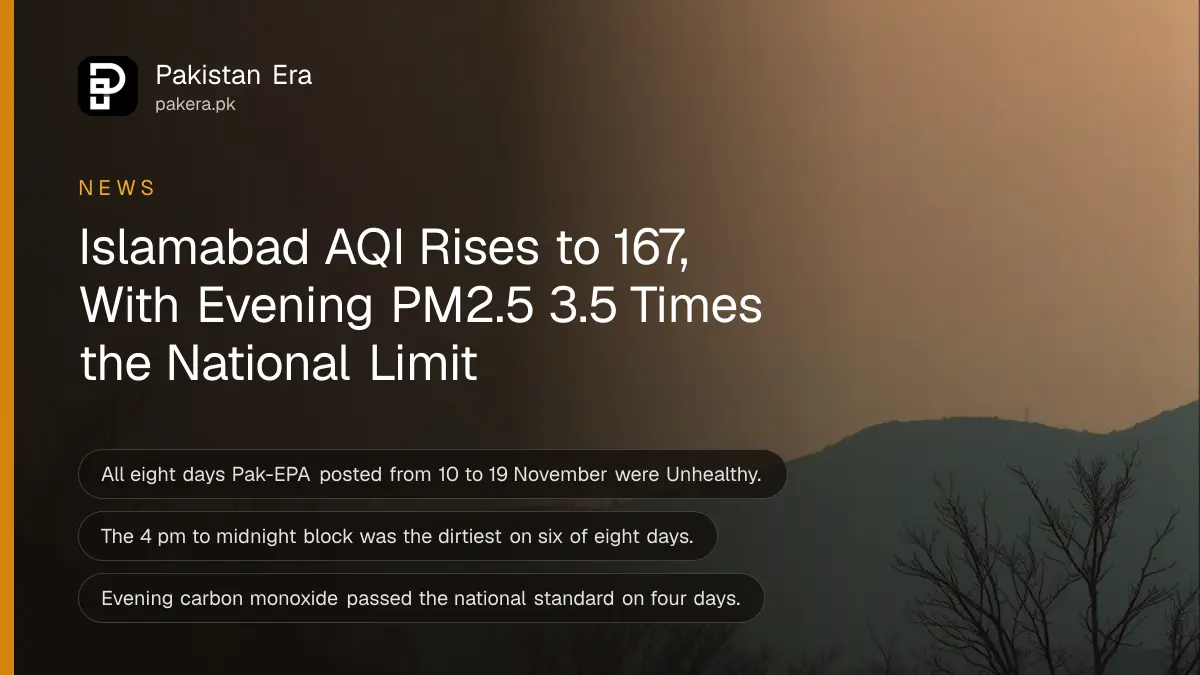
Short answer: Islamabad's air was Unhealthy on all eight days Pak-EPA posted between 10 and 19 November 2026, and it is getting worse. The daily AQI rose from 151 on 16 November to 167 on 19 November. We lined up every reading and found the dirtiest air comes after 4 pm, when fine dust is about double the daytime level.
The Pakistan Environmental Protection Agency (Pak-EPA) posts one table a day for Islamabad. It splits each day into three eight-hour blocks: midnight to 8 am, 8 am to 4 pm, and 4 pm to midnight. Most reports quote only the daily AQI. We put the blocks side by side for the eight days Pak-EPA posted, 10, 11, 12 and 15 to 19 November.
The latest table, for Thursday 19 November, was posted on the morning of Friday 20 November. It gives a 24-hour PM2.5 average of 87.5 µg/m³ and an AQI of 167, Unhealthy. The national limit for PM2.5 in the same table is 35. So the city breathed 2.5 times the limit on average, and 3.5 times the limit in the evening.
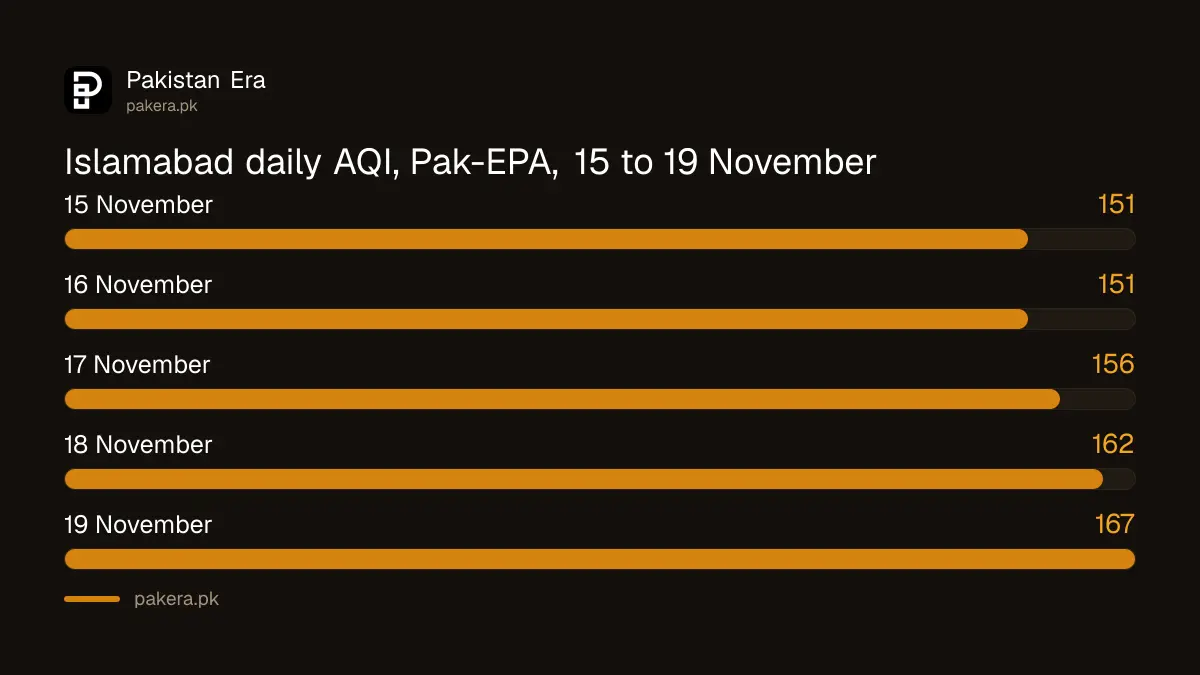
Islamabad's AQI has risen four days in a row to 167
Pak-EPA's daily PM2.5 average for Islamabad climbed from 57.5 µg/m³ on 16 November to 66.8, 78.9 and then 87.5 on 19 November. The AQI rose with it, from 151 to 167. Every one of the eight days was in the Unhealthy band.
| Date | Midnight to 8 am | 8 am to 4 pm | 4 pm to midnight | 24-hour PM2.5 | AQI |
|---|---|---|---|---|---|
| 10 November | 99.3 | 111.4 | 98.8 | 103.2 | 175 |
| 11 November | 95.2 | 98.2 | 104.1 | 99.2 | 173 |
| 12 November | 63.8 | 58.5 | 60.4 | 60.9 | 153 |
| 15 November | 62.9 | 35.4 | 73.8 | 57.4 | 151 |
| 16 November | 58.4 | 53.0 | 61.0 | 57.5 | 151 |
| 17 November | 56.7 | 44.0 | 99.8 | 66.8 | 156 |
| 18 November | 70.2 | 57.1 | 109.3 | 78.9 | 162 |
| 19 November | 73.0 | 66.5 | 122.9 | 87.5 | 167 |
All PM2.5 figures are in micrograms per cubic metre (µg/m³). PM2.5 means particles smaller than 2.5 microns, small enough to reach deep into the lungs. Pak-EPA did not post tables for 13 and 14 November.
The worst days in this run were 10 and 11 November, at AQI 175 and 173. The air then cleared to about 151 for a few days before climbing again. The daily posts for earlier dates are in Islamabad AQI on 15 November.
The 4 pm to midnight block is the dirtiest on six of eight days
On six of the eight days, the 4 pm to midnight block had the highest PM2.5. On six days, the 8 am to 4 pm block had the lowest. From 17 to 19 November, evening PM2.5 averaged 110.7 µg/m³ against 55.9 in the daytime block, about double.
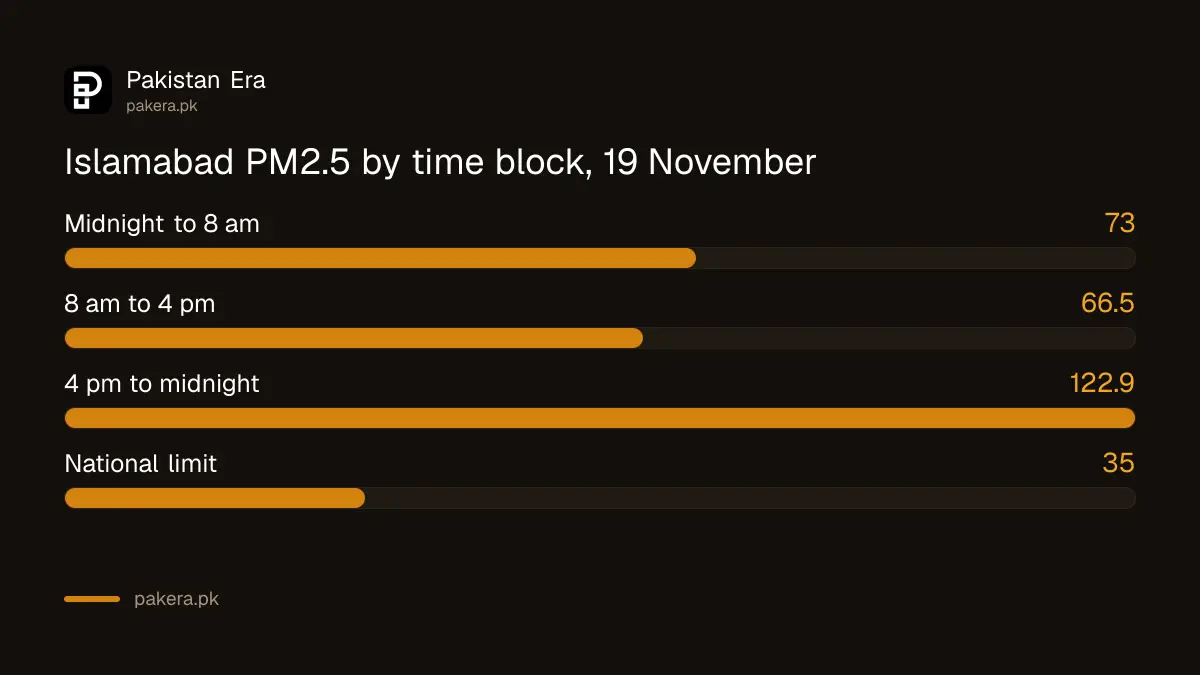
The gap is widening. On 16 November the evening block was only 8 µg/m³ above the daytime block. By 19 November it was 56.4 above it. Daytime readings rose too, from 53 to 66.5, so even the cleanest part of the day is now almost twice the limit.
The two exceptions were 10 November, when the daytime block was worst, and 12 November, when overnight was worst. Both were days when all three blocks were close together, so no time of day was much better than another.
Evening carbon monoxide went above the national limit on four days
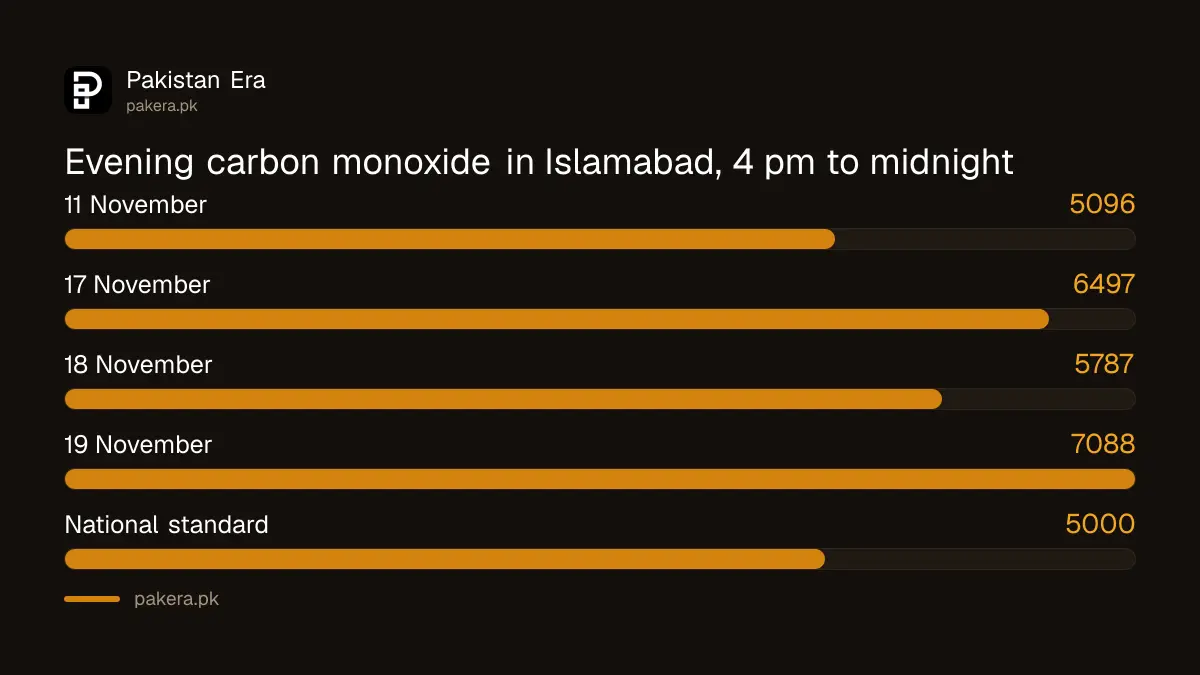
Pak-EPA rates carbon monoxide (CO) as Good every day, because it uses the 24-hour average. But the 4 pm to midnight block went above the 5,000 µg/m³ national standard printed in the same table on 11, 17, 18 and 19 November. On 19 November it reached 7,088.3.
| Date | CO, 4 pm to midnight (µg/m³) | CO, 8 am to 4 pm (µg/m³) | Daily CO rating |
|---|---|---|---|
| 11 November | 5,095.9 | 1,115.1 | Good |
| 17 November | 6,496.7 | 777.2 | Good |
| 18 November | 5,787.1 | 878.8 | Good |
| 19 November | 7,088.3 | 924.9 | Good |
On 19 November evening CO was more than seven times the daytime level. CO is a gas with no smell or colour. In winter, burning fuel in vehicles and in gas heaters and stoves adds to it. Inside a closed room with a heater, levels can rise far higher than outdoors.
Sulphur dioxide and nitrogen dioxide stayed well inside their limits on all eight days. Nitrogen dioxide was highest in the daytime block, peaking at 26.5 on 10 November, against a limit of 80.
What the readings mean for your day in Islamabad
If you can choose, do outdoor work, walks and school sports between 8 am and 4 pm, when readings were lowest. Keep windows shut after sunset. Wear an N95 mask outdoors in the evening, and never run a gas heater in a closed room.
- Move outdoor exercise, a walk or a child's play time to late morning or early afternoon.
- Close windows and doors from about 4 pm, when evening dust starts to build.
- Wear a well-fitted N95 or KN95 mask outdoors in the evening. How to choose one is in wearing an N95 or KN95 mask in smog.
- Turn a gas heater off before sleeping, and keep a window slightly open when it runs.
- Keep children, older people and anyone with asthma or heart disease indoors in the evening.
- Check Pak-EPA's next daily table before planning the weekend.
Where to find the daily Pak-EPA table, and how to read it, is explained in checking Islamabad AQI today.
Common questions
What was Islamabad's AQI on 19 November 2026?
Pak-EPA gave Islamabad an AQI of 167, Unhealthy, for 19 November 2026. The 24-hour PM2.5 average was 87.5 µg/m³, against a national limit of 35.
What time of day is Islamabad's air worst?
From 4 pm to midnight. That block had the highest PM2.5 on six of the eight days Pak-EPA posted between 10 and 19 November 2026.
When is the air cleanest in Islamabad right now?
Between 8 am and 4 pm. That block had the lowest PM2.5 on six of the eight days, though it was still above the limit of 35 on every day.
Is carbon monoxide a problem in Islamabad?
The daily rating is Good, but the evening block went above the 5,000 µg/m³ standard on 11, 17, 18 and 19 November. Indoors, gas heaters can push CO much higher.
Has Islamabad's air been Unhealthy every day this month?
On every day Pak-EPA posted between 10 and 19 November, yes. The AQI ranged from 151 to 175. Tables for 13 and 14 November were not posted.
Why are the PM2.5 limit and the AQI numbers different?
The limit of 35 is a concentration in µg/m³. The AQI is a score built from it. A PM2.5 of 87.5 gives an AQI of 167.
How we verified this
What we checked and where we read it.
We read Pak-EPA's daily Islamabad tables on 20 November 2026, between 2:40 pm and 2:50 pm PKT:
- The Pak-EPA home page, whose Latest News item "Air Quality Index of Islamabad", dated 20 November 2026, carries the table for 19 November.
- The daily table images Pak-EPA has posted for 10, 11, 12 and 15 to 19 November 2026, each read in full. The file names do not follow one pattern, and no tables were posted for 13 and 14 November.
The block comparisons, averages and ratios are our own arithmetic from Pak-EPA's figures. Pak-EPA's tables carry the note that data on Islamabad's air from any other source is not verified or approved by Pak-EPA.
About the author

Senior Writer, Public Services and Technology
Shahid joined us in 2024 as an author. He is a senior contributor to Pakistan's leading technology websites. He writes detailed articles, mostly covering his expertise in the latest tech, mobiles, apps, gadgets, and step-by-step guides. His ideology is to help people understand the latest trends and explain complex methods through very easy-to-understand guides.