JUI-P Women's Reserved Seat Dispute in KP Must Go to an Election Tribunal, Federal Constitutional Court Rules
The FCC refused JUI-P's bid to remove Sadaf Ihsan from a KP women's reserved seat in the National Assembly and said the dispute belongs to an Election Tribunal.
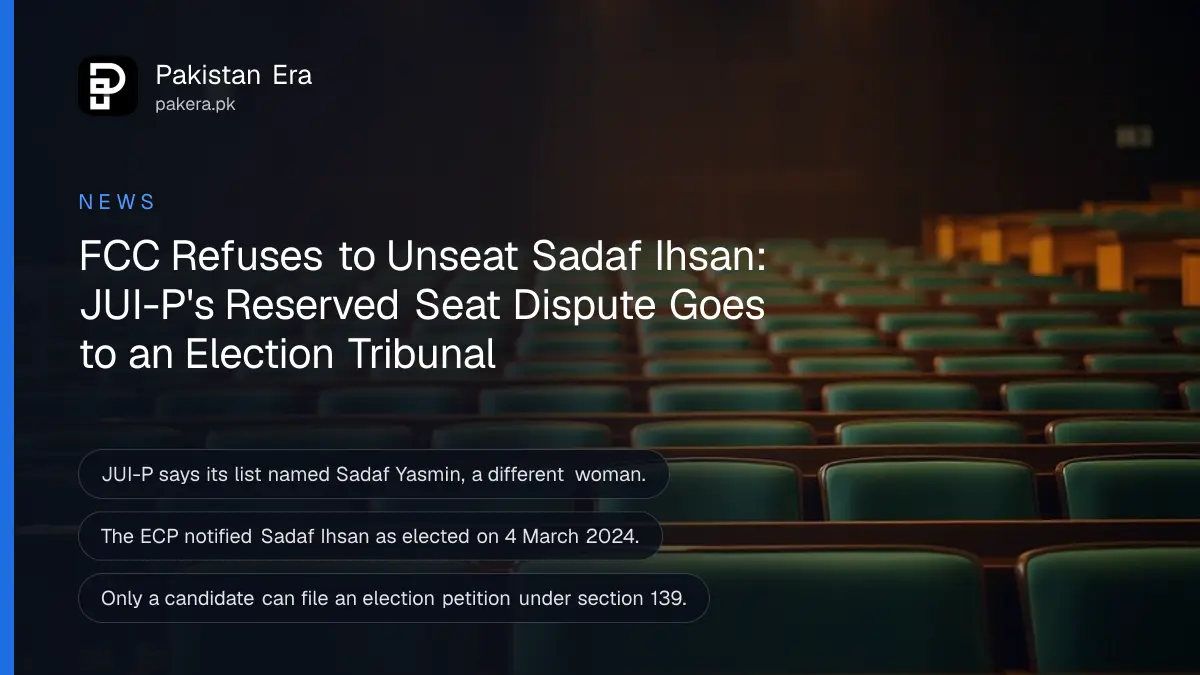
The Federal Constitutional Court of Pakistan has refused to unseat Sadaf Ihsan from a National Assembly seat reserved for women from Khyber Pakhtunkhwa, in a dispute brought by her own party, Jamiat Ulema-e-Islam Pakistan (JUI-P). The court held that a claim that the wrong person was elected must go to an Election Tribunal, not to a High Court or the Election Commission. The judgment was uploaded to the court's judgments page on 19 November 2026 and is approved for reporting.
The case turns on two similar names. JUI-P says its priority list named Sadaf Yasmin, a different woman. The Election Commission of Pakistan (ECP) notified Sadaf Ihsan as elected on the party's seat. Two and a half years later, she still holds it.
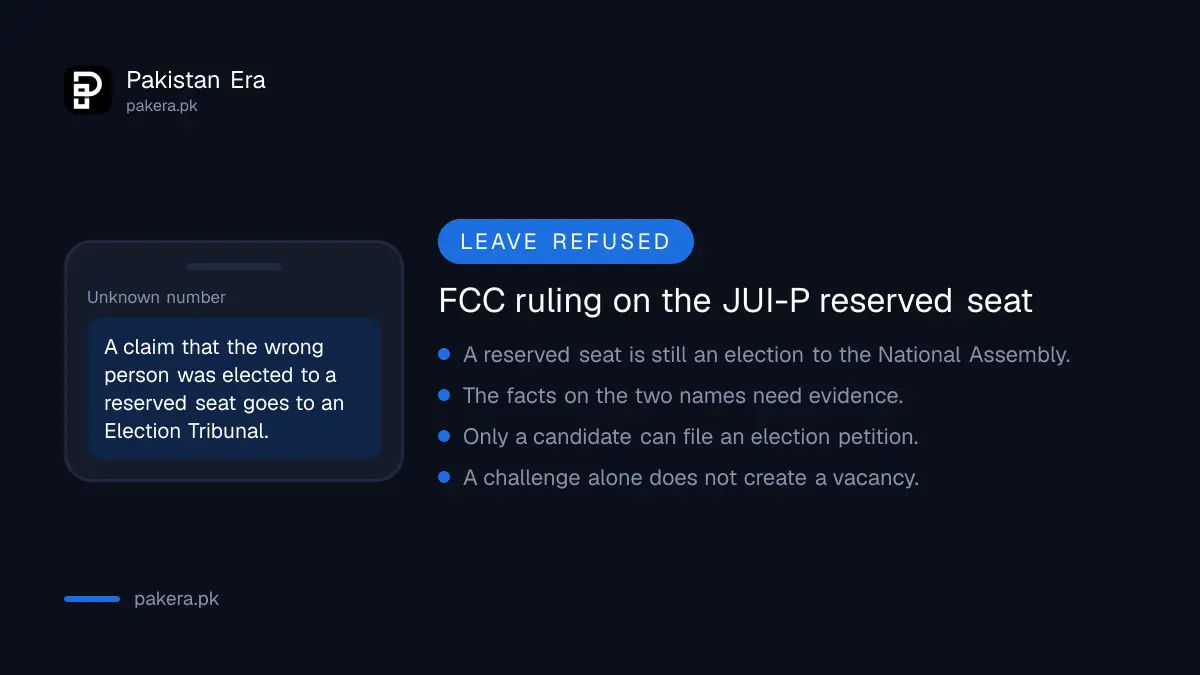
The FCC refused leave and kept the ECP order in place
The court dismissed petitions by JUI-P and by Hina Bibi, another candidate on the party's list, and refused leave to appeal. It upheld the Islamabad High Court order of 9 June 2026 and the ECP order of 28 January 2026.
Chief Justice Amin-ud-Din Khan wrote the judgment, sitting with Justice Aamer Farooq, after a hearing on 5 November 2026. The case numbers are F.C.P.L.A. Nos. 1712 and 1713 of 2026. The Ministry of Parliamentary Affairs and the ECP both sent officers to the hearing.
| Date | What happened |
|---|---|
| 2 February 2024 | An order places Hina Bibi at the bottom of the JUI-P priority list |
| 4 March 2024 | ECP notifies Sadaf Ihsan as elected on a JUI-P women's seat from KP |
| After that | ECP suspends the notification; Peshawar High Court sets the suspension aside |
| 24 December 2025 | FCC, by consent, sets aside the Peshawar ruling and sends the case back to ECP |
| 28 January 2026 | ECP keeps her election and points the parties to the Election Tribunal |
| 9 June 2026 | Islamabad High Court dismisses the JUI-P and Hina Bibi petitions |
| 5 November 2026 | FCC refuses leave to appeal |
A reserved seat is still an election, so the Election Tribunal decides
The court held that a women's reserved seat is filled by an election to the National Assembly. Under Article 225 of the Constitution and section 139 of the Elections Act 2017, the only way to challenge it is an election petition.
Reserved seats are not polled directly. Under Article 51(6), each province is one constituency for women's seats, and parties get seats in proportion to the general seats they win, filling them from lists they submit. Section 104 of the Elections Act bars any change to those lists or their order after the nomination deadline.
JUI-P argued the mix-up was only an administrative error that the ECP or a court could correct. The court disagreed. Removing a notified member and seating a rival is the same relief an election petition seeks, whatever it is called. Section 156(1)(a) of the Act already lists an invalid nomination as a ground to void an election.
The facts were disputed, so they need evidence
The court found no admitted clerical error that could be fixed by comparing records. The party's revised list kept the name Sadaf Yasmin without identifying details, while Sadaf Ihsan filed nomination papers in her own name and appeared in the published record as a JUI-P candidate.
Whether this was an incomplete description, an unauthorised substitution or something else needs witnesses and documents, the court said. That is what an Election Tribunal is set up to examine. The judgment also made these points:
- Party membership alone does not prove a person was nominated.
- A departmental finding of inefficiency against the Returning Officer does not prove impersonation, or give Hina Bibi the seat.
- The ECP's power under section 9 to act on grave illegalities is not a general power to decide every election dispute.
- JUI-P's representative knew of Form-32, the record of her candidature, and the party had routes to object before notification.
- A challenge to a member's nomination does not create a vacancy, so the next name on the list does not move up on that basis.
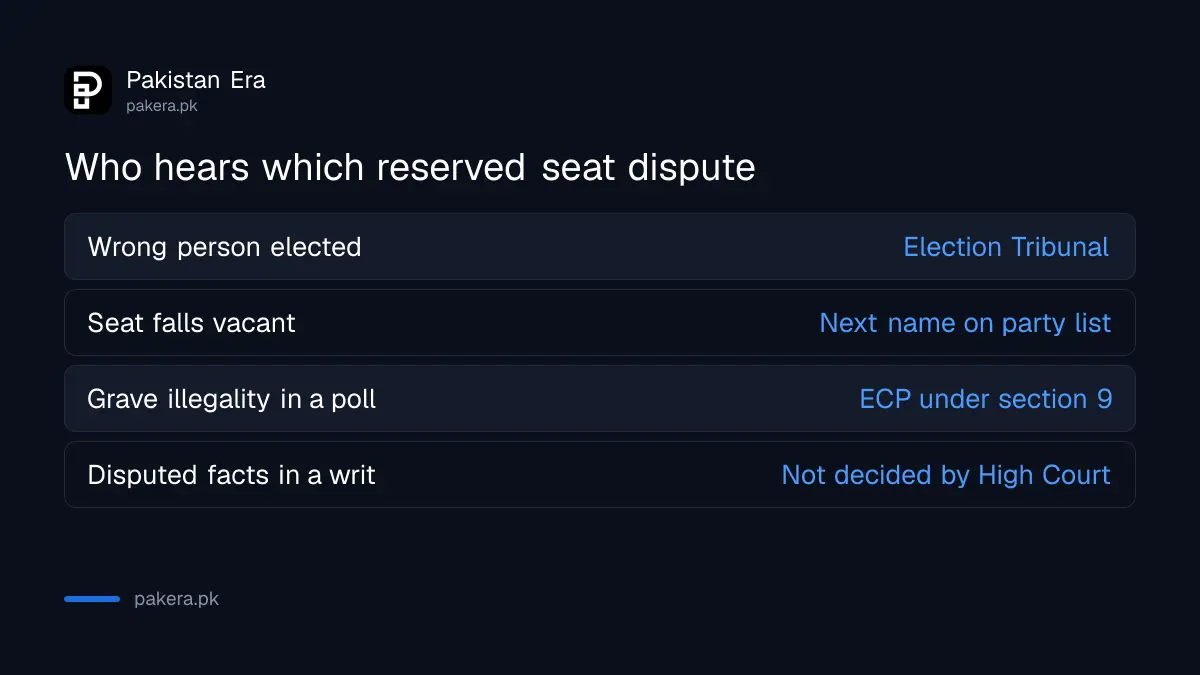
What happens next in the JUI-P dispute
Sadaf Ihsan keeps the seat unless an Election Tribunal voids her election. The court said its own remarks, and those of the ECP and High Court, do not settle the facts, and the tribunal decides standing and limitation.
Here is how the route works from this point:
- Only a candidate can file. Section 139 limits an election petition to a candidate for that election. JUI-P as a party cannot file one, and the court said that gap does not justify using constitutional jurisdiction instead.
- Hina Bibi claims to be a candidate and so may try the tribunal route. The court left it to the tribunal to decide whether her petition can be heard.
- Time limits apply. An election petition normally has to be filed within 45 days of the winner's name appearing in the official Gazette. The court said limitation is for the tribunal to decide.
- The tribunal can take evidence. Sections 141 and 148 of the Elections Act let it examine documents and witnesses, which the court said a writ court cannot do properly.
The steps, fee and deadline for an election petition are set out in how to file an election petition. Complaints about the ECP's own handling go through the ECP complaint helpline and provincial offices.
Common questions
Who holds the JUI-P women's seat from KP now?
Sadaf Ihsan. The ECP notified her on 4 March 2024, and the FCC has upheld the ECP's order of 28 January 2026 keeping her election.
Did the court decide that she was wrongly nominated?
No. It said the question needs evidence and belongs to an Election Tribunal, and that none of the remarks by the ECP, the High Court or the FCC settles it.
Can a political party file an election petition?
Under section 139 of the Elections Act 2017, an election petition is filed by a candidate for that election. The court held a party's interest in its list does not change that rule.
Does the next woman on the list get the seat if a member is challenged?
Not on a challenge alone. A seat passes down the list under Article 224(6) and section 104(5) only on a vacancy, such as death, resignation or disqualification.
Where can I read the judgment?
It is on the court's judgments page under F.C.P.L.A. No. 1712 of 2026. The search steps are in finding a Federal Constitutional Court judgment online.
How we verified this
What we checked and where we read it.
We read the full judgment in F.C.P.L.A. Nos. 1712 and 1713 of 2026, against the Islamabad High Court order of 9 June 2026 in Writ Petitions Nos. 904 and 903 of 2026, on 20 November 2026. It is listed on the Federal Constitutional Court judgments page with an upload date of 19 November 2026, signed at Islamabad on 5 November 2026 and marked approved for reporting. The Constitution and Elections Act sections cited are as quoted and described in the judgment. The 45-day limit is the general rule in section 142 of the Elections Act 2017.
About the author

Global Affairs & Political Economy Writer
Muhammad Hatim is a book lover who started writing because he enjoys it. At Pakistan Era he writes about international relations, geopolitics and the global economy, with a particular interest in South Asia and the forces behind current events.