How to File an Election Petition in Pakistan: 45 Days, Rs 20,000 Deposit and Every Step
How to file an election petition in Pakistan: who can file, the 45 day deadline from the Gazette, the Rs 20,000 deposit, the papers, the tribunal and appeals.

To challenge an election result in Pakistan, a losing candidate files an election petition with the Election Tribunal within 45 days of the winner's name appearing in the official Gazette. The petition needs a Rs 20,000 security deposit at the National Bank of Pakistan, three copies, and every other candidate named as a respondent. The tribunal must decide within 180 days.
Every by-election ends with someone unhappy. After the NA-77 Gujranwala-I and PP-203 Sahiwal-VI polls on 8 November 2026, the same question will come up again. Can the result be challenged, and by whom?
We read Chapter IX of the Elections Act, 2017, sections 139 to 158, and Rule 139 of the Election Rules, 2017. Both are on the Election Commission of Pakistan (ECP) website. This guide sets out who can file, the deadline, the fee, the papers, and what the tribunal can order.
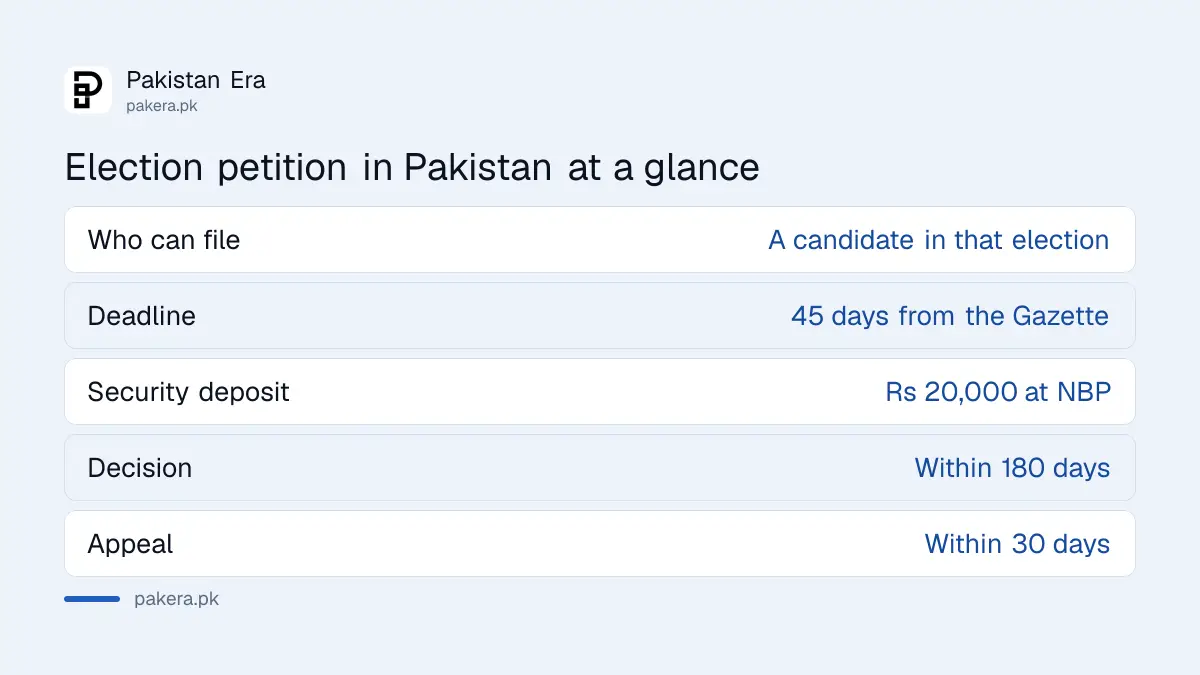
Only a candidate in that election can file a petition
Section 139 says no election can be questioned except by an election petition filed by a candidate for that election. A voter cannot file one. A party cannot file one in its own name.
This surprises people. If you are a voter and you saw rigging, your route is a complaint to the ECP, not a petition. Our page on the ECP complaint helpline for the 8 November polls gives the contacts. A candidate can then use your evidence in a petition.
The deadline is 45 days from the Gazette, not from polling day
Section 142 sets the deadline. The petition must reach the Election Tribunal within 45 days of the publication in the official Gazette of the name of the returned candidate. The returned candidate is the winner the ECP notifies.
So the clock does not start on polling day. It starts when the ECP publishes the winner's name in the Gazette, which comes after the final count on Form 49. Our guide to ECP Forms 45, 47 and 49 explains that sequence.
A petition sent by registered post or courier counts as on time if it is posted within the 45 days. Keep the receipt.
File the petition in seven steps
The Act and Rule 139 set the order. Missing any of the first five can get the petition thrown out at once under Section 145, without a hearing.
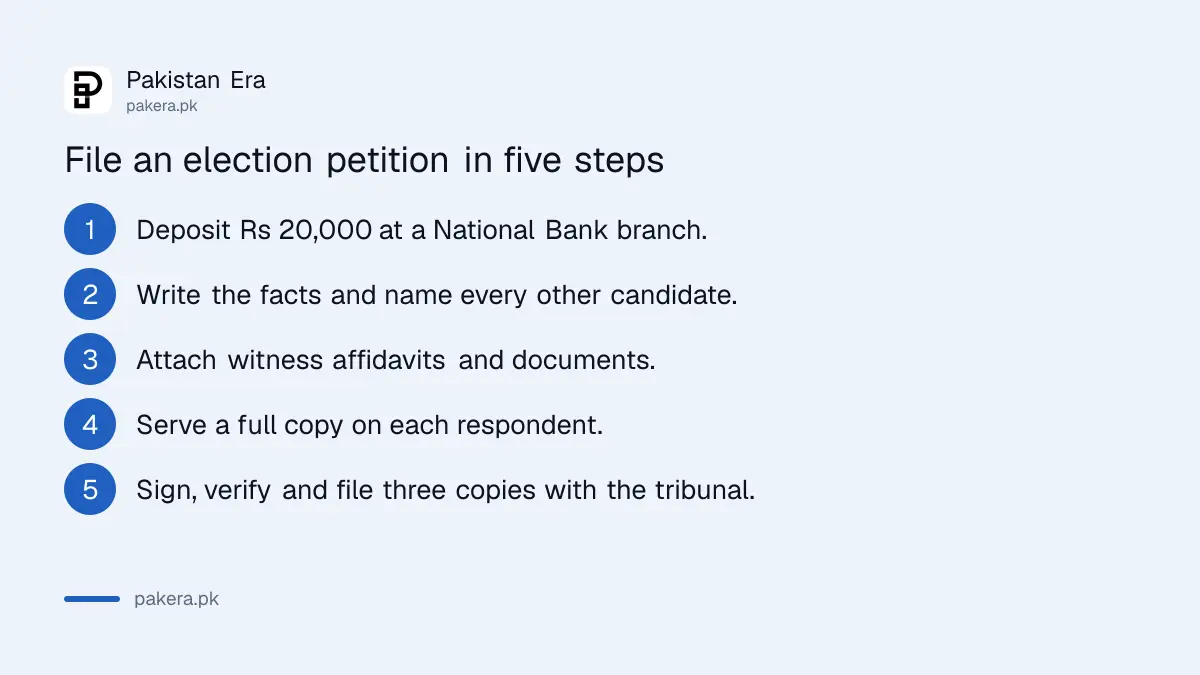
- Deposit Rs 20,000 at any National Bank of Pakistan branch as security for costs, in the ECP's head of account, and keep the receipt.
- Write the petition with a precise statement of the facts, and full details of any corrupt or illegal practice, with names, dates and places.
- Attach a list of witnesses with their statements on affidavits, and the documents you rely on.
- Name every other contesting candidate as a respondent.
- Send each respondent a full copy with all annexures, by hand, registered post or courier, and attach an affidavit saying you did so.
- Sign and verify the petition as the Code of Civil Procedure requires for pleadings.
- File it in three copies with the Election Tribunal, in person, through a person you authorise in writing, or by registered post or courier.
The Election Tribunal is a High Court judge for assembly seats
Section 140 says the ECP appoints the tribunals. For an Assembly or Senate seat, the tribunal is a sitting High Court judge, chosen in consultation with that High Court's Chief Justice. For a local government seat, it is a District and Sessions Judge or an Additional District and Sessions Judge.
| Seat | Who hears the petition | Appeal within 30 days to |
|---|---|---|
| National Assembly (such as NA-77) | A High Court judge | Supreme Court, per the Act text |
| Provincial Assembly (such as PP-203) | A High Court judge | Supreme Court, per the Act text |
| Senate | A High Court judge | Supreme Court, per the Act text |
| Local government | District and Sessions Judge | High Court, final |
The tribunal has the powers of a civil court. It can summon witnesses from anywhere in Pakistan.
The tribunal must decide within 180 days
Section 148 asks the tribunal to hear the case day to day if the parties do not agree on fixed dates. No adjournment can be longer than seven days, and each one costs Rs 100,000. The petition must be decided within 180 days of filing.
If 180 days pass, further adjournments cost Rs 10,000 to Rs 50,000 each and cannot be longer than three days. If the winner causes the delay, the tribunal can order that the winner stops working as a member until the case ends.
The tribunal can void the result, order a re-poll or seat the petitioner
Under Section 154, the tribunal can dismiss the petition. Or it can declare the winner's election void and order a fresh poll at one or more polling stations. It can declare the petitioner or another candidate elected. Or it can void the whole election and order a fresh one in the entire constituency.
Section 156 lists the grounds for voiding a win. The main ones are an invalid nomination, the winner not being qualified on nomination day, and a corrupt or illegal practice by the winner or the winner's agent. A corrupt practice by someone else does not void the win if the winner did not consent and took reasonable care to stop it.
An appeal goes up within 30 days
Section 155 gives 30 days from the tribunal's decision to appeal. The Act text on the ECP site sends Assembly and Senate appeals to the Supreme Court, and local government appeals to the High Court, whose decision is final. Each appeal must be decided within 180 days.
One caution. The Act copy on the ECP site is updated to August 2023. The 2025 constitutional changes created the Federal Constitutional Court. We could not find a consolidated Act that shows whether the appeal forum has changed, so check with a lawyer before you file.
Common questions
Can a voter file an election petition in Pakistan?
No. Section 139 of the Elections Act, 2017 allows only a candidate in that election to file one.
What is the last date to file an election petition?
Within 45 days of the publication of the winner's name in the official Gazette, under Section 142.
What is the fee for an election petition?
A security deposit of Rs 20,000 at the National Bank of Pakistan, under Rule 139 of the Election Rules, 2017. Lawyer's fees are separate.
How long does an election tribunal take?
The Act says the petition must be decided within 180 days of filing.
Can the tribunal order a re-poll at one polling station?
Yes. Section 154 lets it void the result and order a fresh poll at one or more polling stations.
What happens if I miss one of the required papers?
Section 145 says the tribunal must reject the petition summarily if Sections 142, 143 or 144 are not followed.
How we verified this
What we checked, where we read it, and what we could not confirm.
Last checked 7 November 2026. We read sections 139 to 158 of the Elections Act, 2017 (updated to 5 August 2023) and Rule 139 of the Election Rules, 2017 (updated to 31 December 2023), both on the ECP election laws page. For how laws are changed and published, see how to check the latest text of a federal law.
About the author

Global Affairs & Political Economy Writer
Muhammad Hatim is a book lover who started writing because he enjoys it. At Pakistan Era he writes about international relations, geopolitics and the global economy, with a particular interest in South Asia and the forces behind current events.