Wear an N95 or KN95 Mask in Smog: What NIH's Advisory Says for Pakistan
NIH's smog advisory names N95 and KN95 masks outdoors, shut windows and HEPA filters indoors. See who is most at risk and the steps to follow on a smog day.
Short answer: The National Institutes of Health (NIH) in Islamabad tells people in Pakistan to wear a high-quality N95 or KN95 mask outdoors during smog, to cut time outside at peak hours, and to keep windows and doors shut indoors. A loose cloth scarf is not on its list.
Walk through Lahore on a smog morning and you will see three kinds of face cover: a dupatta, a blue surgical mask and a few white N95 respirators. Only one of those three is named in the federal health advisory. We read that advisory on 12 October 2026, and this page sets out what it says in plain words.
The advisory is NIH's "Advisory for Protection and Preventive Measures against Smog", dated November 2025. It is still the latest smog advisory on the NIH advisories page. We did not find a 2026 version, so treat it as the current guidance until NIH posts a new one.
NIH names N95 and KN95 masks, not cloth or surgical masks
The advisory lists "Wear Air Purifying Respirators" and says to use high-quality N95 or KN95 masks when outdoors. It does not name surgical masks or cloth scarves. That is the one mask rule NIH puts in writing, so it is the one to follow.
An N95 or KN95 is a respirator, a mask that seals around the nose and mouth and filters fine particles. The advisory's main worry is PM2.5, particles smaller than 2.5 micrometres. They are small enough to get deep into the lungs and into the bloodstream.
The advisory puts a number on the gap. It says the World Health Organization annual guideline for PM2.5 is 5 micrograms per cubic metre, while average levels in Lahore are often 180 during peak smog season. The advisory is a document of the NIH Centers for Disease Control, so these are NIH's own figures.
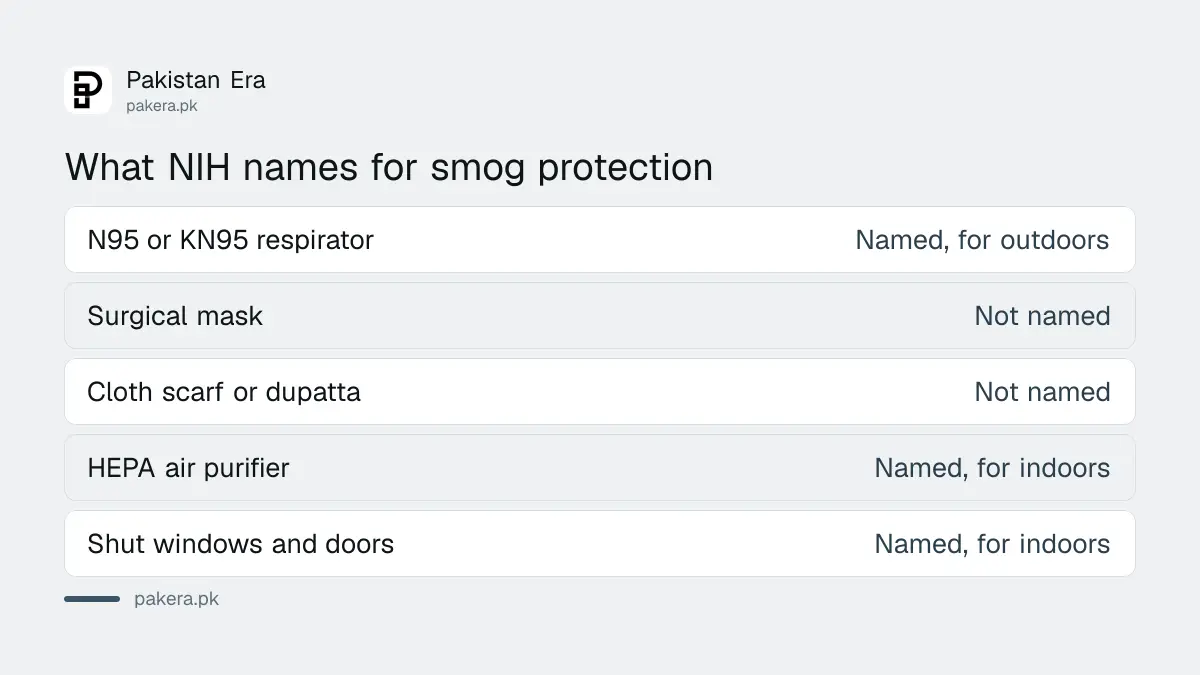
| Cover | On NIH's list? | What to do |
|---|---|---|
| N95 or KN95 respirator | Yes, named | Wear it outdoors in smog |
| Surgical mask | Not named | Not NIH's recommendation for smog |
| Cloth scarf or dupatta | Not named | Not NIH's recommendation for smog |
| HEPA air purifier | Yes, for indoors | Use it with windows shut |
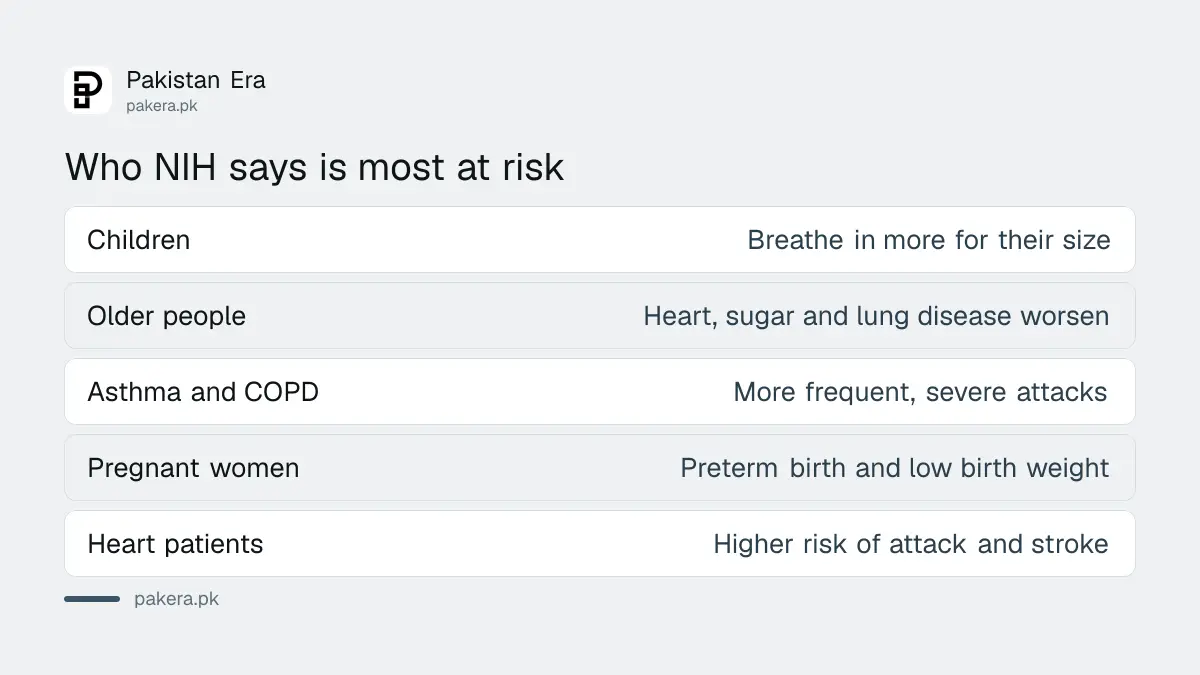
The advisory says who is most at risk
NIH names children, older people, people with asthma, COPD or other lung disease, and pregnant women. It adds that people with heart disease or diabetes are at risk too. If someone in your home is in these groups, they are the first to get the mask and the clean room.
On children, the advisory says they breathe in more pollutants for their body size, and that long exposure can affect lung growth. On older people, it says existing heart disease, diabetes and breathing problems can get worse. On pregnancy, it links smog to preterm birth and low birth weight.
The advisory also says smog is linked with more heart attacks and strokes. That is why a person with heart disease should treat a smoky week as a health risk and not only a chest problem. Our guide on how to protect children and older parents from smog in Punjab adds the Punjab EPA's advice for each AQI level.
Indoors, shut windows and use a HEPA filter
For the home, NIH says close windows and doors, use air purifiers with HEPA filters, and avoid indoor smoke such as cigarettes. HEPA is a filter grade that catches very fine particles. The advisory does not name any brand or model.
It also says to drink plenty of water and to see a health provider if symptoms persist or get worse. The advisory does not give a list of warning signs, so use plain judgment: breathlessness, chest pain or a cough that will not settle is a reason to go to a doctor.
Price is a fair concern, because a HEPA purifier is not cheap. We cover the buying side in our look at air purifiers for smog. A shut window and one smoke-free room cost nothing and are on the NIH list.
Follow the steps in this order on a smog day
Check the air first, then decide whether to go out. If you must go, wear the respirator. When you are back, keep the home sealed. The advisory is built on cutting exposure, so every step below is about doing less breathing of dirty air.
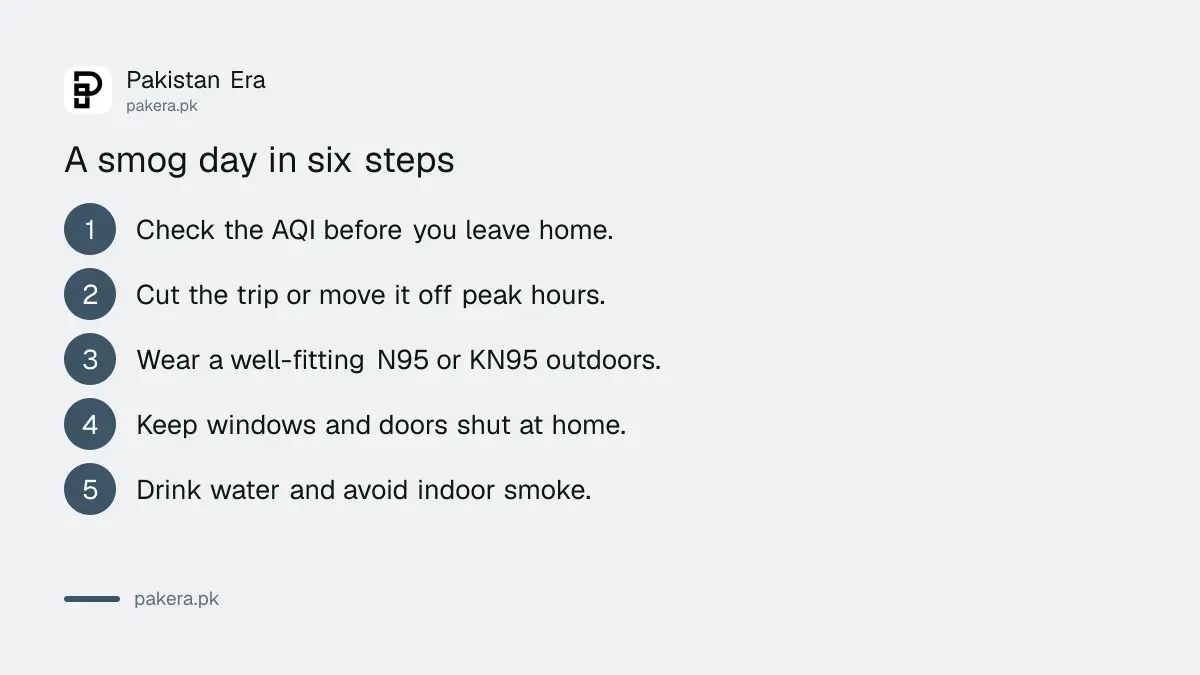
- Check the AQI on the Punjab government's air quality site before you leave. Our note on checking Lahore's air quality live shows where.
- If the AQI is high, cut the trip or move it away from peak smog hours.
- Put on a well-fitting N95 or KN95 before you step outside.
- Back home, keep windows and doors shut and run a HEPA purifier if you have one.
- Drink water through the day and do not smoke indoors.
- Call a doctor if breathing symptoms last or get worse.
The advisory leaves some questions open
NIH's text does not say how long one mask can be worn, how to test the fit, or which AQI number should trigger a mask. It also does not cover children's sizes. We will not invent answers to those. Ask a doctor or the mask maker's instructions for fit and reuse.
The advisory also asks governments for stronger rules on industry and vehicle exhaust, cleaner fuel and more public transport. Those are for the authorities. Punjab's own steps are in our report on the traffic police crackdown on smoky vehicles.
Common questions
Which mask does NIH recommend for smog in Pakistan?
NIH recommends a high-quality N95 or KN95 mask when outdoors. Its advisory does not name surgical masks or cloth scarves.
When does smog season run in Pakistan?
The advisory says seasonal smog typically runs from October to February, in the cold transition months across the Indo-Gangetic plains, which includes Punjab.
Who is most at risk from smog?
The advisory names children, older people, people with asthma, COPD or other lung disease, people with heart disease or diabetes, and pregnant women.
What should I do indoors during smog?
Close windows and doors, use a HEPA air purifier if you can, do not smoke indoors, and drink plenty of water.
Is there a newer NIH smog advisory than November 2025?
We did not find one on 12 October 2026. NIH's advisories page still lists the November 2025 advisory as the latest on smog.
How we verified this
What we checked, where we read it, and what we could not confirm.
We read NIH's smog advisory (November 2025) on the NIH advisories page on 12 October 2026. Advisories are reissued each season, so check that page for a newer version before relying on this one.
About the author

Public Services and Education Journalist
Fajr Riaz is a journalist and content writer at Pakistan Era, based in Lahore. She covers the questions people meet in everyday life in Pakistan: how a public service works, what a change in the rules means, and where to find a reliable answer.