How to Check Your Injection Syringe at a Clinic in Pakistan After DRAP's 2026 Recall Alerts
DRAP issued three syringe recall alerts in June and July 2026. See the brands named, the two kinds of failure, and four checks to make before an injection.
Before any injection, ask the nurse or doctor to open a new, sealed syringe in front of you, and look at the pack for the brand and batch number. In June and July 2026 DRAP, the Drug Regulatory Authority of Pakistan, issued three recall alerts naming syringes that failed lab tests. Two alerts said the re-use block did not work, which can spread hepatitis B, hepatitis C and HIV.
Most syringes in clinics are fine. These alerts name specific brands and batches. They matter because a syringe that can be used twice is dangerous even if it looks normal. We read the three alerts on DRAP's own website on 8 October 2026. We did not test any syringe ourselves.
DRAP named syringes in three alerts this summer
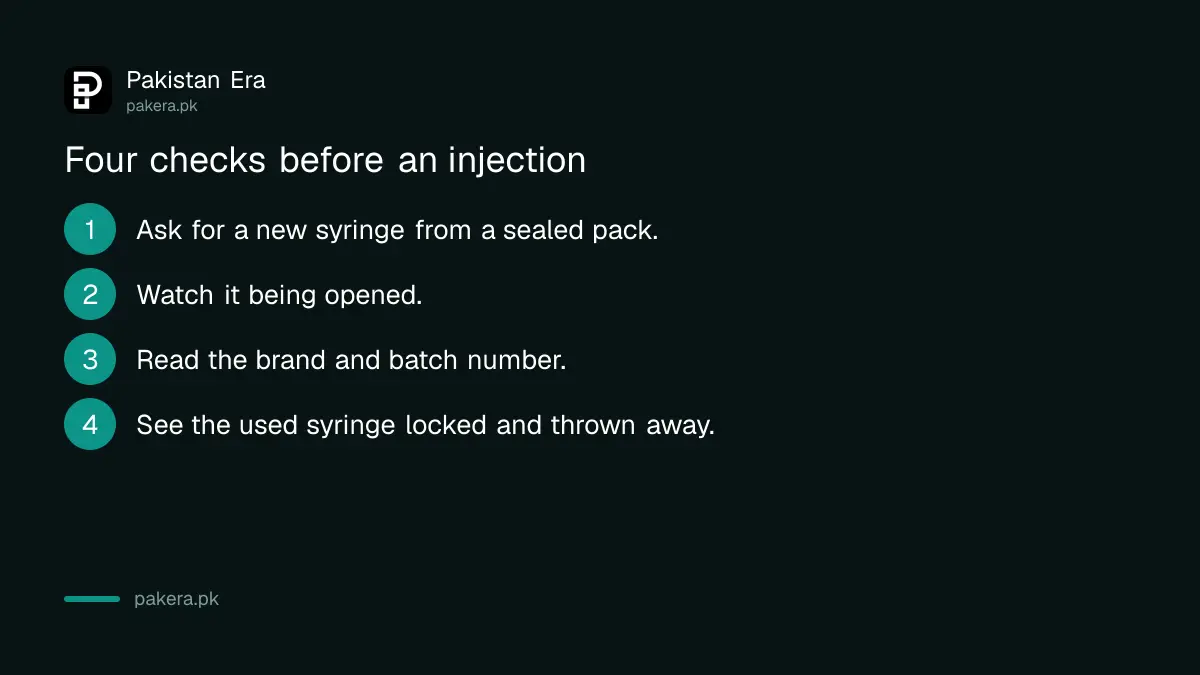
Alert 30 (1 June 2026) named seven auto-disable syringe batches. Alert 34 (8 June 2026) named three auto-disable syringe products. Alert 36 (14 July 2026) named a 10 ml syringe and a 5 ml auto-disable syringe. The test failures differ.
| Alert and date | Product named by DRAP | Test failed |
|---|---|---|
| 30, 1 June 2026 | Seven batches of Zindagi, Biosoft, I.CO, Injekt and Yashfaeen auto-disable syringes, 3 ml to 5 ml | Re-use prevention feature |
| 34, 8 June 2026 | Clinic Auto Disable 3 ml (batch 3-01B-26), Medi Aqua Auto Disable 3 ml (batch AD1B25), Ultra Fine SMD Painless 3 ml (batches 3088CL, 3090CL, 3013DC) | Re-use prevention feature |
| 36, 14 July 2026 | BD 10 ml syringe (batch 5349764) | Absorbance test |
| 36, 14 July 2026 | Accuject Auto-Disable 5 ml (batch S502E26) | Sterility test |
We read Alert 30 only as a summary and did not get all seven batch numbers. For those, open the alert on the Recall Alerts page at dra.gov.pk.
Two kinds of failure carry two kinds of risk
A re-use prevention failure means the syringe may not lock after one use. DRAP says this raises the risk of hepatitis B, hepatitis C and HIV. A sterility failure, in the Accuject batch, means germs may be present, which DRAP says may raise the risk of serious infection.
The absorbance failure for the 10 ml syringe, in simple words, indicates more extractable substances than allowed. DRAP lists it as substandard. It did not give any patient advice beyond the recall.
Check four things before an injection
These steps are common-sense safety, not a DRAP rule. They take one minute and a polite request. A good clinic will not mind.
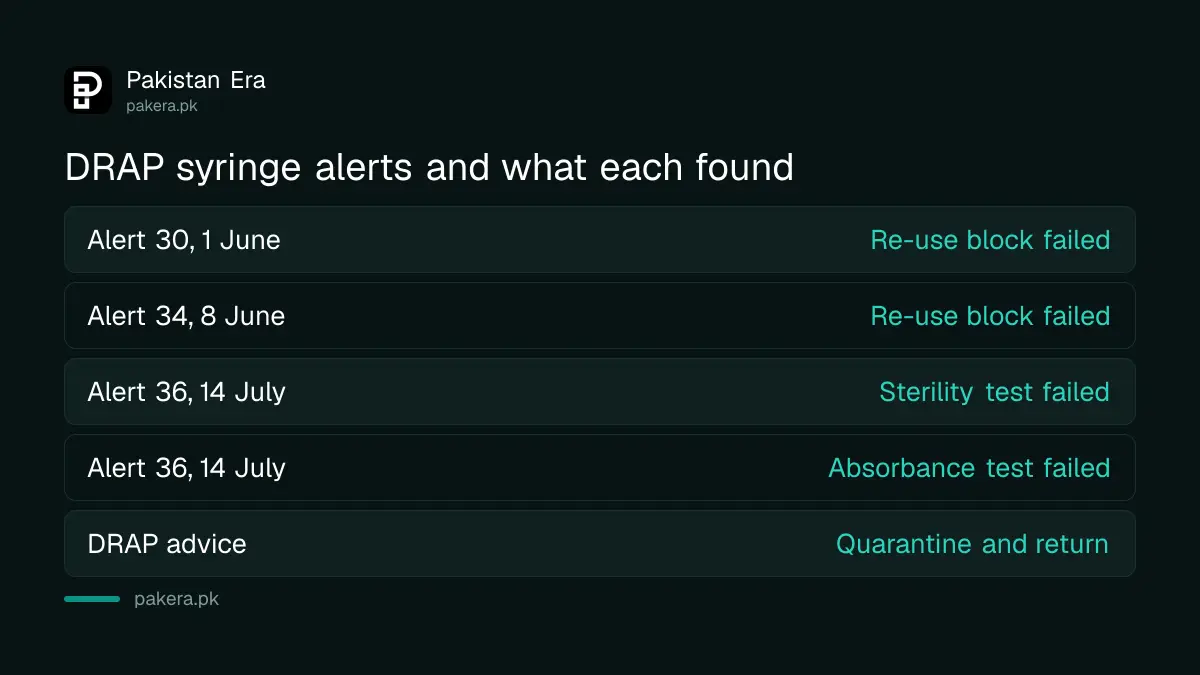
- Ask for a new syringe taken from a sealed pack.
- Watch it opened. Do not accept one already out of its wrapper.
- Look at the pack for the brand and batch number. Compare it with the table.
- Ask that the used syringe is locked or broken and thrown in a box in front of you.
If the brand and batch match an alert, politely ask for another one and tell the clinic about the alert. Do not argue. If you feel unwell afterwards, see a doctor. We cannot tell you what a symptom means.
What DRAP asks clinics and pharmacists to do
DRAP told pharmacists to check their stock and stop supplying the named batches. It told health facilities to quarantine and return them. It asked that problems be reported to its National Pharmacovigilance Centre.
So a clinic or pharmacy that sells a named batch after the alert is not following DRAP's instruction. If you buy syringes for home use, for example for a family member who needs regular injections, check the pack against the table and buy from a licensed pharmacy. Our guide to checking a pharmacy's drug licence in Punjab shows how.
Report a problem and check the clinic
Report a syringe you think is faulty to DRAP through the "Report a Problem" link on dra.gov.pk. Write the brand, batch, shop or clinic, and date. The steps are in the guide to reporting a medicine side effect to DRAP, and the guide to checking if a medicine batch is recalled works the same way for a recalled pack.
If a clinic keeps using syringes it should not, you can complain to the health regulator. See the guide to complaining against a hospital or doctor in Punjab. In KP, a licensed clinic list is explained in the guide to checking a clinic or lab is licensed in KP. To check the person treating you, use the guide to checking a doctor is registered with PMDC.
Worried about a past injection? Free hepatitis tests exist. See the guide to free hepatitis tests and treatment, and speak to a doctor about whether a test makes sense for you.
What we could not confirm
We could not confirm that any of these batches reached a clinic you may visit. DRAP's alerts name products found by testing, not where they were used. We did not get the full batch list for Alert 30. This guide is not medical advice.
Common questions about substandard syringe alerts
What is an auto-disable syringe?
It is a syringe designed to lock after one use so it cannot be used again. DRAP's alerts name some that failed the lock test.
Does an alert mean my clinic uses bad syringes?
No. The alerts name specific brands and batches. Most clinics use others. Ask to see the pack to be sure.
Can I refuse an injection if the pack is opened?
Yes. You can ask for a new sealed syringe. It is a reasonable request, and a good clinic will agree.
Should I get tested if I had an injection recently?
Speak to a doctor. They will decide whether a test is needed. Free tests for hepatitis are available at some centres.
Where do I find the full alerts?
On the Recall Alerts page under Safety Info at dra.gov.pk. They are numbered 30, 34 and 36.
Last checked 8 October 2026 on DRAP recall alerts 30, 34 and 36.
About the author

Senior Writer, Public Services and Technology
Shahid joined us in 2024 as an author. He is a senior contributor to Pakistan's leading technology websites. He writes detailed articles, mostly covering his expertise in the latest tech, mobiles, apps, gadgets, and step-by-step guides. His ideology is to help people understand the latest trends and explain complex methods through very easy-to-understand guides.