How to Report a Medicine Side Effect to DRAP
Had a bad reaction to a medicine or vaccine in Pakistan? Report it to DRAP online in English or Urdu, or by phone. What the form asks and what to keep ready.
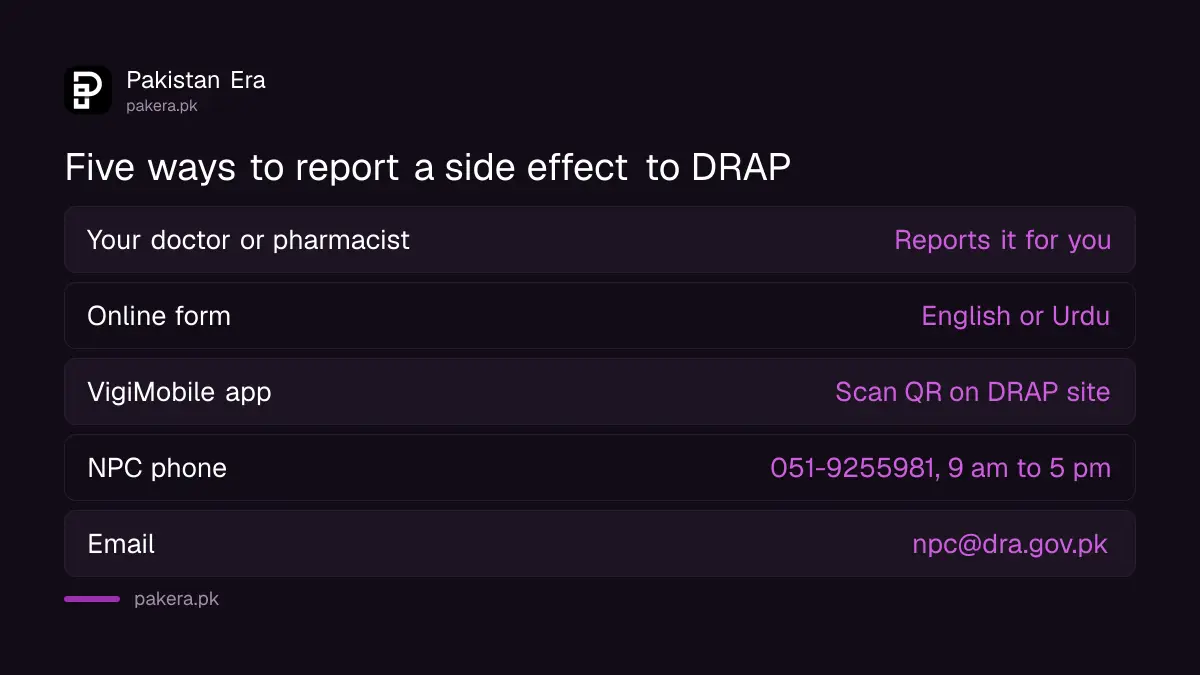
To report a medicine side effect in Pakistan, use DRAP's Med Vigilance E Reporting System at vigiflow-eforms.who-umc.org/pk/adr, in English or Urdu. You can also call the National Pharmacovigilance Centre on 051-9255981, 9 am to 5 pm on working days, or email npc@dra.gov.pk. Tell your doctor first, and do not stop a medicine on your own.
A rash two days after a new antibiotic. Swollen lips after a painkiller. A child who will not stop vomiting after a syrup. Most families tell the doctor, change the medicine and move on. Few know the report can go further, to the Drug Regulatory Authority of Pakistan (DRAP), which can change a warning or pull a product. We read DRAP's reporting pages, its October 2025 guidelines for patients and the online form itself, so you know what to have ready.
DRAP says anyone can report: patients, carers, relatives and health workers. You do not need a doctor's permission, and you do not need to be sure the medicine caused the problem.
DRAP's National Pharmacovigilance Centre collects side effect reports
The National Pharmacovigilance Centre (NPC) is the DRAP unit in Islamabad that tracks harm from medicines after they reach the market. Pharmacovigilance simply means watching medicines for safety. The NPC collects reports from patients, doctors, companies and provincial centres, then looks for patterns.
Why does this matter? Clinical trials test a medicine on a limited group of people. Rare reactions often show up only after thousands of people use it. DRAP's patient guidelines say this plainly, and that is why your one report counts.
When the NPC finds a real safety signal, its guidelines say DRAP may:
- add a new warning or contraindication, a condition in which the medicine should not be used
- remove an approved use for some diseases or age groups
- give advice on how the medicine should be used
- in some cases, stop the use of the medicine
The same system covers vaccines, medical devices and alternative medicines, not just tablets and syrups.
Report any unusual effect, mild or serious
DRAP asks you to report any unusual symptom you suspect came from a medicine, even a mild one. Serious events should be reported as soon as possible. You do not have to prove the medicine caused it. DRAP's experts make that judgement.
DRAP's guidelines define a serious event as one that:
- causes death
- is life threatening
- needs a hospital stay or makes one longer
- causes lasting disability
- causes a birth defect
- is judged medically important for another reason
Vaccines count too. A reaction after a jab, such as a flu vaccine, is what DRAP calls an AEFI, an adverse event following immunization. It goes through the same form.
One honest caution. If the reaction is severe, such as trouble breathing or a swollen face, get medical help first. A report helps others later. It does not treat the patient now.
Keep the medicine box: the form asks for six things
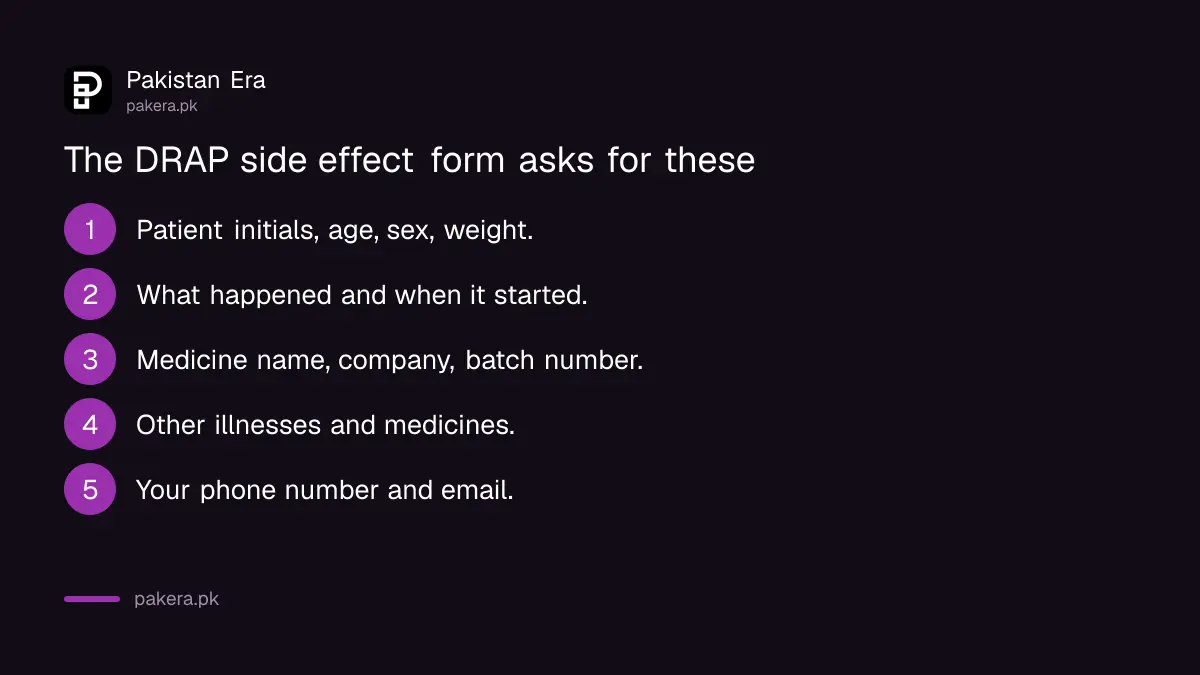
The online form asks about the patient, the reaction, the medicine, other illnesses and your contact details. The medicine box matters most, because it carries the brand name, company and batch number. Without a batch number, DRAP cannot trace a bad lot.
| Section of the form | What you enter |
|---|---|
| User of the medicine | Initials, sex, age or date of birth, weight, province |
| Reactions or symptoms | What happened in your own words, start date, outcome, seriousness |
| Medicines | Medicine name, company name on the pack, batch number, dose, how it was taken, dates |
| Reason for taking it | The illness, for example diabetes or headache |
| Current and previous illnesses | Medical history, allergies, other medicines taken at the same time |
| Contact details | Email and phone number, so the NPC can follow up |
The form lets you add more than one medicine and more than one reaction. It also asks what you did with the medicine after the reaction: stopped it, lowered the dose or kept going. Give a phone number. DRAP's guidelines say the NPC contacts reporters when key details are missing and for serious cases.
Before you report, it helps to check the medicine is registered with DRAP. Its registration number sits on the pack, close to the batch number.
Reporting online takes seven steps
Open the DRAP form, choose English or Urdu, accept the terms, describe the reaction, add the medicine details from the box, add the patient and your contact details, then review the summary and submit. A confirmation email follows once the NPC receives it.
- Open the form. DRAP links to the Med Vigilance E Reporting System from its safety reporting page.
- Pick your language. English and Urdu are both offered.
- Say who you are. Choose the option for reporting for yourself or a relative, and accept the terms.
- Describe the reaction. Give the start date, what happened and the outcome. Tick a seriousness box if it applies.
- Add the medicine. Copy the name, company and batch number from the pack.
- Add the patient and your contact details. Initials are enough for the patient.
- Review and send. Ask for the email receipt and keep the case number.
The form saves drafts on your phone and sends queued reports when you are back online. That helps if your signal is weak.
DRAP also offers VigiMobile, a phone app made for the NPC by the Uppsala Monitoring Centre, which works with the World Health Organization. DRAP's guidelines say it is not in the Google or Apple app stores. You open it by scanning the QR code on DRAP's website. DRAP now asks people to use this instead of the older Med Safety app, which is no longer available for reporting in Pakistan.
Report through one channel only
DRAP accepts reports through your doctor or pharmacist, the online form, the VigiMobile app, the NPC phone line or the company that makes the medicine. Use only one. If your doctor has already reported the reaction, do not report it again.
DRAP's first advice is to tell your doctor or pharmacist. They can check the reaction in person and report it for you on the yellow form health workers use. Report it yourself if you cannot reach them or they will not do it.
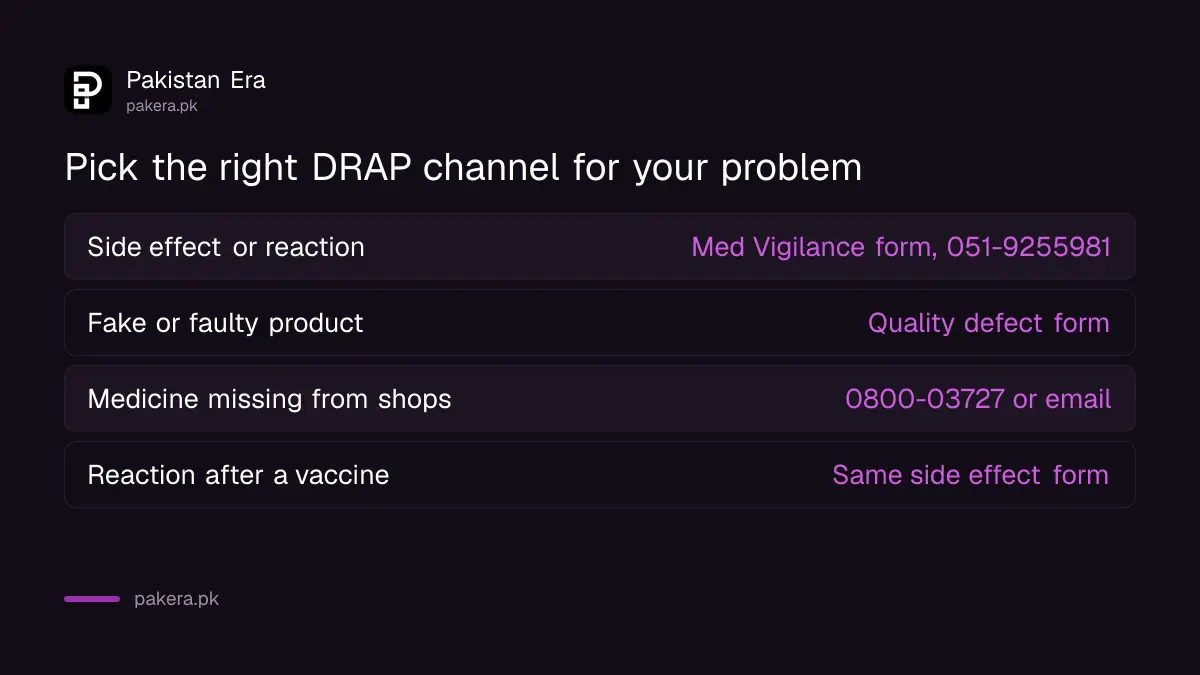
A side effect is not the same as a bad product. If the tablets look wrong, the syrup is cloudy or the pack seems fake, that is a quality defect. DRAP takes those on a separate product quality defect form, which asks for the batch number, expiry date and where you bought it. Bad batches can lead to a recall, like the Punjab recall of DryGlit syrup and three other medicines in September 2026.
If a medicine is missing from shops, that is a third route. DRAP takes shortage reports on its toll-free number 0800-03727 during working hours, or by email at drugshortages@dra.gov.pk.
Common questions
Can a patient report a side effect directly to DRAP?
Yes. DRAP says anyone can report, including patients, carers and relatives, through the online form, the VigiMobile app or the NPC phone line.
Should I stop the medicine if I get a side effect?
Not on your own. DRAP's guidelines warn that stopping treatment can sometimes be more harmful than a mild reaction. Speak to your doctor first.
Can I report in Urdu?
Yes. The online form and the VigiMobile app are both available in English and Urdu.
What if I do not know the batch number?
Send the report anyway with whatever you have. The batch number helps DRAP trace a bad lot, so check the strip, bottle or box before you throw it away.
Will DRAP reply to me?
You get a confirmation email when the NPC receives your report. Its staff may call or email if details are missing or the case is serious.
Can I report a reaction after a vaccine?
Yes. DRAP's guidelines cover adverse events after immunization through the same form, app and phone line.
How we verified this
What we checked, where we read it, and what we could not confirm.
We checked this on 3 October 2026 on DRAP's own pages: Safety Reporting, Adverse Events Reporting, Product Quality Defects and Public Medicine Shortage Reporting. We also read DRAP's Adverse Events Reporting Guidelines for Patients, Caregiver and Consumers, 2nd edition, effective 23 October 2025, and the field list of the Med Vigilance E Reporting System form, which is hosted for DRAP on a World Health Organization partner server. The NPC's address is the Prime Minister's National Health Complex, Park Road, Islamabad.
About the author

Public Services and Education Journalist
Fajr Riaz is a journalist and content writer at Pakistan Era, based in Lahore. She covers the questions people meet in everyday life in Pakistan: how a public service works, what a change in the rules means, and where to find a reliable answer.