Punjab Recalls DryGlit Syrup, Trezine, Zinad and Bemin Batches
Punjab has recalled DryGlit syrup batches S13326 and S13426 plus Trezine, Zinad and Bemin, press reports say. Check the batch on your pack and what to do.
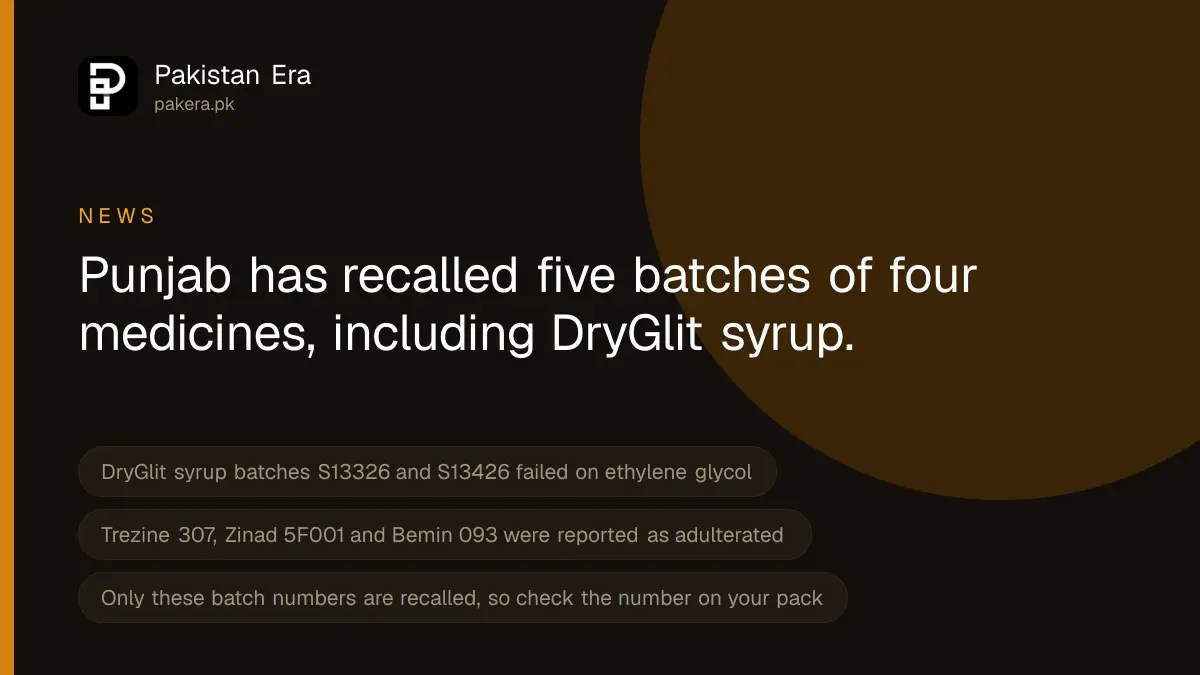
Punjab health authorities have recalled five batches of four medicines: DryGlit 120 mL syrup (batches S13326 and S13426), Trezine cetirizine 10mg (batch 307), Zinad tizanidine 2mg (batch 5F001) and Bemin mecobalamin 500mcg (batch 093). Check the batch number on your pack. If it matches, stop using it and take it back to the pharmacy.
These details come from news reports of the alert. Punjab has not yet posted it on its own drug advisory list, so treat the batch details as unconfirmed until it does. Checking your pack costs nothing either way.
The syrup is the one to look at first. The Drug Testing Laboratories Punjab found that the ethylene glycol in DryGlit went above the permitted limit, according to the reports. Ethylene glycol is a toxic chemical that should never be in a medicine people swallow. The other three were declared "adulterated". That is a legal term under the Drugs Act 1976, and DRAP has used it for medicines whose contents are wrong or misleading.
This Punjab medicine recall covers only the listed batch numbers. Other batches of the same brands are not named in it. That detail matters, because the brand name alone tells you nothing.
Five batches of four medicines are in the Punjab recall
The recall names DryGlit syrup, Trezine, Zinad and Bemin. DryGlit has two batches listed and the others one each, so there are five batch numbers in total. Pharmacies, wholesalers, distributors and hospitals have been told to stop dispensing them immediately and report their stock to drug inspectors.
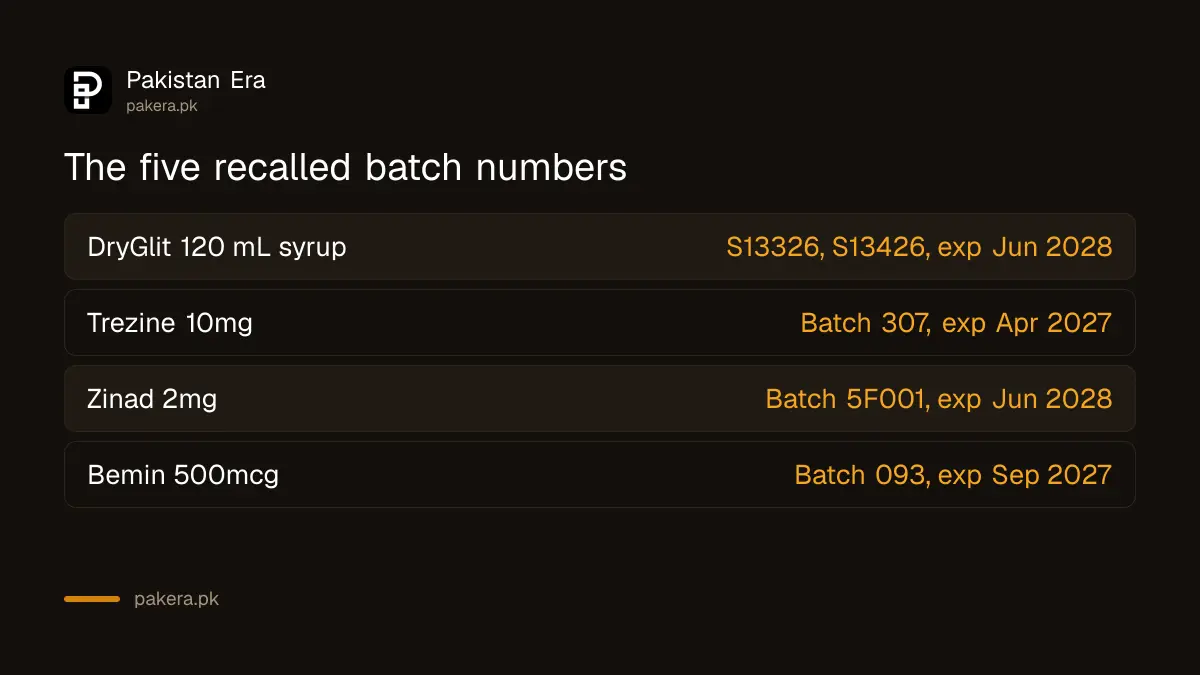
| Product | Medicine inside | Batch | Expiry | Problem |
|---|---|---|---|---|
| DryGlit 120 mL syrup | Not given in the reports | S13326 and S13426 | June 2028 | Substandard, ethylene glycol above the limit |
| Trezine 10mg | Cetirizine, an allergy medicine | 307 | April 2027 | Adulterated |
| Zinad 2mg | Tizanidine, a muscle relaxant | 5F001 | June 2028 | Adulterated |
| Bemin 500mcg | Mecobalamin, a form of vitamin B12 | 093 | September 2027 | Adulterated |
Manufacturers and market authorisation holders (the companies that hold the licence to sell each product) have been told to start the recall and send a recall assessment, a root cause analysis and a plan to stop it happening again, according to the reports. The reports do not name the makers.
Reports differ on the date. One says the alert was issued on 23 September 2026, and another carried it on 24 September. We could not read the alert itself, so we cannot settle which is right.
Ethylene glycol in a syrup is a serious fault
Ethylene glycol is an industrial chemical used in antifreeze. It usually gets into a syrup through a contaminated batch of a sweet solvent such as glycerin or propylene glycol. Swallowed, it can damage the kidneys, and children are most at risk.
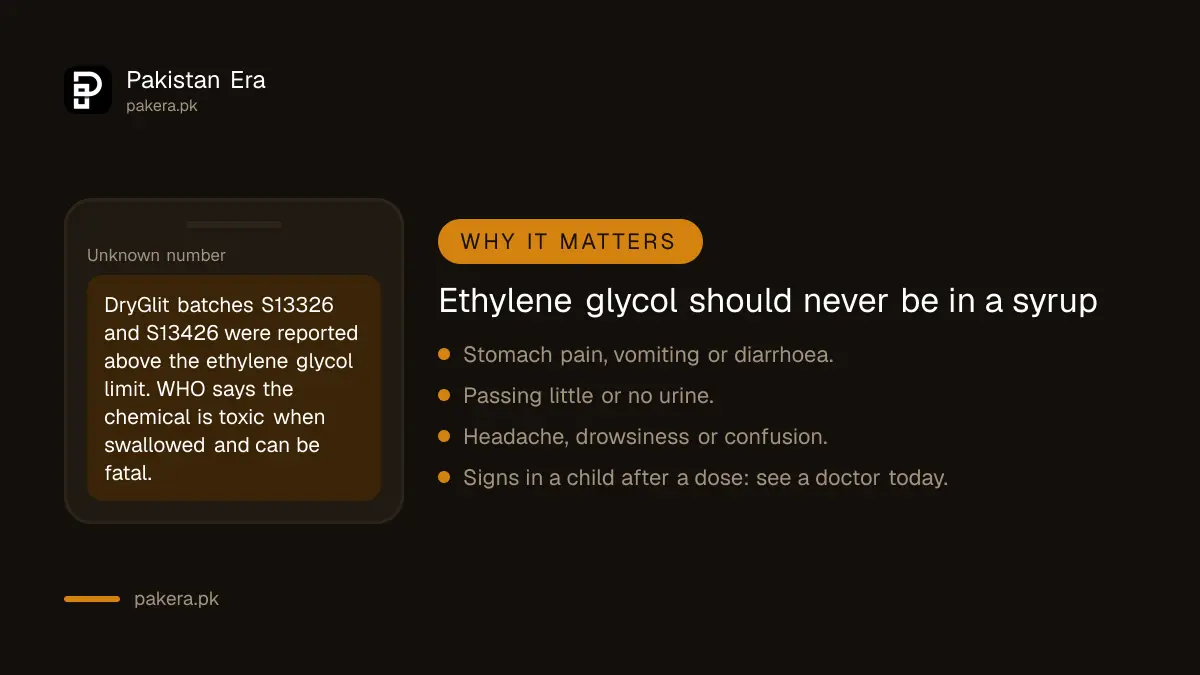
This is not a theoretical risk. In October 2022 the World Health Organization warned about contaminated cough syrups for children in The Gambia. It said diethylene glycol and ethylene glycol "are toxic to humans when consumed and can prove fatal".
The WHO lists these warning signs: stomach pain, vomiting, diarrhoea, being unable to pass urine, headache, confusion or a changed mental state, and sudden kidney injury. A small child gets a bigger dose for their body weight from the same spoonful, which is why a syrup is more worrying than a tablet.
Keep this in proportion. A lab result above the limit is not a report that anyone has been harmed. Neither report mentions anyone falling ill. But if someone in your home took it and now has any of those signs, see a doctor today and take the bottle with you.
You can check the batch number on the pack in under a minute
Medicine packs carry a printed batch number and an expiry date. Look for "Batch No.", "B. No." or "Lot" on the box, the bottle label or the edge of the tablet strip. Compare it, letter by letter, with the five numbers in the table above.
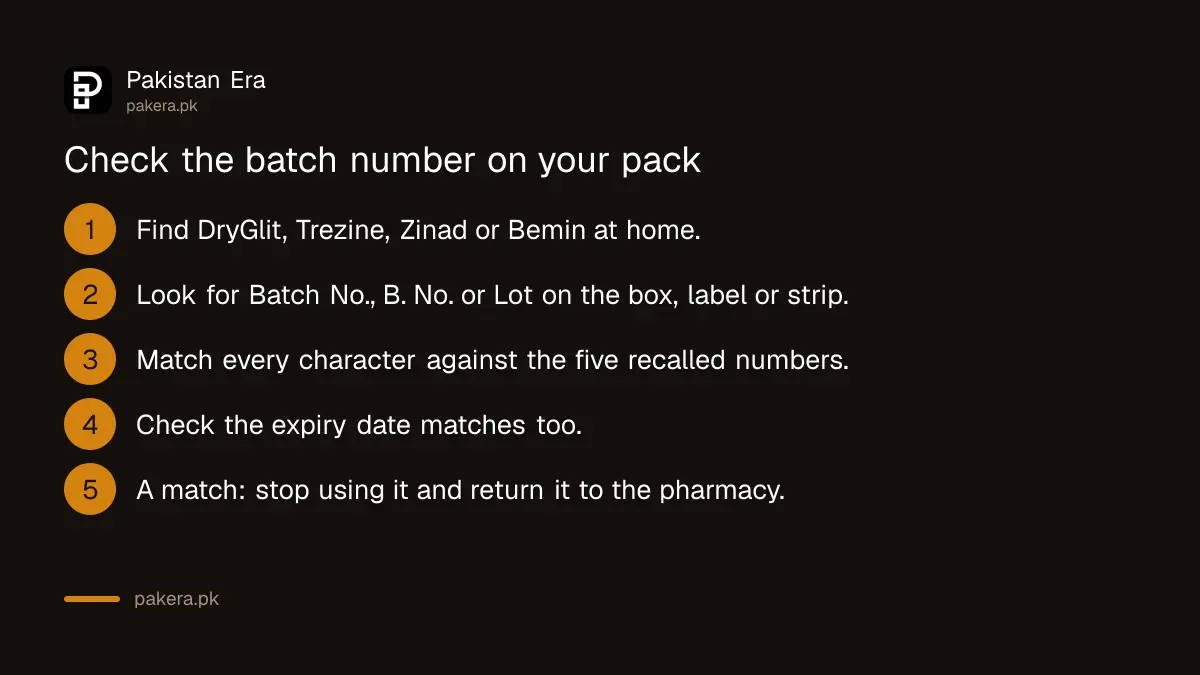
- Find the medicine at home. Check the brand name first: DryGlit, Trezine, Zinad or Bemin.
- Look for the printed batch number. On a strip it is usually pressed into the foil edge. On a bottle it is on the label or the bottom.
- Match every character. For DryGlit, only S13326 and S13426 are recalled. For Zinad it is 5F001, for Trezine 307 and for Bemin 093.
- Check the expiry date too. It should read June 2028 for DryGlit and Zinad, April 2027 for Trezine and September 2027 for Bemin.
- If the numbers do not match, your pack is not in this recall. If they do, set it aside and follow the steps in the next section.
Tablets cut from a strip and handed over loose are the hard case. If you cannot see a batch number, go back to the pharmacy that sold them and ask which batch it was.
Stop using a recalled batch, but ask a doctor about a prescribed medicine
If your pack matches, stop using it. Do not throw it away or flush it. Take it back to the pharmacy you bought it from. If you take Zinad or another prescribed medicine every day, talk to your doctor about a replacement before you stop.
Tizanidine is the main case where that caution applies. Zinad is a muscle relaxant, and people on it are usually on it for a reason. Your doctor can move you to a different batch or a different brand of the same medicine. Cetirizine and vitamin B12 tablets are usually easier to swap, but the doctor or pharmacist should still make that call.
Keep the pack, the receipt if you have one, and a note of when you bought it. The pharmacy should take it back. Medical stores have been told to stop dispensing these batches and report their stock, so a refusal is worth reporting. Defective goods a seller will not refund or replace are also the kind of dispute you can take to consumer court without a lawyer.
Report a bad medicine to DRAP or call 1033 in Punjab
Anyone can report a side effect or a faulty medicine to the Drug Regulatory Authority of Pakistan (DRAP). Use its online reporting link or its quality defect form. In Punjab, the free Healthline 1033 runs all day, every day, and you can speak to a doctor there.
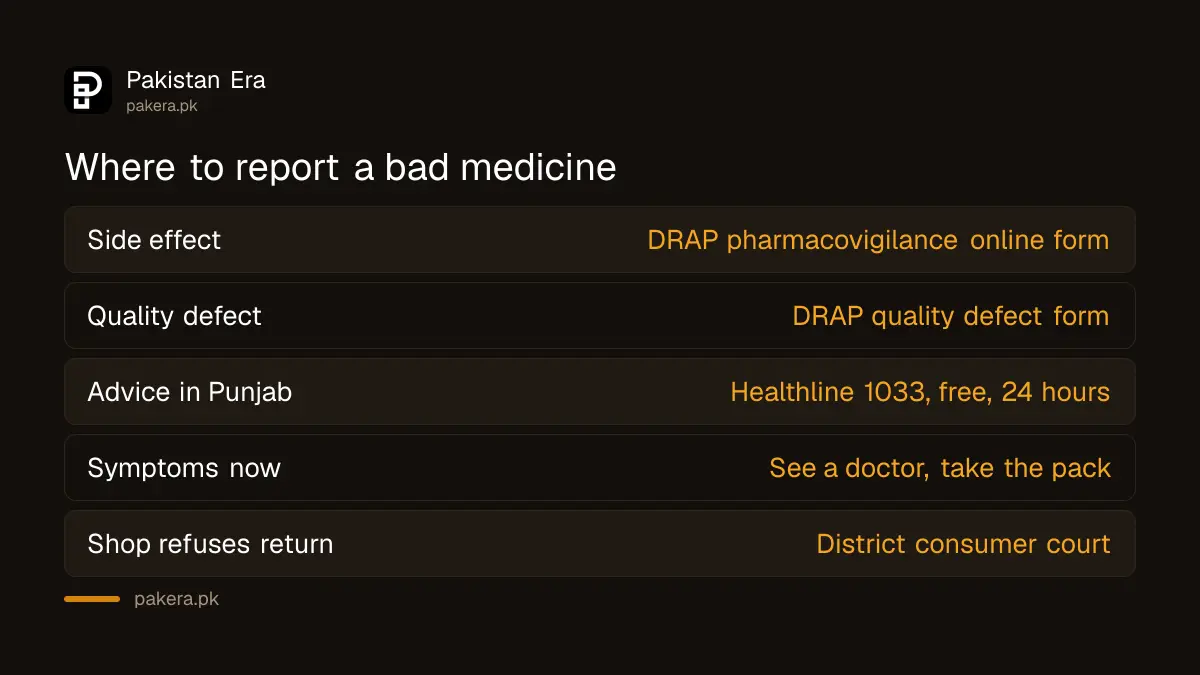
DRAP is the federal body that registers medicines and handles their price approvals. It also runs the reporting system. When we opened its safety reporting page on 24 September 2026, it said patients, carers and health workers can all report directly. Side effects go to the National Pharmacovigilance Centre, the DRAP unit that tracks harm from medicines, through an online form it links to. Quality problems with a product go through a separate form run by its Quality Assurance and Lab Testing Division. DRAP also says that if you think you have had a reaction, you should first speak to a health professional, who can report it for you.
The same day we opened the Healthline 1033 page on the Punjab Primary and Secondary Healthcare Department website. It describes 1033 as a toll free line run 24 hours a day, 365 days a year, where callers can talk to women medical officers. If your complaint is about how a clinic or hospital treated you rather than about the medicine, a complaint against a hospital or doctor in Punjab goes to a different body.
Punjab has flagged these same medicine types before
This is not the first alert for any of the four. When we went through Punjab's own list of drug advisories on 24 September, it already showed an earlier Bemin batch, a tizanidine tablet, cetirizine brands and an oral liquid with ethylene glycol, all declared faulty earlier in 2026.
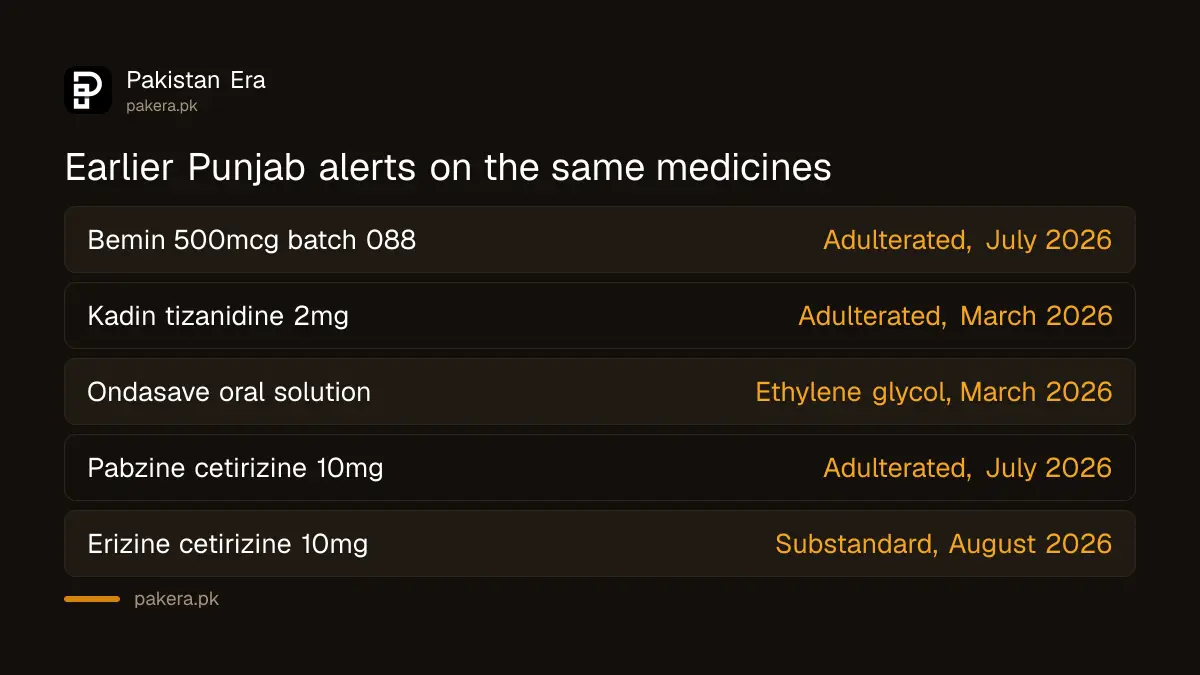
- Bemin 500mcg, batch 088. Declared adulterated and substandard. The Directorate of Drugs Control Punjab issued a prompt alert on 22 July 2026 and then stopped six more batches, 087, 104, 107, 108, 111 and 117, pending investigation. The maker named was BJ Pharmaceuticals, Lahore. Batch 093 was not in that list.
- Kadin tizanidine 2mg, batch 569. Declared adulterated in a recall posted in March 2026.
- Ondasave oral solution. Declared substandard in March 2026 for ethylene glycol above the permitted limit.
- Cetirizine 10mg tablets. Brands including Pabzine, Aksozine, Citraclor and Erizine were recalled between June and August 2026.
That list on the department website stops at 11 August, so it does not yet carry this week's alert. It also does not tell us whether the new Bemin batch comes from the same maker, and we have not assumed it does. What the pattern does show is that the same medicine types keep failing. Buying from a licensed pharmacy is the first protection. Checking the batch is the second. The same habit of checking before you trust applies when you check whether a blood bank is licensed in Punjab.
We also went through DRAP's national recall list the same day. Its newest entry was dated 29 July 2026, and none of these four products was on it. So, as of 24 September, this is a Punjab recall. DRAP has in the past turned Punjab lab results into national alerts, but it had not done so here when we checked.
Common questions
Which medicines has Punjab recalled on 24 September 2026?
DryGlit 120 mL syrup batches S13326 and S13426, Trezine 10mg batch 307, Zinad 2mg batch 5F001 and Bemin 500mcg batch 093. Only those batch numbers are recalled.
Is every DryGlit syrup unsafe?
No. The recall names two batches, S13326 and S13426, both with a June 2028 expiry. Other batches are not named. Check the number on your bottle.
What should I do if my child took DryGlit from a recalled batch?
Stop giving it. If the child has stomach pain, vomiting, is passing little or no urine, or seems drowsy or confused, see a doctor straight away and take the bottle.
Can I stop taking Zinad on my own?
Ask your doctor first. Stop the recalled batch, but get a replacement from a different batch or brand arranged before you go without it.
Will the pharmacy take back a recalled medicine?
It should. Pharmacies and distributors have been told to stop dispensing these batches and report their stock to drug inspectors. Keep the pack and any receipt.
Has DRAP issued a national recall for these batches?
Not when we checked on 24 September 2026. DRAP's newest recall alert was dated 29 July 2026 and did not include these products.
How we verified this
What we checked, where we read it, and what we could not confirm.
Last checked 24 September 2026. The four products, five batch numbers, expiry dates and the substandard and adulterated findings come from news reports, which agree on every batch and expiry but differ on whether the alert was issued on 23 or 24 September. We could not read the alert itself: the drug advisory list on the Punjab Primary and Secondary Healthcare Department's Drug Control page ends at 11 August 2026, and the Specialized Healthcare department's site did not load. The earlier Bemin, Kadin, Ondasave and cetirizine alerts are from that official list. We read DRAP's safety reporting page and its recall alerts list, whose newest entry was 29 July 2026. The ethylene glycol warning signs are from the WHO medical product alert of 5 October 2022. Healthline 1033 details are from the Punjab department's own page.
About the author

Public Services and Education Journalist
Fajr Riaz is a journalist and content writer at Pakistan Era, based in Lahore. She covers the questions people meet in everyday life in Pakistan: how a public service works, what a change in the rules means, and where to find a reliable answer.