How to Take a Shop to Consumer Court, Free and Without a Lawyer
There is no court fee, you can file on plain paper, and you do not need a lawyer. What consumer courts cover and how to file a claim.
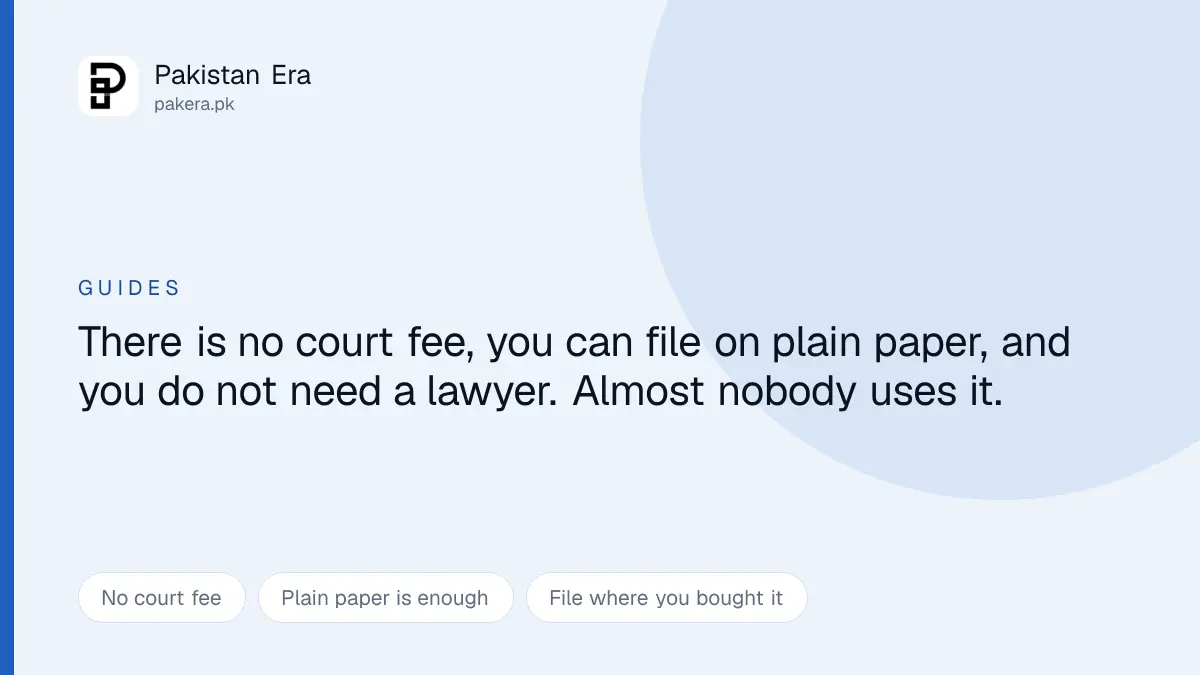
If a shop sold you something faulty and will not put it right, you can take them to a consumer court. There is no court fee. You can file on plain paper. You do not need a lawyer.
All three of those are true, and almost nobody knows it, which is why these courts are used far less than the volume of complaints in Pakistan would suggest.
Three facts that change the calculation
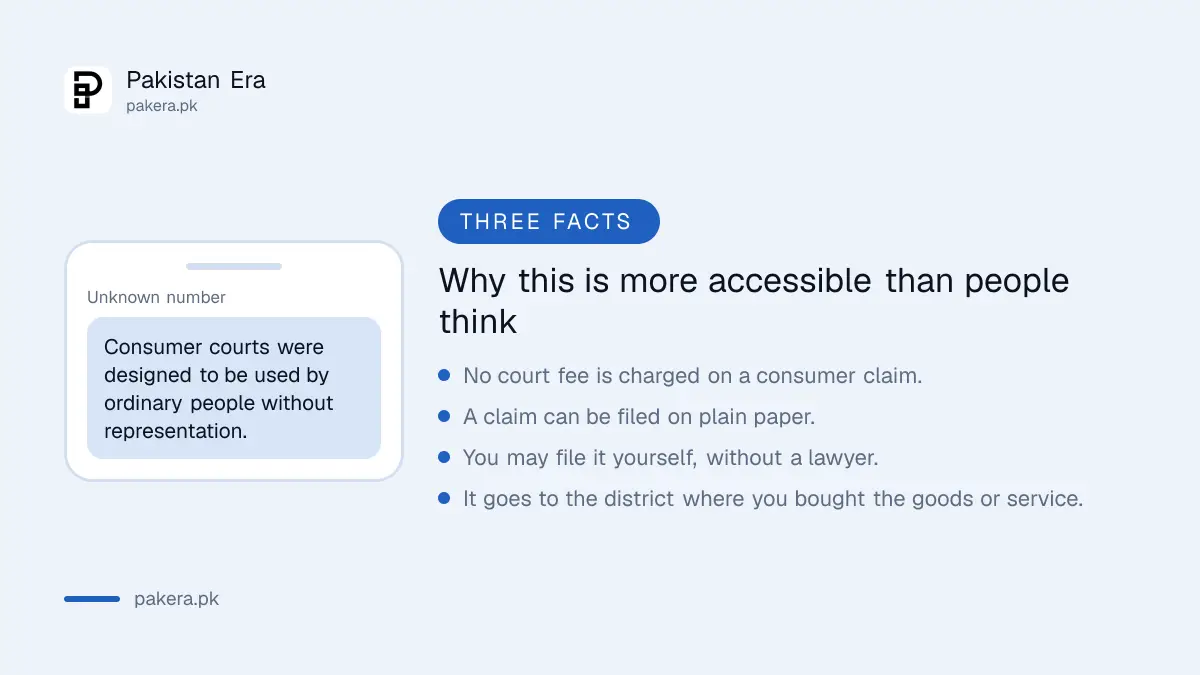
- No court fee is charged on a claim filed to protect consumer rights.
- A claim can be written on plain paper. There is no prescribed expensive form and no stamp paper requirement to start.
- You may file it yourself. Representation is allowed, not required. The forum was designed for ordinary people.
Put together, the cost of trying is your time and your bus fare. That is a very different proposition from the civil courts, and it is the reason this is worth knowing before you write off a bad purchase.
Which law applies, and who hears it
| Province | Law |
|---|---|
| Punjab | Punjab Consumer Protection Act 2005 |
| Sindh | Sindh Consumer Protection Act 2014 |
| Who hears the case | A District and Sessions Judge, or an Additional District and Sessions Judge |
| Alternative route | District consumer protection councils |
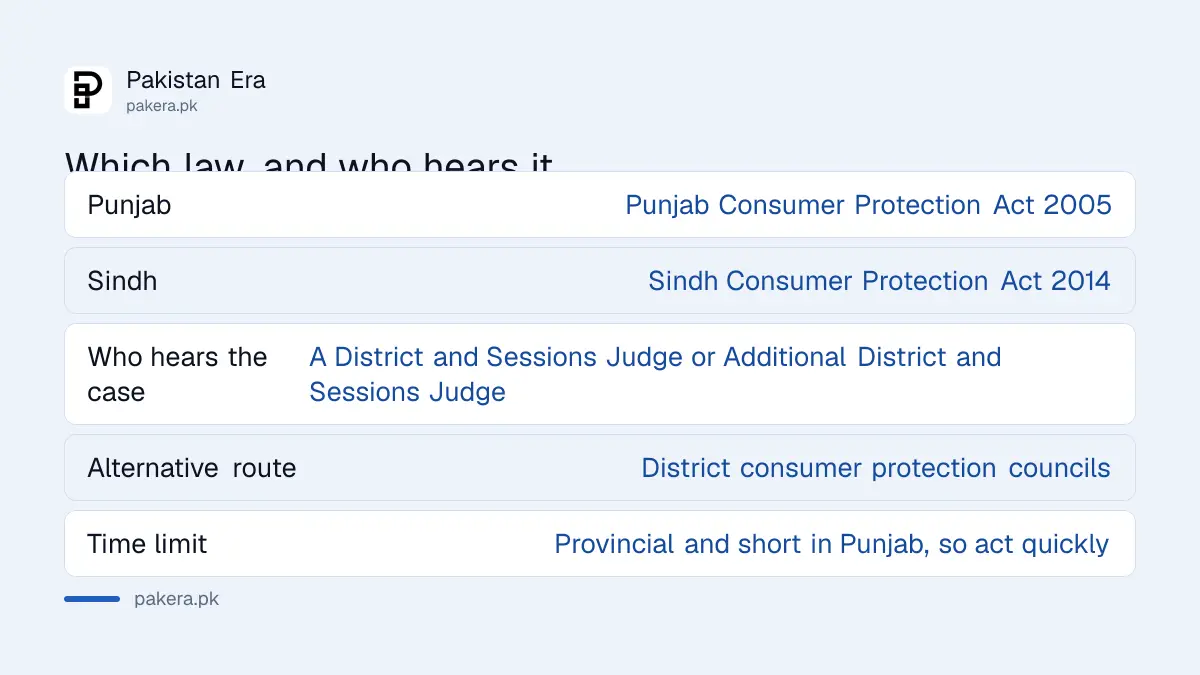
Consumer protection is provincial, so the statute, the time limit and the exact procedure depend on where you are. We are setting out Punjab and Sindh because those are the two we could verify. If you are in Khyber Pakhtunkhwa or Balochistan, the framework exists but check your own provincial position rather than assuming these apply.
You file in the district where you bought the goods or service, not where you live now.
The time limit is short, and it is the thing that catches people
This is the part to act on today rather than next month.
In Punjab you file within 30 days of the cause of action, after a 15-day written notice to the seller (section 28 of the Punjab Consumer Protection Act 2005). Sindh sets the same steps and the same 30 days (section 29 of the Sindh Consumer Protection Act 2014). Either way, a consumer claim is not something you can leave for a year while you argue with a shop.
So complain to the seller quickly, in writing, and if that goes nowhere, move. Waiting to see whether they come round is the most common way a good claim dies.
How to file
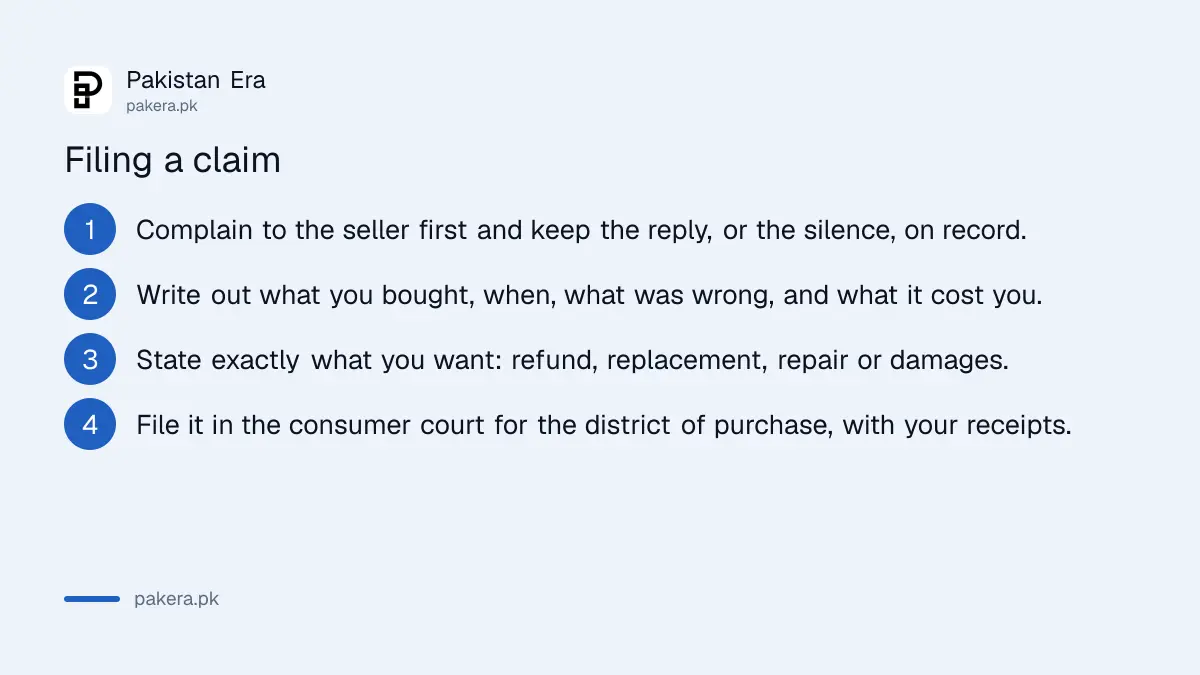
- Complain to the seller first, in writing, and keep the reply. Silence is also evidence, so keep proof of when you wrote.
- Write out the facts. What you bought, when, from whom, what was wrong, and what it cost you.
- State exactly what you want. Refund, replacement, repair, or damages. A claim that only complains invites a hearing that only sympathises.
- Attach your evidence. Receipt, warranty card, packaging, photographs of the defect, and the correspondence.
- File it in the consumer court for the district of purchase.
What these courts are for
- Defective goods that the seller will not refund, replace or repair
- Services not delivered as promised or paid for
- Misleading claims about what a product does
- Short measure or adulteration
- Warranty refused where the warranty plainly applies
- Overcharging against a displayed or advertised price
What they are not for is a purchase you simply regret, or a fault you caused. The claim has to rest on the seller or the product failing, not on the deal being worse than you hoped.
Where this sits among the other routes
Consumer courts handle sellers of goods and services. The regulated sectors have their own faster routes, and using the right one matters.
For a bank, it is the Banking Mohtasib, which is free and has its own 45 day rule, covered in our guide to complaining about your bank. For a mobile operator, it is PTA. For electricity, it is your DISCO and then NEPRA. For a federal government department, it is the Wafaqi Mohtasib.
And for anything at all, including provincial bodies, the Pakistan Citizen's Portal is the wide net.
A note on what this is not
This explains that the forum exists, that it is free, and that it is built for people to use themselves. It is not legal advice and it will not draft your claim.
A lawyer is not required, but for a high value claim or a complicated one, one is still worth having. The point is that cost should not be the reason you never file.
Questions readers are asking
Does it cost money to file in consumer court?
No court fee is charged on a consumer claim. You can also file on plain paper and represent yourself.
Do I need a lawyer for consumer court?
No. A consumer may file directly. A lawyer is optional and worth considering for high value or complicated claims.
Where do I file?
In the consumer court for the district where you bought the goods or service. The case is heard by a District and Sessions Judge or an Additional District and Sessions Judge.
How long do I have to file?
Not long, and it varies by province. Punjab guidance points to roughly a month from the dispute arising; Sindh allows longer. Confirm your provincial limit and act quickly.
What can I ask for?
Refund, replacement, repair or damages. Say which one you want rather than leaving it open.
What law covers this?
The Punjab Consumer Protection Act 2005 in Punjab and the Sindh Consumer Protection Act 2014 in Sindh. Consumer protection is a provincial subject, so check your own province.
About the author

Tax, Bills and Technology Writer
Ali Akhtar is a young and curious voice here at Pakistan Era. He is currently pursuing his A-Levels and has a growing interest in Pakistan’s changing industrial landscape and educational trends. Ali likes to write in a way that helps him explain and explore the world around him. His writing reflects the perspective of the new generation navigating the evolving trends of Pakistan where technology, youth innovation, and shifting opportunities are reshaping the country’s future.