52 Life-Saving Medicines Are Approved But Cannot Be Sold Yet
Cancer, diabetes and Parkinson's drugs cleared pricing on 24 July. They stay off the shelves until the cabinet signs and DRAP notifies a price.
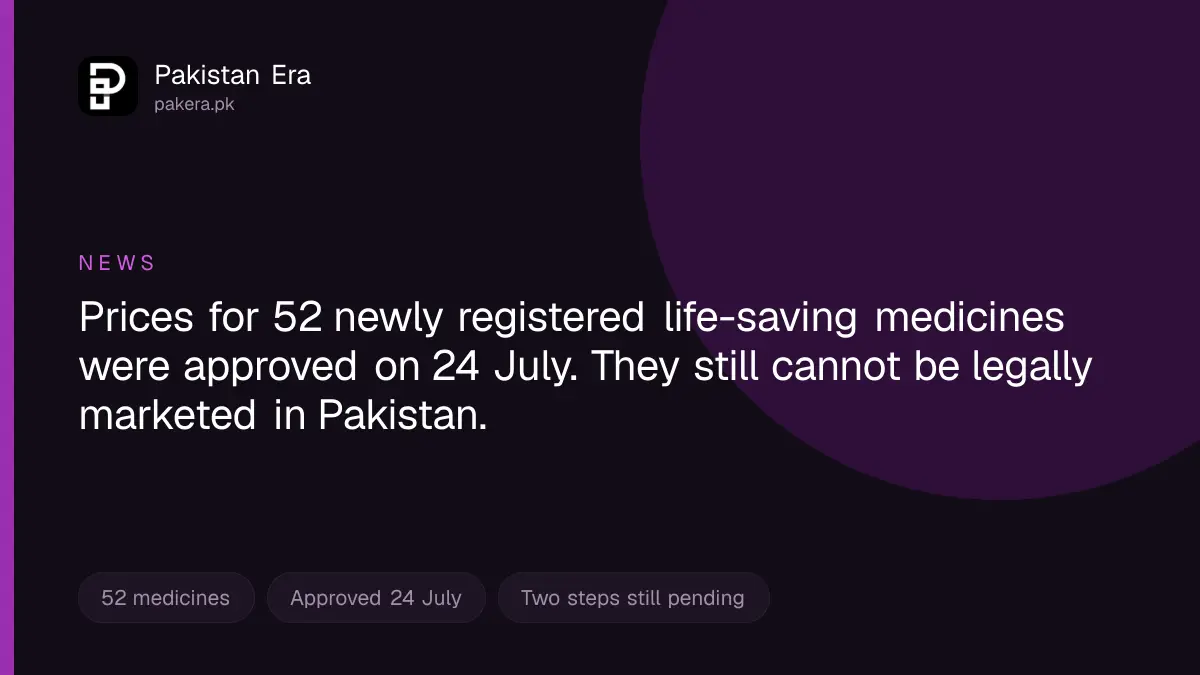
Fifty-two newly registered life-saving medicines had their prices approved on 24 July 2026. Three weeks later they still cannot legally be sold in Pakistan.
They cover cancer, diabetes, haemophilia and Parkinson's disease. One of them is Keytruda, an immunotherapy used internationally across more than twenty types of cancer.
Nothing is wrong with the medicines. What is missing is a piece of paper.
Five stages, and where it stopped
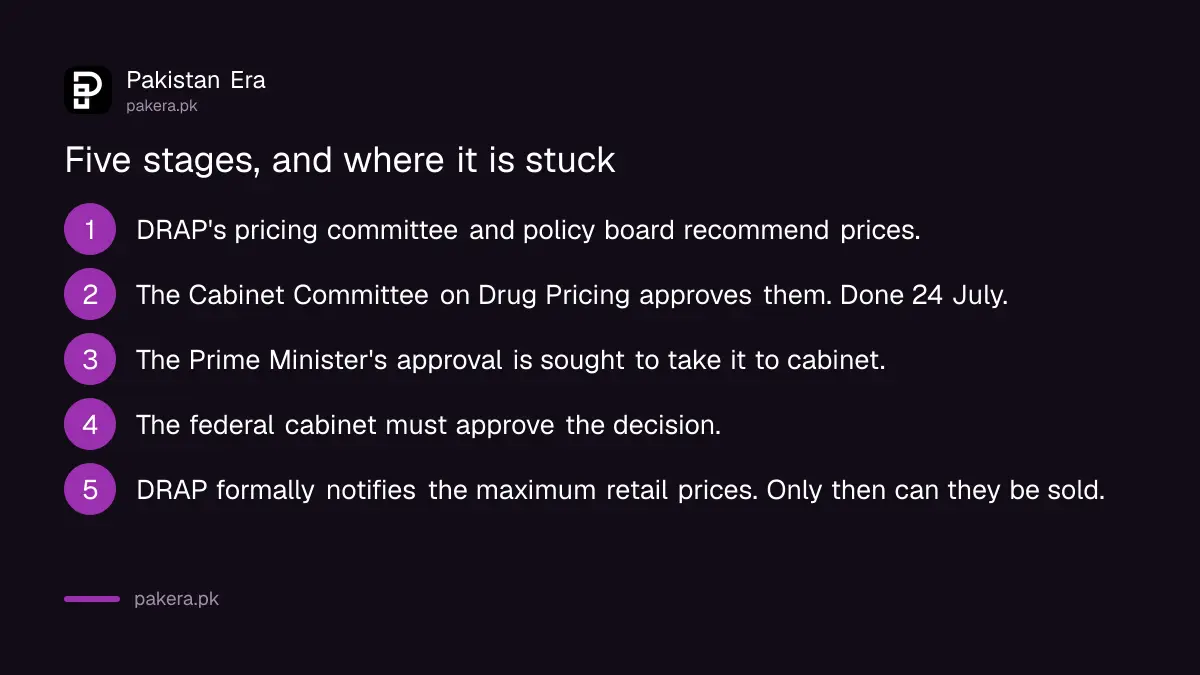
Most coverage of this says "prices approved", which sounds like the end of the process. It is stage two of five.
- DRAP's Drug Pricing Committee and Policy Board recommend prices. Done.
- The Cabinet Committee on Drug Pricing approves them. Done, on 24 July 2026.
- The Prime Minister's approval is sought to put the matter before the federal cabinet. This is the stage now being reported.
- The federal cabinet approves the decision. Pending.
- DRAP formally notifies the maximum retail prices. Pending. Only after this can the medicines be marketed.
Health Minister Syed Mustafa Kamal and Finance Minister Muhammad Aurangzeb are reported to be taking it to the Prime Minister with senior health officials.
What is actually waiting
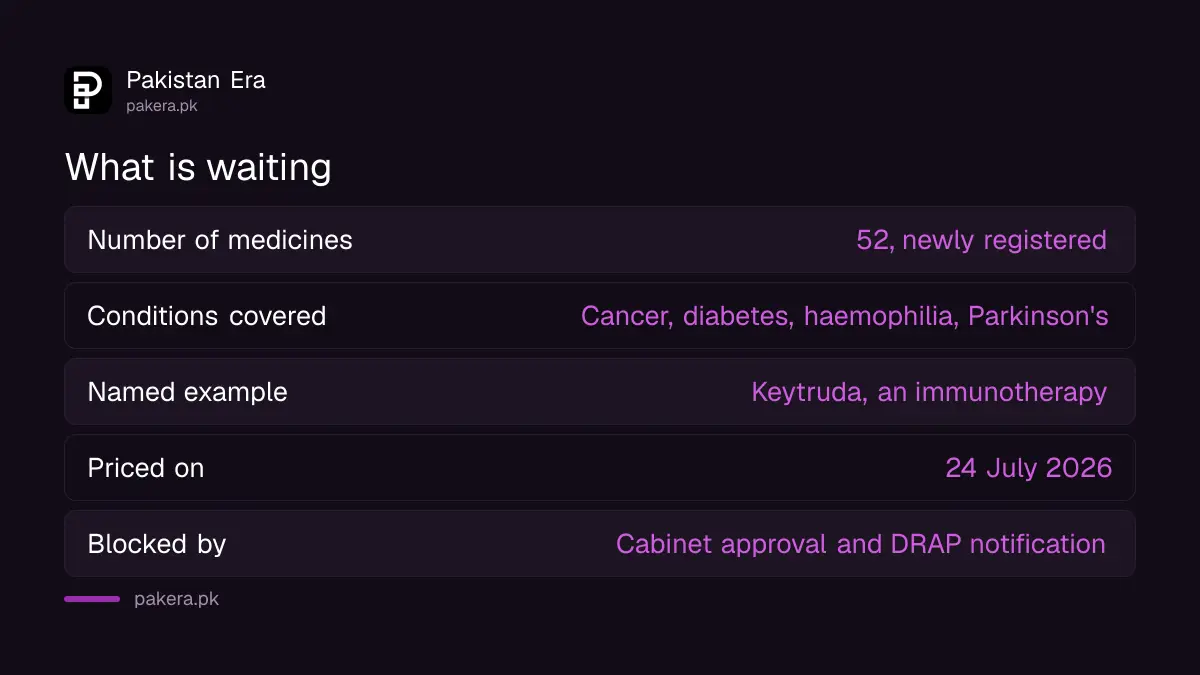
| Detail | Position |
|---|---|
| Medicines | 52, newly registered |
| Conditions | Cancer, diabetes, haemophilia, Parkinson's |
| Named in reporting | Keytruda, generic name pembrolizumab |
| Prices approved | 24 July 2026 |
| Still required | Cabinet approval, then DRAP notification |
This is not a safety problem
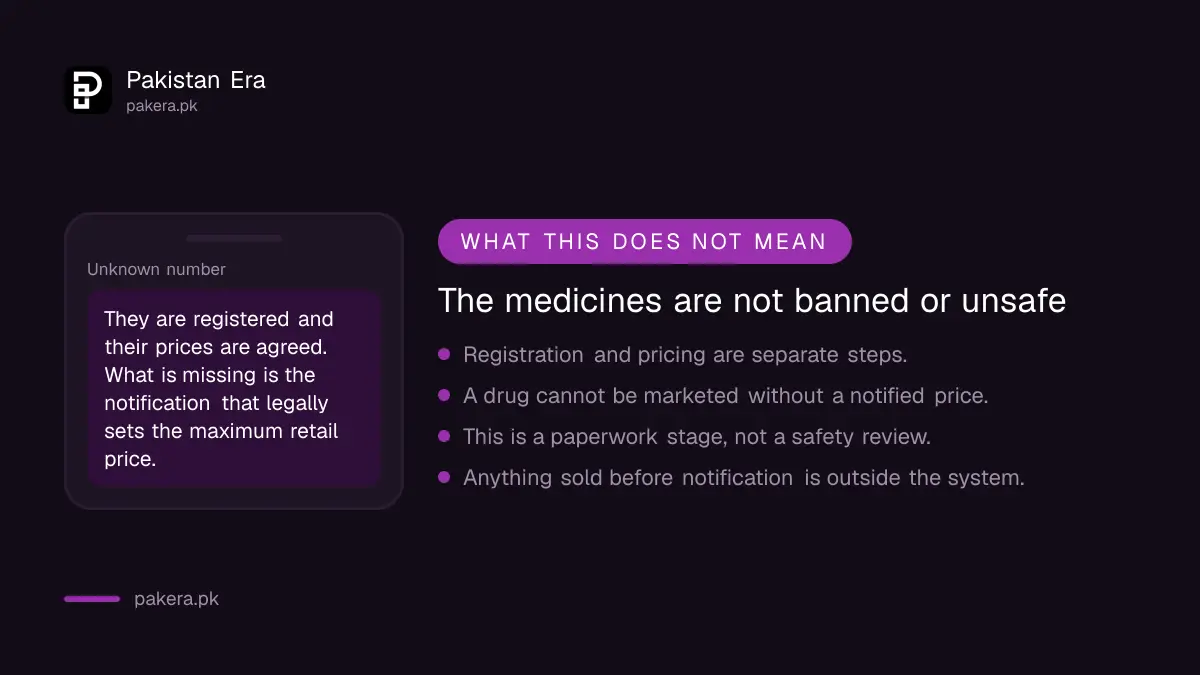
Worth saying plainly, because the alternative reading would frighten people who are waiting on a cancer drug.
These medicines are not banned, not withdrawn, and not under any safety review. They are registered, which is the step that establishes they may be used in Pakistan. Their prices have been agreed.
The blockage is administrative. Under Pakistan's system a medicine cannot be marketed without a notified maximum retail price, and that notification has not been issued. So a drug that is approved, priced and manufactured sits outside the legal market on a technicality of sequence.
One consequence worth knowing: if something appears for sale before notification, it is outside the regulated system, and neither its price nor its supply chain is covered by anything.
Why registration and pricing are separate
People assume approval is one event. It is two, and they answer different questions.
Registration asks whether the medicine may be used at all, which is a safety and efficacy question handled by the regulator.
Pricing asks what may be charged for it, which is an affordability question handled through a committee structure that reaches up to the cabinet.
Pakistan controls medicine prices centrally, which is why the second stage exists and why it involves the finance ministry at all. The trade-off is the one visible here: price control protects patients from being charged anything at all, and it inserts a political approval step between a working drug and a pharmacy shelf.
What we are not telling you
We are not publishing prices for any of the 52. The entire point is that no price is notified yet, and an approved-but-unnotified figure is no use to somebody standing at a counter.
We are not listing the medicines beyond the one named in reporting, because we have not seen the full schedule.
And we are not predicting when the cabinet will take it up. There is no announced date.
If you are waiting on one of these
The practical position, stated carefully, because we are not in a position to advise on anyone's treatment.
Ask your consultant whether the specific drug you need is among the 52, and what is currently being used in its place. A newly registered medicine is usually an addition to the options rather than the only one, and your doctor will know what is available now.
If you are told a medicine can be obtained through an unofficial route while notification is pending, that is worth a careful conversation with the prescribing doctor rather than a purchase. Medicines outside the regulated market have no price protection and no traceable supply chain.
If cost rather than availability is the obstacle, the provincial health schemes cover treatment for several of these conditions, and what the Punjab card actually pays for is set out in what the Sehat Card covers now, alongside the province's other free health programmes, which include a cancer programme.
Questions readers are asking
Are the 52 medicines available in Pakistan now?
No. Their prices were approved on 24 July 2026, but they cannot be legally marketed until the federal cabinet approves and DRAP notifies the maximum retail prices.
Have these medicines been banned?
No. They are registered and their prices are agreed. The outstanding step is a price notification, not a safety decision.
What conditions do they treat?
Reporting names cancer, diabetes, haemophilia and Parkinson's disease among them, including Keytruda, an immunotherapy used across more than twenty cancer types.
How much will they cost?
No price has been notified, which is precisely what is holding them up. We are not quoting approved figures that are not yet in force.
When will they be available?
No date has been announced for the cabinet to take up the matter.
Why does pricing need cabinet approval?
Pakistan controls medicine prices centrally, so a maximum retail price is a policy decision rather than a commercial one, and it moves through a committee structure up to the cabinet.
What should I do if I need one of these drugs?
Ask your consultant whether your medicine is among the 52 and what alternatives are available now. Be cautious about anything offered outside the regulated market while notification is pending.
About the author
Public Services and Education Journalist
Fajr Riaz is a journalist and content writer at Pakistan Era, based in Lahore. She covers the questions people meet in everyday life in Pakistan: how a public service works, what a change in the rules means, and where to find a reliable answer.