The Sehat Card Was Not Stopped. It Now Pays Half for Most Treatments.
Punjab's own health company says the card was never cancelled, only pulled from government hospitals. We read its FAQ. Here is what it covers.
"Sehat Card band ho gaya" is one of the most repeated claims in Punjab right now. We went to the body that actually runs the programme to check it.
The answer is that the card was not stopped. It was withdrawn from government hospitals and continues in private ones.
But there is a second fact on the same page that almost nobody is reporting, and it is the one that decides what you pay. For many treatments, the card now covers half the cost and you pay the other half.
What the authority actually says
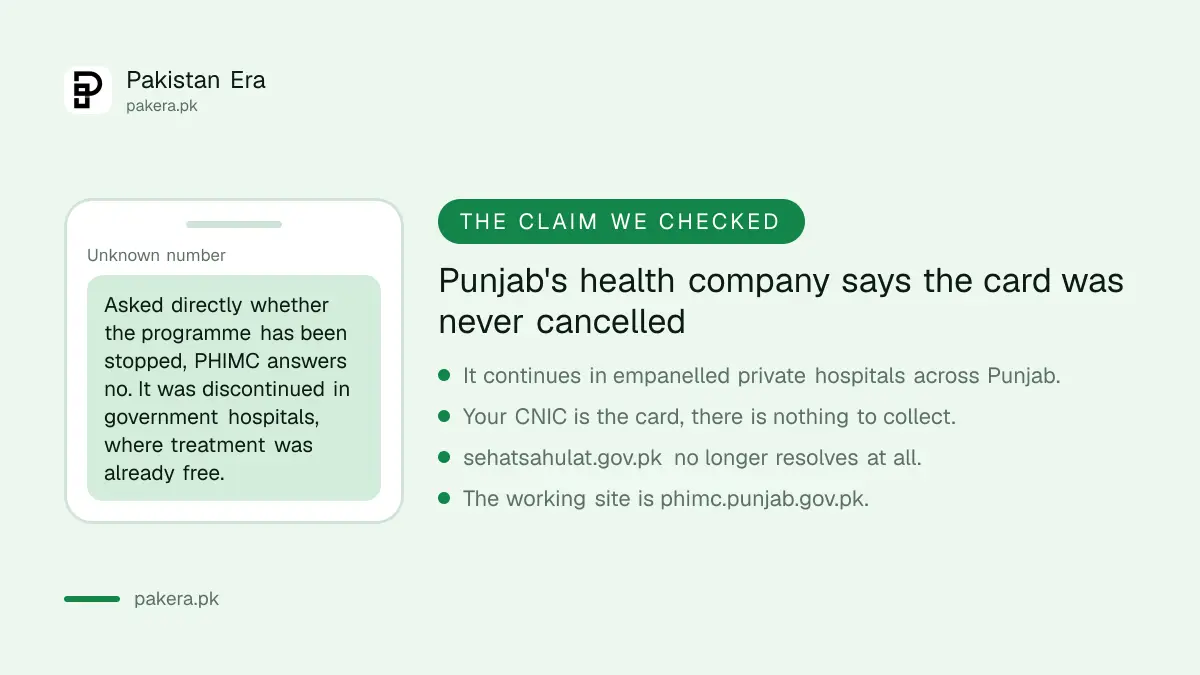
The Punjab Health Initiative Management Company runs the scheme. Its own FAQ, which we read on 11 August 2026, asks the question directly: is it true that the Sehat Card programme has been stopped?
Its answer, in its words, is that this is not true, that the misunderstanding is due to a change in policy, and that the programme has only been discontinued in government hospitals. It adds that treatment in government hospitals was already completely free and remains free, so in its view the public has not lost out.
Treatment continues in empanelled private hospitals across Punjab.
That reasoning is worth understanding rather than just accepting. It holds if the government hospital near you provides the treatment you need. It holds less well if the reason you used the card was to reach a private hospital in an emergency, which the company itself describes as one of the programme's original purposes.
The fifty per cent rule
Here is the sentence that matters most, and it sits several answers down an FAQ page.
At empanelled private hospitals, the card provides free treatment for:
- Cancer
- ICU, CCU and NICU
- Medical cases
- Thalassemia
- All emergency services
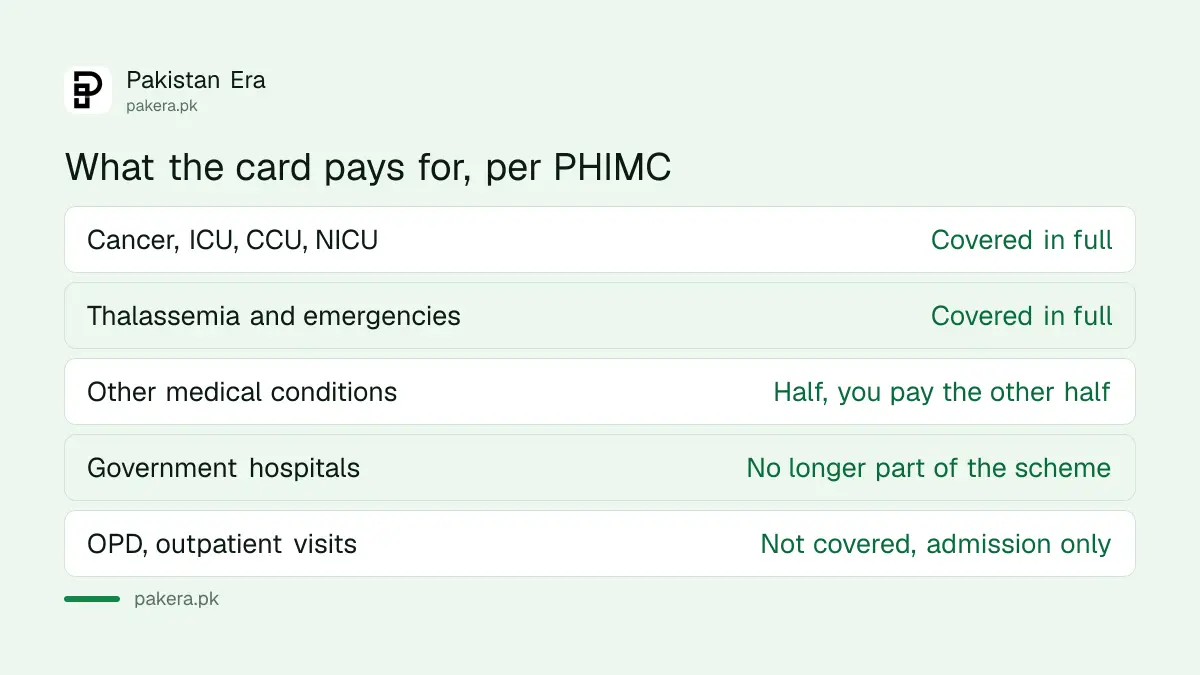
For other medical conditions, the company states that 50 per cent of the treatment cost is covered by the Sehat Card, and the remaining 50 per cent is paid by the patient's family.
| Situation | What the card pays |
|---|---|
| Cancer, ICU, CCU, NICU | Full cost |
| Thalassemia | Full cost |
| Emergency services | Full cost |
| Other medical conditions | Half, the family pays the rest |
| Outpatient or OPD visits | Nothing, admission only |
| Government hospitals | Not part of the scheme now |
So a card that most people describe as free treatment is, outside that named list, a half subsidy. If you are planning a procedure rather than arriving in an emergency, that is the difference between a bill you expected and one you did not.
What is covered, in practice
Only in-patient treatment counts. If you are not admitted, the card does nothing. OPD is not covered, and neither are medicines or lab tests unless you are admitted as a patient.
Within admission, the company lists in-patient medical and surgical procedures, emergency admissions, fractures and injuries, heart procedures including angioplasty and bypass, and cancer treatment.
If there is no empanelled hospital near you, the company's own advice is to see a local doctor first, and go to an empanelled hospital where the doctor will tell you if you need to be admitted.
Your CNIC is the card
There is nothing physical to collect, and anyone charging you for a card is selling you something that does not exist.
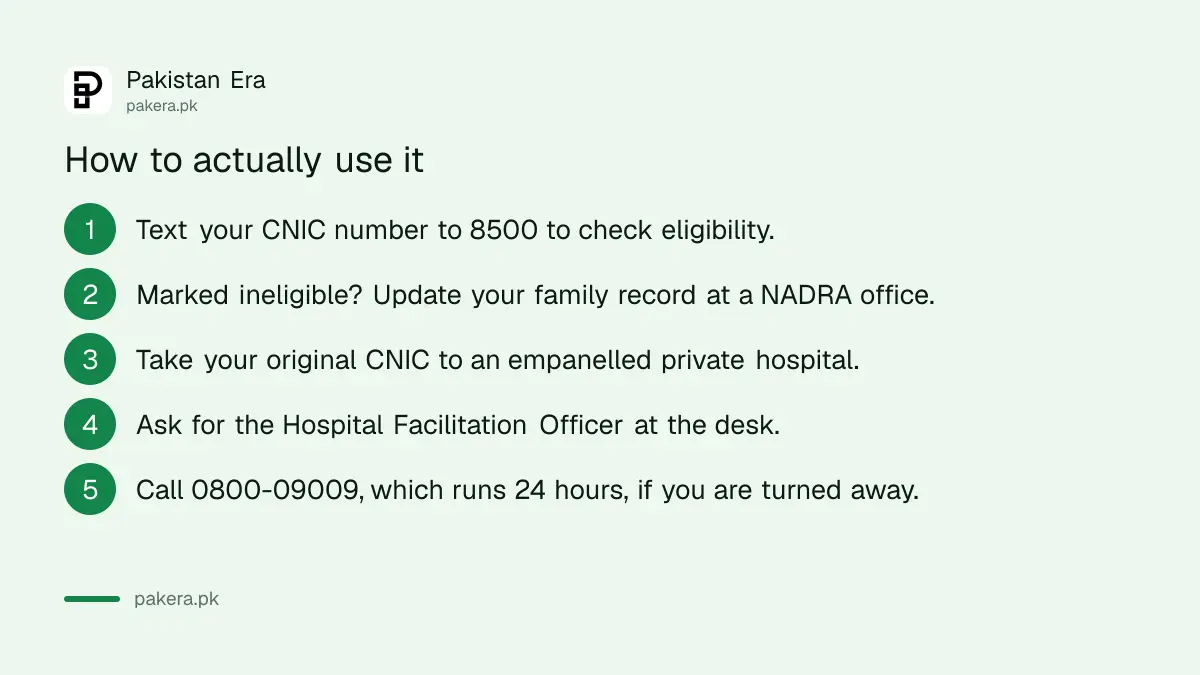
- Check eligibility by texting your CNIC number to 8500, or online through the company's site.
- If you are marked ineligible but are a permanent resident of Punjab, visit a NADRA office and update your family data. The record then syncs to the programme automatically.
- Take your original CNIC to an empanelled private hospital.
- Ask for the Hospital Facilitation Officer, whose job is to walk you through admission.
- If you are refused, call the helpline before you pay for anything.
One card covers the family: husband, wife and unmarried children. A baby born in an empanelled hospital is added automatically. For a child born elsewhere, or any child under 18 missing from the record, take a Form-B to the hospital desk. If your CNIC details are out of date, our guide to applying for and updating a CNIC covers the NADRA side.
The numbers to keep
We read all of these on the company's own page on 11 August 2026.
| For | Contact |
|---|---|
| Helpline, 24 hours | 0800-09009 |
| Helpline, Mon to Sat, 8am to 11pm | 0333-6756390 |
| Landline, same hours | 042-99066000 and 042-99066001 |
| Eligibility by SMS | Text your CNIC to 8500 |
| info@phimc.punjab.gov.pk |
These join our running list of numbers we have read off institutions' own pages rather than copied from other lists, in government helplines checked at source.
The address most people are given is dead
One more thing worth knowing, because it wastes a lot of people's time.
sehatsahulat.gov.pk does not resolve at all. We tested it the same day. It is still the address shared in messages and printed in older articles.
The working site is phimc.punjab.gov.pk. This is a recurring pattern with Pakistani government services, where the remembered address is dead and the live one is somewhere else, which we documented across about forty domains in testing Pakistani government websites.
What we could not confirm at source
Two things in the wider story we are attributing to reporting rather than stating ourselves.
The withdrawal from public hospitals is reported to have taken effect on 30 June 2025, with the Punjab government citing financial inefficiencies. Separately, the federal government is reported to have restored Sehat Sahulat for Islamabad, Azad Jammu and Kashmir and Gilgit-Baltistan from 16 January 2026.
We did not read either on an official page, so treat both as reported. The coverage rules above are different: those come straight from the company that administers the scheme.
If you are outside Punjab, the position differs by province, and we set that out in our guide to checking your Sehat Card eligibility.
Questions readers are asking
Has the Sehat Card been stopped?
No. The Punjab Health Initiative Management Company says it was discontinued in government hospitals only, and continues in empanelled private hospitals across Punjab.
Is Sehat Card treatment still free?
For cancer, ICU, CCU, NICU, medical cases, thalassemia and emergency services, yes. For other medical conditions the card covers 50 per cent and the family pays the rest.
Can I use the Sehat Card at a government hospital?
Not under the scheme. The company's position is that treatment at government hospitals was already free and remains free, so the card is not needed there.
How do I check if I am eligible?
Text your CNIC number to 8500, or check online on phimc.punjab.gov.pk. If you are marked ineligible but are a permanent resident of Punjab, update your family data at a NADRA office.
Does the card cover OPD or medicines?
No. Only in-patient admission is covered. Medicines and lab tests are covered only if you are admitted.
What is the Sehat Card helpline?
0800-09009, which runs 24 hours. There is also 0333-6756390 and 042-99066000 or 042-99066001, Monday to Saturday from 8am to 11pm.
Do I need a physical card?
No. Your CNIC is the card. Take the original to an empanelled hospital and ask for the Hospital Facilitation Officer.
About the author
Public Services and Education Journalist
Fajr Riaz is a journalist and content writer at Pakistan Era, based in Lahore. She covers the questions people meet in everyday life in Pakistan: how a public service works, what a change in the rules means, and where to find a reliable answer.