How to Get a PESSI Social Security Card in Punjab
A PESSI card comes from your employer, not your own application. The benefits, how to check your status, and what to do if you are missing.
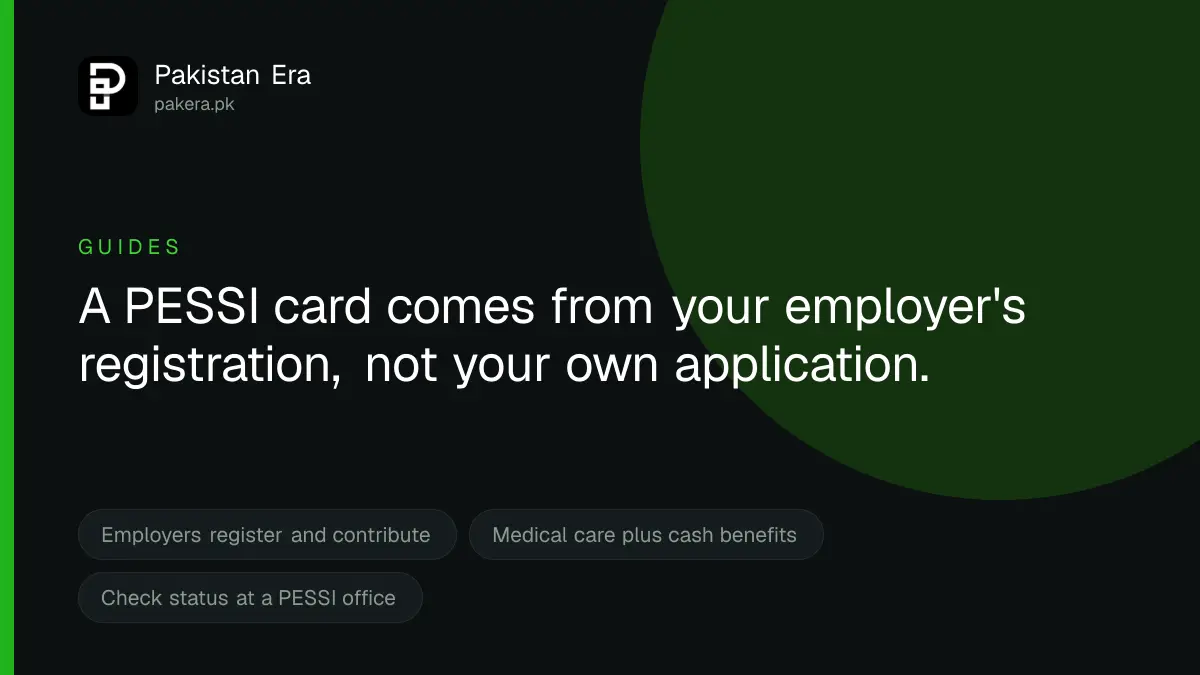
You do not apply for a PESSI card yourself. Your employer registers you with the Punjab Employees Social Security Institution and pays the contribution. Ask your employer for your social security number, then take your CNIC to the nearest PESSI office to confirm your record. The PESSI helpline is 0800-73774.
PESSI works under the provincial social security law of 1965 and runs its own hospitals and dispensaries. The card is often called the Mazdoor Card. We read its benefit rates and forms on pessi.punjab.gov.pk on 8 November 2026.
PESSI Cash Benefits and Rates
Medical treatment is the benefit people know. The cash benefits are less known and are often worth more. These are the rates PESSI publishes for secured (registered) workers:
| Benefit | What PESSI pays |
|---|---|
| Sickness benefit | 75% of wages for up to 121 days a year |
| Sickness benefit for TB or cancer | 100% of wages for up to 365 days |
| Injury benefit, for a work injury | 100% of wages for up to 180 days a year |
| Maternity benefit | 100% of wages for 6 weeks before and 6 weeks after birth |
| Disablement gratuity | One time payment for 5% to 20% disability, set by the Medical Board |
| Partial disablement pension | For 21% to 66% disability, based on wages and degree, with medical care |
| Total disablement pension | Over 66% disability: life pension at 100% of wages, with medical care |
| Survivor's pension | 100% of wages to survivors if the worker dies from a work injury |
| Iddat benefit | 100% of wages during iddat if a secured woman worker's husband dies |
| Death grant | 100% of last drawn wages to the dependant |
| Diet charges | Rs 700 a day for indoor patients |
| Survivor medical care | One year of medical care after a natural death |
PESSI also pays ambulance or travel costs on referral to a hospital, and sends 10 workers on Hajj each year by ballot. Its healthcare list includes heart treatment at the Rehmatul-Lil-Alameen Institute of Cardiology in Lahore, kidney and hepatitis treatment in Social Security hospitals, and prostheses and spectacles for workers and their families.
Dependant cover is the part worth checking early, because a worker who never falls ill may still need the card for a spouse, a child or a parent. Confirm at your local PESSI office exactly who is recorded as your dependants, since an unrecorded dependant is a problem discovered at the worst moment.
Registration Is the Employer's Duty
An establishment that falls within the law is required to register with PESSI and to contribute for its workers. The contribution is the employer's to pay. A worker cannot buy in independently, and there is no route where you register yourself and pay your own way.
What you can do is find out where you stand.
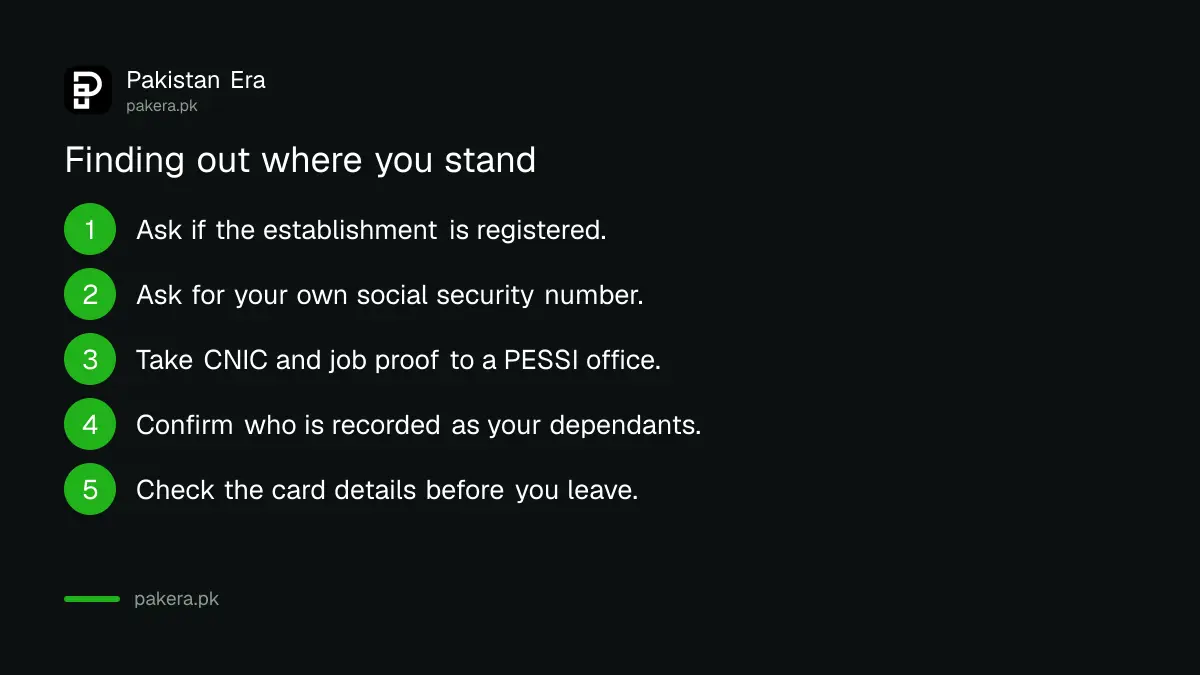
- Ask your employer or the HR department whether the establishment is registered.
- Ask whether you personally have been entered and get your social security number.
- Take your CNIC and your employment details to the nearest PESSI office.
- Ask them to confirm your status and who is recorded as your dependants.
- Get the card issued and check the details printed on it before you leave.
Take proof of employment if you have it, such as an appointment letter, a pay slip, or a salary bank statement. The office is matching you to an employer record, so anything connecting you to the establishment helps.
PESSI lists the forms your employer uses in the forms section of its home page. The two to ask about are the Worker Registration Form (Annex-A), available in Urdu, and the Establishment Registration Form. Employers can also register a business and pay contributions online through PESSI's initiatives.
When the Employer Has Not Registered You
This is the common situation and it is uncomfortable, because the person who has to fix it is the person paying you. Start with the assumption of an administrative gap rather than a refusal, since establishments do miss workers, particularly recent joiners and anyone hired through a contractor.
Ask in writing and keep a copy. If the establishment is registered but you are not on it, that is usually correctable in one step. If the establishment itself is not registered, PESSI and the provincial labour department are the bodies that deal with compliance, and the labour department at labour.punjab.gov.pk is where questions about employer obligations belong. The PESSI helpline 0800-73774 can tell you which directorate covers your area.
Be realistic about the position you are in. Get advice about how to raise it before you raise it, and use the written record. We are not going to pretend this is risk free for a worker, and it would be dishonest to do so.
PESSI, EOBI and the Sehat Card Are Three Different Things
Workers routinely mix these up and then expect a benefit the wrong body provides.
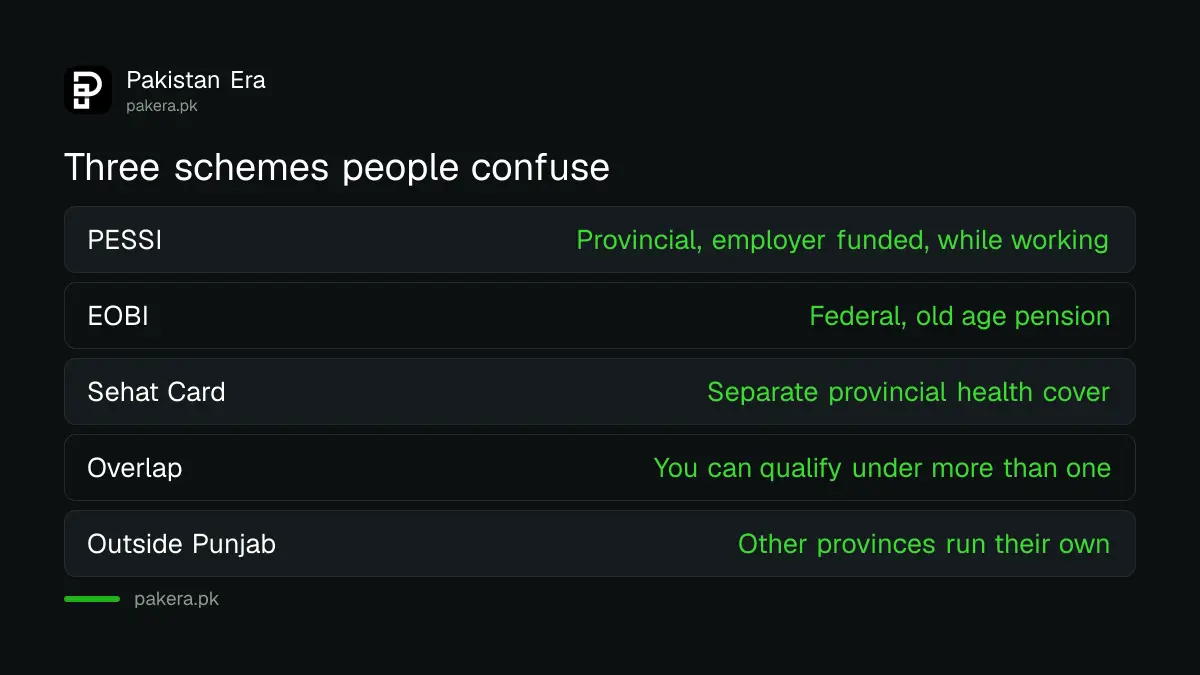
PESSI is provincial social security in Punjab, funded by employer contributions, giving medical care and cash benefits while you are working. EOBI is the federal old age benefits institution and is about pension, which we cover in our guide to checking and applying for an EOBI pension. The Sehat Card is a separate provincial health cover scheme, and what it currently covers is set out in our page on the Sehat Card.
You can be entitled under more than one at the same time. Being registered with PESSI does not remove an EOBI entitlement, and neither replaces the other.
Nobody Sells a Genuine PESSI Card
Because registration runs through employers, an offer to get you a card privately is not a shortcut into the system. Contributions are recorded against an establishment, and a card without that record behind it will fail at the point where you actually need treatment.
Do not pay an agent, and do not hand over your CNIC to anyone promising registration outside your workplace. If a card or number is being offered for a fee, walk away. If you are not covered by PESSI, Punjab's free dialysis, cancer and heart schemes may still help, set out in Punjab's free health programmes beyond the Sehat Card. If you want to verify your own position, the PESSI office will tell you, and that costs nothing.
Common Questions About the PESSI Card
What is the PESSI helpline number?
0800-73774, as shown on the PESSI website.
How much sickness benefit does PESSI pay?
75% of wages for up to 121 days a year, or 100% of wages for up to 365 days for TB or cancer.
Can I register myself with PESSI?
No. Registration and contributions run through the employer. What you can do is confirm your status at a PESSI office and press your employer to enter you.
Does the card cover my family?
Dependants are covered for medical care, but only those recorded against you. Check at the office who is listed rather than assuming.
Is PESSI the same as the Sehat Card?
No. PESSI is contributory social security through employment in Punjab. The Sehat Card is a separate scheme with its own coverage.
What happens if I change jobs?
Your entitlement follows registration and contributions, so tell the new employer and confirm at a PESSI office that the record has moved rather than lapsed.
Does PESSI cover workers outside Punjab?
No. Social security is provincial. Sindh, Khyber Pakhtunkhwa and Balochistan run their own institutions under their own rules.
How we verified this
What we checked and where we read it.
Last checked 8 November 2026. We read the benefit rates on the PESSI cash benefits page, the treatment list on the PESSI healthcare benefits page, and the forms list and helpline on the PESSI home page. Ask the PESSI office for the current contribution rate. The 1965 law basis is as published on the Punjab government portal.
About the author

Public Services and Education Journalist
Fajr Riaz is a journalist and content writer at Pakistan Era, based in Lahore. She covers the questions people meet in everyday life in Pakistan: how a public service works, what a change in the rules means, and where to find a reliable answer.