Karachi HIV Outbreak: 120 Cases Traced to One Hospital
Screening around Kulsum Bai Valika Hospital found 120 HIV cases, most of them children. Now 21 more have surfaced near Landhi. What is known.
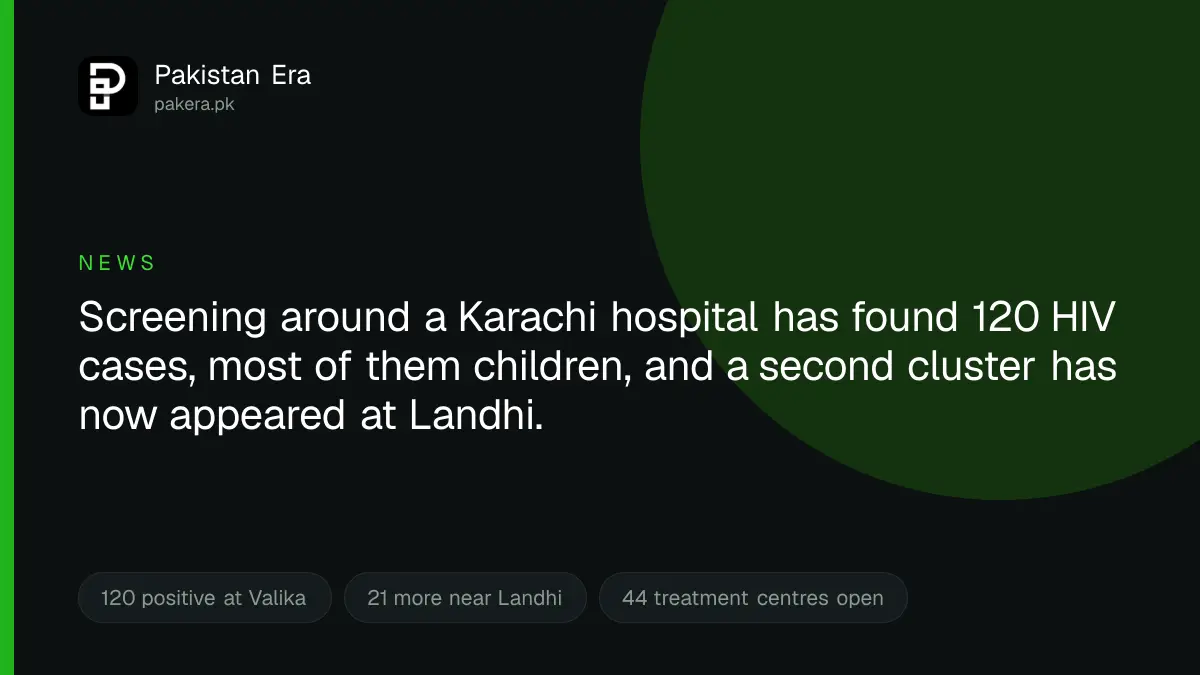
Screening around Kulsum Bai Valika Hospital in Karachi's SITE Town has found 120 people HIV positive out of roughly 10,500 tested. Most of them are children.
Update, 11 October 2026: NIH reported 17 suspected HIV cases in week 38.
In August 2026 the screening moved outward to Landhi. Of about 7,500 people tested around Landhi Social Security Hospital, 21 more tested positive.
We should be clear about what we can and cannot tell you. These figures come from court proceedings and from reporting by Al Jazeera, Express Tribune, Pakistan Today, ProPakistani and others. We tried to read the World Health Organisation's Pakistan page directly and it did not respond to us, and we could not open a Sindh AIDS Control Programme figure of our own. So treat every number here as reported, and read the sourcing at the end.
The cluster was noticed by residents, not by the system
Officials trace the outbreak to October 2025, when the first six HIV positive cases reached the provincial health department.
It became public in November 2025, and not because of surveillance. Residents of SITE Town noticed that children who had been treated at the same hospital were turning up infected. The screening followed the community's alarm.
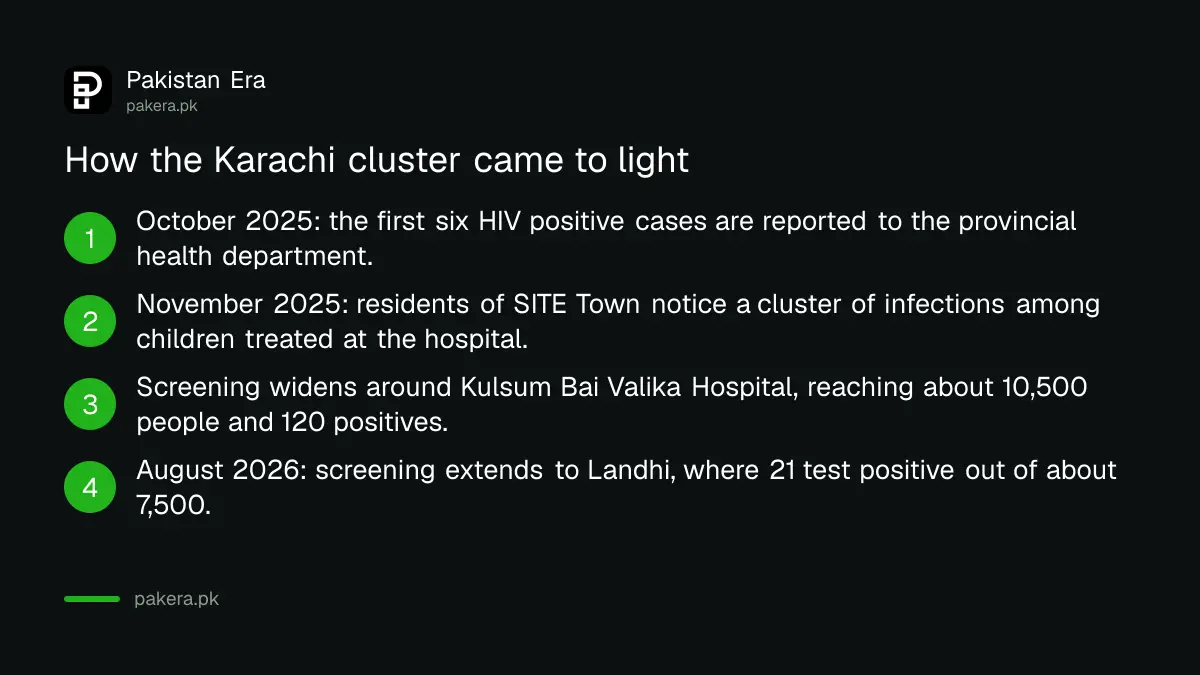
That sequence matters, because it is the part that repeats. Each time a cluster is found in Sindh, the pattern has been the same: a community notices, testing follows, and the number rises with every round of screening.
This is the fourth Sindh cluster in a decade
Treating this as a single Karachi story understates it. Sindh has recorded repeated HIV clusters since 2016, and children have been the majority of cases in the largest of them.
| Year | Place | Reported cases | Who was affected |
|---|---|---|---|
| 2016 | Larkana | Not established by us | Dialysis patients |
| 2019 | Ratodero, Larkana district | More than 1,000 | Over 80 per cent children |
| May 2026 | Gambat, Khairpur | More than two dozen | Children |
| 2025 to 2026 | Karachi, SITE Town and Landhi | 120 plus 21 | Mostly children |
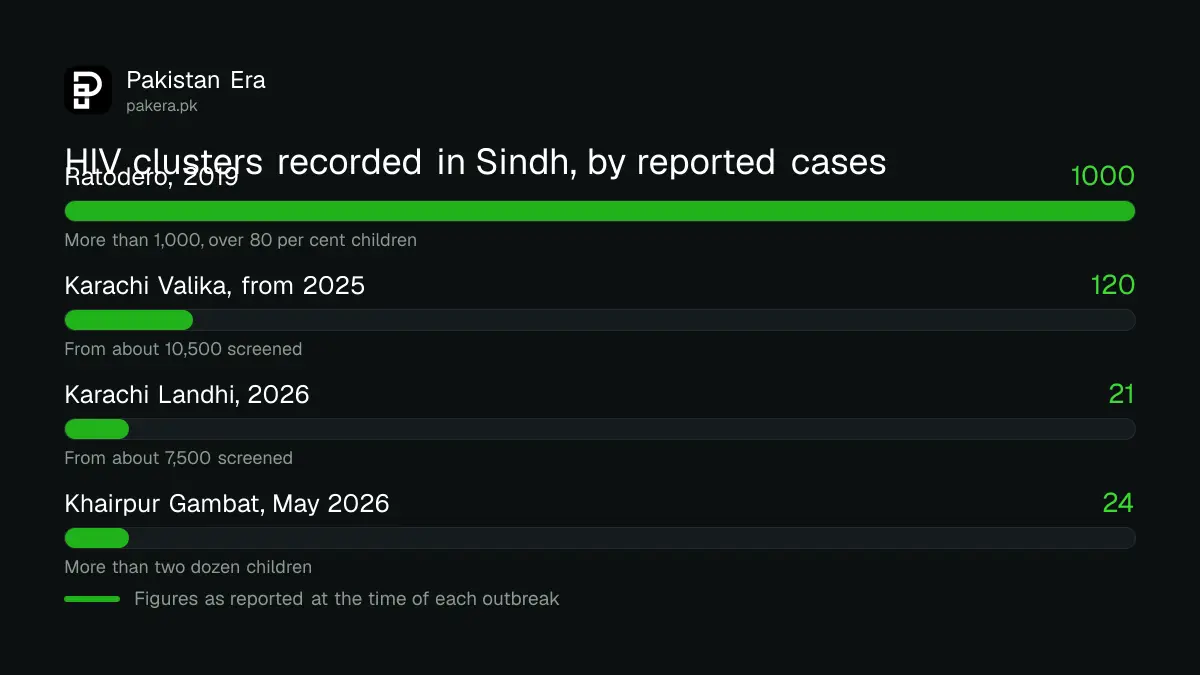
Ratodero in 2019 remains the largest. More than a thousand people were infected and over 80 per cent of them were children.
The cause has not been formally established
We are not going to name a cause, because no final inquiry finding has been published that we could read.
What we can report is that across these outbreaks, officials and health bodies have consistently pointed to infection control in clinical settings, and to unsafe injection practice in particular, including the reuse of syringes. Authorities have acknowledged negligence in the Valika case and started action against those held responsible.
One detail from Landhi complicates the simple version. Several of those who tested positive there had no prior history at the hospital. That suggests at least some infections came from somewhere else, which is a different and harder problem than a single facility failing.
What has been done so far
The Sindh High Court was told on 5 August 2026 that 44 HIV treatment centres are now operating across the province.
Final show cause notices have been issued to 37 doctors, paramedics and officials on the recommendation of inquiry committees looking into the Valika cases. Some reports describe this as suspensions rather than show cause notices; we are using the wording from the court reporting and flagging the difference. A committee of senior doctors and hospitals has also been formed to arrange treatment for those infected.
What a patient can actually check
You cannot inspect a hospital's sterilisation records. You can do a small number of things at the point where the needle goes in, and they are worth doing everywhere in Pakistan, not only in Karachi.
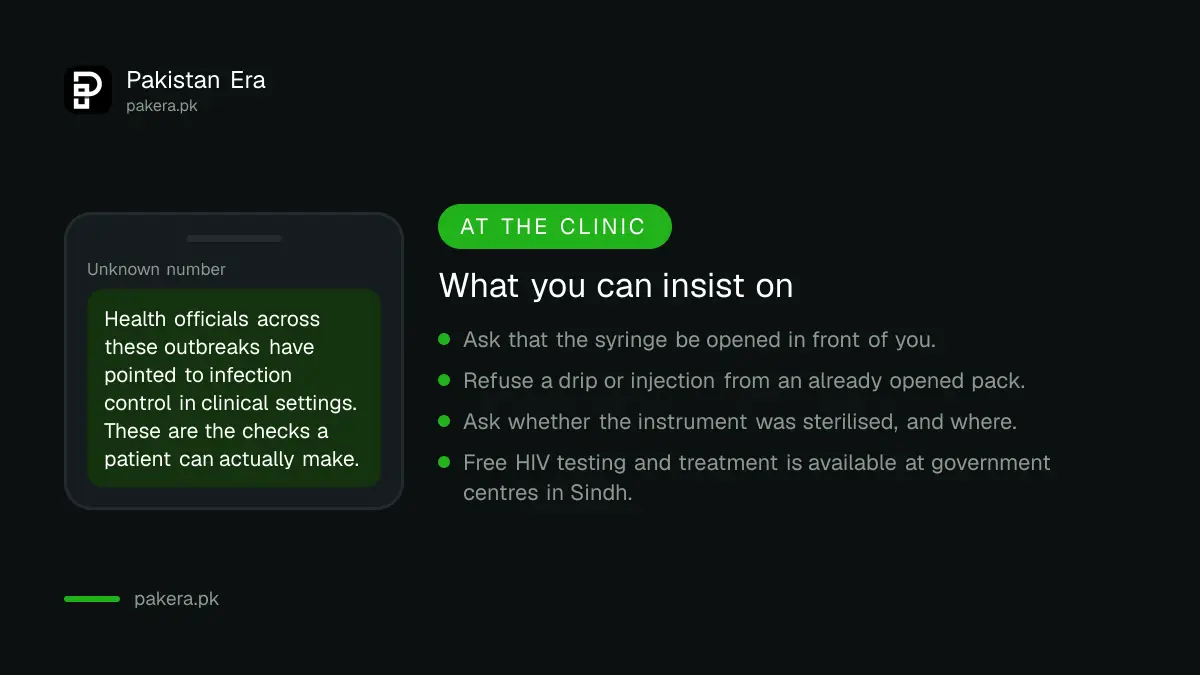
- Ask for the syringe to be opened in front of you. A sealed pack opened in your presence is the single most useful check available to a patient.
- Refuse an injection or a drip from a pack that is already open. This applies to clinics, pharmacies and home visits alike.
- Ask where instruments were sterilised before any procedure that breaks the skin, including dental work, minor surgery and cosmetic treatments.
- Be equally careful outside hospitals. Barbers, ear piercing and tattooing all involve blood contact.
- Do not accept an injection you were not told you needed. Ask what it is and why an oral medicine will not do.
- Get tested if you are worried. Testing and antiretroviral treatment are provided free at government centres in Sindh, and there are now 44 of them.
HIV today is a manageable long term condition when it is diagnosed and treated. The danger in an outbreak like this one is not only infection, it is late diagnosis, and children who were infected in 2025 may still be undiagnosed.
Why this keeps happening
The repetition is the story. Four clusters in ten years, in the same province, with children as the main victims each time, points at something that has not been fixed between them rather than at four separate accidents.
Screening finds cases after the fact. Infection control prevents them. The gap between those two things is where every one of these outbreaks has happened, and it is the gap the 44 new treatment centres do not close, because treatment centres come after infection.
It is the same shape as the other avoidable deaths we have counted this season. Most of the monsoon's electrocution deaths came from hazards that were known about and left in place, which we set out in the piece on why electrocution is killing more people than drowning. Knowing the cause has not been the difficult part.
We have written before about how thinly Pakistani households are protected when a health problem arrives without warning, in our guide to the dengue warning signs that mean go to hospital. The same weakness applies here. The system responds when the numbers become impossible to ignore.
Questions readers are asking
How many HIV cases have been found in Karachi?
120 positive from about 10,500 people screened around Kulsum Bai Valika Hospital in SITE Town, plus 21 positive from about 7,500 screened around Landhi Social Security Hospital in August 2026.
Are the cases mostly children?
Yes. The Valika cluster is reported as predominantly paediatric, which matches the pattern of earlier Sindh outbreaks. In Ratodero in 2019, more than 80 per cent of over a thousand cases were children.
What caused the outbreak?
No final inquiry finding has been published that we could read. Officials have pointed to infection control failures and unsafe injection practice, and authorities have acknowledged negligence, but we are not stating a cause as established fact while inquiries continue.
Where can I get tested for HIV in Sindh?
44 HIV treatment centres are operating across the province, the Sindh High Court was told on 5 August 2026. Testing and treatment at government centres are free.
Has anyone been held responsible?
Final show cause notices have been issued to 37 doctors, paramedics and officials following inquiry committee recommendations. Some outlets report this as suspensions.
Is HIV treatable in Pakistan?
Yes. Antiretroviral treatment is available free through government centres. It is a long term condition that is managed with medication, and early diagnosis makes a substantial difference to outcomes.
About the author
Public Services and Education Journalist
Fajr Riaz is a journalist and content writer at Pakistan Era, based in Lahore. She covers the questions people meet in everyday life in Pakistan: how a public service works, what a change in the rules means, and where to find a reliable answer.