Old Charges Cannot Be Reopened Without New Material, Federal Constitutional Court of Pakistan Rules in NAB Service Case
The FCC set aside a NAB charge sheet over matters examined years ago, and held a High Court must hear a challenge to a charge sheet issued without power.
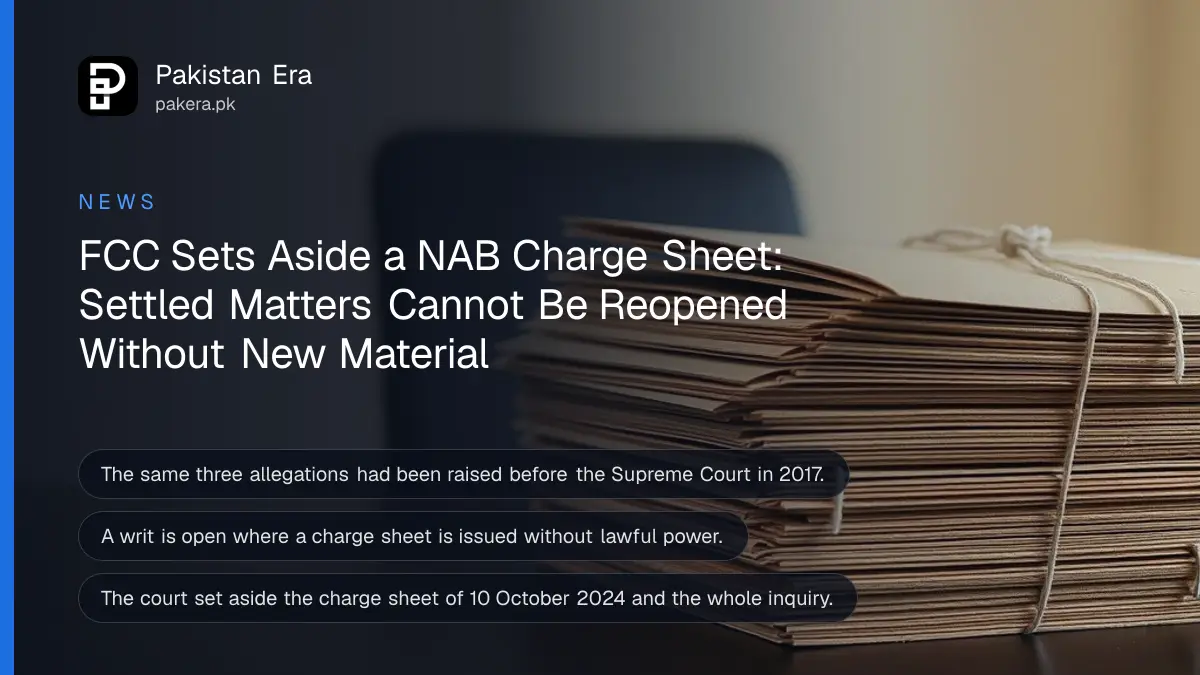
A government department cannot issue a fresh charge sheet over matters that were already examined and acted on years ago, unless it has new material. The Federal Constitutional Court of Pakistan has ruled this in a National Accountability Bureau (NAB) service case, and held that a High Court must hear such a challenge even before any penalty is passed. The detailed judgment was uploaded to the court's judgments page on 16 November 2026.
The ruling matters to any federal or provincial employee who receives a charge sheet about events from 10 or 20 years back. It sets out when you can go straight to the High Court, and when you must answer the inquiry first.
What the Federal Constitutional Court decided
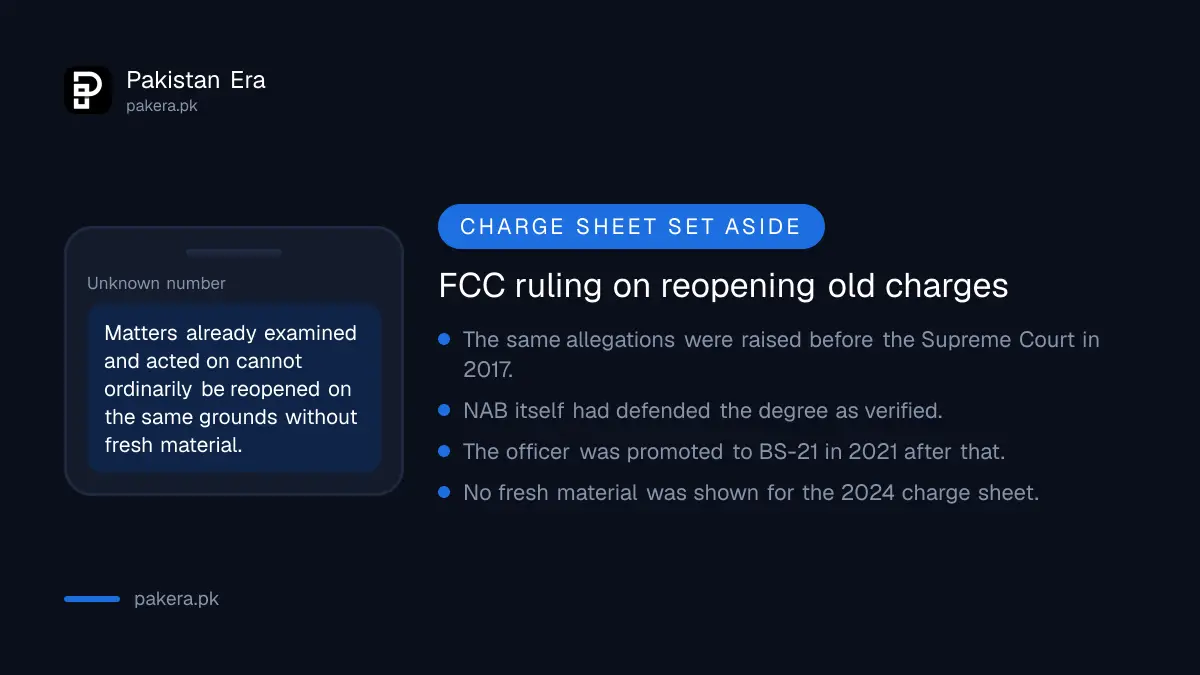
The court set aside a NAB charge sheet of 10 October 2024 against one of its Director Generals, and the whole inquiry under it. The charges repeated questions about his 2003 induction and his degree that had already been examined after a Supreme Court case in 2017.
Justice Syed Hasan Azhar Rizvi and Justice Muhammad Karim Khan Agha decided F.C.P.L.A. No. 1690 of 2026 after a hearing and short order on 16 October 2026. The detailed reasons, written by Justice Agha, are approved for reporting. The court turned the petition into an appeal and allowed it.
| Date | What happened |
|---|---|
| 30 September 2003 | Officer absorbed into NAB as Deputy Director (BS-18) |
| 31 March 2017 | Supreme Court judgment in Suo Motu Case No. 13 of 2016 orders scrutiny of NAB appointments |
| 2018 and 2019 | A committee reviews his case; NAB moves his BS-19 and BS-20 promotion dates later |
| 12 March 2020 | Supreme Court disposes of an application raising the same degree questions |
| 10 October 2024 | NAB issues a fresh charge sheet on those questions |
| 12 May 2026 | Islamabad High Court dismisses his writ as premature |
| 16 October 2026 | FCC sets aside the charge sheet and the inquiry |
Why the old charges could not be reopened
The court found that the same three allegations had already been raised before the Supreme Court and answered by NAB itself. NAB had told the court the degree was verified by the Higher Education Commission. With no new material, bringing the same charges back after two decades was not a lawful use of disciplinary power.
The charge sheet alleged three things: that he lacked five years of experience when absorbed, that he studied for a degree without a departmental no objection certificate, and that the degree was fake. The court noted that NAB had promoted him to BS-21 in 2021 after all these points were known.
Its key line is that service matters need "a measure of certainty and finality". Where a case has been examined under court directions and action taken, it "cannot ordinarily be reopened time and again on the same grounds". Otherwise, the court said, officers face "repeated harassment through the misuse of disciplinary proceedings".
When you can challenge a charge sheet in the High Court
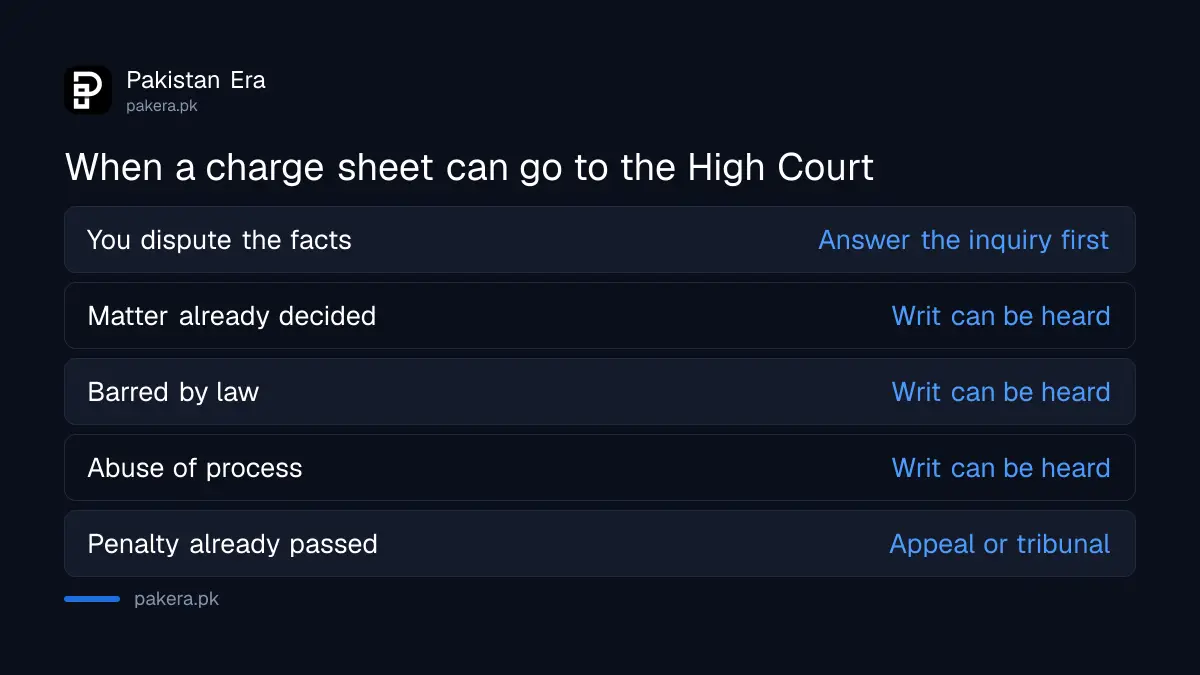
Normally a charge sheet or show cause notice is not challenged in a High Court, because you can answer it in the inquiry and appeal any penalty. But the court said a writ is open where the action is clearly without jurisdiction, barred by law or an abuse of process.
The difference is between two kinds of challenge:
- You dispute the facts. For example, you say you did not do what the charge sheet says. That is for the inquiry officer, and a writ is usually premature.
- You dispute the power to start the case at all. For example, the matter was already decided, or the law bars it. That question goes to whether the authority could begin, and a High Court should examine it.
The court said having a chance to reply before the inquiry officer "does not cure the absence of lawful authority". So the Islamabad High Court was wrong to dismiss the writ as premature.
What to do if you get a charge sheet about old events
Reply on time, and say clearly in your reply if the same matter was already examined, decided or acted on. Collect the earlier orders. If the department had no lawful power to start, take legal advice on a writ petition rather than waiting for the penalty.
- Note the date you received the charge sheet and the deadline for your written defence.
- Get copies of every earlier inquiry, committee report, court order and notification on the same issue.
- In your reply, list each allegation and show where it was examined before and what action followed.
- Ask what fresh material the department relies on. The ruling turned on the absence of any.
- If the issue is the department's power to begin, a lawyer can file a writ under Article 199 in the High Court.
- If you are already penalised, use the departmental appeal and the service tribunal routes in time.
The ordinary misconduct process, including penalties and replies, is explained in misconduct and dismissal rules in Pakistan. Private sector workers have a different route, covered in job termination rules in Pakistan.
Common questions
Can a department reopen a matter that was already examined?
Not ordinarily, the FCC held. Where an appointment or promotion was scrutinised under court directions and action was taken, it cannot be reopened again on the same grounds without fresh material or a lawful reason.
Can I go to the High Court against a charge sheet?
Usually not, because you can reply in the inquiry. But the court said a writ is open where the charge sheet itself is without lawful authority, barred by law or an abuse of process.
Does long delay matter in a disciplinary case?
Yes. The court said reopening allegations about events more than two decades old, with no new material, would defeat the earlier scrutiny and leave officers exposed to constant fresh proceedings.
Does this ruling apply to provincial employees?
The case was about NAB's own service rules, but the principles it relied on, finality in service matters and the test for a writ against a charge sheet, come from earlier Supreme Court rulings that courts apply generally.
What happened to the inquiry in this case?
The court declared the charge sheet of 10 October 2024 and the whole disciplinary proceeding under it to be without lawful authority, and set them aside.
Where can I read the full judgment?
It is on the FCC judgments page under F.C.P.L.A. No. 1690 of 2026. The search steps are in finding a Federal Constitutional Court judgment online.
How we verified this
What we checked and where we read it.
We read the full judgment in F.C.P.L.A. No. 1690 of 2026, against the Islamabad High Court's judgment of 12 May 2026 in Writ Petition No. 3582 of 2024, on 17 November 2026. It is listed on the Federal Constitutional Court judgments page with an upload date of 16 November 2026 and is marked approved for reporting. The judgment is signed at Islamabad on 16 October 2026 as the reasons for the short order of that date. The officer's name is left out on purpose, as the ruling's value to readers is its principle.
About the author

Global Affairs & Political Economy Writer
Muhammad Hatim is a book lover who started writing because he enjoys it. At Pakistan Era he writes about international relations, geopolitics and the global economy, with a particular interest in South Asia and the forces behind current events.