Misconduct and Dismissal Rules at Work in Pakistan
A fine is capped at three paisa in the rupee. Dismissal needs written notice within a month, a chance to explain, and an inquiry.
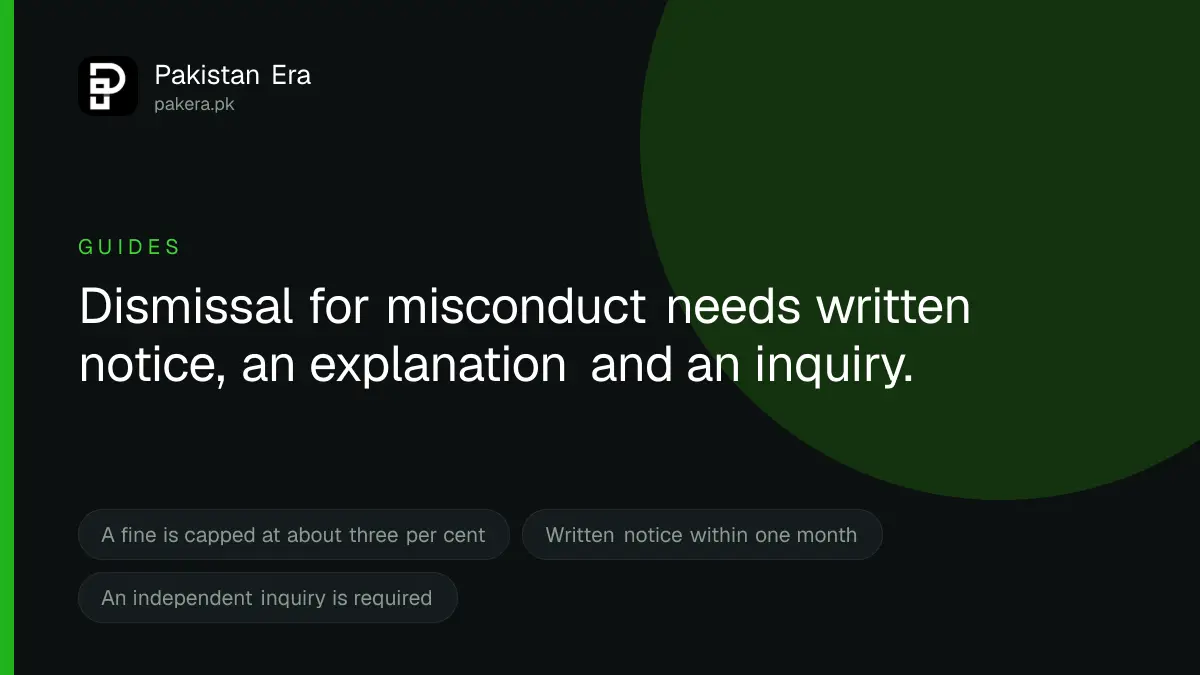
Your employer cannot dismiss you for misconduct without telling you in writing within one month, letting you explain, and holding an independent inquiry. And a fine cannot exceed three paisa in the rupee of your monthly wages.
That is roughly three per cent. Anything larger taken from your pay as a punishment is outside what the law describes.
We read Standing Order 15 of the Industrial and Commercial Employment (Standing Orders) Ordinance, 1968 on 1 September 2026.
What the law allows as punishment
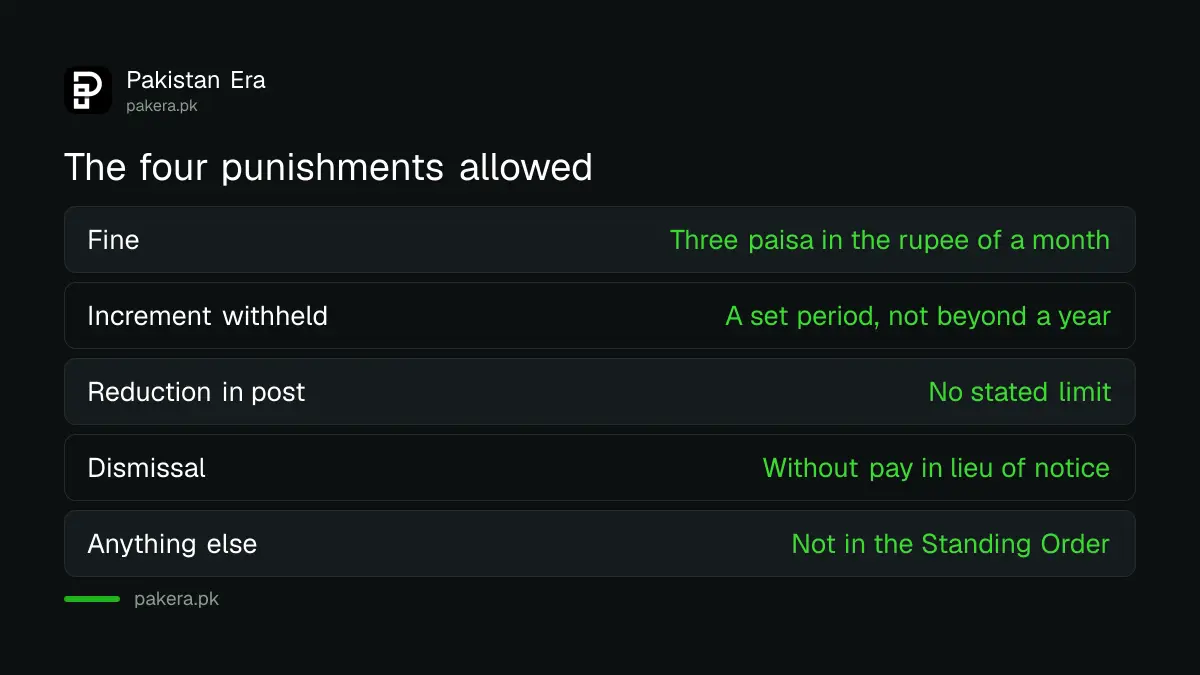
There are four, and they are listed in order of severity.
| Punishment | The limit |
|---|---|
| Fine | Up to three paisa in the rupee of a month's wages |
| Withholding increment or promotion | For a specified period not exceeding one year |
| Reduction to a lower post | No stated limit |
| Dismissal | Without compensation in lieu of notice |
Two things follow from that list. A fine has a hard cap. And withholding your increment is not open ended, it must be for a specified period and cannot run beyond a year.
The protection before dismissal
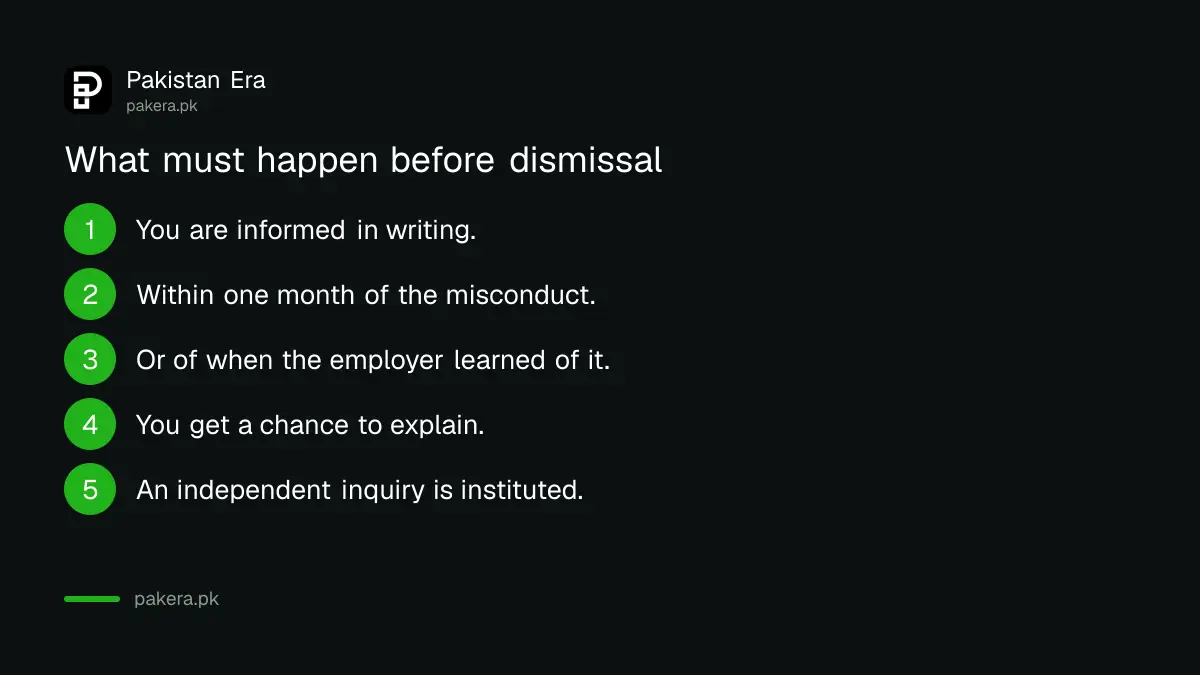
Standing Order 15(4) is the part worth knowing by heart. No order of dismissal shall be made unless four things happen.
- You are informed in writing of the alleged misconduct.
- That happens within one month of the misconduct, or of the date it came to the employer's notice.
- You are given an opportunity to explain the circumstances alleged against you.
- The employer institutes an independent inquiry before dealing with the charges.
The one month clock is the detail most people have never heard. An allegation raised long after the event, or after it was already known about, does not sit comfortably with what the Standing Order requires.
The Standing Order also says the approval of the employer is required in every case of dismissal. A supervisor announcing on the floor that you are finished is not that.
What counts as misconduct
The list is specific, which cuts both ways. It is worth reading so you know what is actually on it.
It covers wilful insubordination or disobedience to a lawful and reasonable order of a superior, theft, fraud or dishonesty connected with the employer's business or property, wilful damage to or loss of the employer's goods, and taking or giving bribes or any illegal gratification.
It also covers habitual absence without leave, or absence without leave for more than ten days, habitual late attendance, habitual breach of any law applicable to the establishment, riotous or disorderly behaviour during working hours or any act subversive of discipline, habitual negligence or neglect of work, striking work or inciting others to strike in contravention of law, and go slow.
Note the word habitual, which appears repeatedly. One late arrival is not what the list describes. Note also the ten day threshold on absence without leave, which is a defined line rather than a matter of opinion.
The smaller list, for fines
A separate and lighter list covers acts for which a workman may be reprimanded or fined rather than dismissed.
Where the Payment of Wages Act, 1936 applies, the list is the one approved by the Chief Inspector of Factories or the officer concerned. In other cases the Standing Order lists disregard or disobedience of rules or orders, improper behaviour such as drunkenness, making false or misleading statements, inefficient, dilatory, careless or wasteful working, and malingering.
Frequent repetition of any of those smaller acts is itself listed as misconduct. So a pattern can escalate, but a single instance of the lighter kind is a fine matter, not a dismissal matter.
Why misconduct changes what you are owed
This is where the money sits, and it is the reason employers sometimes prefer the misconduct route.
Dismissal under this Standing Order is expressly without payment of compensation in lieu of notice. Separately, the gratuity provision in the same Ordinance applies where a workman resigns or is terminated for any reason other than misconduct.
So a misconduct finding can affect both your notice pay and your gratuity. That is exactly why the written notice, the chance to explain and the independent inquiry matter, and why they are worth insisting on rather than walking away.
Our guide to gratuity and provident fund rules sets out what is normally owed, and our guide to termination rules covers the ordinary notice position where misconduct is not alleged.
What to do if it happens to you
Keep the process on paper from the first moment.
Ask for the allegation in writing if you are told about it verbally. Reply in writing, and keep a copy. Note the date you were first told, and the date the incident is said to have happened, because the gap between them matters. Ask whether an inquiry has been instituted and who is conducting it.
If your pay is docked, work out three paisa in the rupee of your monthly wages and compare it against what was taken.
Our guide to what your employer must display at work covers the related requirement that hours, wage rates, holidays and pay days are posted where you can read them.
Which workplaces this covers
The Ordinance applies to industrial and commercial establishments, which is wider than factories alone.
Labour is a provincial subject, and each province administers its own version with its own amendments and numbering. The copy we read is the Punjab applied text. Treat the shape as common and check the numbering for your province before quoting it.
Common questions
How much can I be fined?
Up to three paisa in the rupee of the wages payable to you in a month, in the manner prescribed under the Payment of Wages Act, 1936.
Can they stop my increment indefinitely?
No. Withholding of increment or promotion must be for a specified period not exceeding one year.
Can I be dismissed on the spot?
No order of dismissal is to be made unless you are informed in writing, within one month, and given an opportunity to explain, with an independent inquiry instituted.
How long can I be absent before it is misconduct?
Absence without leave for more than ten days is listed, as is habitual absence without leave.
Does a misconduct dismissal affect my gratuity?
The gratuity provision applies where the reason is other than misconduct, so a finding of misconduct affects it.
Is one late arrival misconduct?
The list refers to habitual late attendance, not a single instance.
How we verified this
What we checked, where we read it, and what we could not confirm.
Last checked 1 September 2026. We read Standing Order 15 of the Industrial and Commercial Employment (Standing Orders) Ordinance, 1968 on that date, in the copy published in the International Labour Organization's NATLEX database rather than on a Government of Pakistan page, and we say so because the distinction matters. The four punishments of fine, withholding of increment or promotion for a specified period not exceeding one year, reduction to a lower post and dismissal without payment of compensation in lieu of notice, the cap of three paisa in the rupee of a month's wages, the list of acts and omissions for which a fine may be levied including disregard or disobedience of rules or orders, improper behaviour such as drunkenness, false or misleading statements, inefficient, dilatory, careless or wasteful working and malingering, the list of acts treated as misconduct including wilful insubordination, theft, fraud or dishonesty, wilful damage, bribery, habitual absence without leave or absence without leave for more than ten days, habitual late attendance, habitual breach of law, riotous or disorderly behaviour, habitual negligence, frequent repetition of the lighter acts, unlawful striking or inciting to strike and go slow, and the requirement in subsection 4 that no order of dismissal be made unless the workman is informed in writing within one month of the misconduct or of its coming to the employer's notice and given an opportunity to explain, with the employer's approval required in every case and independent inquiries instituted, are all taken from that text. The copy we read is the Punjab applied version. Labour is a provincial subject and other provinces administer their own versions. Nothing here is legal advice.
About the author

Senior Writer, Public Services and Technology
Shahid joined us in 2024 as an author. He is a senior contributor to Pakistan's leading technology websites. He writes detailed articles, mostly covering his expertise in the latest tech, mobiles, apps, gadgets, and step-by-step guides. His ideology is to help people understand the latest trends and explain complex methods through very easy-to-understand guides.