The Rules When a Job in Pakistan Ends
One month notice or wages in lieu, a written order stating the reason, and final dues by the second working day. What the ordinance sets out.
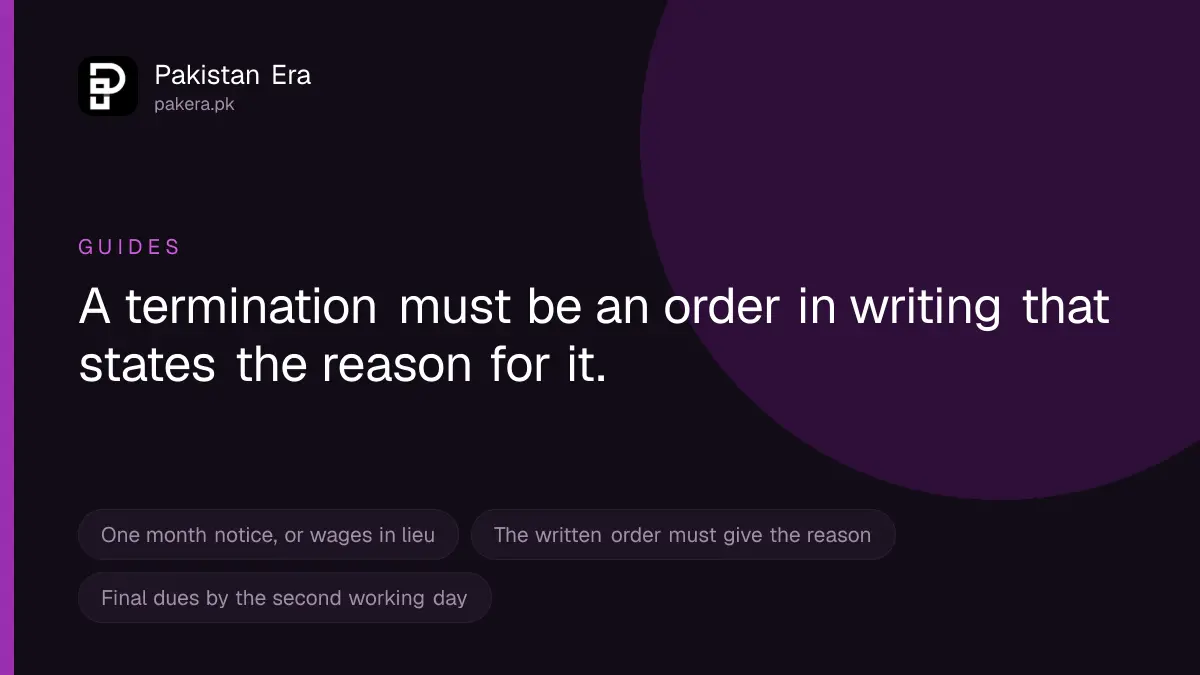
A termination has to be in writing, and the written order has to state the reason. That single requirement is the one most often ignored, and it is the one that decides whether a worker has anything to argue about later.
We read the text of the Industrial and Commercial Employment (Standing Orders) Ordinance, 1968 on 29 August 2026 in the copy held in the International Labour Organization's NATLEX database. The clauses below are quoted from Standing Order 12 and the two standing orders that follow it.
Notice depends on what you were employed as
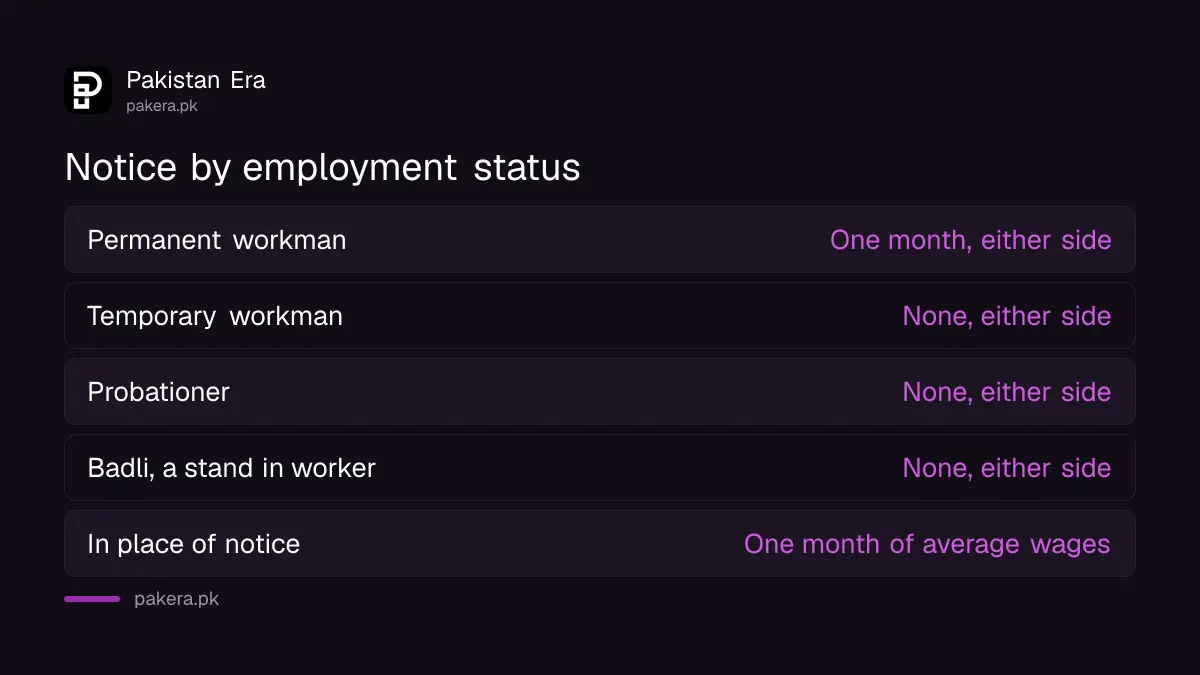
Standing Order 12(1) covers a permanent workman. To end that employment for any reason other than misconduct, one month's notice must be given, and the clause says it works in both directions: by the employer or by the workman.
| Status | Notice required |
|---|---|
| Permanent workman | One month, either side |
| Temporary, any pay basis | None, either side |
| Probationer | None, either side |
| Badli, a stand in worker | None, either side |
| Instead of notice | One month's wages in lieu |
Where notice is not given, the clause allows one month's wages in lieu, and it is specific about how that month is valued: on the basis of the average wages earned during the last three months. If your pay varies, that average is the number to work from rather than your basic salary.
Clause 2 then removes the notice requirement entirely for temporary workmen on any pay basis, for probationers and for badli workers. It cuts both ways there too, so a temporary worker who walks out owes no notice and no wages in lieu.
The order has to be in writing and has to give the reason
Standing Order 12(3) is the clause worth memorising. It says the services of a workman shall not be terminated, and a workman shall not be removed, retrenched, discharged or dismissed, except by an order in writing which shall explicitly state the reason for the action taken.
Note how wide that list is. It is not only formal termination. Removal, retrenchment, discharge and dismissal are all named, so relabelling the exit does not move it outside the requirement.
The clause then gives a route. A workman who is aggrieved by the termination, removal, retrenchment, discharge or dismissal may take action under section 25-A of the Industrial Relations Ordinance, 1969, and the grievance provisions of that section apply.
The 1969 Ordinance the clause points to has since been replaced. Today the grievance route sits in the industrial relations law that covers the workplace. For Islamabad and for firms working in more than one province it is section 33 of the Industrial Relations Act 2012, with a grievance petition to the NIRC. Elsewhere it is the province's own industrial relations act.
What to do the day it happens
The practical problem is that a verbal instruction to stop coming in leaves no record of anything, including the date. Fix that first, calmly and in writing.
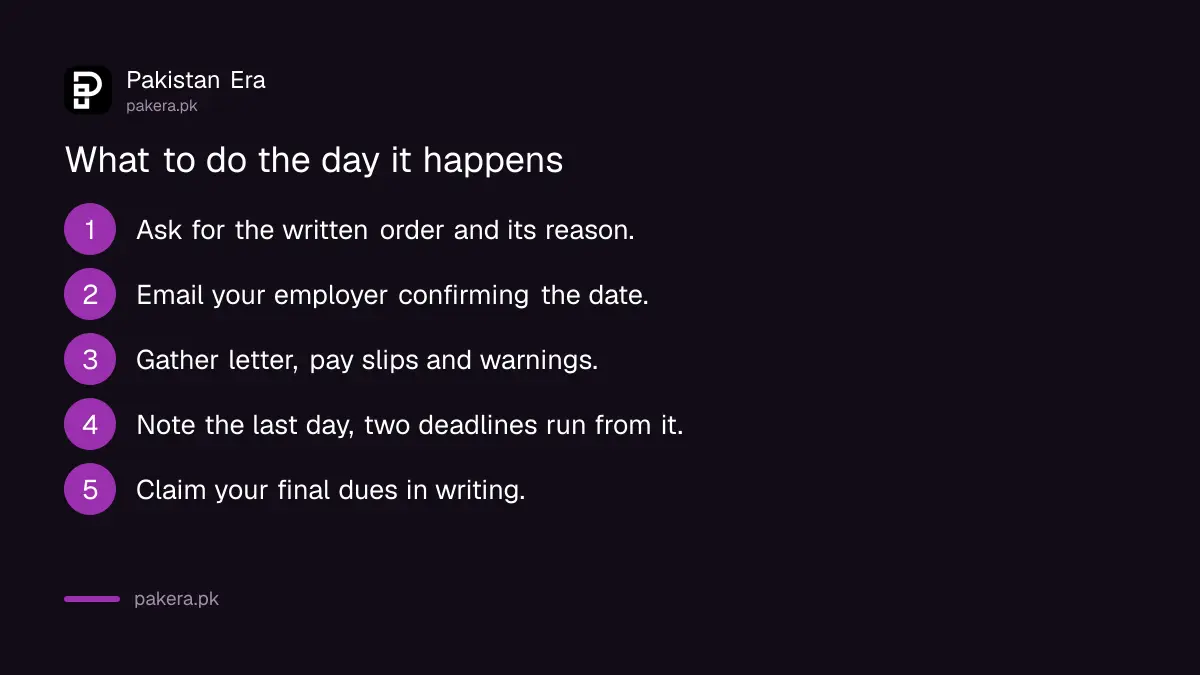
- Ask for the written order and for the reason stated in it.
- If nothing arrives, email your employer confirming what you were told and on what date.
- Keep your appointment letter, pay slips and any warning letters together.
- Note the date service ended, because two deadlines run from it.
- Put your claim for final dues in writing rather than asking verbally.
An email you sent yourself the same day is not proof of the employer's decision, but it fixes the date and the account you gave while it was fresh. That is worth a great deal more than a memory six months later.
Two deadlines run from the last day
Standing Order 12(4) says that where the services of any workman are terminated, the wages he has earned and other dues, including payment for unavailed leave, are to be paid before the expiry of the second working day from the day his services are terminated.
That is far tighter than the next payroll date, which is what most people are told to wait for, and unavailed leave is named in the clause rather than left to company policy. The second deadline is gratuity, which runs on its own rules, and our guide to what your employer owes you when you leave sets those out.
Misconduct is a separate procedure
Clause 5 says the services of a permanent or temporary workman shall not be ended on the ground of misconduct otherwise than in the manner prescribed in Standing Order 15. So misconduct is not a shortcut. It is a different route with its own steps.
This matters financially as well as procedurally, because misconduct is the exception that removes the gratuity entitlement. A reason recorded loosely in a written order can therefore cost money, which is another argument for reading that order carefully rather than filing it.
Retrenchment has an order, and a right of return
Standing Order 13 sets out who goes first. Where a workman is to be retrenched and he belongs to a particular category of workmen, the employer shall retrench the workman who is the last person employed in that category. Last in, first out, applied within the category rather than across the whole establishment.
Standing Order 14 then adds something people rarely know they have. Where workmen are retrenched and the employer proposes to employ any person within one year of the retrenchment, the retrenched workmen have a claim on that re employment. If your old employer starts hiring again a few months later, that clause is the reason to write to them.
Which jobs and which province
The ordinance applies to industrial and commercial establishments as it defines them, so it does not reach every job. Government service and many small establishments sit under other rules.
Labour became a provincial subject after the eighteenth amendment, and each province administers its own version of this ordinance. The copy we read cites the Punjab Industrial Relations Act, 2010, which places it in the Punjab line. Confirm the version applied in your province before relying on a section number, and read your appointment letter too, since a contract may promise more than the statute but not less. If money has already been withheld, our guide to making a formal complaint covers how to structure one.
Common questions about termination in Pakistan
Can my employer fire me verbally?
The clause requires an order in writing that explicitly states the reason. Ask for it, and record the date and what you were told if nothing is issued.
How much notice am I owed?
One month if you are a permanent workman, or one month's wages in lieu calculated on your average wages over the last three months.
Do I have to give notice if I resign?
A permanent workman gives one month either way. A temporary workman, probationer or badli owes no notice and no wages in lieu.
When must my final salary be paid?
Before the expiry of the second working day from the day service ended, and payment for unavailed leave is included in that.
Does retrenchment give me any claim to my old job?
Standing Order 14 covers re employment where the employer takes on any person within one year of the retrenchment.
How we verified this
What we checked, where we read it, and what we could not confirm.
Last checked 29 August 2026. Every clause here was read by us in the text of the Industrial and Commercial Employment (Standing Orders) Ordinance, 1968, document PAK86160 in the ILO NATLEX database of national labour legislation. That is the statute rather than a Government of Pakistan web page, and we did not read it on a provincial labour department site. The one month notice and wages in lieu on the last three months average, the removal of notice for temporary workmen, probationers and badli workers, the requirement of an order in writing explicitly stating the reason, the section 25-A grievance route, the second working day deadline for wages and unavailed leave, the separate misconduct procedure under Standing Order 15, the last in first out rule for retrenchment and the re employment claim within one year are all taken from that text. The copy we read cites the Punjab Industrial Relations Act, 2010. Labour is a provincial subject after the eighteenth amendment, so confirm the numbering and wording applied in your province before acting. Nothing here is legal advice, and a disputed termination is a matter for a labour lawyer or the labour department in your district.
About the author

Senior Writer, Public Services and Technology
Shahid joined us in 2024 as an author. He is a senior contributor to Pakistan's leading technology websites. He writes detailed articles, mostly covering his expertise in the latest tech, mobiles, apps, gadgets, and step-by-step guides. His ideology is to help people understand the latest trends and explain complex methods through very easy-to-understand guides.