What Your Employer Must Display at Work in Pakistan
Working hours, holidays, pay days and wage rates must be posted at the entrance, in Urdu. Plus the rules on stopping a shift.
Your employer has to put your working hours, your holidays, your pay days and your wage rates on a notice board, in Urdu, where you can read them.
Not on request. Not in a file in the office. On a board at or near the main entrance.
Most workers have never been told this is a legal requirement. We read it in the Industrial and Commercial Employment (Standing Orders) Ordinance, 1968 on 31 August 2026.
What must be displayed
| Standing Order | What has to be posted |
|---|---|
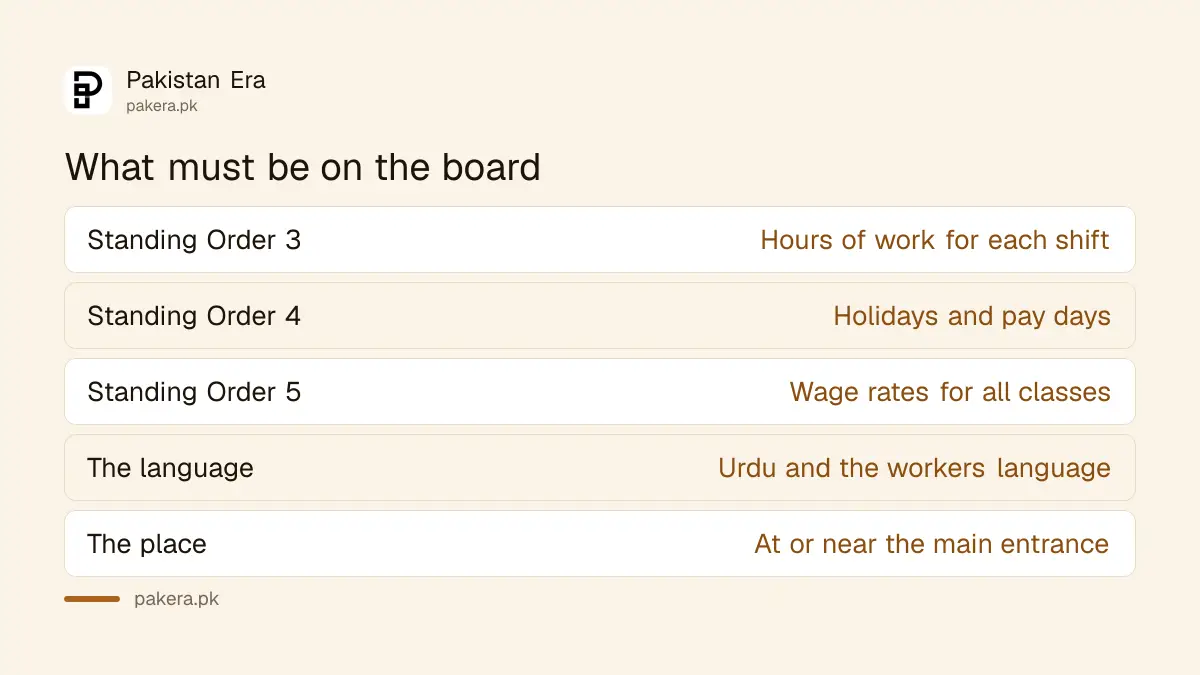
| 3 | The periods and hours of work for all classes of workmen in each shift |
| 4 | The days observed as holidays, and the pay days |
| 5 | The rates of wages for all classes of workmen and all classes of work |
Standing Order 3 also says where and in what language. The hours must be exhibited in Urdu and in the principal language of the workmen employed, on notice boards maintained at or near the main entrance of the establishment, and at the time keeper's office if there is one.
That combination is the useful part. A rule posted only in English, in a manager's office, does not meet what the Ordinance describes.
Why a notice board matters
Wage disputes usually come down to what was agreed. When the rate for your class of work is posted publicly, there is much less room for it to be described differently later.
The same is true of holidays and pay days. A posted pay day is a date you can point at. An unposted one is whenever the office says.
If nothing is displayed where you work, that is worth raising politely and in writing before it becomes a dispute. Ask for the notice to be put up rather than accusing anyone, and keep a copy of what you asked.
Shift work has its own rules
Standing Order 6 allows an employer to run more than one shift, at its discretion, and says workmen are liable to be transferred from one shift to another. But it also puts conditions on stopping a shift.
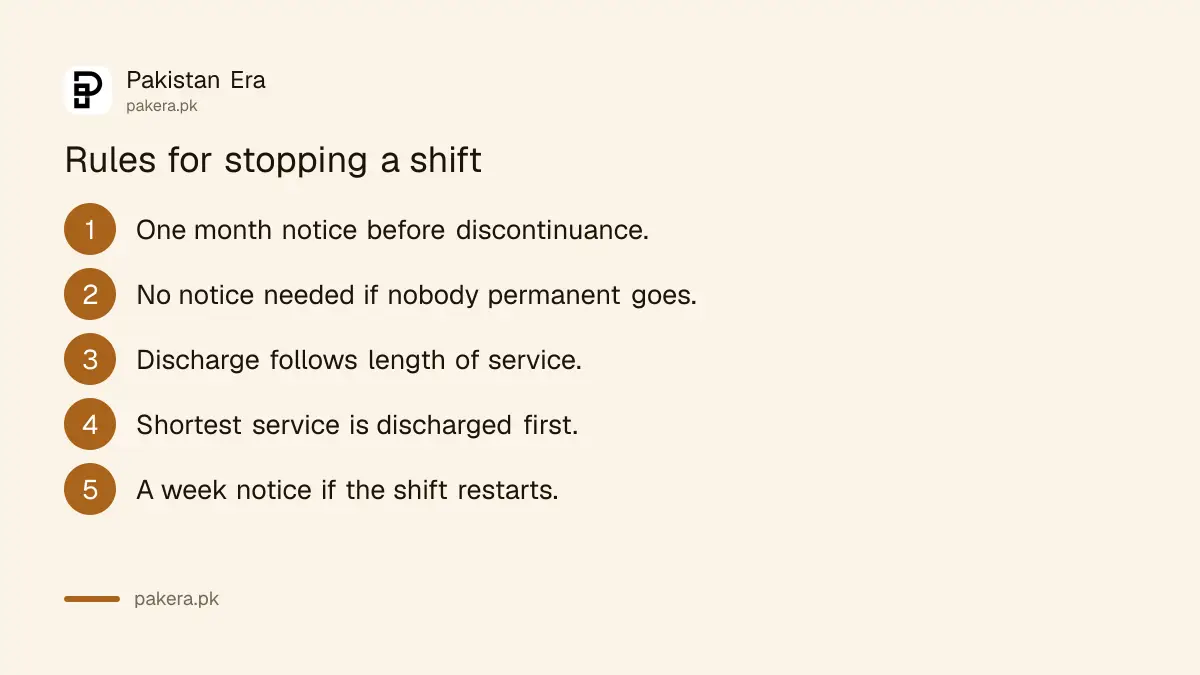
- A shift cannot be discontinued without one month's notice beforehand.
- That notice is not needed if no permanent employee will be discharged as a result.
- If permanent workmen must be discharged, length of service decides the order.
- Those with the shortest service are discharged first.
- If the shift restarts, a week's notice is posted at the main entrance.
And there is a re-employment point that is easy to miss. Where the shift is restarted, workmen discharged because it was discontinued have a claim to be taken back if they present themselves at the time of restarting.
So if your shift was stopped and you were let go, keep an eye on whether it starts again. Turning up matters, because the Ordinance ties the entitlement to presenting yourself.
How this fits with the rest of your rights
These notice rules sit alongside the parts of the same Ordinance that deal with money and dismissal.
What you are owed when you leave, including gratuity and your provident fund, is covered in our guide to gratuity and provident fund rules. The notice you are entitled to and the requirement for a written order stating the reason are covered in our guide to termination rules in Pakistan.
Read together, the pattern is that the Ordinance repeatedly requires things in writing or on display. That is the practical theme worth carrying: what is written down is what you can rely on.
Which workplaces this covers
The Ordinance applies to industrial and commercial establishments, which is broader than factories alone and takes in a great deal of ordinary commercial employment.
Labour is a provincial subject after the eighteenth amendment, and each province administers its own version of this Ordinance with its own amendments. The copy we read is the Punjab applied text, which refers to the Punjab Industrial Relations Act 2010.
So treat the shape as common across the country and check the section numbering for your own province before quoting it to anyone.
Common questions
Does my employer have to display my working hours?
Standing Order 3 requires the periods and hours of work for all classes of workmen in each shift to be exhibited on notice boards at or near the main entrance.
In which language?
In Urdu and in the principal language of the workmen employed.
What about wages and holidays?
Standing Orders 4 and 5 require holidays, pay days and wage rates for all classes of work to be posted on the same boards.
Can my employer move me between shifts?
Yes. Standing Order 6 says workmen are liable to be transferred from one shift to another.
Can a shift just be stopped?
Not without one month's notice, unless no permanent employee is discharged as a result.
If the shift restarts, can I get my job back?
The Ordinance ties that to presenting yourself when the shift restarts, after a week's notice is posted.
How we verified this
What we checked, where we read it, and what we could not confirm.
Last checked 31 August 2026. We read the text of the Industrial and Commercial Employment (Standing Orders) Ordinance, 1968 on that date, in the copy published in the International Labour Organization's NATLEX database rather than on a Government of Pakistan page, and we say so because the distinction matters. Standing Order 3 on publication of working time including the requirement to exhibit hours in Urdu and the principal language of workmen on notice boards at or near the main entrance and at the time keeper's office, Standing Order 4 on publication of holidays and pay days, Standing Order 5 on publication of wage rates for all classes of workmen and work, and Standing Order 6 on shift working including the one month notice before discontinuance, the exemption where no permanent employee is discharged, discharge in order of shortest service, the week's notice on restarting and the position of discharged workmen who present themselves, are all taken from that text. The copy we read is the Punjab applied version, which refers to the Punjab Industrial Relations Act 2010. Labour is a provincial subject and other provinces administer their own versions with their own amendments and numbering. Nothing here is legal advice.
About the author

Senior Writer, Public Services and Technology
Shahid joined us in 2024 as an author. He is a senior contributor to Pakistan's leading technology websites. He writes detailed articles, mostly covering his expertise in the latest tech, mobiles, apps, gadgets, and step-by-step guides. His ideology is to help people understand the latest trends and explain complex methods through very easy-to-understand guides.