406 PPC in Pakistan: Criminal Breach of Trust Punishment and Bail
406 PPC criminal breach of trust in Pakistan: up to 7 years or fine, cognizable, non-bailable and not compoundable, plus Sections 407 to 409 and what to keep.
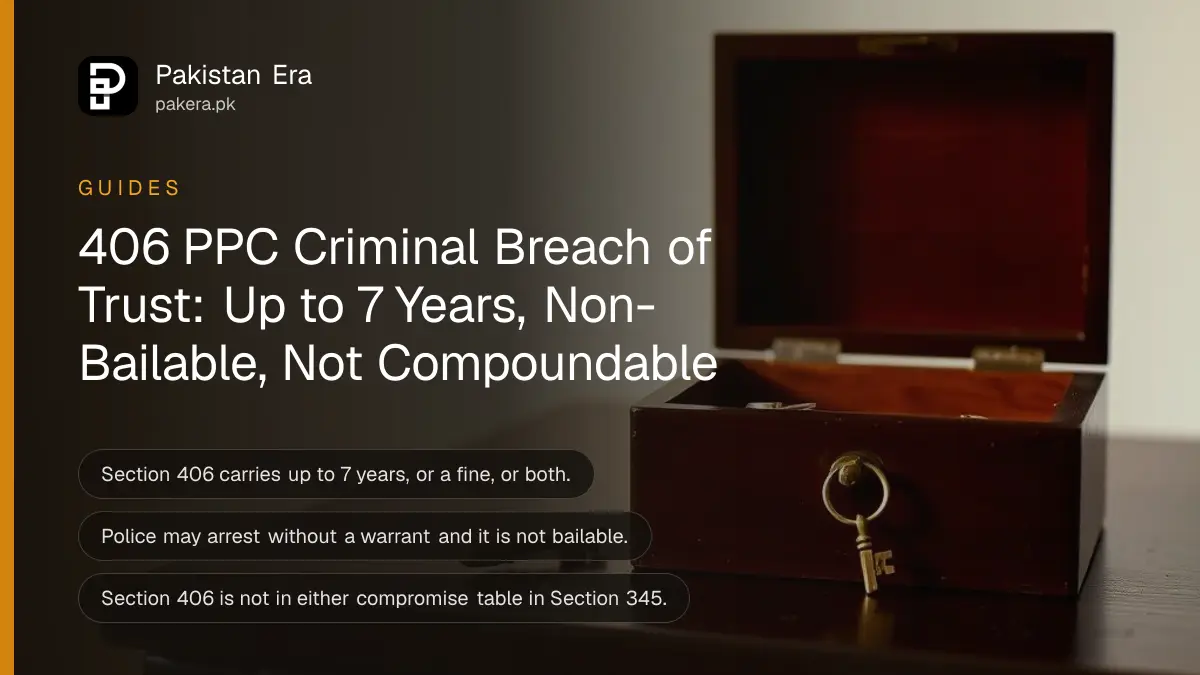
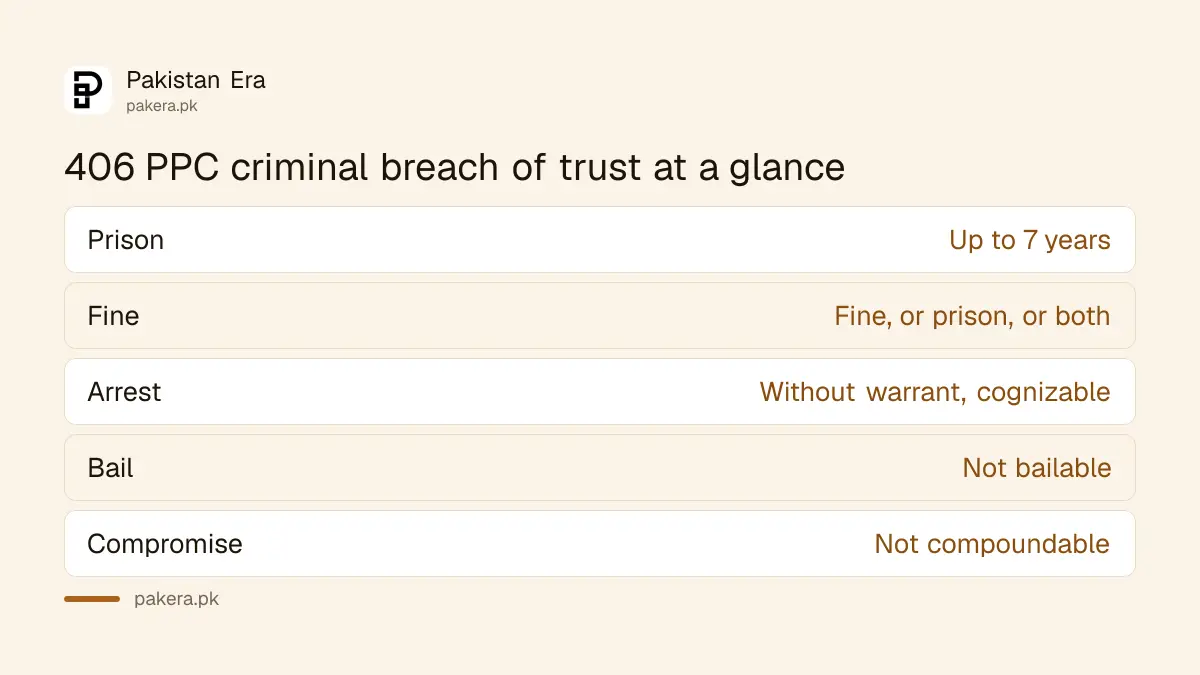
Short answer: Section 406 of the Pakistan Penal Code (PPC) punishes criminal breach of trust: dishonestly keeping or misusing property that was handed to you in trust. The PPC sets up to 7 years in prison, or a fine, or both. The Code of Criminal Procedure (CrPC) lists 406 as cognizable, not bailable and not compoundable, so a private settlement does not end the case by itself.
A 406 FIR usually follows a falling-out over money or goods that were handed over for a purpose. A partner keeps the business cash. A relative sells gold given for safekeeping. A dealer takes a car to sell and never pays. Below is what 406 needs, the punishment, the bail position, and the limits on compromise.
What criminal breach of trust means under Section 405
Section 405 PPC defines criminal breach of trust as dishonestly misappropriating, converting, using or disposing of property that was entrusted to you, against the law or the agreement under which you got it. Section 406 then sets the punishment.
Three things have to be shown:
- Entrustment: the property, or control over it, was handed to the accused. Money, gold, goods, a vehicle or documents can all count.
- Dishonest use: the accused misappropriated it, converted it to his own use, or used or disposed of it against the terms.
- Against a direction or agreement: the use breaks a law on how the trust is to be carried out, or a contract, express or implied.
The PPC's own illustrations include a warehouse keeper who sells goods left with him for storage, and an executor who keeps the estate for himself instead of dividing it under the will. Allowing someone else to misuse the property wilfully also counts.
406 is different from 420
In cheating under Section 420, the victim is deceived into handing over the property. In breach of trust, the handover was honest at the start and the dishonesty came later. Police often add both sections to one FIR, and the court decides which one the facts prove. The cheating rules are in the PPC sections list.
The punishment is up to 7 years in the PPC
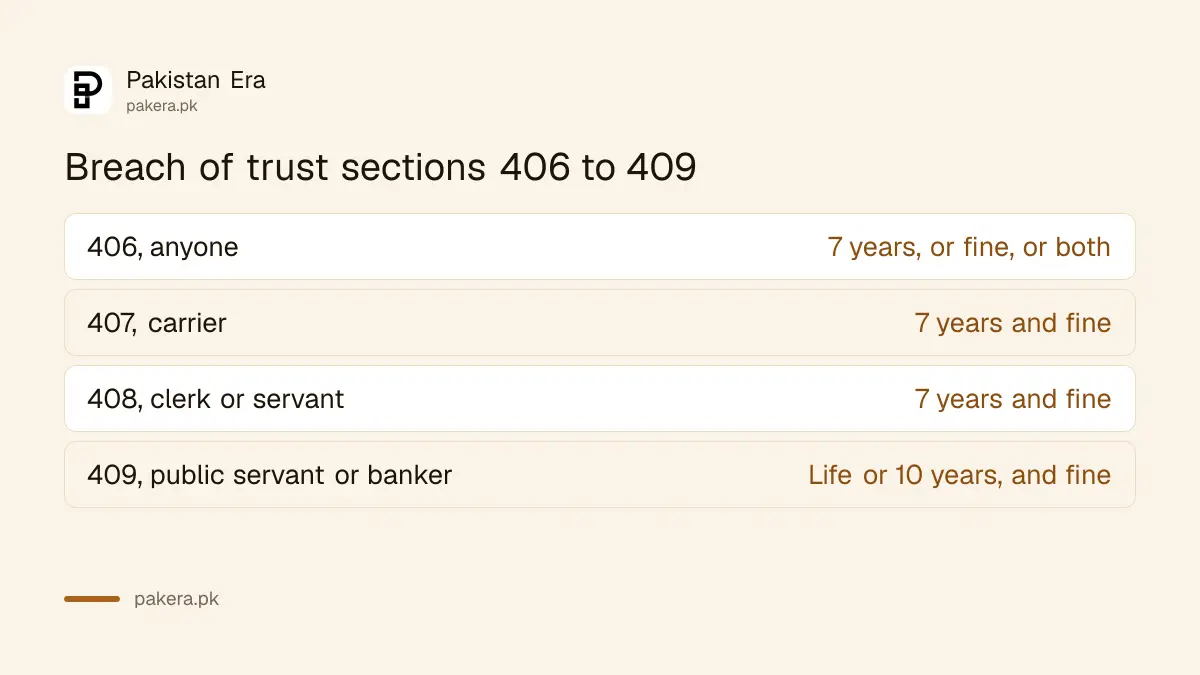
Section 406 reads "imprisonment of either description for a term which may extend to seven years, or with fine, or with both". The figure was raised from three years by the Criminal Law (Amendment) Ordinance 1981. Heavier sections apply to carriers, employees, public servants and bankers.
| Section | Who | Maximum in the PPC |
|---|---|---|
| 406 | Anyone entrusted with property | 7 years, or fine, or both |
| 407 | A carrier, wharfinger or warehouse keeper | 7 years and fine |
| 408 | A clerk or servant entrusted by the employer | 7 years and fine |
| 409 | A public servant, banker, merchant, broker, attorney or agent | Life, or up to 10 years, and fine |
One point confuses many people. The CrPC's second schedule still prints "3 years" against Section 406, because the schedule was not updated when the PPC changed. The PPC section itself is the punishment the court applies.
406 PPC is cognizable and not bailable
The CrPC schedule says police may arrest without a warrant for Section 406, a warrant issues in the first instance, and the offence is not bailable. It names a Magistrate of the first or second class as the trial court for 406.
"Not bailable" means bail is a court decision, not a right. The accused, or his lawyer, applies to the court, and the court weighs the facts. How that decision is made is set out in bailable and non-bailable offences. If bail is granted, the court asks for a bond and usually one or more sureties.
406 is not in the compromise tables
Section 345 of the CrPC has two tables of offences that can be compounded. Section 406 is in neither. Section 345(7) says no offence shall be compounded except as that section provides, so a 406 case cannot be closed by a compromise deed alone.
That surprises families who settle the money and expect the case to end. The trial still runs on the evidence. A settlement is not an automatic acquittal, as an accepted compromise is for 420 under Section 345 compounding.
If the case should never have been registered, the route is different. A cancellation report by police, or a petition to quash, are covered in cancelling a false FIR.
What to do in a 406 dispute
Whether you are the complainant or the accused, the paper trail decides a 406 case. Keep the proof of handover, the terms on which the property was given, and every message about it. Then take advice from a criminal lawyer before you go to the police.
- Collect proof of entrustment. A receipt, agreement, bank transfer, delivery slip or witness who saw the handover.
- Record the terms. What the property was for, and when it was to be returned or paid for.
- Keep the demand. A written demand for return and any reply, including WhatsApp messages.
- Give a written application to police. Attach copies and keep one with the receipt stamp.
- Use the next step if refused. Senior police officers, or the Sessions Judge as Justice of the Peace under Section 22-A CrPC.
If the dispute is really about a loan that was not repaid, with no entrustment for a purpose, it may be a civil claim instead. A bounced cheque has its own offence under Section 489-F. Free legal help is on the Supreme Court's legal aid helpline, 1818.
Common questions
What is the punishment for 406 PPC in Pakistan?
Up to 7 years of imprisonment of either description, or a fine, or both, under the PPC text as amended in 1981.
Is 406 PPC bailable?
No. The CrPC schedule lists it as not bailable, so the accused applies and the court decides on the facts.
Is 406 PPC compoundable?
No. Section 406 is not in either compounding table in Section 345 CrPC, and Section 345(7) bars compounding outside those tables.
Why does the CrPC schedule say 3 years for 406?
The schedule row was not updated when the PPC raised the term to seven years in 1981. The court applies the PPC section.
What is the difference between 406 and 420 PPC?
Section 420 needs deception before the handover. Section 406 covers property handed over honestly and misused later.
Which court tries a 406 case?
The CrPC schedule names a Magistrate of the first or second class for Section 406. Section 409 cases go to a Court of Session or a first class Magistrate.
How we verified this
What we checked and where we read it.
Sections 405 to 409 are from the Pakistan Penal Code PDF, and the second schedule rows and the Section 345 tables are from the Code of Criminal Procedure PDF, both on the Ministry of Law's Pakistan Code website. The PPC footnote shows Section 406 raised from three to seven years by the Criminal Law (Amendment) Ordinance 1981; the CrPC schedule row still prints 3 years. This page explains the law and is not legal advice.
Last checked 15 November 2026.
About the author

Global Affairs & Political Economy Writer
Muhammad Hatim is a book lover who started writing because he enjoys it. At Pakistan Era he writes about international relations, geopolitics and the global economy, with a particular interest in South Asia and the forces behind current events.