How to Settle a Criminal Case by Compromise in Pakistan: Section 345 Offences
Check which offences section 345 lets you settle by compromise in Pakistan, who may settle, when the court must agree and why a settlement equals an acquittal.
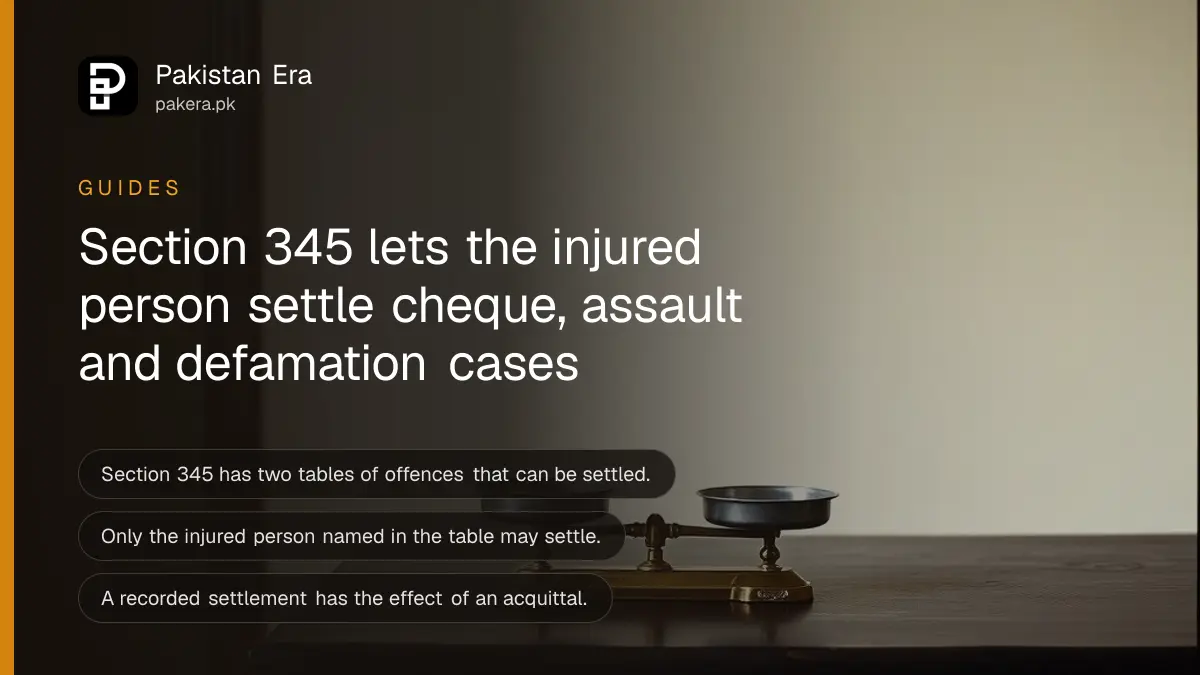
Short answer: Section 345 of the Code of Criminal Procedure lets the injured person settle some offences, such as a dishonoured cheque under section 489-F, assault, trespass, defamation and criminal intimidation. Other offences, including hurt and rioting, need the court's permission first. A settlement works as an acquittal.
Many criminal cases in Pakistan start from a quarrel over money, property or words. Months later both sides want to stop. The law allows that for a list of offences, but only in the way the Code describes. A private promise outside court does not end a case.
We read the Code of Criminal Procedure, 1898 on the Pakistan Code portal (pakistancode.gov.pk) on 14 October 2026, section 345 and the sections around it. This guide follows that text. It is general information, not legal advice for your file.
Section 345 lists the offences that can be settled
Section 345 has two tables. The first lists offences the injured person can compound, meaning settle, on their own. The second lists offences that can be compounded only with the court's permission. No offence outside these tables can be settled.
The first table includes wrongful restraint (sections 341 and 342), assault or criminal force (352, 355 and 358), mischief that harms a private person (426 and 427), criminal trespass (447), house trespass (448), a dishonestly issued cheque (489-F), defamation (500 to 502), insult meant to provoke a breach of the peace (504) and criminal intimidation (506, except where the punishment is seven years).
The second table includes rioting (147 and 148), the hurt offences in Chapter XVI such as shajjah, jaifah and hurt by rash driving, cheating (417 to 420), dishonest misappropriation (403) and a second marriage in the lifetime of a spouse (494). For qatl, the table names the heirs of the victim and points to section 311 of the Pakistan Penal Code.
Only the injured person can settle, not the police or a third party
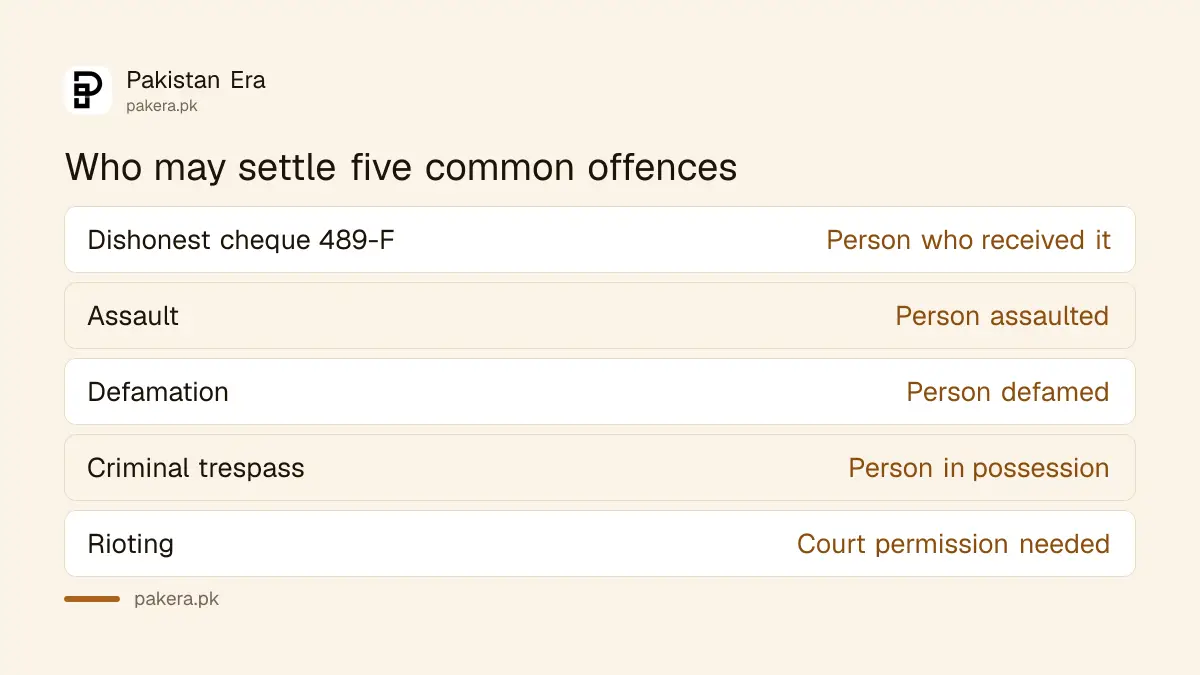
Each row of the table names who may compound. For a cheque it is the person in whose favour the cheque was issued. For assault it is the person assaulted. For defamation it is the person defamed. A friend, elder or the police cannot settle for them.
If that person is under 18 or of unsound mind, section 345(4) allows someone competent to contract on their behalf to settle, but only with the court's permission. Section 345(3) adds that abetting or attempting a compoundable offence can be settled in the same way.
Section 345(2A) deals with offences in the name of karo kari, siyah kari or similar customs. The court may allow a waiver or settlement there only on conditions it considers fit, with the consent of the parties.
Court permission decides the second table and pending appeals
For offences in the second table, the court where the case is pending must allow the settlement. If the accused is already convicted and an appeal is pending, section 345(5) says the court hearing the appeal must give leave first.
A High Court in revision can also let a person compound an offence they are entitled to compound, under section 345(5A). A Court of Session can do the same when it exercises revision powers under section 439A.
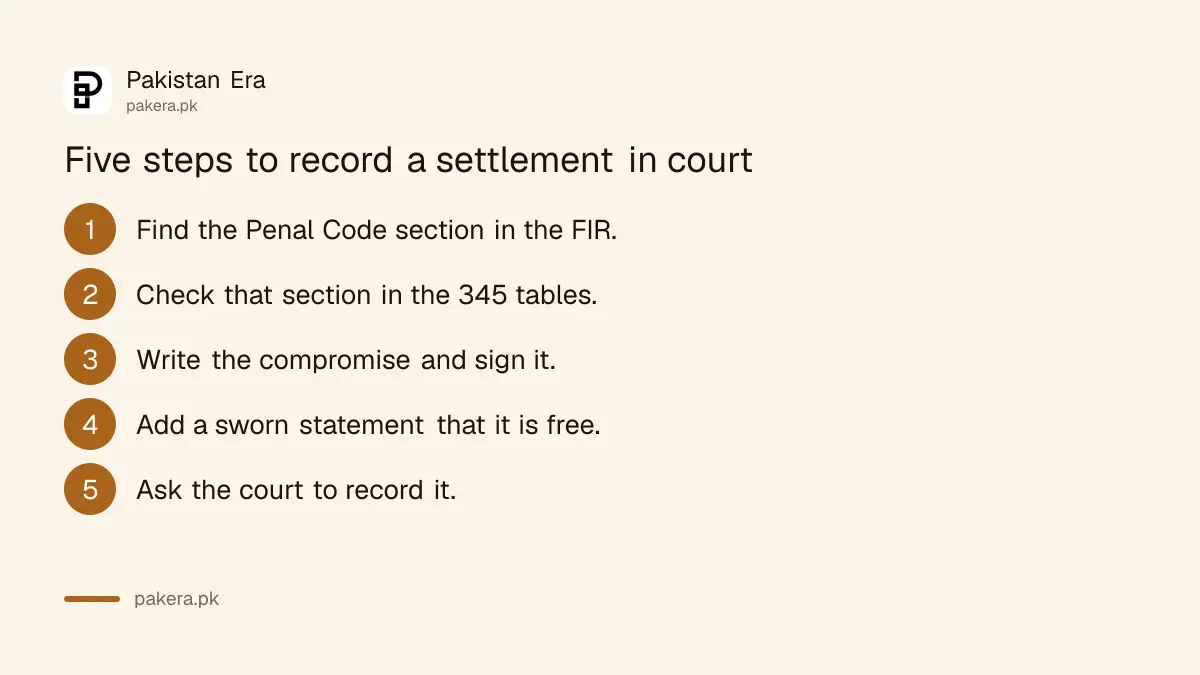
So the order matters. The parties agree, they sign a written compromise, and they put it before the court. The court checks that the offence is on the list and that the right person is settling. Then it records the compromise.
- Find the section of the Pakistan Penal Code in the FIR or the complaint.
- Check that section in the section 345 tables.
- Write the compromise and have the injured person sign it.
- Attach a sworn statement that the settlement is free and not forced.
- Give both to the court where the case is pending and ask for it to be recorded.
A recorded settlement has the effect of an acquittal
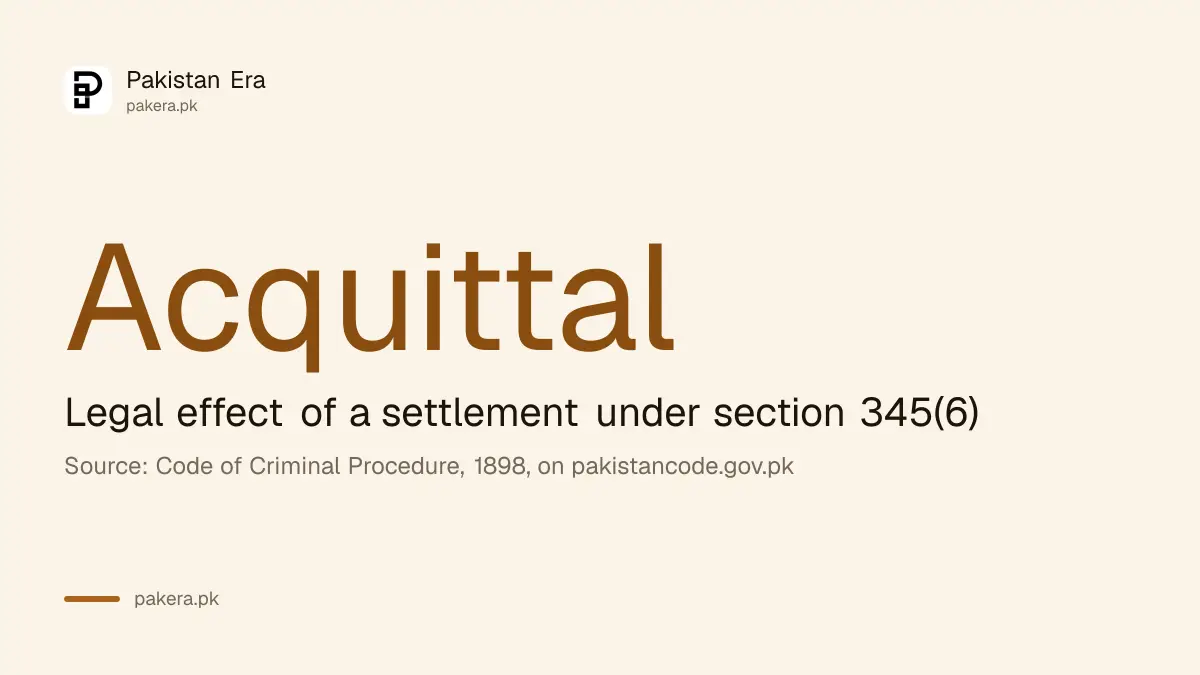
Section 345(6) says that compounding an offence has the effect of an acquittal of the accused with whom the offence was compounded. The case ends. Section 345(7) adds that no offence can be waived or compounded except as section 345 and section 311 of the Penal Code allow.
| Question | What section 345 says |
|---|---|
| Who settles a 489-F cheque case | The person in whose favour the cheque was issued |
| Who settles an assault case | The person assaulted |
| Who settles a defamation case | The person defamed |
| Is court permission needed for rioting | Yes, it is in the second table |
| Is court permission needed after conviction | Yes, leave of the appeal court under 345(5) |
| Effect of settlement | Same as an acquittal under 345(6) |
One case shows why the list matters. If a cheque to you bounces, you may file under section 489-F. Our guide on what to do when a cheque bounces explains that route. If the debtor later pays, you can compound, because 489-F is in the first table.
What to do before you sign a compromise
Before you sign, read the section named in the case papers and match it to the tables. Get the amount and the date written down. Ask for the compromise to be recorded by the court, not just exchanged between the two sides.
If you are the accused, a signed paper alone does not close the case. The court must record it. Keep copies of the order. If you are on bail, our guide on getting bail in Pakistan explains what bail already requires of you, and a free lawyer can be found through the options in our legal aid guide for Punjab.
Common questions
Can a murder case be settled in Pakistan?
Section 345(2) lists qatl offences in the second table. They are compounded by the heirs of the victim, subject to section 311 of the Penal Code, and the court must give permission.
Can the police stop a case because both sides agree?
Section 345 gives the power to the injured person and the court, not to the police. The agreement should be put before the court where the case is pending.
Does a cheque case end if the debtor pays?
Section 489-F is in the first table. The person in whose favour the cheque was issued can compound it, and the settlement has the effect of an acquittal.
Can I settle after the court has convicted me?
Only with the leave of the court that will hear the appeal, as section 345(5) says. Without that leave the settlement is not allowed.
Does a settlement on stamp paper outside court count?
The section requires composition under its own terms and the court's recording for the second table. We found nothing in section 345 that gives a private paper the power to end a case alone.
How we verified this
What we checked, where we read it, and what we could not confirm.
We read section 345 of the Code of Criminal Procedure, 1898, in the Pakistan Code PDF (pakistancode.gov.pk) on 14 October 2026. The file states it was last amended on 16 February 2017, so check that no later amendment changed the tables. The table in the PDF text is printed in columns that can shift, so pairs of offence and person were read by their position and by the wording of each row. Ask a lawyer to confirm the row for your offence before you sign.
About the author

Tax, Bills and Technology Writer
Ali Akhtar is a young and curious voice here at Pakistan Era. He is currently pursuing his A-Levels and has a growing interest in Pakistan’s changing industrial landscape and educational trends. Ali likes to write in a way that helps him explain and explore the world around him. His writing reflects the perspective of the new generation navigating the evolving trends of Pakistan where technology, youth innovation, and shifting opportunities are reshaping the country’s future.