How to Get Bail in Pakistan: Bailable and Non-Bailable Offences
Bail depends on whether the FIR offence is bailable or not. See what sections 496 to 499 say, who can release you, the surety paperwork and how bail ends.
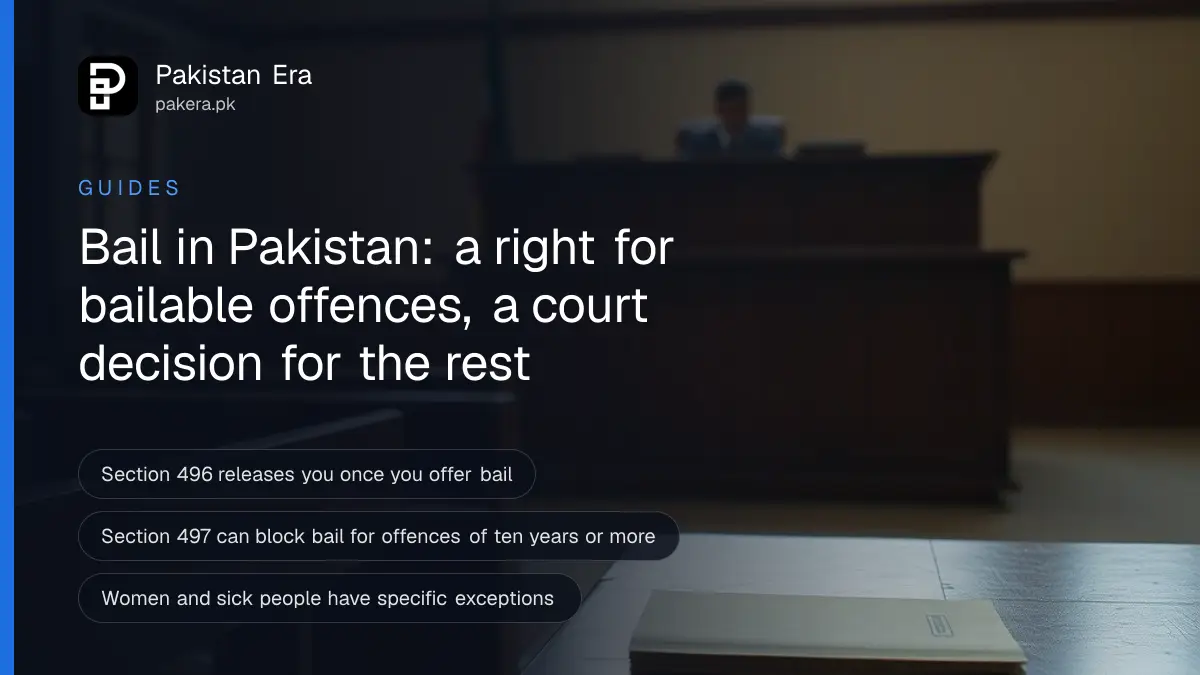
Whether you can get bail as of right depends on one thing: whether the offence in the FIR is bailable or non-bailable. For a bailable offence, the law says you shall be released once you are ready to give bail. For a non-bailable offence, a court decides, and some cases are shut out unless a special condition is met.
A family hears the words "bail" and "FIR" on the worst night of their year and has nothing to work with. This guide gives the sections that decide the question, in plain words, so you can talk to a lawyer with the right questions in hand.
Bailable offences carry a right to release
Section 496 of the Code of Criminal Procedure, 1898 says a person arrested for a bailable offence shall be released on bail once prepared to give it. The police officer or court may instead take a bond without sureties. Nobody has to argue for it.
We read this section in the Code as published on the Pakistan Code website on 8 October 2026, in the version last amended in 2017. If your offence is bailable, ask the station to take bail there and then. They do not need a judge to say yes.
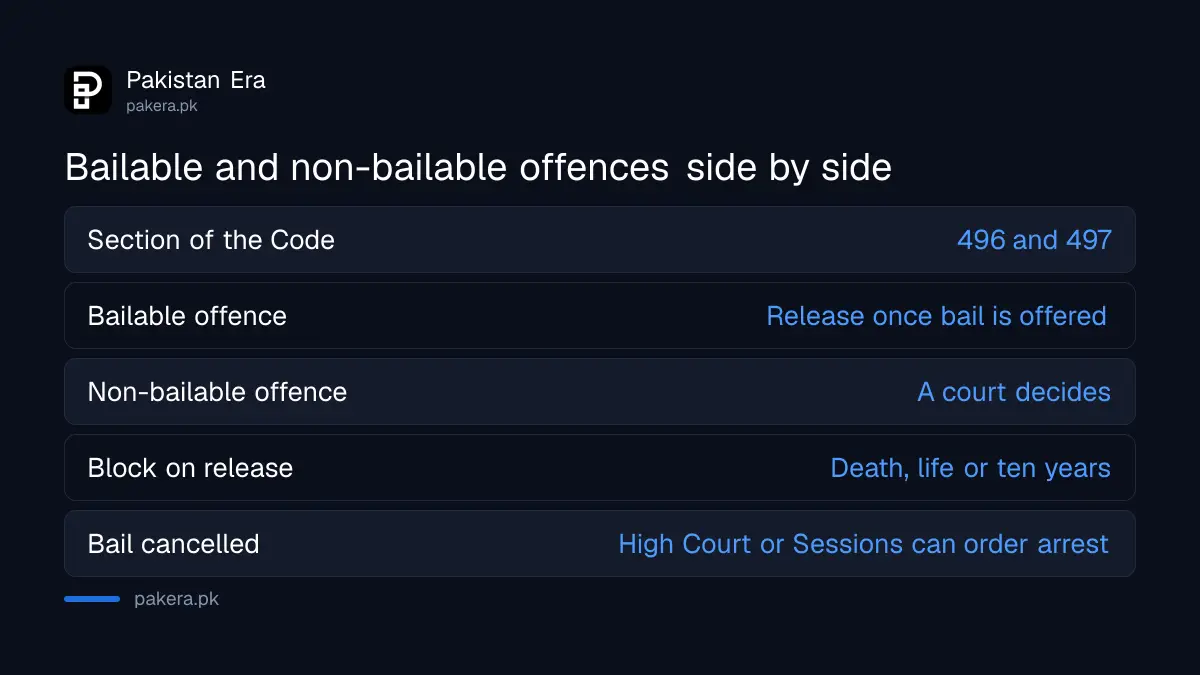
| Question | Bailable offence | Non-bailable offence |
|---|---|---|
| Section of the Code | 496 | 497 |
| Is release a right? | Yes, once bail is offered | No, a court may release you |
| Who can grant it? | Police officer or court | Police officer or court, but with limits |
| Reasons recorded? | Not stated in section 496 | Yes, in writing (section 497(3)) |
Non-bailable offences are a court decision with firm limits
Under section 497 a person accused of a non-bailable offence may be released, but not if there appear reasonable grounds for believing they are guilty of an offence punishable with death, imprisonment for life or imprisonment for ten years.
The section then softens that for specific people and for long delays. These exceptions are the ones lawyers raise most often:
- A person under sixteen, a woman or a sick or infirm person may be released on bail.
- A woman refused bail on that ground shall be released after six months in custody if trial has not concluded, unless she caused the delay.
- For offences not punishable with death, release is directed after a year in custody without a concluded trial, or six months for a woman.
- For offences punishable with death, the period is two years, or one year for a woman.
The delay rules do not apply where the accused or someone acting for them caused the delay. They are also not meant for previously convicted offenders of death or life offences or people the court thinks dangerous. Section 497(2) adds that if there are not reasonable grounds to believe the offence was committed but enough to justify further inquiry, bail can be granted pending that inquiry.
The FIR section number tells you which path you are on
Ask your lawyer to read the sections named in the FIR against the Code's schedule of offences. That list marks each offence as bailable or not and sets the punishment, which is the number that decides section 497.
We have not mapped individual offences in this guide. A single FIR often names several sections, and one non-bailable section is enough to put you on the harder path. If you are unsure, get a copy of the FIR first. The guide to what to do when police refuse or delay your FIR shows how to get one in Punjab.
Surety and bond are the paperwork that releases you
Before you walk out, a bond must be signed. Section 499 requires a bond for a sum the officer or court thinks sufficient, and, when you are released on bail, one or more sufficient sureties who promise you will attend when called.
A surety is a person who guarantees you will appear. Section 498 says the bond amount must not be excessive. It also lets the High Court or a Court of Session direct that a person be admitted to bail, or that bail set by police or a Magistrate be reduced.
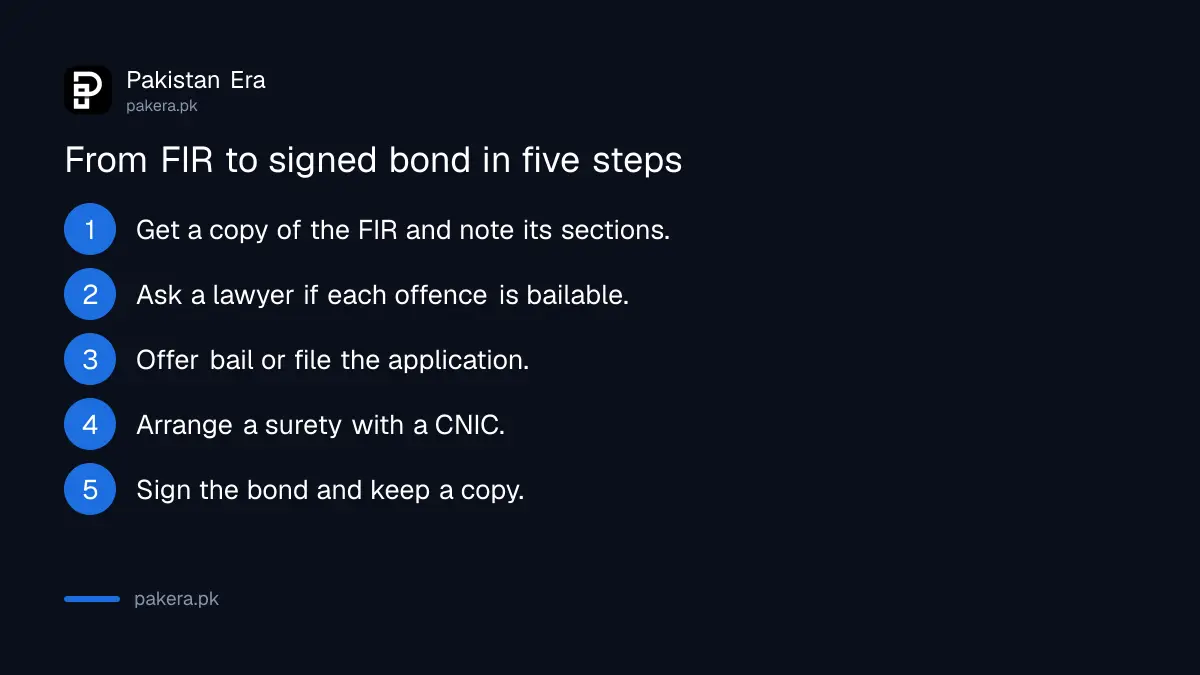
- Get a copy of the FIR and note every section named.
- Ask your lawyer whether each offence is bailable or not.
- For a bailable offence, offer bail at the station or before the Magistrate.
- For a non-bailable offence, file a bail application in the right court.
- Arrange a surety with a CNIC and the property or income proof your lawyer asks for.
- Sign the bond and keep a copy. Attend every date.
Bail can be cancelled, and the court can order an arrest
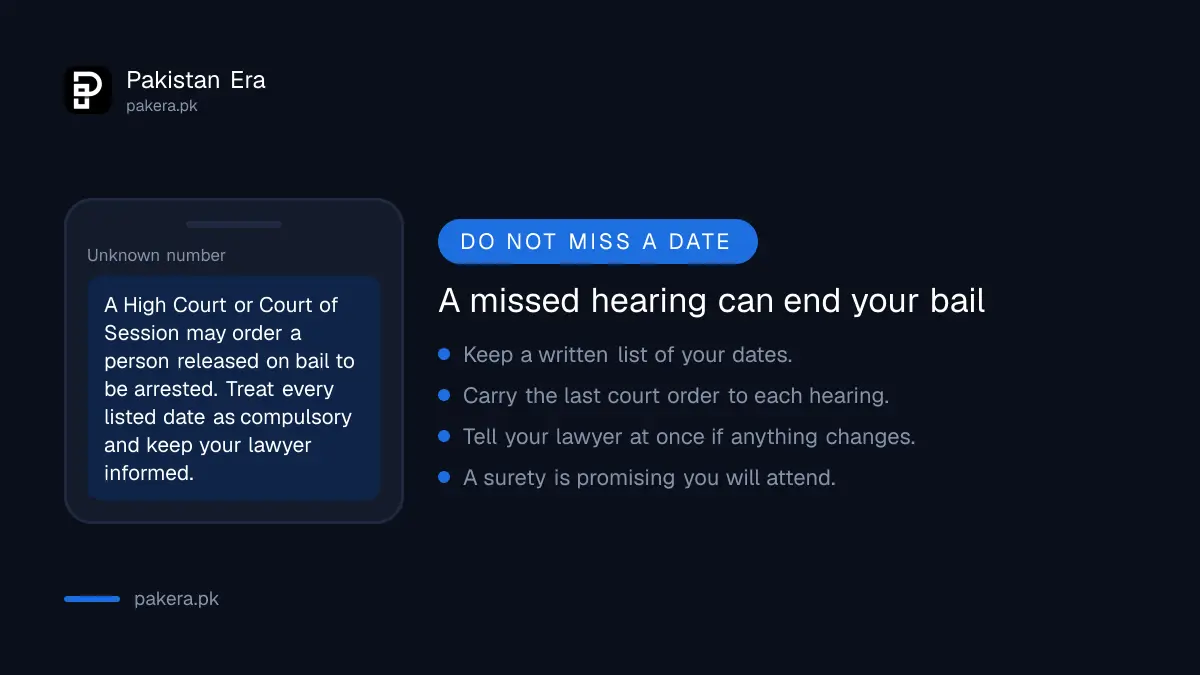
Section 497(5) says a High Court or Court of Session may cause a person released under that section to be arrested and committed to custody. Missed dates and broken conditions are the usual risks, so treat every hearing as compulsory.
This is why the Lahore High Court's reported instruction on 7 October 2026 matters to families. It concerns where police may act after bail is cancelled, not whether it can be. Read the news in the report on the Lahore High Court ban on arrests inside its premises.
The text we read also carries section 498A, which says nothing in sections 497 or 498 requires a court to grant bail to a person who is not in custody, not present in court or against whom no case stands registered. How courts handle a request for protection before arrest is a legal question to put to a lawyer, and we do not cover it here.
Know your rights while the bail is being arranged
While paperwork is being done, the Constitution still applies: you must be told the grounds of arrest, may consult a lawyer of your choice and must be produced before a magistrate within 24 hours. Our guide to your rights when arrested explains each one.
If you cannot afford a lawyer, legal aid exists. See the guide to a free lawyer in Punjab, or free legal aid in Khyber Pakhtunkhwa. Check the person you hire is real with the guide to verifying a lawyer's licence.
Common questions about getting bail in Pakistan
What is the difference between bailable and non-bailable?
For a bailable offence, release on bail is a right once you offer it. For a non-bailable offence, a court decides, and some serious cases are shut out.
Who can grant bail?
A police officer can release you in a bailable case. A court grants or refuses bail in non-bailable cases. The High Court and Court of Session can direct bail in any case.
How long can I be held before bail must be considered?
Section 497 sets periods after which release is directed if trial has not concluded: one year for most offences, two for offences punishable with death, and shorter for women. Delay caused by the accused does not count.
What is a surety?
A person who signs a bond that you will attend court when called. Courts ask for a CNIC and proof they can cover the amount.
Can bail be cancelled?
Yes. The High Court or Court of Session can order a released person arrested under section 497(5). Missing dates is the usual trigger.
How we verified this
What we checked, where we read it, and what we could not confirm.
Last checked 8 October 2026. Sections 496 to 499 and 498A of the Code of Criminal Procedure, 1898 were read in the PDF published at pakistancode.gov.pk, in the version last amended in 2017. We could not confirm whether later amendments or Punjab, Sindh or Khyber Pakhtunkhwa provincial changes alter these sections, so ask your lawyer to check the current text for your province. We did not read the schedule listing each offence. The Lahore High Court letter is reported in the press on 7 October 2026 and we have not seen the letter itself. Article 10 of the Constitution is as published by the National Assembly at na.gov.pk. This guide is information, not legal advice.
About the author

Senior Writer, Public Services and Technology
Shahid joined us in 2024 as an author. He is a senior contributor to Pakistan's leading technology websites. He writes detailed articles, mostly covering his expertise in the latest tech, mobiles, apps, gadgets, and step-by-step guides. His ideology is to help people understand the latest trends and explain complex methods through very easy-to-understand guides.