Your Rights When You Are Arrested in Pakistan
You must be told the grounds, you may pick your own lawyer, and a magistrate must see you within twenty four hours of the arrest.

If you are arrested in Pakistan you must be told the grounds, you cannot be denied a lawyer of your own choosing, and you must be produced before a magistrate within twenty four hours. These are constitutional rights, not police policy.
The twenty four hours excludes the time needed to travel to the nearest magistrate's court, and nothing else.
We read Articles 10, 10A, 13 and 14 of the Constitution on 10 September 2026, in the text published by the National Assembly of Pakistan.
What Article 10 gives you
| Right | What the Constitution says |
|---|---|
| To be told why | Informed of the grounds for arrest, as soon as may be |
| To a lawyer | To consult and be defended by a legal practitioner of your choice |
| To see a magistrate | Within twenty four hours of arrest |
| Travel time | Excluded, to the court of the nearest magistrate |
| Beyond that | No detention without the authority of a magistrate |
Read the lawyer clause carefully. It is not a right to a lawyer. It is a right to consult and be defended by a legal practitioner of your choice, which means the choice belongs to the person arrested.
The twenty four hour rule, and what it does not stretch for
Article 10(2) says every person arrested and detained in custody shall be produced before a magistrate within twenty four hours of the arrest, excluding the time necessary for the journey from the place of arrest to the court of the nearest magistrate.
The only thing the clause allows to be added is travel, and only travel to the nearest magistrate rather than a preferred one.
It then closes the gap. No such person shall be detained in custody beyond that period without the authority of a magistrate. So continued custody after twenty four hours is not a police decision. It requires a magistrate to authorise it.
That is why the time and date of arrest matter so much, and why the first thing a family should establish and write down is when the person was actually taken.
Three more protections that sit alongside it
Article 10A, inserted by the Eighteenth Amendment in 2010, says that for the determination of civil rights and obligations or in any criminal charge, a person shall be entitled to a fair trial and due process.
Article 13 says no person shall be prosecuted or punished for the same offence more than once, and no person accused of an offence shall be compelled to be a witness against himself.
Article 14 says the dignity of man and, subject to law, the privacy of home shall be inviolable, and that no person shall be subjected to torture for the purpose of extracting evidence.
That last clause is unqualified. It does not say torture is discouraged or that evidence so obtained is weak. It says no person shall be subjected to it for that purpose.
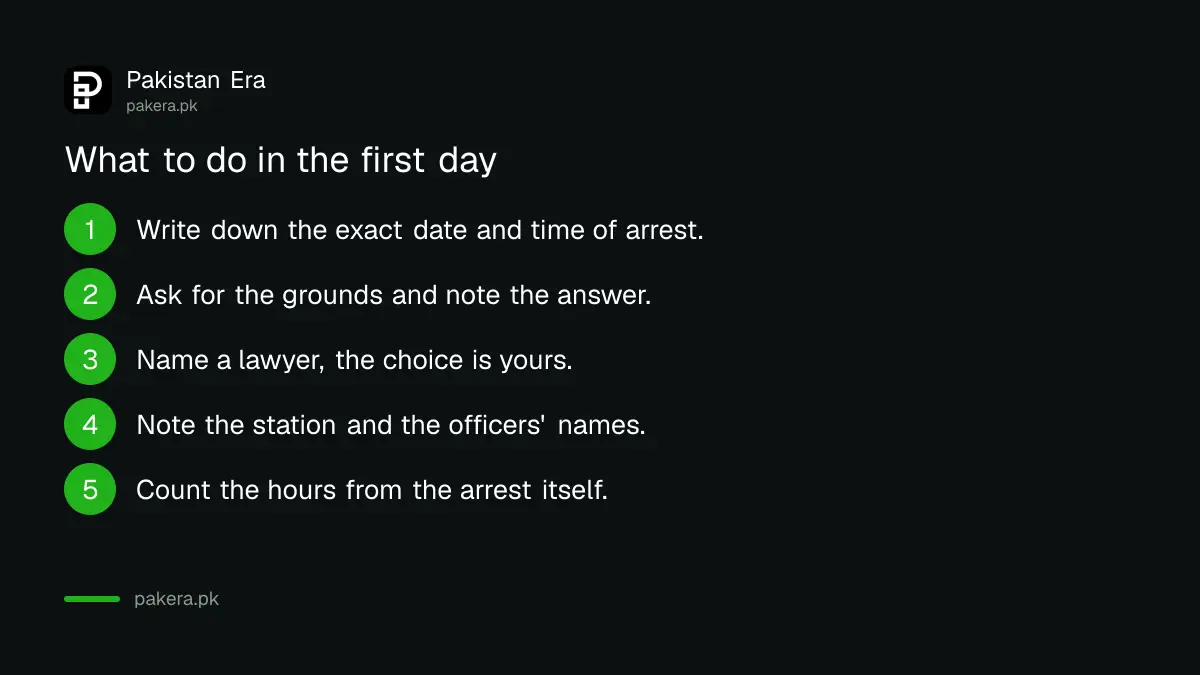
What to do in the first day
- Write down the exact date and time of the arrest, and who was present.
- Ask for the grounds of arrest and note what you are told.
- Name a lawyer, because the right is to a practitioner of your choice.
- Note the police station and the names of the officers dealing with it.
- Count the twenty four hours from the arrest, not from when the family found out.
Families often learn of an arrest hours after it happened, and then start the clock from their own phone call. The Constitution starts it at the arrest.
Our guide to getting a free lawyer in Punjab covers the Legal Aid Agency, whose definition of an indigent person expressly includes a person involved in the commission of an offence who cannot afford an advocate. Our guide to checking a court case online covers following the case once it is registered.
The exception, and it is a real one
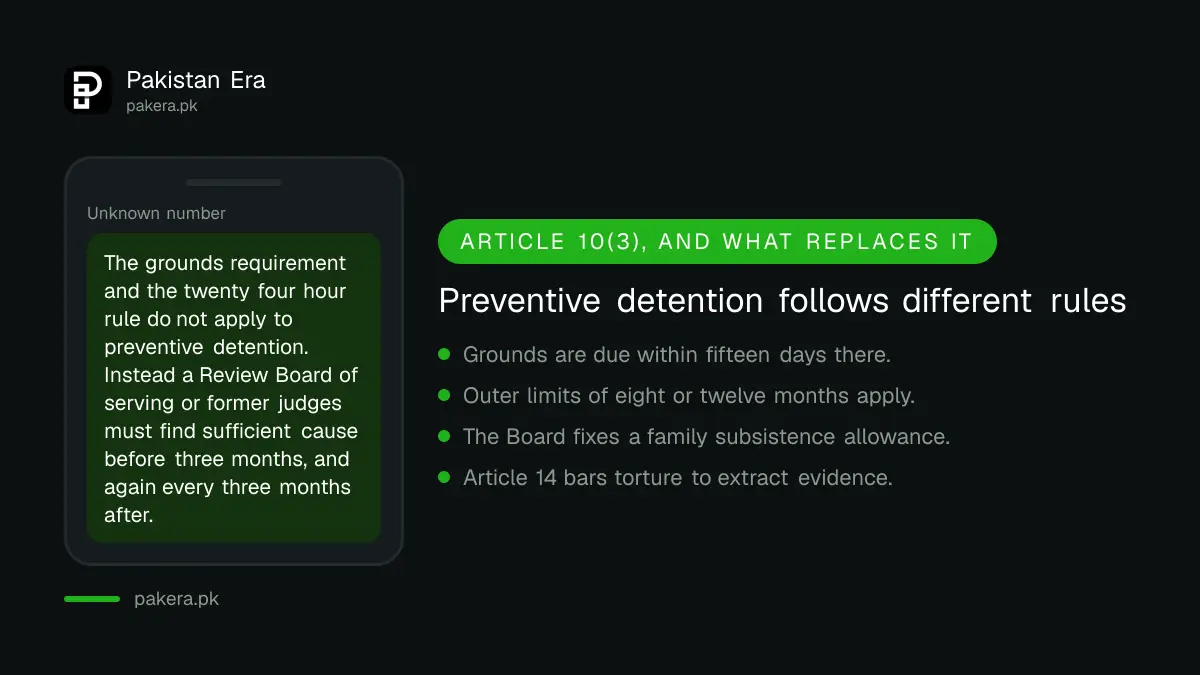
Article 10(3) states that clauses (1) and (2) do not apply to a person arrested or detained under any law providing for preventive detention.
So the grounds requirement and the twenty four hour rule do not operate in that category. The Constitution then imposes a different set of limits instead.
Preventive detention law may only be made to deal with persons acting in a manner prejudicial to the integrity, security or defence of Pakistan or any part of it, its external affairs, public order, or the maintenance of supplies or services.
Detention beyond three months requires a Review Board, after giving the person an opportunity of being heard in person, to report that there is sufficient cause. After that the case must be reviewed again before the end of each further three month period.
The grounds must be communicated to the detained person within fifteen days, with the earliest opportunity to make a representation against the order, though the authority may refuse to disclose facts it considers against the public interest to disclose.
Who sits on a Review Board
The Constitution defines this rather than leaving it to the detaining authority, which is the point of it.
For a person detained under a federal law, the Board is appointed by the Chief Justice of Pakistan and consists of a chairman and two other persons, each of whom is or has been a judge of the Supreme Court or a High Court. For a provincial law, the Board is appointed by the Chief Justice of the High Court concerned, on the same pattern from High Court judges.
Article 10(7) sets outer limits as well. Within twenty four months from the day of first detention, a person may not be detained for more than eight months in total where the ground is acting prejudicially to public order, or twelve months in any other case, subject to exceptions the Article lists.
Article 10(8) requires the Review Board to determine the place of detention and to fix a reasonable subsistence allowance for the person's family.
Where to take a complaint
If the process itself has gone wrong, there are published channels, and using one creates a dated record that a phone call does not.
Our guide to police services you can use without going in covers the complaint cell and the virtual desks, and our guide to the Pakistan Citizen Portal covers the federal channel. Where the matter involves violence against a woman, our guide to getting a protection order in Punjab sets out a separate court route with its own timelines.
Common questions
How long can police keep someone before a magistrate sees them?
Twenty four hours from the arrest, excluding travel time to the nearest magistrate's court.
Must I be told why I am being arrested?
Yes. Article 10(1) requires the grounds to be given as soon as may be.
Can I choose my own lawyer?
Yes. The right is to consult and be defended by a legal practitioner of your choice.
Can I be forced to give a statement against myself?
Article 13 says a person accused of an offence shall not be compelled to be a witness against himself.
Does the twenty four hour rule always apply?
No. It does not apply to preventive detention, which the Constitution regulates separately with Review Boards and its own time limits.
What does the Constitution say about torture?
Article 14(2) says no person shall be subjected to torture for the purpose of extracting evidence.
How we verified this
What we checked, where we read it, and what we could not confirm.
Last checked 10 September 2026. We read the Constitution of the Islamic Republic of Pakistan as published by the National Assembly of Pakistan at na.gov.pk. Article 10(1) requiring that a person arrested be informed as soon as may be of the grounds for arrest and not be denied the right to consult and be defended by a legal practitioner of his choice; Article 10(2) requiring production before a magistrate within twenty four hours of arrest, excluding the time necessary for the journey from the place of arrest to the court of the nearest magistrate, and barring detention beyond that period without the authority of a magistrate; Article 10(3) excluding preventive detention from clauses (1) and (2); Article 10(4) limiting the grounds on which preventive detention law may be made and requiring a Review Board, after affording an opportunity of being heard in person, to report sufficient cause before detention exceeds three months and before each further three month period; the definition of the appropriate Review Board as appointed by the Chief Justice of Pakistan for federal detentions and by the Chief Justice of the High Court concerned for provincial detentions, in each case a chairman and two others who are or have been judges of the Supreme Court or a High Court as applicable; Article 10(5) requiring the grounds to be communicated within fifteen days with the earliest opportunity to make a representation, subject to the authority's power to refuse to disclose facts it considers against the public interest; Article 10(7) limiting total detention within twenty four months of first detention to eight months where the ground is public order and twelve months in any other case, subject to the exceptions stated there; and Article 10(8) requiring the Review Board to determine the place of detention and fix a reasonable subsistence allowance for the family, are all quoted from that text. Article 10A on the right to a fair trial and due process, inserted by the Eighteenth Amendment in 2010; Article 13 on protection against double punishment and self incrimination; and Article 14 on the inviolability of the dignity of man and the bar on torture for the purpose of extracting evidence, are from the same source. The edition published on that site is the Sixth Edition, stated as modified up to 28 February 2012. The Articles quoted here are fundamental rights provisions in Part II Chapter 1 and Article 10A was the most recent change among them, so the text is quoted as published; confirm against a current edition before relying on any clause in proceedings. This article sets out constitutional provisions so that people know what they are. It is not legal advice, and anyone facing arrest or detention should speak to a lawyer.
About the author

Public Services and Education Journalist
Fajr Riaz is a journalist and content writer at Pakistan Era, based in Lahore. She covers the questions people meet in everyday life in Pakistan: how a public service works, what a change in the rules means, and where to find a reliable answer.