How to Get a Protection Order Against Violence in Punjab
First hearing within seven days, decision within ninety. The court can order him out, seize his gun and attach his wages.
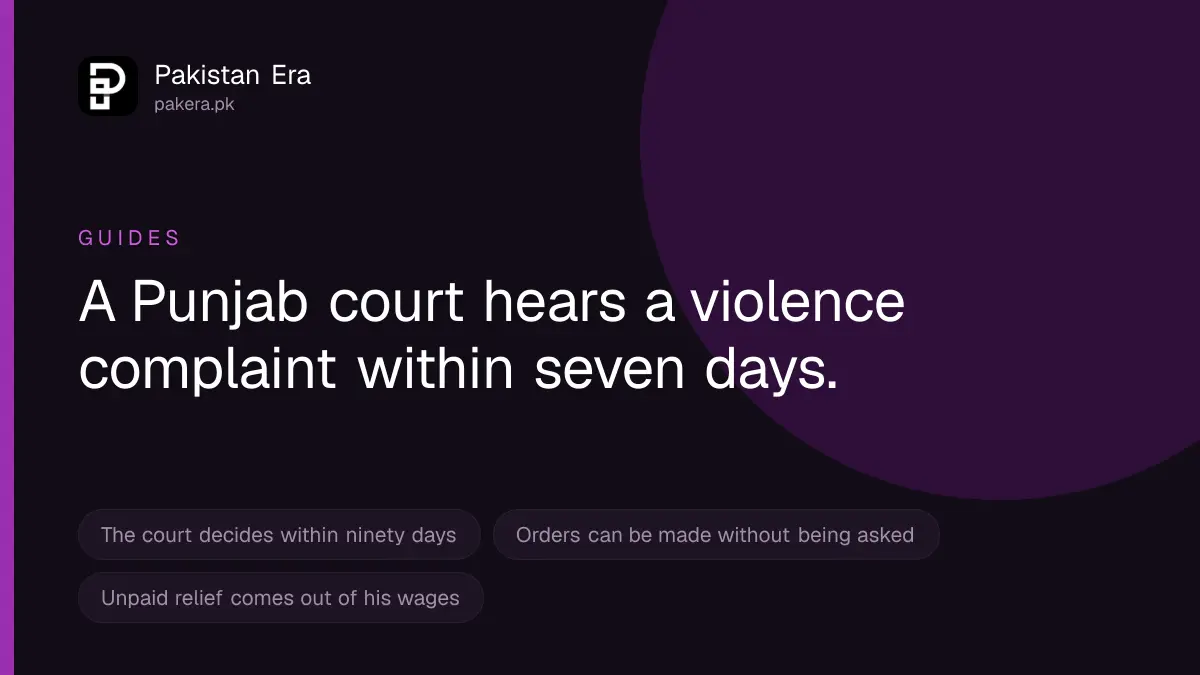
A court in Punjab must fix the first hearing within seven days of a complaint about violence against a woman, and must decide it within ninety days. It can order the man out of the house, take his firearms, and fit him with a GPS tracker.
The Punjab Women Protection Authority helpline is 080001737, toll free. That number comes first because everything below takes longer than a phone call.
We read the Punjab Protection of Women against Violence Act 2016 on 9 September 2026, in the text published by the Law and Parliamentary Affairs Department, and the Authority's own pages at pwpa.punjab.gov.pk.
The clocks the court works to
| Stage | Time limit in the Act |
|---|---|
| First hearing | Not beyond seven days from receipt of the complaint |
| Defendant's reply to the notice | Seven days from receiving it |
| No reply filed | Court assumes no plausible defence and proceeds |
| Final decision | Within ninety days, as a summary trial |
| Appeal | Thirty days, decided within sixty |
An interim order can come earlier still. The court may act on the affidavit of the aggrieved person alone if the complaint shows on the face of it that violence has happened or is likely.
What a protection order can require
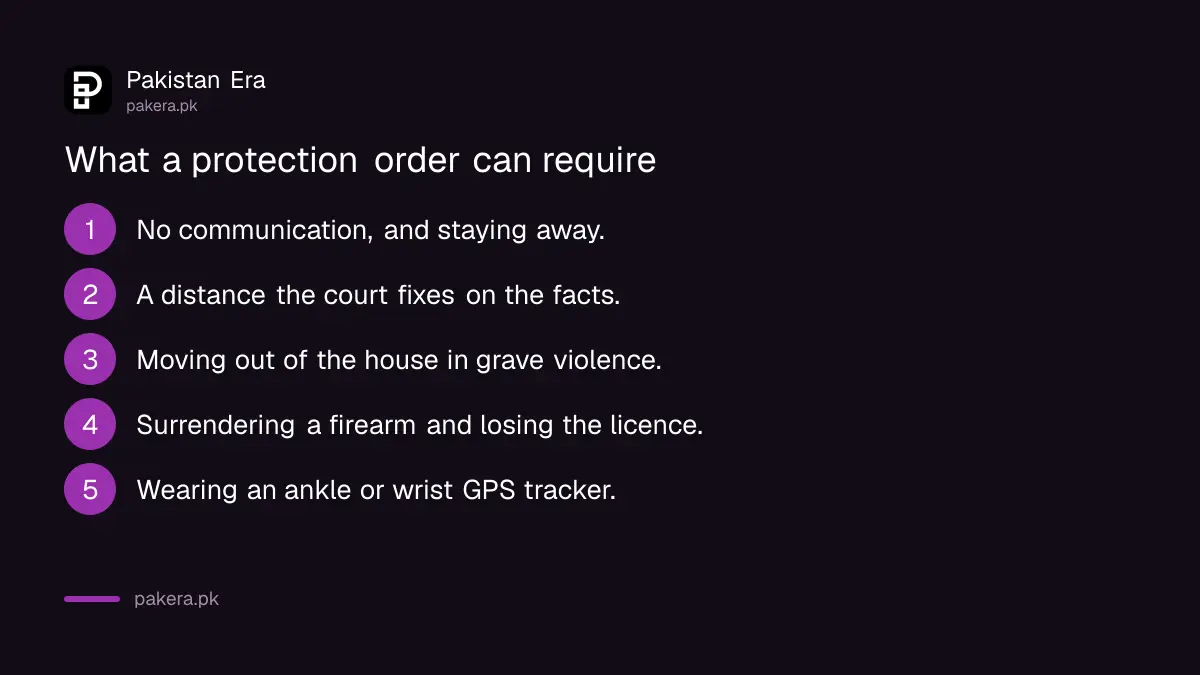
Section 7 lists what the court may direct, and the list is longer than most people expect.
No communication with her, with or without exceptions. Stay away from her. Stay at a distance the court fixes on the facts. Move out of the house where there has been grave violence and her life, dignity or reputation is in danger.
Surrender any firearm he lawfully holds, and be barred from buying one or obtaining a licence. Stay away from her place of employment and other places she goes. Refrain from causing violence to a dependent, another relative, or anyone helping her.
And for grave violence or likely grave violence, wear an ankle or wrist bracelet GPS tracker.
Two things about that list matter as much as its contents. The court may issue one or more of these directions even if she has not asked for them. And it may add any further condition it thinks reasonably necessary for her safety or that of her dependent child.
She does not have to leave the house
The instinct is that safety means leaving. The Act starts from the opposite position.
Section 5 says a victim of domestic violence shall not be evicted from the house without her consent, save in accordance with law, and that if she has been wrongfully evicted the court shall restore the position as it stood before. She may choose to stay in the house, to move to alternative accommodation arranged by the defendant according to his means, or to go to a shelter home.
A residence order under section 8 backs that up. The court can confirm her right to stay, order him to hand over property or documents she is entitled to, restrain him and his relatives from entering the shelter home or her workplace, and order him to arrange alternative accommodation or pay the rent for it.
The choice is hers. The orders exist to make each option workable rather than to push her toward one.
Money, and how it is actually collected
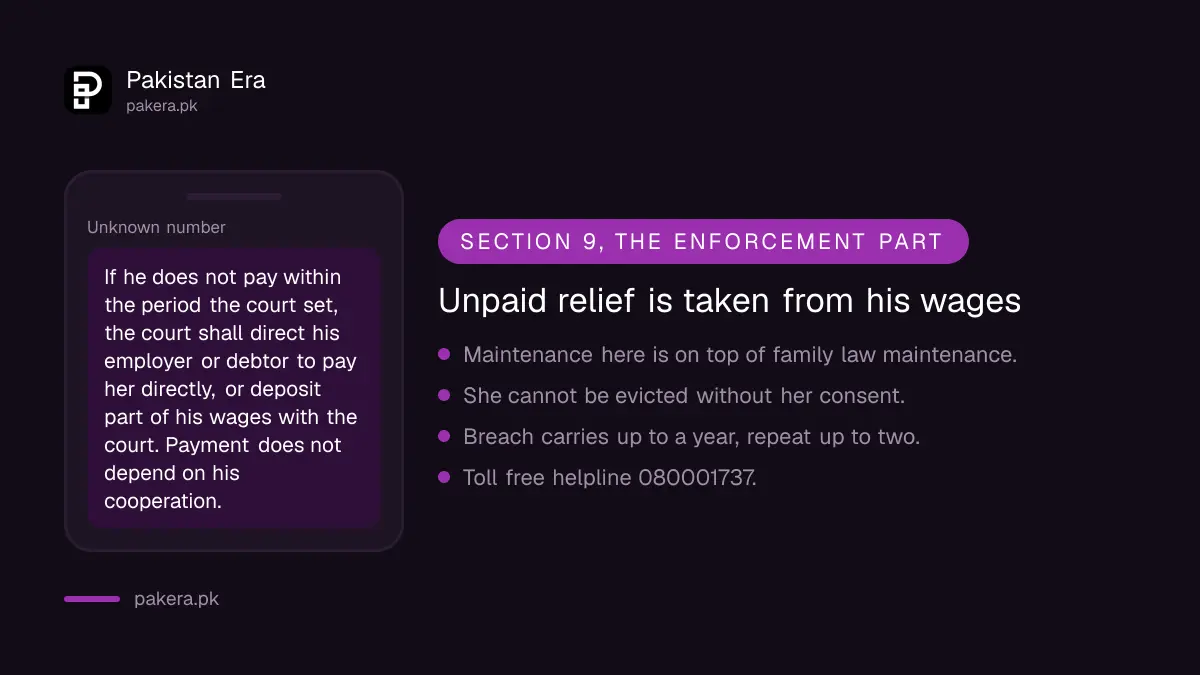
A monetary order under section 9 can cover compensation for economic abuse, loss of earning, medical expenses, loss caused by destruction or removal of her property, rent and meals in a shelter home, and reasonable maintenance for her and her children.
That maintenance is expressly in addition to any maintenance order under family law, not instead of it. Our guide to claiming maintenance in the family court covers that separate route.
The enforcement provision is the part worth knowing. If he does not pay within the period the court set, the court shall direct his employer or his debtor to pay her directly, or to deposit a portion of his wages or the debt with the court.
So payment does not depend on his cooperation. It can be taken from his salary at source.
What happens if he breaks the order
- Breach of an interim, protection, residence or monetary order carries up to one year, or a fine of fifty thousand to two hundred thousand rupees, or both.
- Illegally interfering with the GPS tracker is treated the same way.
- A second or further violation carries one to two years, and a fine of one hundred thousand to five hundred thousand rupees.
- The court may direct a Women Protection Officer to protect or assist her.
- The court may direct the police to assist that officer in implementing the order.
Cognizance is taken only on the complaint of a District Women Protection Officer, or a Women Protection Officer acting for her, so the officer is part of the enforcement route rather than an optional extra.
Protection Centres and the rescue power
The Act requires Protection Centres to act as a converging point for the services a case needs: police reporting, registration of criminal cases, medical examination, and collection of forensic and other evidence, with a duty to collect or assist in collecting evidence within twenty four hours.
The Authority's Violence Against Women Centre in Multan was established on 25 March 2017, and District Women Protection Officers are posted across Punjab.
The entry power in section 15 is written carefully and it is worth reading as written. A Women Protection Officer may enter any place or house to rescue an aggrieved person, but shall not rescue her without her consent. Entry can be forced in collaboration with the police if access is refused, and only a female officer may exercise the power of entry into a woman's place of abode.
The consent requirement is a protection, not an obstacle. Nobody can be removed from a house against her will under this Act.
The other side of the same Act
Two penalties point the other way and are worth stating plainly.
Obstructing a District Women Protection Officer or a Women Protection Officer carries up to six months or a fine up to five hundred thousand rupees, or both.
Giving false information about violence, which the person knows or has reason to believe is false, carries up to three months or a fine of fifty thousand to one hundred thousand rupees, or both.
Free legal help may be available. Our guide to getting a free lawyer in Punjab covers the Legal Aid Agency, whose definition of an indigent person expressly includes a woman in a family dispute over divorce, maintenance, dowry, dower or custody. Our guide to a workplace harassment complaint covers a different forum, and our guide to what Rescue 1122 does covers medical emergencies.
Common questions
How fast is the first hearing?
The Act says the first date of hearing shall not be beyond seven days from receipt of the complaint by the court.
Can the court order him out of the house?
Yes, in a case of grave violence where her life, dignity or reputation is in danger.
Can it take his gun?
Yes. The court can order him to surrender a lawfully held firearm and bar him from buying one or getting a licence.
What is the GPS tracker provision?
For grave or likely grave violence, the court may direct him to wear an ankle or wrist bracelet GPS tracker.
Do I have to ask for each order?
No. The court may issue directions under sections 7 and 8 even if they were not prayed for.
What if he does not pay a monetary order?
The court shall direct his employer or debtor to pay her directly or deposit part of his wages with the court.
How we verified this
What we checked, where we read it, and what we could not confirm.
Last checked 9 September 2026. We downloaded the Punjab Protection of Women against Violence Act 2016 from the Punjab Code portal at punjablaws.punjab.gov.pk, in the text published by the Law and Parliamentary Affairs Department, Government of the Punjab, and read it. Section 4 requiring the first date of hearing not beyond seven days from receipt of the complaint, a show cause notice giving the defendant seven days, the assumption of no plausible defence where no reply is filed, and final decision within ninety days under the summary trial provisions; section 5 on the right to reside in the house and restoration after wrongful eviction; section 6 allowing an interim order on the affidavit of the aggrieved person or other material; section 7 listing the directions available in a protection order including no communication, staying away, a court fixed distance, an ankle or wrist bracelet GPS tracker for grave or likely grave violence, moving out of the house, surrender of a firearm and a bar on purchase or licence, staying away from her place of employment, and protection of dependants, relatives and helpers, together with the power to issue directions not prayed for, to add conditions, to require a bond, to direct a Women Protection Officer and to direct police assistance; section 8 on residence orders including alternative accommodation or rent and restraint on the defendant and his relatives; section 9 on monetary orders covering economic abuse, loss of earning, medical expense, property loss, shelter rent and meals and maintenance in addition to family law maintenance, and the direction to an employer or debtor to pay or deposit wages where the defendant does not pay; section 13 on Protection Centres and the twenty four hour evidence collection duty; section 15 on entry and rescue, the consent requirement and the female officer requirement; section 18 on obstructing an officer; section 19 on false complaints; section 20 on breach of orders and interference with the GPS tracker; section 21 on cognizance only upon the complaint of a District Women Protection Officer or a Women Protection Officer; and section 22 on a thirty day appeal decided within sixty days, are all taken from that text. The toll free helpline 080001737, the telephone number 042-99333817, the Violence Against Women Centre in Multan established on 25 March 2017, and the posting of District Women Protection Officers across Punjab, are taken from the Punjab Women Protection Authority site at pwpa.punjab.gov.pk read on the same date. This is the Punjab Act and applies in the Punjab. Nothing here is legal advice. If you are in immediate danger, call the helpline or the police rather than reading further.
About the author

Public Services and Education Journalist
Fajr Riaz is a journalist and content writer at Pakistan Era, based in Lahore. She covers the questions people meet in everyday life in Pakistan: how a public service works, what a change in the rules means, and where to find a reliable answer.