Justice Munib Akhtar Is Acting Chief Justice of Pakistan: What Article 180 Says and What Changes for Cases
Justice Munib Akhtar is Acting Chief Justice of Pakistan from 15 October 2026 while the Chief Justice is abroad. What Article 180 requires and what changes.
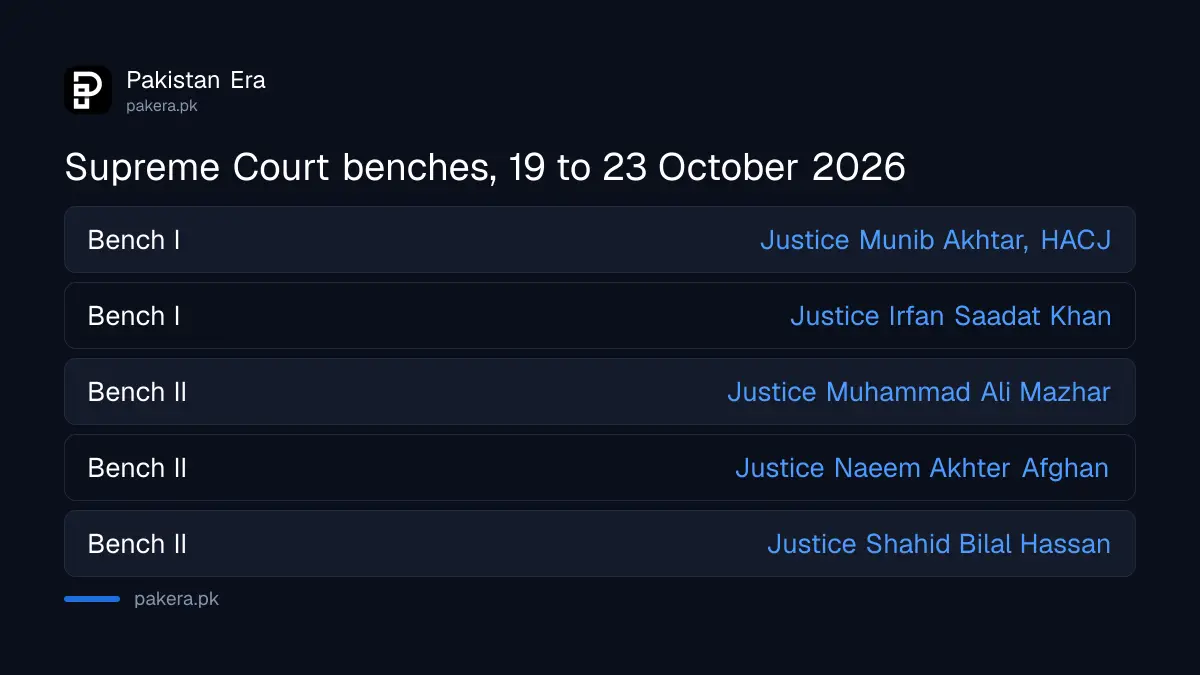
Justice Munib Akhtar is the Acting Chief Justice of Pakistan from 15 October 2026, while Chief Justice Yahya Afridi is abroad. The Supreme Court announced the oath on 15 October, and its weekly cause list for 19 to 23 October lists Bench I as "Justice Munib Akhtar, HACJ", with Justice Irfan Saadat Khan. Article 180 of the Constitution requires the President to appoint the most senior of the other judges to act whenever the Chief Justice is absent. Cases, filing and hearings continue as normal.
We read Article 180 and the articles around it in the Constitution text published by the National Assembly, and the Supreme Court's press release headlines and cause list on its website, on 19 October 2026. The press release PDF itself would not open for us, so the ceremony details are not on this page. What matters to a litigant is below.
Article 180 makes the appointment automatic, not political
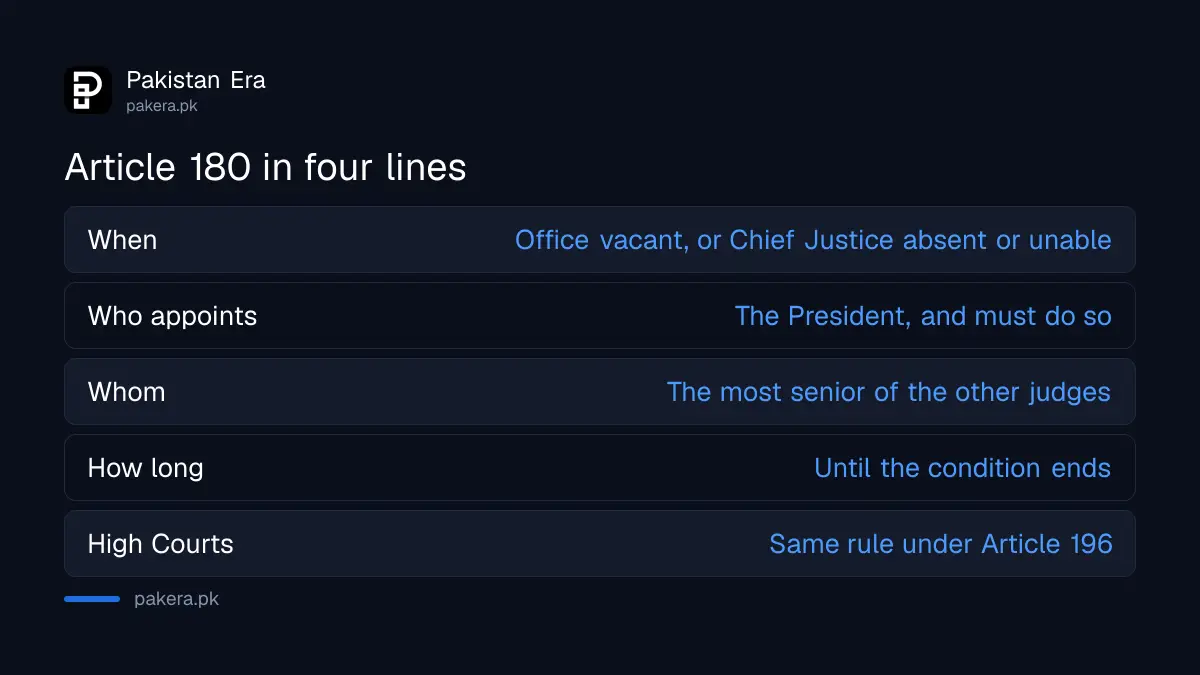
Article 180 says that at any time when the office of Chief Justice of Pakistan is vacant, or the Chief Justice is absent or unable to perform the functions of the office for any other cause, the President shall appoint the most senior of the other judges of the Supreme Court to act as Chief Justice.
Two words carry the rule. "Shall" means the President has no choice about whether to appoint. "Most senior" means no choice about whom. The acting appointment follows seniority on the court, which is why the oath on 15 October went to Justice Munib Akhtar. The provision was reworded by Presidential Order 14 of 1985 to fix the choice on the senior-most judge, according to the footnote in the official text.
Article 181, which sits next to it, is different. It lets the President appoint a High Court judge, including a retired one, to act temporarily as a Supreme Court judge when a seat is vacant or a judge is absent. That appointment lasts until the President revokes it. Article 196 gives the same acting rule for a High Court chief justice.
The Chief Justice is in London, so the acting role is for the trip
The Supreme Court's press release of 16 October 2026 is headed "Chief Justice of Pakistan welcomed as honorary bencher of the Inner Temple". The Inner Temple is one of the four Inns of Court in London, the professional bodies that admit barristers in England and Wales. An honorary bencher is a senior member admitted by invitation.
That is the "absent" limb of Article 180. The Chief Justice remains Chief Justice; the acting appointment covers the days he is out of the country. The court has not published a return date, and we could not open the press release to check whether it names one. When the Chief Justice resumes, the acting appointment ends on its own, because the condition in Article 180 no longer exists.
| Date | Event | Source |
|---|---|---|
| 15 October 2026 | Justice Munib Akhtar takes oath as Acting Chief Justice | Supreme Court press release headline, PR-165 |
| 16 October 2026 | Chief Justice welcomed as honorary bencher of the Inner Temple | Supreme Court press release headline, PR-166 |
| 19 to 23 October 2026 | Bench I listed as Justice Munib Akhtar, HACJ, and Justice Irfan Saadat Khan | Final Cause List 41 of 2026 |
| Not published | Chief Justice's return date | Not in any page we could open |
Nothing changes for a case already filed or due for hearing
The cause list for 19 to 23 October shows the court sitting in two benches of Monday to Friday at 9:00 am. Bench I is the Acting Chief Justice with Justice Irfan Saadat Khan. Bench II is Justice Muhammad Ali Mazhar, Justice Naeem Akhter Afghan and Justice Shahid Bilal Hassan. The list carries the usual note that cases are fixed at 9:00 am or soon after, and that no adjournment will be granted on any ground.
So a hearing fixed this week goes ahead. A petition filed this week is received by the same registry. The acting Chief Justice signs what the Chief Justice would sign as head of the court, including the roster and the fixation of cases, which are administrative acts. The rules for filing a case in the Supreme Court and the fees do not change.
What an acting Chief Justice does and does not do
The Constitution does not list separate powers for an acting Chief Justice. He acts "as Chief Justice", so the administrative functions of the office pass to him for the period: presiding over the court, constituting benches under the court's rules, and representing the court. Judicial decisions are still those of the bench that hears the case, whether the Chief Justice or the acting Chief Justice sits on it.
Some functions sit with the Chief Justice by name in other laws and in the Constitution, such as chairing the Judicial Commission of Pakistan under Article 175A. Whether an acting Chief Justice exercises those, or whether they wait, depends on the wording of each provision and on practice. We did not find a published Supreme Court statement on that for this period, so we do not claim one way or the other.
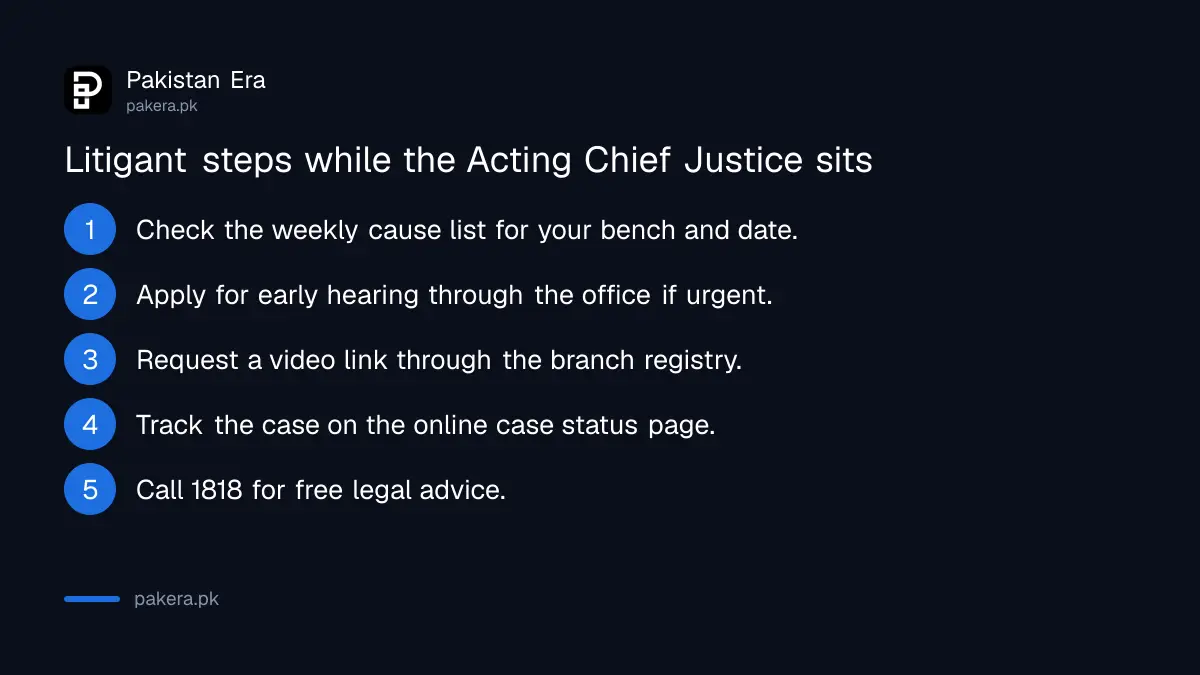
- Check the weekly cause list on the Supreme Court website for the bench your case is fixed before, and the date and time.
- If your case needs urgent listing, apply for an early hearing in the usual way; the application goes to the office, not to a named judge.
- If you are outside Islamabad, the video link hearing request works as before through the branch registries.
- Track your case with the online case status, which is explained in how to check a court case status online.
- For free advice on any of this, the court's 1818 call centre connects callers to bar council lawyers.
The same rule applied in every past absence and vacancy
Article 180 covers two situations. The first is absence, as now. The second is vacancy, when a Chief Justice retires and the successor has not yet taken oath. In both, the senior-most judge acts. There is no fixed limit on how long an acting appointment lasts, because it ends when the condition ends: the Chief Justice returns, or a new one is sworn in.
Retirement for a Supreme Court judge is at sixty-five under Article 179. The appointment of the Chief Justice is governed by Article 175A, which was amended in 2024 and 2025. Those changes do not touch Article 180, which still reads as substituted in 1985, so the acting rule is the one settled part of the office.
Common questions
Who is the Acting Chief Justice of Pakistan?
Justice Munib Akhtar, from 15 October 2026, according to the Supreme Court's press release and the cause list for 19 to 23 October 2026, which lists him as HACJ.
Why is there an acting Chief Justice?
The Chief Justice is abroad. The court's 16 October release records his admission as an honorary bencher of the Inner Temple in London. Article 180 requires an acting appointment during an absence.
Who chooses the acting Chief Justice?
The President appoints, but Article 180 fixes the choice on the most senior of the other Supreme Court judges. There is no discretion.
Does my hearing still go ahead?
Yes. The cause list for 19 to 23 October lists both benches sitting Monday to Friday at 9:00 am, with the standard note that no adjournment is granted.
When does the acting appointment end?
When the Chief Justice returns and resumes office. No return date has been published on a page we could open.
What is an honorary bencher?
A senior member of one of London's four Inns of Court admitted by invitation. The Inner Temple is one of the four.
How we verified this
What we checked, where we read it, and what we could not confirm.
Last checked 19 October 2026. Articles 175A, 179, 180, 181 and 196 and the footnote on the 1985 substitution are from the Constitution of the Islamic Republic of Pakistan as published on the National Assembly website, which we read on 19 October 2026. The oath of 15 October, the Inner Temple release of 16 October and the bench composition come from the press release headlines and Final Cause List 41 of 2026 on the Supreme Court of Pakistan website, read the same day. The press release PDFs returned an access error, so we could not confirm who administered the oath, where, or the Chief Justice's return date. The description of the Inner Temple is general knowledge, not from an official Pakistani source. This is general information, not legal advice.
About the author

Global Affairs & Political Economy Writer
Muhammad Hatim is a book lover who started writing because he enjoys it. At Pakistan Era he writes about international relations, geopolitics and the global economy, with a particular interest in South Asia and the forces behind current events.