FBR SRO 2276: Income Tax Appeals Go Faceless, With a Hidden Commissioner and Video Hearings
FBR SRO 2276 of 24 November 2026 makes income tax appeals faceless: filed on IRIS, a hidden Commissioner, video hearings. What changes and what stays the same.
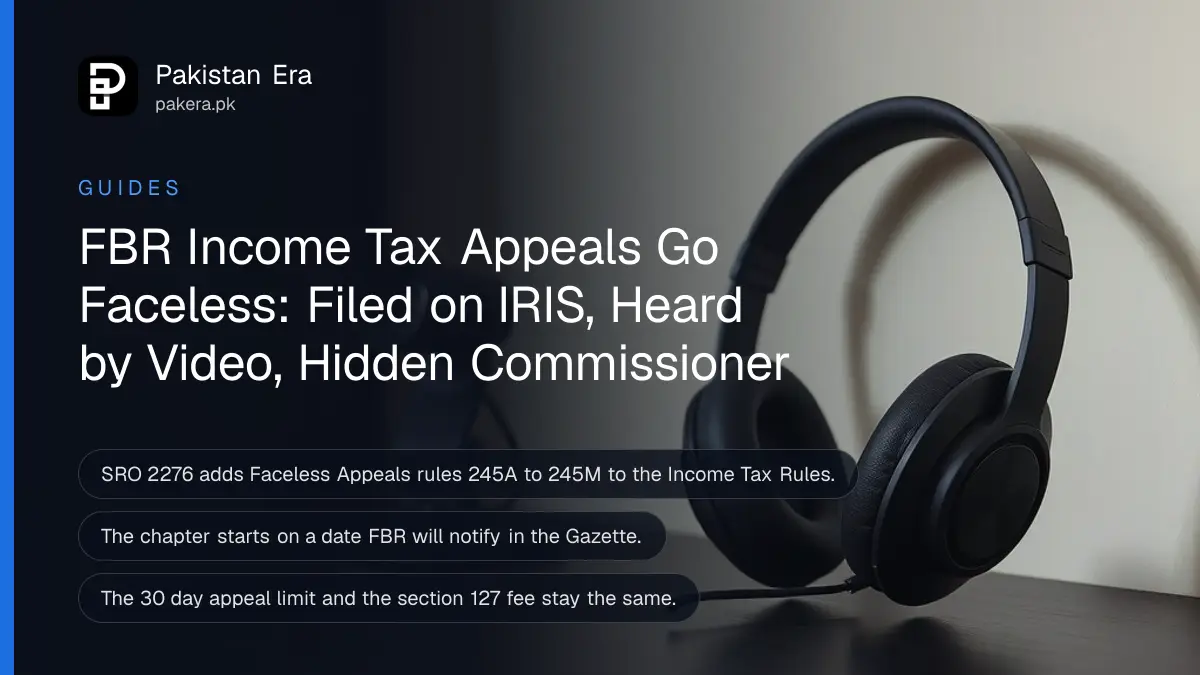
FBR's SRO 2276(I)/2026, dated 24 November 2026, makes income tax appeals faceless. Appeals that run through the National Faceless Centre will be filed on IRIS, sent to a hidden Commissioner (Appeals) at random and heard only by video. The chapter starts on a date FBR still has to notify.
So nothing changes for an appeal you file this week. What changes is the route your next appeal may take once FBR switches the chapter on, and the habits that will matter then: filing on time online, uploading clean scans and keeping your IRIS inbox watched.
SRO 2276 adds a Faceless Appeals chapter to the Income Tax Rules
SRO 2276 inserts Chapter XIXA, rules 245A to 245M, into the Income Tax Rules, 2002. It covers appeals under section 127 that are processed through the National Faceless Centre. It is the final version of the draft FBR published as SRO 2136 on 18 November 2026.
The chapter applies to two groups of appeals:
- appeals against orders passed by an officer of the Faceless Centre, such as a faceless assessment; and
- appeals against orders by any other officer, but only for the people or classes of orders FBR later names in the Gazette.
Rule 245A(2) says the chapter comes into force on a date FBR notifies, and the dates may differ for different classes of appeals. If your assessment came from the faceless unit under SRO 2062 for faceless income tax assessment, your appeal is the most likely to go faceless first.
The old appeal and the faceless appeal compared
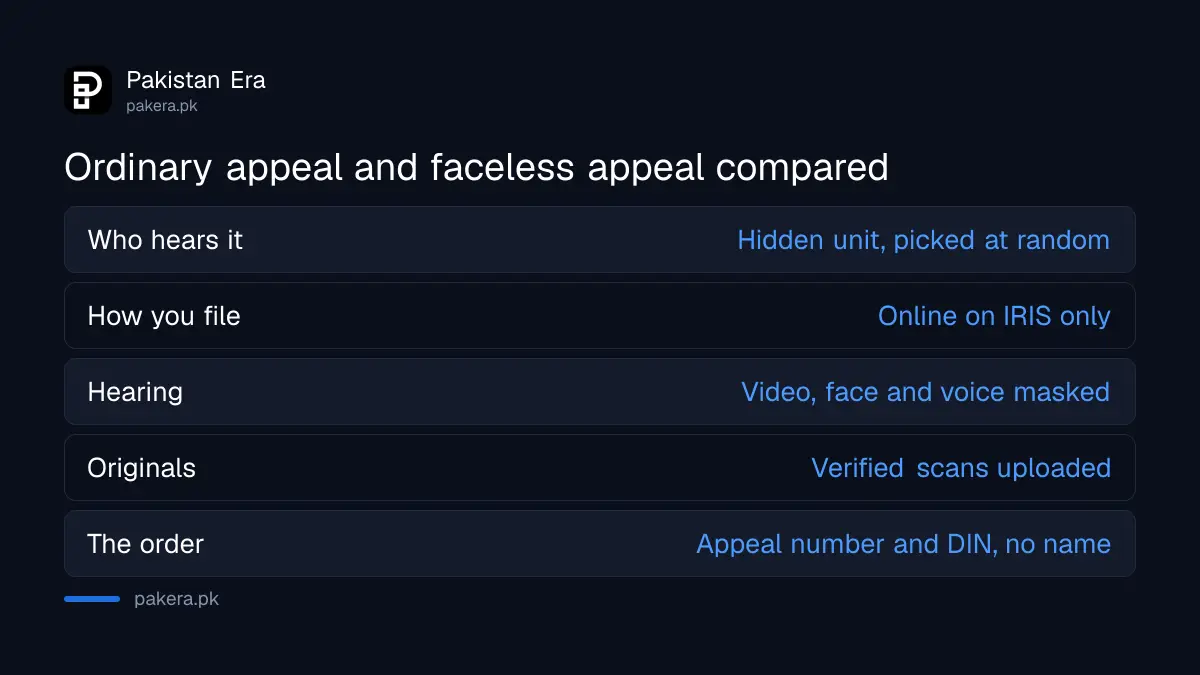
Today you file with a named Commissioner (Appeals), may appear in person and get a signed order. Under Chapter XIXA you file on IRIS, never learn who decides, attend by video only and get an order carrying a Digital Identification Number instead of a name.
| Point | Ordinary appeal now | Faceless appeal under SRO 2276 |
|---|---|---|
| Who hears it | The Commissioner (Appeals) with jurisdiction, named | An Appellate Unit picked at random by an algorithm, kept anonymous |
| How you file | Appeal form under rule 76 | Electronically on the e-portal (IRIS), same form |
| Hearing | In person or as arranged | Video only; face hidden, voice modulated |
| Original documents | Produced before the Commissioner | Uploaded as verified scans; originals checked by a Field Operations unit if asked |
| The order | Signed and named | No name or signature; appeal number and DIN |
| Pending appeals | Stay where they are | Stay with the same Commissioner unless FBR orders a transfer |
The 30 day limit, the fee and the tax to pay first stay the same
SRO 2276 changes the procedure, not the Ordinance. You still appeal within 30 days of the notice of demand, still pay the fee in section 127, and must still have paid the tax due with your return. Chapter XII of the rules keeps applying wherever Chapter XIXA is silent.
| Rule | What it says |
|---|---|
| Time to appeal | 30 days from service of the notice of demand, section 127(5) |
| Fee against an assessment | Rs 5,000 for a company, Rs 2,500 for anyone else |
| Fee against any other order | Rs 5,000 for a company, Rs 1,000 for anyone else |
| Time for the decision | 120 days, plus 60 if extended, section 129(4) |
| Next step if you lose | Appellate Tribunal within 30 days, section 131 |
The full method, with the fee rules and the tax you must clear first, is in the steps to appeal an FBR income tax order to the Commissioner (Appeals). One more thing stays the same: rule 245A(4) keeps your right under section 127 to go straight to the Appellate Tribunal where the law allows it.
How a faceless appeal will run, step by step
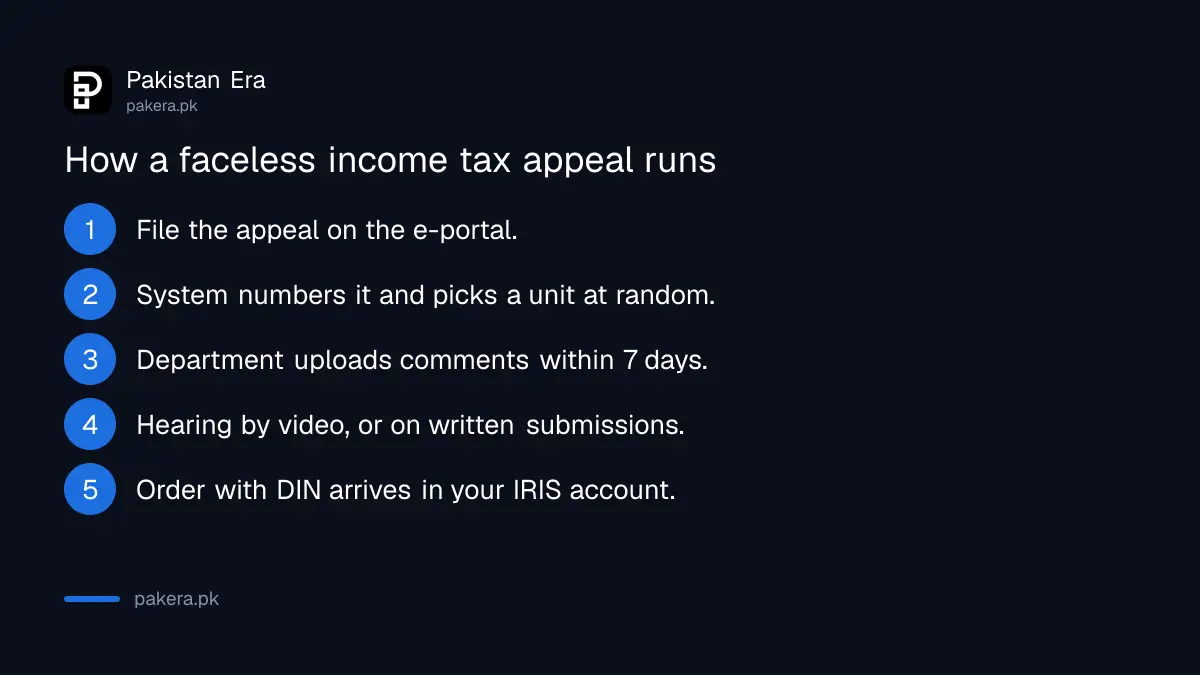
You file on the e-portal, the system gives the appeal a number and allocates it, the department is sent your appeal and uploads its comments within seven days if asked, then a video hearing is held and the order arrives in your IRIS account.
- File the appeal electronically on the e-portal in the form under rule 76.
- The system assigns a unique appeal number and sends it to an Appellate Unit at random.
- The respondent Commissioner gets the appeal through the system and uploads para-wise comments within seven days of being asked.
- All notices, written arguments and evidence go through the e-portal only.
- The hearing is by video. You may instead ask, on the portal, for the appeal to be decided on written submissions.
- The order, with the tax upheld, is uploaded and sent to you, the respondent and the Field Operations Wing at the same time.
Stays, late appeals and a portal that fails
A request to stay recovery is filed on the portal and fixed for an e-hearing, and the order is sent the day it is passed. Requests to admit a late appeal or new evidence are also filed and decided online. A confirmed portal failure counts as sufficient cause for delay.
- Stay of recovery. Filed under section 128(1A) or (1AA) on the e-portal. The respondent is heard by video before a decision, and the order goes to you, the respondent and the field office the same day.
- Late appeal. An application for condonation under section 127(6) goes on the e-portal.
- Portal down. Rule 245L: if you missed a deadline because the e-portal was down, and FBR confirms the technical failure, that is sufficient cause. Take a dated screenshot of any error.
- No internet. Rule 245I(5) lets you ask to join the video hearing from the e-hearing room of the nearest Field Operations unit.
Safeguards that come with the hidden Commissioner
The officer who audited or assessed you cannot hear your appeal. A Commissioner with a personal or financial link must declare it and step aside. Once a hearing starts, the appeal moves only for written reasons, and you can ask to be heard afresh.
The Appeals Wing reports to Member (Legal) Inland Revenue, and the Centre's Director General and Chief Commissioner cannot direct a Commissioner (Appeals) on any appeal. Orders under this chapter are not open to quality control review under rule 242. Every hearing is recorded and kept in the e-portal as part of the record. The same design is used for sales tax in SRO 2134 for faceless sales tax appeals.
Common questions
Is the faceless income tax appeal system in force now?
No. SRO 2276 is final, but rule 245A(2) says the chapter starts on a date FBR notifies in the Gazette. Until then, appeals follow the current procedure.
Will my pending appeal be moved to the faceless system?
Not automatically. A pending appeal stays with its Commissioner (Appeals) unless FBR orders a transfer. If it is moved, the record goes over electronically and the case continues from where it stood.
Can I meet the Commissioner (Appeals) in person?
No. Rule 245G(2) says neither side appears in person. The hearing is by video, or on written submissions if you choose that on the portal.
How do I go to the Tribunal if I do not know who decided my appeal?
Quote the appeal number and the Digital Identification Number on the order in place of the Commissioner's name. Rule 245J(4) sets this out.
Do I still need to send original documents?
Upload verified scans instead. The Commissioner (Appeals) can still ask for an original, for written reasons, and a Field Operations unit then checks it and uploads a report.
How we verified this
What we checked and where we read it.
We read SRO 2276(I)/2026, dated 24 November 2026, in full on the FBR Income Tax SRO list on 25 November 2026, where it is listed as "Amendments in the Income Tax Rules, 2002 - Faceless Appeals Rules". The list also shows the draft, SRO 2136(I)/2026 of 18 November. Time limits and fees come from sections 127 to 131 of the FBR copy of the Income Tax Ordinance, 2001, amended up to 30 June 2026. The SRO's own heading prints the number as 2276(l), which we read as 2276(I).
Free on WhatsApp
Get last dates and rule changes on WhatsApp
We post new last dates, fee changes and fixes for common problems, a few short posts a day.
Follow Pakera on WhatsAppOther followers cannot see your number.
Pakera Solves It
Which online process wasted your time this week?
A portal that will not load, a form nobody explains, a complaint that went nowhere. Tell us. Every week we pick one, solve it step by step and publish the answer.
About the author

Tax, Bills and Technology Writer
Ali Akhtar is a young and curious voice here at Pakistan Era. He is currently pursuing his A-Levels and has a growing interest in Pakistan’s changing industrial landscape and educational trends. Ali likes to write in a way that helps him explain and explore the world around him. His writing reflects the perspective of the new generation navigating the evolving trends of Pakistan where technology, youth innovation, and shifting opportunities are reshaping the country’s future.