Internal Migration in Pakistan: Census 2023 Shows Who Moves, Where and Why
About 13.08 million Pakistanis live outside their birth district. See each province, why people move, who moves and the main routes in the 2023 census.
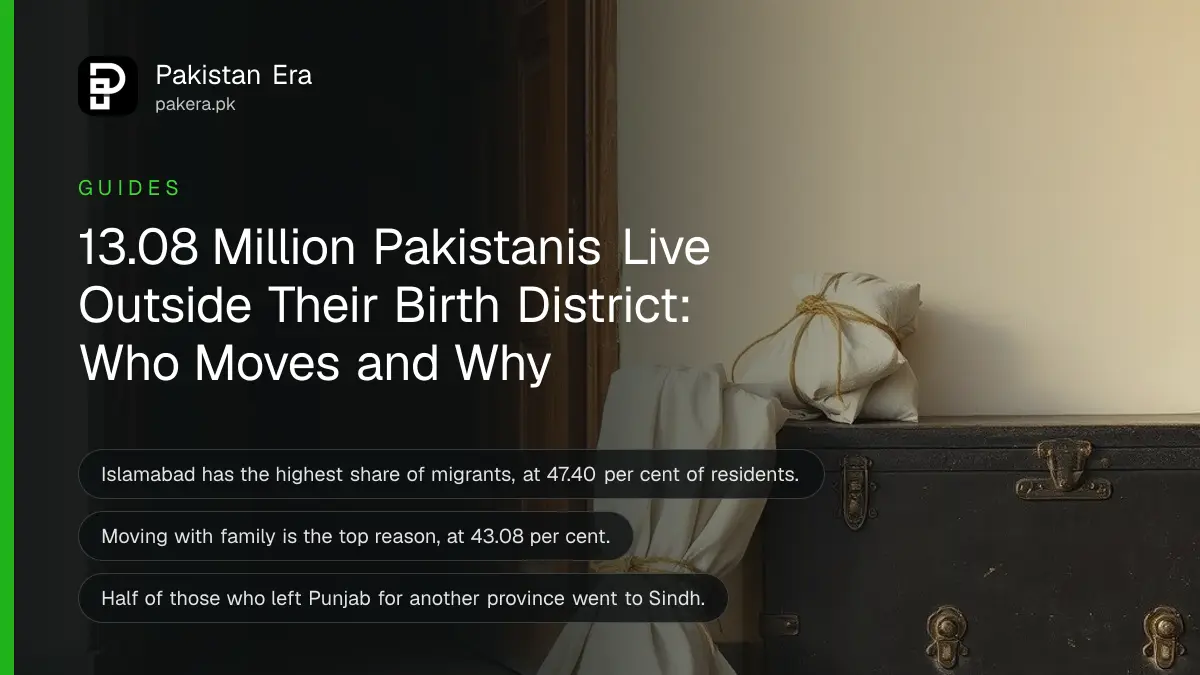
About 13.08 million Pakistanis live in a district other than the one they were born in, according to the 2023 census. That is 5.44 per cent of the population. Islamabad is the biggest magnet: 47.40 per cent of its residents were born somewhere else. The most common reason for moving is to go with family (43.08 per cent), then work (19.84) and marriage (19.62).
We went through the migration tables in the Pakistan Bureau of Statistics (PBS) National Census Report 2023. Below are the figures for each province, the reasons people move, who moves, the main routes between provinces and what to update when you move.
| Area | Share of residents born in another district | About how many people |
|---|---|---|
| Pakistan | 5.44% | 13.08 million |
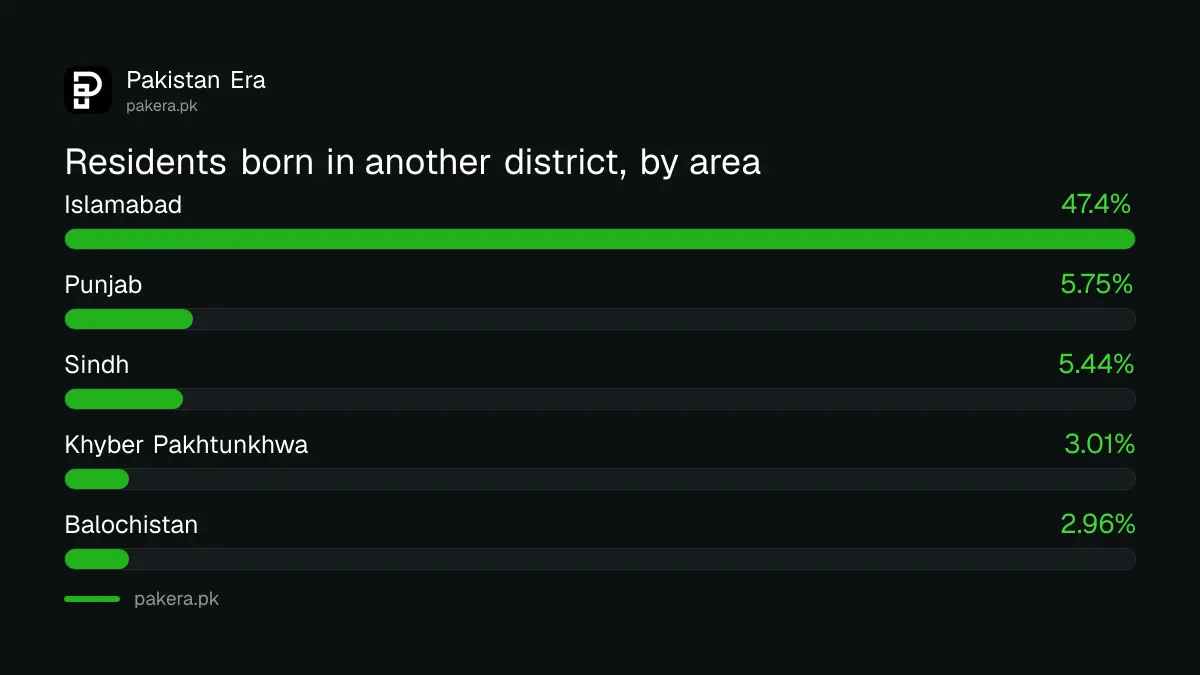
| Islamabad | 47.40% | 1.08 million |
| Punjab | 5.75% | 7.32 million |
| Sindh | 5.44% | 3.03 million |
| Khyber Pakhtunkhwa | 3.01% | 1.22 million |
| Balochistan | 2.96% | 0.43 million |
5.44 per cent of Pakistanis live outside their birth district
The census counts a person as a migrant if their district of birth is different from the district where they now live. This covers moves inside a province and between provinces. It does not count people who moved abroad.
Cities draw the most migrants. In urban areas 9.00 per cent of people were born in another district, against 3.19 per cent in villages. Women move slightly more than men, 5.75 per cent against 5.14, mostly because of marriage.
The national figure of 13.08 million and the province numbers in the table are our arithmetic: each area's 2023 population multiplied by its PBS migration rate.
Almost half of Islamabad was born somewhere else
Islamabad's rate of 47.40 per cent is almost nine times the national rate. As the capital, it pulls people for government jobs, private work and education. Punjab, at 5.75 per cent, has the largest number of migrants because of its size and its big cities. Balochistan has the lowest rate, at 2.96 per cent.
Family, work and marriage are the main reasons people move
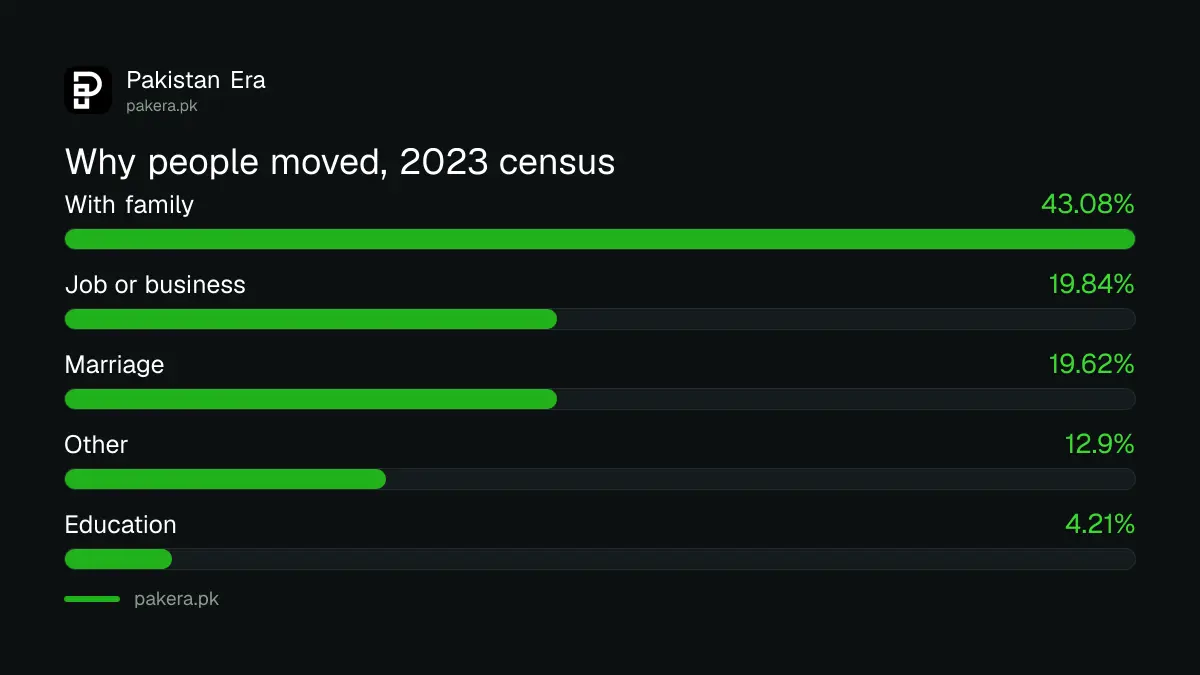
Moving with family is the top reason, at 43.08 per cent. Job or business is next at 19.84 per cent, and marriage is close behind at 19.62. Only 4.21 per cent moved for education.
| Reason for moving | All | Men | Women |
|---|---|---|---|
| With family | 43.08% | 38.77% | 47.18% |
| Job or business | 19.84% | 37.42% | 3.15% |
| Marriage | 19.62% | 1.16% | 37.16% |
| Education | 4.21% | 5.95% | 2.55% |
| Returned home | 0.36% | 0.50% | 0.23% |
| Other | 12.90% | 16.21% | 9.73% |
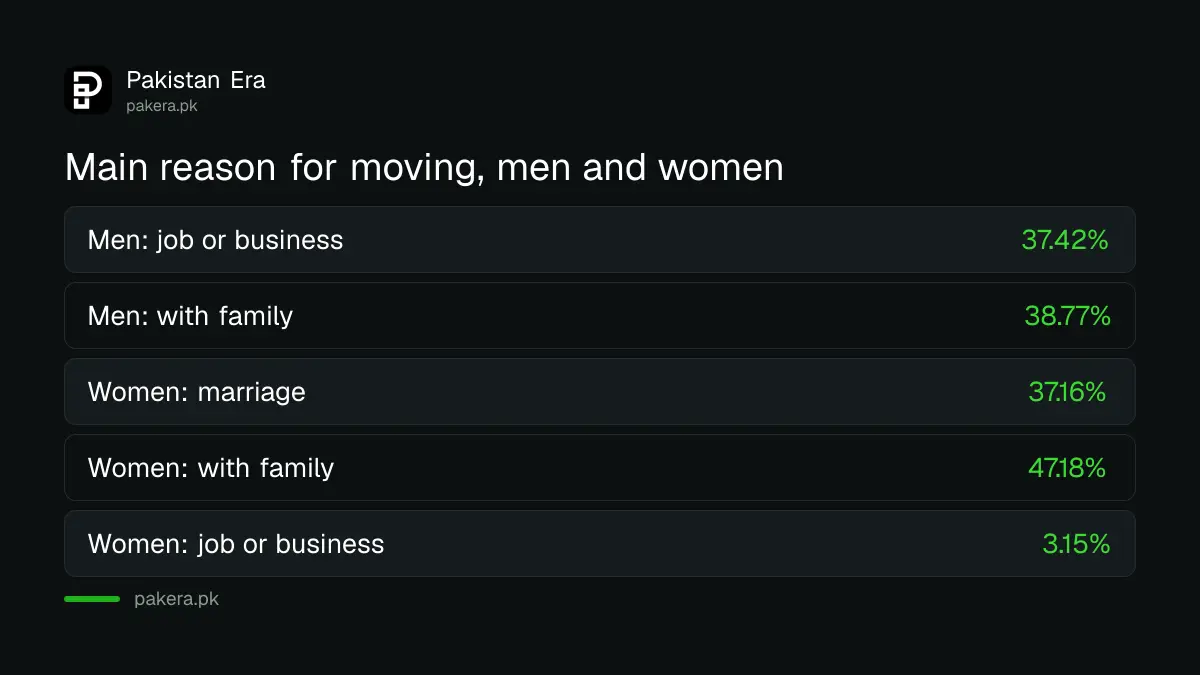
Men and women move for very different reasons. Among men who moved, 37.42 per cent did so for work. Among women, 37.16 per cent moved because of marriage and almost half moved with their family.
In villages, marriage is the reason for 25.70 per cent of moves. In cities, it is 16.22 per cent, and work counts for more, at 22.37 per cent.
Most migrants are aged 25 to 40
People aged 25 to 40 make up 31.35 per cent of migrants, the largest group. The 41 to 60 group is next at 23.20 per cent, then 15 to 24 at 18.55 per cent. These are the ages when people start work and marry.
Punjab to Sindh is the biggest route between provinces
The PBS report traces moves between provinces from birth district to current district. Half of people who left Punjab for another province went to Sindh (50.2 per cent), mainly to Karachi. Another 41.2 per cent went to Islamabad.
| Born in | Main destinations, share of those who left the province |
|---|---|
| Punjab | Sindh 50.2%, Islamabad 41.2% |
| Khyber Pakhtunkhwa | Punjab 44.9%, Sindh 34.1%, Islamabad 19.8% |
| Sindh | Punjab 62.4% |
Balochistan draws few migrants from other provinces. The report links this to fewer jobs and less city growth there.
What to update when you move to a new district
A move changes your address on several official records. Updating them avoids trouble with voting, jobs and police checks.
- Change the present address on your CNIC at NADRA. The steps are in changing your address on the CNIC.
- Move your vote to the new area with ECP Form 21, then confirm your vote by SMS to 8300.
- If you rent, register as a tenant with the police. In Punjab, use Punjab tenant registration; Sindh and Islamabad have their own systems.
- Your domicile certificate does not change on its own when you move. Read how a domicile certificate works before you apply for quota jobs.
Common questions
How many people migrate within Pakistan?
The 2023 census found 5.44 per cent of people living outside their birth district. On a population of 240.46 million, that is about 13.08 million people.
Which province has the most migrants?
By number, Punjab, with about 7.32 million. By share, Islamabad, where 47.40 per cent of residents were born in another district.
Why do people move within Pakistan?
Moving with family (43.08 per cent), job or business (19.84), marriage (19.62) and education (4.21) are the main reasons in the 2023 census.
Do more men or women migrate?
Slightly more women: 5.75 per cent of women against 5.14 per cent of men live outside their birth district. Most women move for marriage or with family.
Does the census count Pakistanis who moved abroad?
No. The 2023 census migration question covers only moves between districts inside Pakistan.
Where do people from Khyber Pakhtunkhwa move to?
Of those who left the province, 44.9 per cent went to Punjab, 34.1 per cent to Sindh and 19.8 per cent to Islamabad.
How we verified this
What we checked and where we read it.
We checked these figures on 25 November 2026 in the PBS census page and its National Census Report 2023: section 3.7 (inter-regional migration and Figure 3.14), section 4.8 with Table 4.27 (migration by sex, area and reason) and Table 4.28 (migration by province), and Figure 4.21 (migration by age group).
The counts of people are our own arithmetic: the 2023 population of each area times its migration rate. The report's chart of reasons gives slightly different figures from its table (for example 43.28 against 43.08 per cent for moving with family); we use the table. The province-to-province shares are as given in the report text.
Free on WhatsApp
Get last dates and rule changes on WhatsApp
We post new last dates, fee changes and fixes for common problems, a few short posts a day.
Follow Pakera on WhatsAppOther followers cannot see your number.
Pakera Solves It
Which online process wasted your time this week?
A portal that will not load, a form nobody explains, a complaint that went nowhere. Tell us. Every week we pick one, solve it step by step and publish the answer.
About the author

Senior Writer, Public Services and Technology
Shahid joined us in 2024 as an author. He is a senior contributor to Pakistan's leading technology websites. He writes detailed articles, mostly covering his expertise in the latest tech, mobiles, apps, gadgets, and step-by-step guides. His ideology is to help people understand the latest trends and explain complex methods through very easy-to-understand guides.