Pakistan Population by Province and City: 2023 Census Figures
Pakistan's 2023 census counted 241,499,431 people. See every province against 2017, the ten cities above one million and the districts growing fastest.
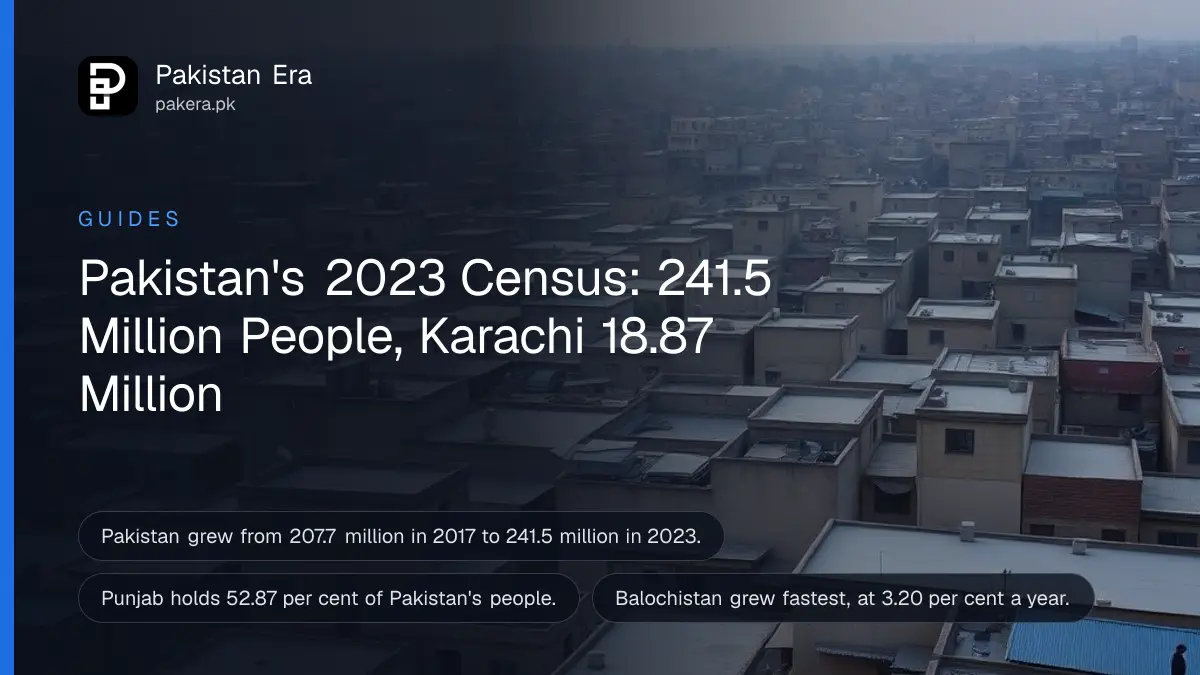
Pakistan's population is 241,499,431, according to the 2023 digital census by the Pakistan Bureau of Statistics (PBS). That is 33.8 million more than in 2017, an average growth of 2.55 per cent a year. Punjab holds 52.87 per cent of the people, and Karachi is the largest city at 18.87 million.
The census covers the four provinces and Islamabad. Gilgit-Baltistan and Azad Jammu and Kashmir are counted separately and are not in these totals. We took the figures from the PBS National Census Report 2023 and put them in one place: each province, the ten cities above one million, and the districts growing fastest.
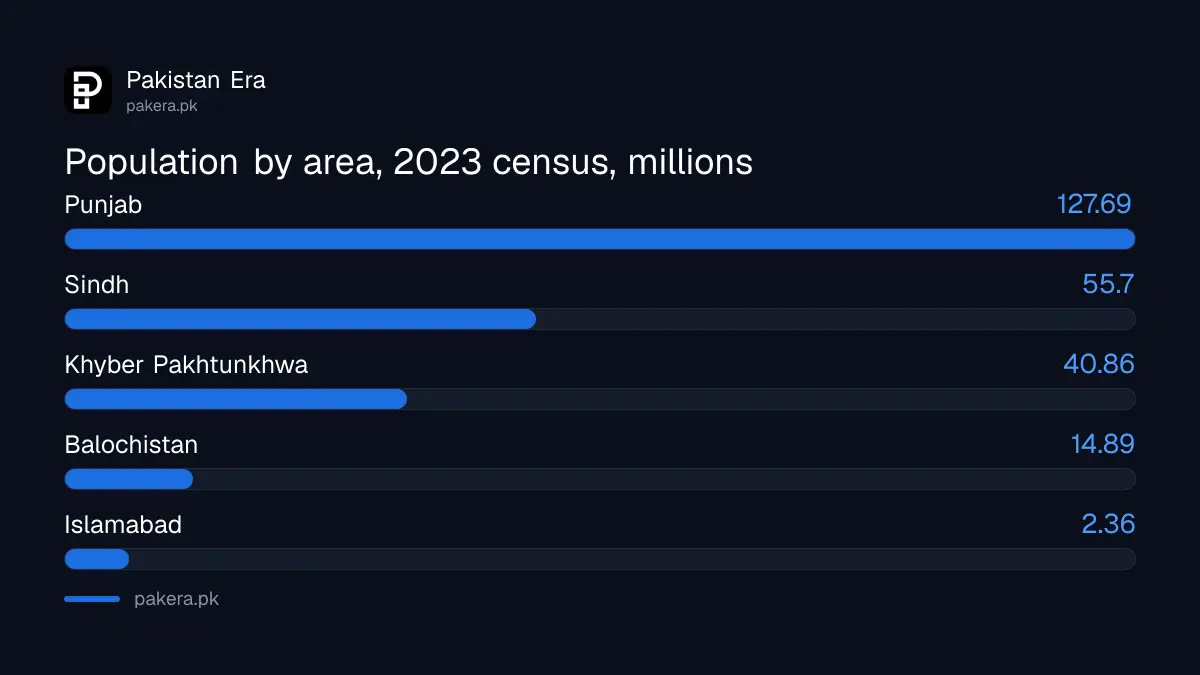
| Area | 2017 census | 2023 census | Share of Pakistan | Growth a year |
|---|---|---|---|---|
| Pakistan | 207,684,626 | 241,499,431 | 100% | 2.55% |
| Punjab | 109,989,655 | 127,688,922 | 52.87% | 2.53% |
| Sindh | 47,854,510 | 55,696,147 | 23.06% | 2.57% |
| Khyber Pakhtunkhwa | 35,501,964 | 40,856,097 | 16.92% | 2.38% |
| Balochistan | 12,335,129 | 14,894,402 | 6.17% | 3.20% |
| Islamabad Capital Territory | 2,003,368 | 2,363,863 | 0.98% | 2.81% |
Pakistan has 241.5 million people and adds about 5.6 million a year
The 2023 census counted 241.5 million people, up from 207.7 million in 2017. Growth averaged 2.55 per cent a year, faster than the 2.40 per cent of 1998 to 2017. At that pace Pakistan adds roughly 5.6 million people every year.
The 5.6 million is our arithmetic: 33.8 million extra people spread over the six years between the two counts. That is roughly the population of Multan, Hyderabad and Quetta cities put together, every single year.
The Council of Common Interests approved the results in its 50th meeting on 5 August 2023. PBS says the census was the first one done on tablets, with every building geo-tagged.
Balochistan grew fastest and Khyber Pakhtunkhwa slowest
Balochistan grew 3.20 per cent a year between 2017 and 2023, the fastest of any area. Islamabad followed at 2.81 per cent. Khyber Pakhtunkhwa grew slowest at 2.38 per cent. Punjab's share of the country slipped again, as it has since 1951.
In 1951, Punjab held 60.9 per cent of the people. In 2023 it holds 52.9 per cent. Sindh rose from 17.9 to 23.1 per cent over the same years, and Balochistan from 3.5 to 6.2 per cent.
Some districts grew far faster than their province. The census report lists Washuk (9.51 per cent a year), Lower Kohistan (9.05), Panjgur (8.36), Kharan (8.17) and Orakzai (7.3) at the top. In Karachi, the East district grew 5.32 per cent a year and the South district 4.71 per cent.
| District | Province | Growth a year, 2017 to 2023 |
|---|---|---|
| Washuk | Balochistan | 9.51% |
| Lower Kohistan | Khyber Pakhtunkhwa | 9.05% |
| Panjgur | Balochistan | 8.36% |
| Kharan | Balochistan | 8.17% |
| Orakzai | Khyber Pakhtunkhwa | 7.30% |
| Karachi East | Sindh | 5.32% |
Ten cities have more than one million people, led by Karachi and Lahore
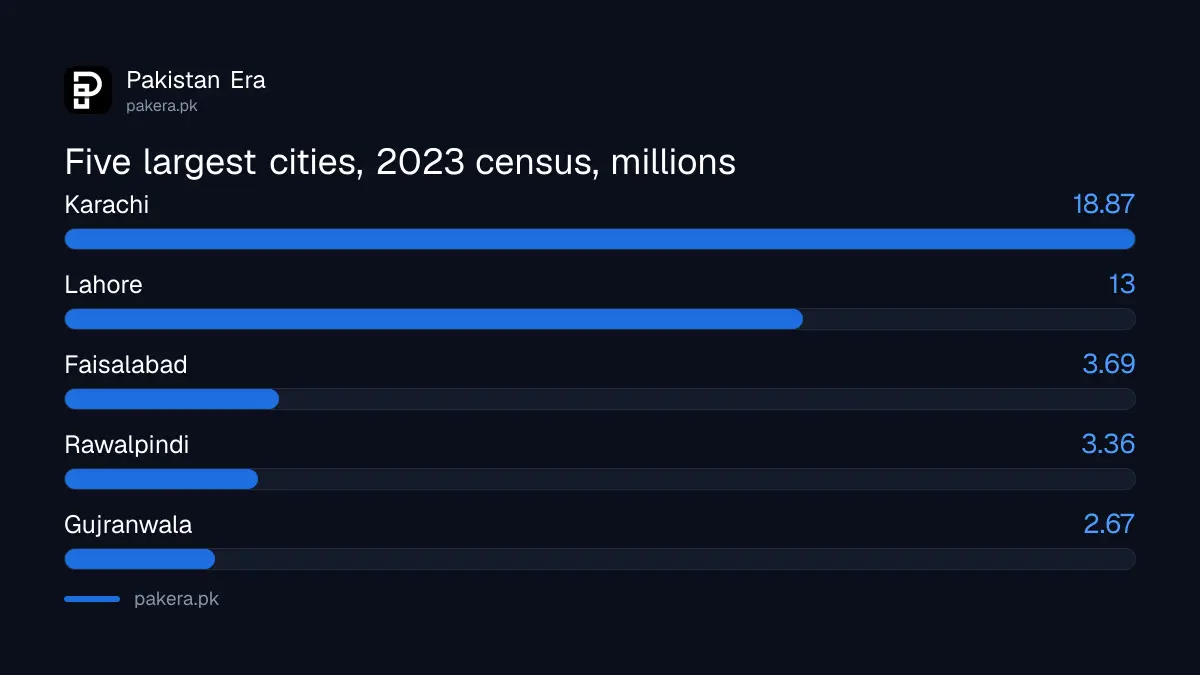
Karachi has 18.87 million people and Lahore 13 million. Faisalabad, Rawalpindi, Gujranwala, Multan, Hyderabad, Peshawar, Quetta and Islamabad also pass one million. Together these ten cities hold over 20 per cent of all Pakistanis and 54 per cent of its urban people.
| Rank | City | Population, 2023 census |
|---|---|---|
| 1 | Karachi | 18.87 million |
| 2 | Lahore | 13.00 million |
| 3 | Faisalabad | 3.69 million |
| 4 | Rawalpindi | 3.36 million |
| 5 | Gujranwala | 2.67 million |
| 6 | Multan | 2.22 million |
| 7 | Hyderabad | 1.92 million |
| 8 | Peshawar | 1.91 million |
| 9 | Quetta | 1.57 million |
| 10 | Islamabad | 1.11 million |
Karachi grew from 14.88 million in 2017, about 4.05 per cent a year. Lahore grew from 11.12 million, about 2.65 per cent a year. The next ten cities, each between half a million and one million, are Sargodha, Sialkot, Bahawalpur, Jhang, Sheikhupura, Gujrat, Sahiwal and Okara in Punjab, and Sukkur and Larkana in Sindh.
Six in ten Pakistanis still live in rural areas
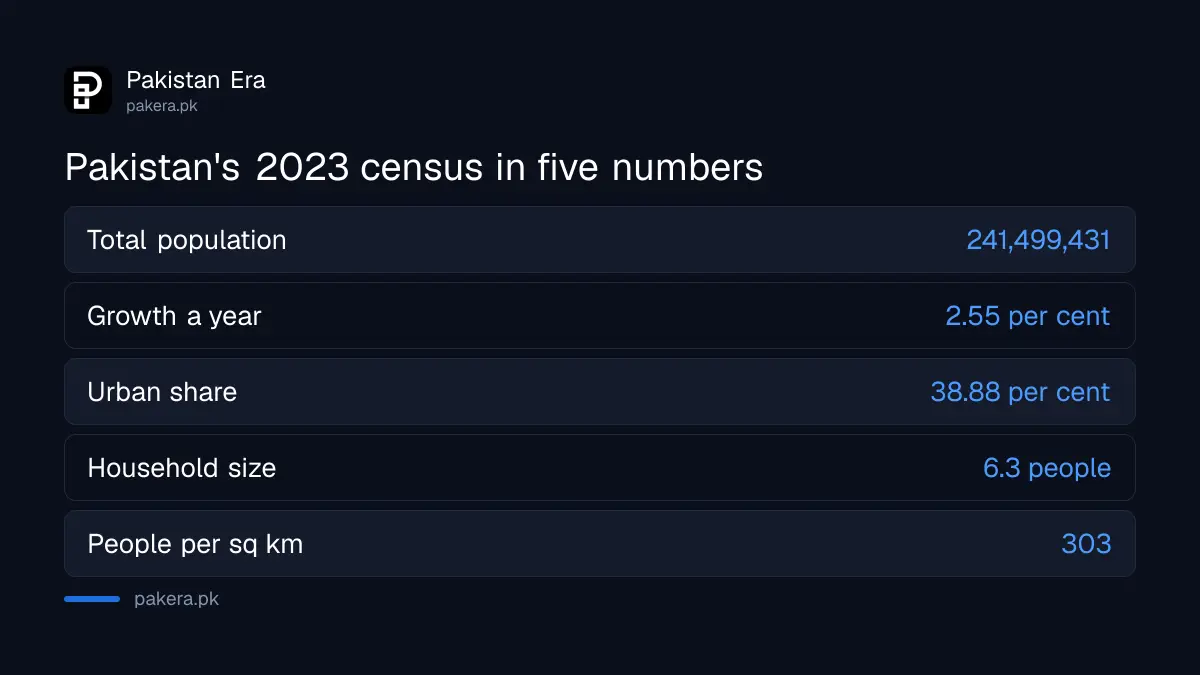
The census counted 147.61 million people in rural areas, 61.12 per cent, and 93.88 million in towns and cities, 38.88 per cent. The average household has 6.3 people, slightly fewer than 6.4 in 2017. Khyber Pakhtunkhwa has the largest households, at about 6.9 people.
Islamabad is the most crowded area, with about 2,609 people per square kilometre. Balochistan, the largest province by area, has about 43. The national figure is 303 people per square kilometre.
| Measure | 2023 census |
|---|---|
| Men | 51.49% (including transgender people) |
| Women | 48.51% |
| Urban population | 93.88 million (38.88%) |
| Rural population | 147.61 million (61.12%) |
| Average household size | 6.3 people |
| People per square kilometre | 303 |
How to find your own district's population in the PBS tables
PBS publishes a district table for each province on its census page. Table 1 gives the area, population by sex, density, urban share, household size and the 2017 figure for every district and tehsil. It takes about two minutes to find yours.
- Open the census page on the PBS website, pbs.gov.pk/census.
- Scroll to the detailed results of the 7th Population Census.
- Pick Table 1 for your province, the "districts" version, not the "province" one.
- Open the PDF and search for your district name in capital letters, for example LAHORE DISTRICT.
- Read the total population, then the 2017 figure near the end of the row to see how much it grew.
For Lahore, Table 1 shows 13,004,135 people in 2023 against 11,119,985 in 2017. The district PDFs are wide, so open them on a laptop or turn your phone sideways.
What the census means for your household
The census decides more than a headline number. PBS says the count is linked to the allocation of seats in the assemblies and of resources. School places, hospital beds, water and power planning all start from it.
If your area grew fast, expect pressure on the services you use: school admissions, hospital queues and water supply. Faster-growing districts such as Karachi East and the Balochistan districts above feel this first. The same PBS office runs other counts that matter for planning, such as the 2024 agricultural census of livestock. For the bigger economic picture, the GDP and per capita income figures show how fast incomes grow against a population rising 2.55 per cent a year. The body that sets population policy is the National Population Council.
Common questions
What is the population of Pakistan according to the 2023 census?
241,499,431 people in the four provinces and Islamabad. Gilgit-Baltistan and Azad Jammu and Kashmir are not included in this figure.
What is the population growth rate of Pakistan?
2.55 per cent a year on average between the 2017 and 2023 censuses, up from 2.40 per cent between 1998 and 2017.
Which is the largest city of Pakistan by population?
Karachi, with 18.87 million people in 2023. Lahore is second with 13 million.
Which province has the largest population?
Punjab, with 127.69 million people, or 52.87 per cent of the total.
How many people live in an average Pakistani household?
About 6.3 people, according to the 2023 census. Khyber Pakhtunkhwa has the largest households at about 6.9.
When will the next census be held?
No date has been announced. The 2023 count came six years after 2017, while the earlier gap was 19 years.
How we verified this
What we checked and where we read it.
We checked these figures on 25 November 2026 in the PBS National Census Report 2023, linked from the PBS census page: the summary chapter, section 3.2 (district growth rates), 3.3 (provincial shares), 3.4 (leading cities), Table 4.1 (population since 1951) and Table 4.2 (area, density and household size). The Lahore figures come from PBS Table 1 for Punjab districts. The 5.6 million a year figure is our arithmetic.
Two points to note. In the report's Table 4.2, the province names are printed one row out of line with their numbers; we matched each row by its population share, which the report's text confirms. The report's Table 4.5 on major cities uses wider boundaries for some cities (for example the whole of Faisalabad and Rawalpindi districts), so its figures differ from the city counts in the main text. We use the main text figures above.
Free on WhatsApp
Get last dates and rule changes on WhatsApp
We post new last dates, fee changes and fixes for common problems, a few short posts a day.
Follow Pakera on WhatsAppOther followers cannot see your number.
Pakera Solves It
Which online process wasted your time this week?
A portal that will not load, a form nobody explains, a complaint that went nowhere. Tell us. Every week we pick one, solve it step by step and publish the answer.
About the author
Senior Writer, Public Services and Technology
Shahid joined us in 2024 as an author. He is a senior contributor to Pakistan's leading technology websites. He writes detailed articles, mostly covering his expertise in the latest tech, mobiles, apps, gadgets, and step-by-step guides. His ideology is to help people understand the latest trends and explain complex methods through very easy-to-understand guides.