National Population Council of Pakistan: Who Sits on It, and What Its Executive Committee Asked Provinces to Do
Pakistan's National Population Council is chaired by the PM. Its Executive Committee first met on 12 November 2026. Members, tasks for provinces and the data.
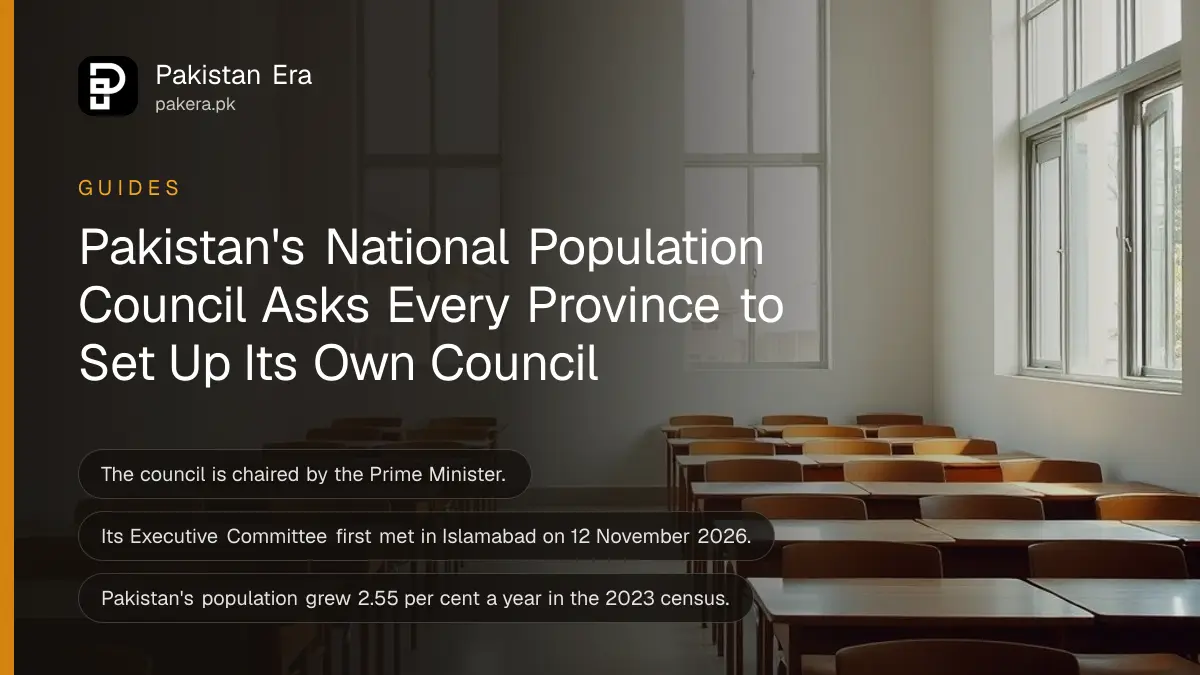
Pakistan's National Population Council is the top federal body on population, chaired by Prime Minister Shehbaz Sharif, with provincial, AJK and Gilgit-Baltistan leaders, key federal ministers and the military leadership on it. Its Executive Committee met for the first time on 12 November 2026 at the Planning Commission in Islamabad and asked every province to set up its own population council.
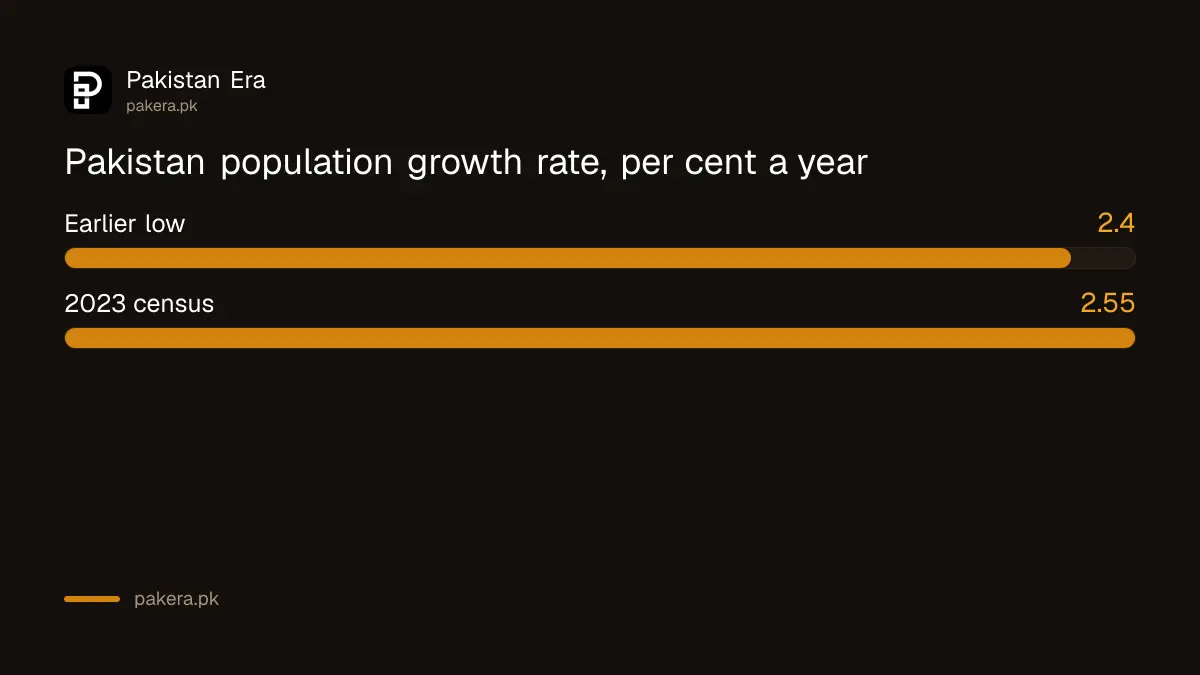
The council exists because Pakistan's population grew at 2.55 per cent a year in the 2023 Digital Census, reaching 241.49 million. The government says that rate rose from 2.4 per cent, and that the country could pass 386 million people by 2050 if trends continue. Here is what the council is, who runs it, and what it has asked provinces to do.
What the National Population Council is
The National Population Council is a high-level forum, chaired by the Prime Minister, that brings federal and provincial leaders together on population policy. The government set it up in 2026 because, after the 18th Amendment, health, education and family planning sit with provinces, and no single body aligned them.
Planning Minister Ahsan Iqbal described its purpose on World Population Day, 11 July 2026. Pakistan "has not lacked policies on population", he said, but has lacked a "sufficiently empowered mechanism to align all key actors behind one national direction". The council is meant to be that mechanism.
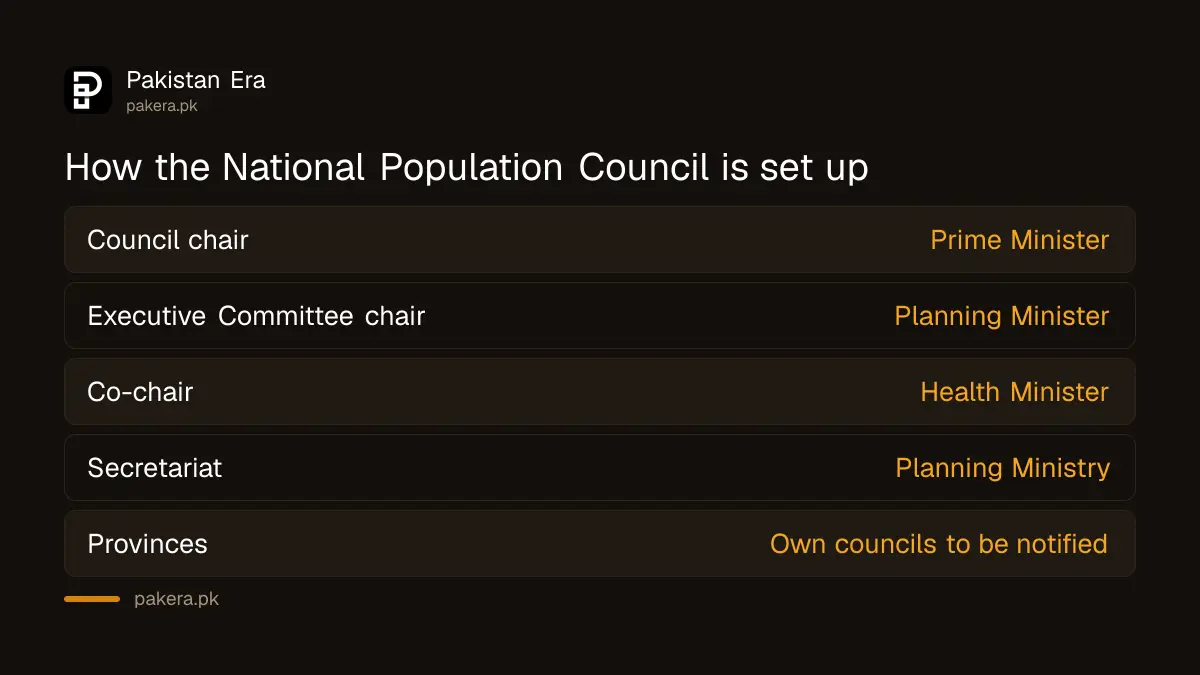
| Body | Chair | Role |
|---|---|---|
| National Population Council | Prime Minister | Sets national direction on population |
| Executive Committee | Planning Minister, co-chaired by Health Minister | Turns council policy into targets and drives delivery |
| Secretariat | Ministry of Planning, Development and Special Initiatives | Supports the committee and tracks progress |
| Provincial Population Councils | To be notified by each province | Carry the plan into provinces and regions |
Who sits on the council and its Executive Committee
The council brings together the Prime Minister, the provincial leadership, AJK and Gilgit-Baltistan leaders, key federal ministers, and the Chief of Defence Forces and Army Chief with the military leadership. The Executive Committee is chaired by Ahsan Iqbal and co-chaired by Health Minister Syed Mustafa Kamal.
The committee's first meeting on 12 November 2026 included federal ministers and secretaries, provincial and regional ministers, and senior officials from the planning and development, health and population welfare departments of every province, AJK and Gilgit-Baltistan.
- Chair: Ahsan Iqbal, Federal Minister for Planning, Development and Special Initiatives.
- Co-chair: Syed Mustafa Kamal, Federal Minister for National Health Services, Regulations and Coordination.
- Constituted by: the Prime Minister.
- Secretariat: the Planning Ministry.
What the first Executive Committee meeting decided
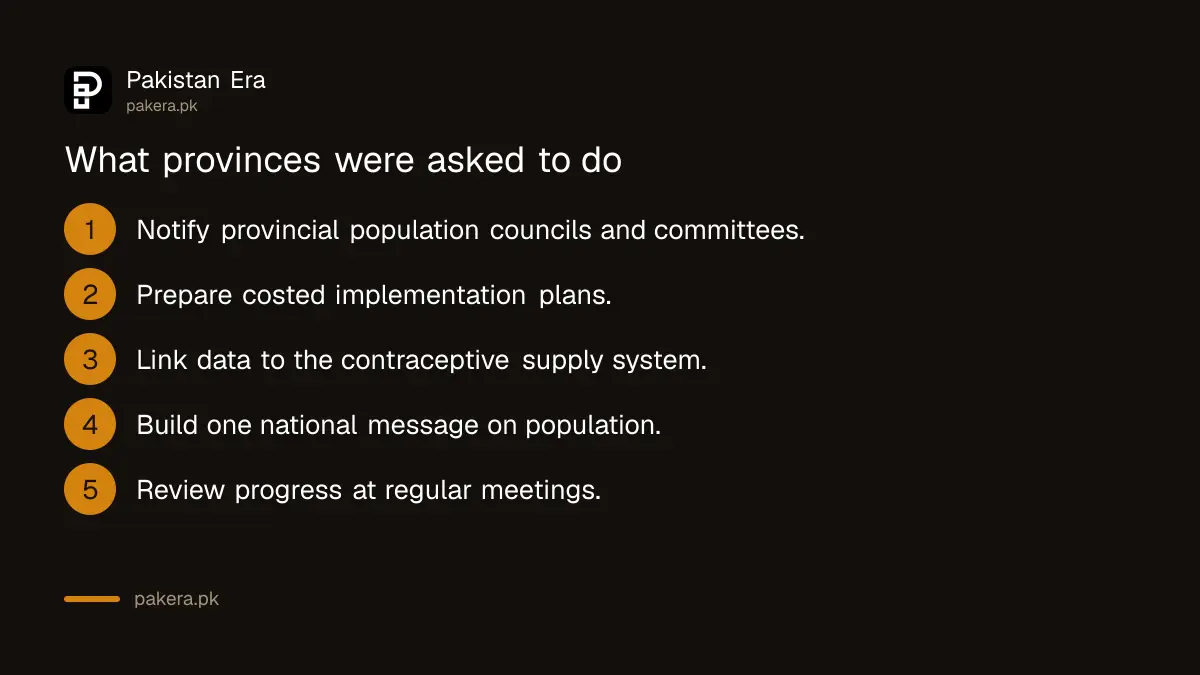
The committee considered a draft National Health and Population Policy and a National Population Stabilization Program from the Health Ministry. It asked provinces and regions to notify their own population councils and committees, prepare costed plans, and link their data to the national contraceptive supply system.
- Notify Provincial Population Councils and Executive Committees in every province and region.
- Prepare costed implementation plans in line with the National Population Stabilization Program.
- Link missing data to the Contraceptive Logistics Management Information System, so the country sees its full contraceptive supply chain.
- Build a unified national message on population, with the information ministries.
- Meet regularly to review progress against agreed indicators.
The meeting followed a preliminary session of the full council on 30 October 2026, chaired by the Prime Minister.
The population figures behind the council
Pakistan counted 241.49 million people in the 2023 Digital Census, growing 2.55 per cent a year. Women have 3.6 children on average, the same in 2017-18 and in the 2024-25 Household Integrated Economic Survey, down from 4.1 in 2006-07.
| Measure | Figure | Source cited by the government |
|---|---|---|
| Population, 2023 | 241.49 million | 2023 Digital Census |
| Annual growth rate | 2.55% | 2023 Digital Census |
| Earlier growth rate | 2.4% | As stated by the Planning Minister |
| Fertility, 2006-07 | 4.1 births per woman | Planning Ministry |
| Fertility, 2024-25 | 3.6 births per woman | Household Integrated Economic Survey |
| Possible population, 2050 | Over 386 million | If current trends continue |
The minister gave a simple example of why the rate matters. If the economy grows 5 per cent while the population grows 2.5 per cent, growth per person is only about 2.5 per cent.
The NFC Award question
The National Finance Commission (NFC) Award shares federal tax money among provinces, and population carries 82 per cent of the weight. At the 12 November meeting, Ahsan Iqbal said this can reward population growth, and called for linking the Award to development and sustainability measures.
That is a proposal, not a decision. Any change to the NFC formula needs a new Award agreed between the federation and the provinces. How the current Award divides money is set out in each province's NFC share for 2026-27.
For families, the council does not change any service yet. Family planning and health services still run through provincial departments. Federal support for mothers and children, such as BISP's Nashonuma, is listed in federal welfare schemes in Pakistan.
Common questions
Who chairs the National Population Council?
Prime Minister Muhammad Shehbaz Sharif. Its Executive Committee is chaired by Planning Minister Ahsan Iqbal and co-chaired by Health Minister Syed Mustafa Kamal.
When did the Executive Committee first meet?
On 12 November 2026, at the Planning Commission in Islamabad. The full council held a preliminary meeting on 30 October 2026.
What is Pakistan's population growth rate?
2.55 per cent a year, according to the 2023 Digital Census, which counted 241.49 million people.
What are provinces asked to do?
Notify provincial population councils and executive committees, prepare costed plans in line with the National Population Stabilization Program, and link their contraceptive supply data to the national system.
Will the NFC formula change?
Not yet. The Planning Minister proposed linking the NFC Award to development and sustainability indicators. Changing it needs a new Award agreed with the provinces.
How we verified this
What we checked and where we read it.
Checked on 15 November 2026. We read two Press Information Department releases from the Planning Ministry: PR No. 144 of 12 November 2026 on the Executive Committee's first meeting, and PR No. 91 of 11 July 2026 on the council's make-up and the census and fertility figures. The draft National Health and Population Policy and the Stabilization Program were not published with either release, so their targets are not given here.
About the author

Global Affairs & Political Economy Writer
Muhammad Hatim is a book lover who started writing because he enjoys it. At Pakistan Era he writes about international relations, geopolitics and the global economy, with a particular interest in South Asia and the forces behind current events.