Provinces to Get Rs 8.85 Trillion From the Federal Budget in 2026-27, Punjab Rs 4.40 Trillion
Pakistan's 2026-27 budget plans Rs 8,848 billion for the provinces: Punjab Rs 4,403bn, Sindh Rs 2,207bn, KP Rs 1,443bn, Balochistan Rs 795bn. Check the table.
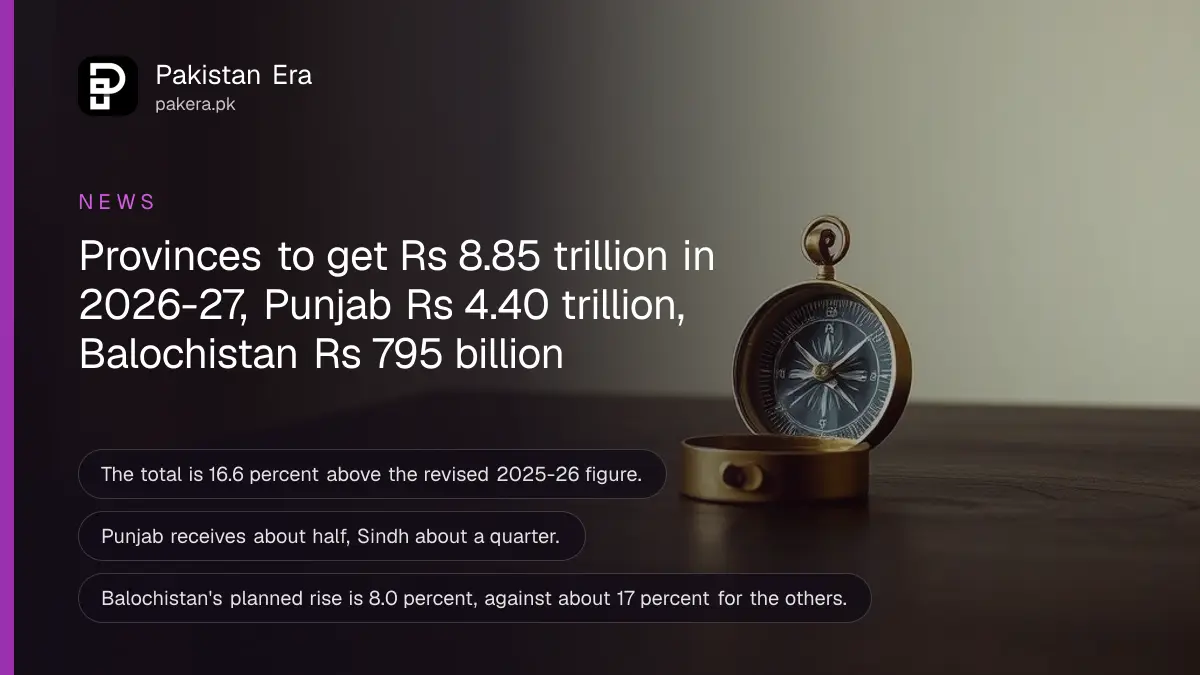
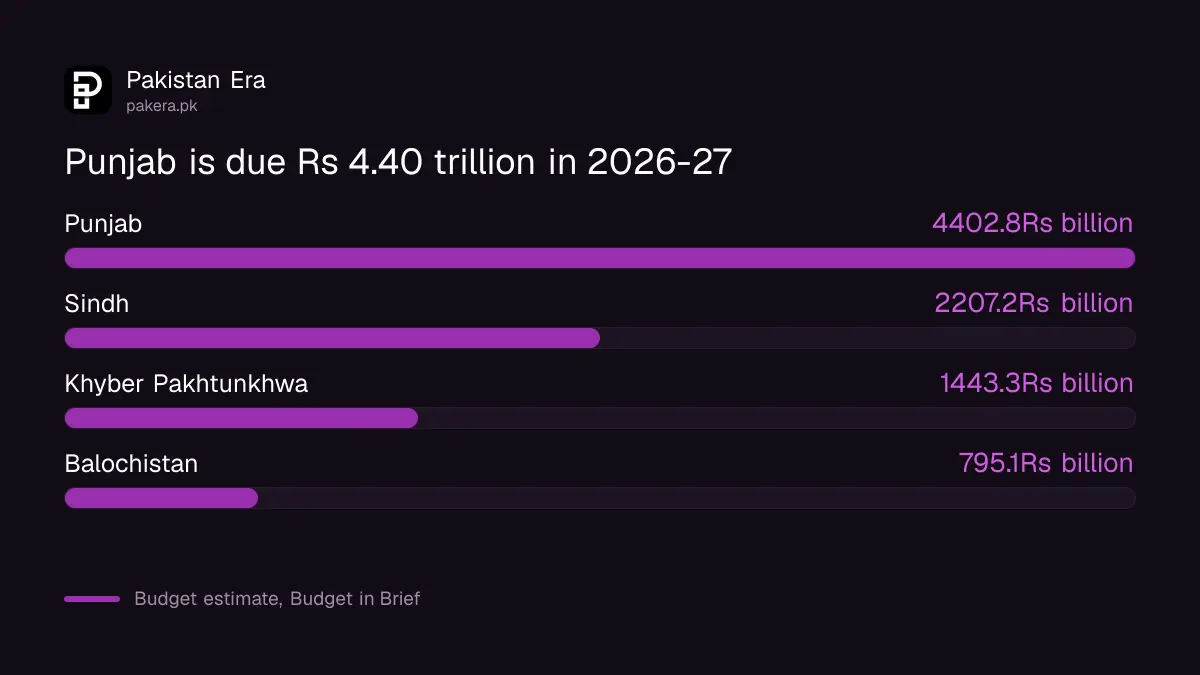
The federal budget for 2026-27 plans to pass Rs 8,848.5 billion, about Rs 8.85 trillion, to the provinces. Punjab is due Rs 4,402.8 billion, Sindh Rs 2,207.2 billion, Khyber Pakhtunkhwa Rs 1,443.3 billion and Balochistan Rs 795.1 billion. The total is 16.6 percent above the revised figure for 2025-26.
The provinces get this money from the federal taxes that are shared under the National Finance Commission (NFC) Award, plus some direct payments linked to oil and gas. The numbers are budget estimates from the Finance Division's Budget in Brief, dated 12 June 2026. We read it on 13 October 2026. Actual transfers depend on tax collection during the year.
Punjab gets half of the provincial total
Punjab's Rs 4,402.8 billion is 49.8 percent of the Rs 8,848.5 billion. Sindh gets 24.9 percent, Khyber Pakhtunkhwa 16.3 percent and Balochistan 9.0 percent. The shares are our own arithmetic on the printed amounts.
| Province | Revised 2025-26, Rs billion | Budget 2026-27, Rs billion | Change |
|---|---|---|---|
| Punjab | 3,745.1 | 4,402.8 | +17.6% |
| Sindh | 1,879.1 | 2,207.2 | +17.5% |
| Khyber Pakhtunkhwa | 1,231.8 | 1,443.3 | +17.2% |
| Balochistan | 735.9 | 795.1 | +8.0% |
| Total | 7,591.8 | 8,848.5 | +16.6% |
The Budget in Brief lists Khyber Pakhtunkhwa's amount as including 1 percent for the war on terror. Balochistan's planned increase is about half that of the others. The document does not explain why. We did not find a reason in the pages we read.
Taxes supply Rs 8.64 trillion and oil and gas the rest
Of the total, Rs 8,635.2 billion comes from the divisible pool of federal taxes. A further Rs 213.3 billion is straight transfers: gas development surcharge, royalties on natural gas and crude oil, and excise duty on natural gas.
| Source in the divisible pool, 2026-27 | Rs billion |
|---|---|
| Income tax | 4,246.4 |
| Sales tax (not including sales tax on services) | 2,815.1 |
| Customs duties | 946.8 |
| Federal excise | 611.7 |
| Capital value tax | 15.2 |
| Total divisible pool | 8,635.2 |
These are the amounts to be shared with the provinces, not the full tax targets. Sales tax on services is left out because the provinces collect that themselves.
Income tax is 49.2 percent of the pool, sales tax 32.6 percent, customs 11.0 percent and federal excise 7.1 percent. The shares are our arithmetic. Because the pool is a share of taxes the FBR collects, the provinces' real receipts rise or fall with FBR collection. A shortfall at the FBR is felt in every province.
| Straight transfer, 2026-27 | Rs billion |
|---|---|
| Royalty on natural gas | 93.1 |
| Gas development surcharge | 69.4 |
| Royalty on crude oil | 44.6 |
| Excise duty on natural gas | 6.2 |
| Total | 213.3 |
The Budget in Brief shows only the total for these four items. It does not split them by province in this table, and we did not read the rules that decide who receives them.
The transfer is 43 percent of gross federal revenue
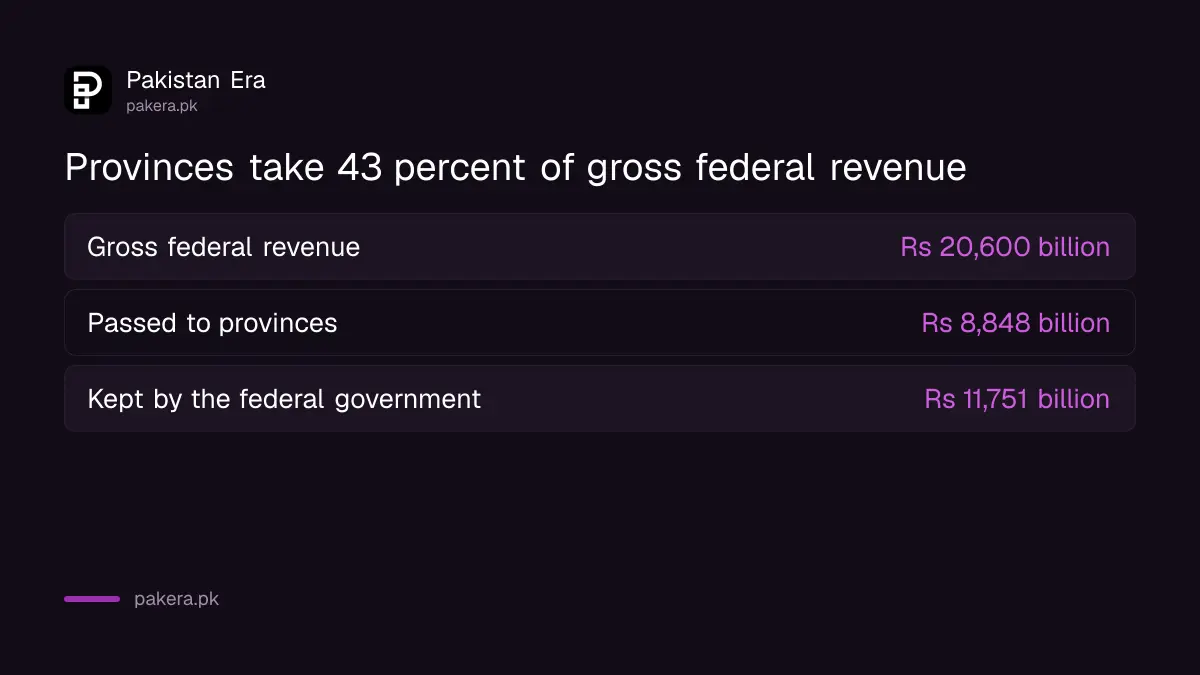
The federal government expects Rs 20,600 billion in gross revenue. After it passes Rs 8,848 billion to the provinces, it keeps Rs 11,751 billion. The provincial share is therefore 43.0 percent of the gross figure.
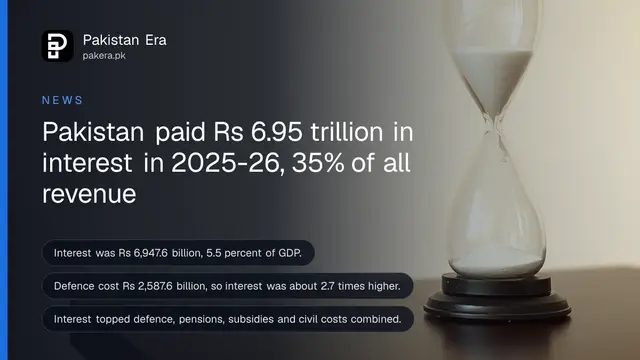
That Rs 11,751 billion is what the federal government has to meet its own bills. Interest alone takes Rs 8,054 billion of it, as shown in the 2026-27 budget breakdown.
Last year the provinces received more than the May estimate
For 2025-26, the provisional fiscal table shows provinces received Rs 7,668.8 billion under the NFC Award. The Budget in Brief revised figure was Rs 7,591.8 billion. The actual was Rs 77.0 billion higher.
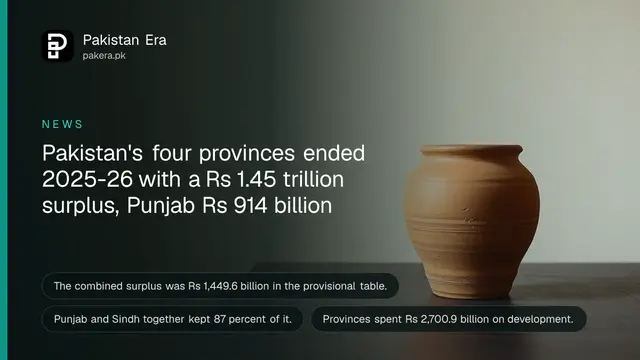
The provinces then ended the year with a combined surplus of Rs 1,449.6 billion, as set out in the provincial surplus report. The 2026-27 budget expects a provincial surplus of Rs 1,794 billion.
Each province decides its own spending, so the federal budget only plans the transfer.
How to look up the provincial share
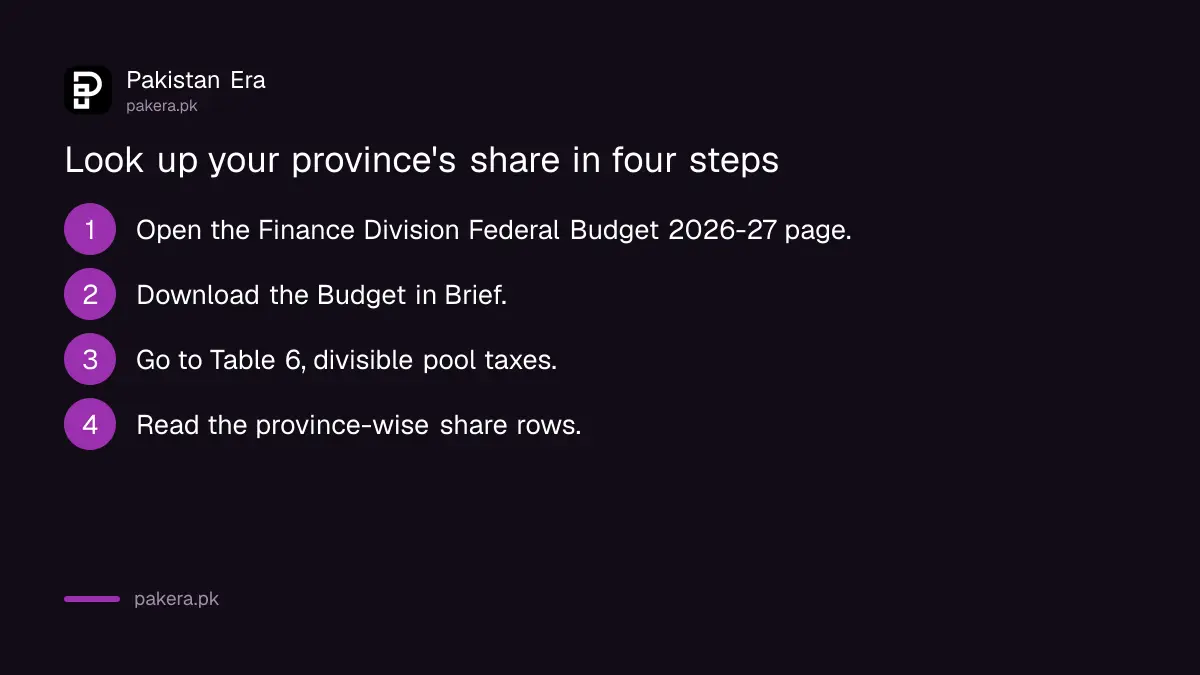
- Open the Finance Division page for Federal Budget 2026-27.
- Download the "Budget in Brief" file.
- Find Table 6, "Details of Divisible Pool Taxes (Transfers to Provinces)".
- Read the "Province-wise share" rows at the bottom.
- Check the unit: the table is in Rs million.
Each province gets more rupees in 2026-27
The budget adds money for every province compared with the revised 2025-26 figure. The amounts below are our own subtraction of the printed numbers.
Punjab rises from Rs 3,745.1 billion to Rs 4,402.8 billion, which is Rs 657.7 billion more. Sindh rises by Rs 328.1 billion and Khyber Pakhtunkhwa by Rs 211.5 billion. Balochistan rises from Rs 735.9 billion to Rs 795.1 billion, which is Rs 59.2 billion more.
So the largest province gains about eleven times as many rupees as the smallest. The percentage rise for Balochistan is also lower, at 8.0 percent.
Common questions
How much will the provinces receive in 2026-27?
Rs 8,848.5 billion in the budget estimate: Rs 8,635.2 billion from the divisible pool and Rs 213.3 billion in straight transfers.
Which province gets the most?
Punjab, with Rs 4,402.8 billion. Sindh is second at Rs 2,207.2 billion.
What is the NFC Award?
It is the agreement on how federal tax money is shared between the federal government and the provinces, and among the provinces.
Why is Balochistan's increase smaller?
The document does not say. Its planned amount rises 8.0 percent, against about 17 percent for the other three.
Are these actual payments?
No. They are budget estimates. Actual payments depend on how much the federal government collects.
Does this change my provincial taxes?
No. This is a transfer between governments. Provincial taxes are set in each province's own budget.
How we verified this
What we checked, where we read it, and what we could not confirm.
Last checked on 13 October 2026, Pakistan time. We read Table 6 and Table 1 of the Budget in Brief 2026-27 on the Finance Division website, and the 2025-26 actuals in its Pakistan Fiscal Operations table. We did not read the NFC Award text. Percentages are our own arithmetic.
About the author

Global Affairs & Political Economy Writer
Muhammad Hatim is a book lover who started writing because he enjoys it. At Pakistan Era he writes about international relations, geopolitics and the global economy, with a particular interest in South Asia and the forces behind current events.