Pakistan's 2026-27 Budget Sets Aside Rs 8.05 Trillion for Interest, 43% of Federal Spending
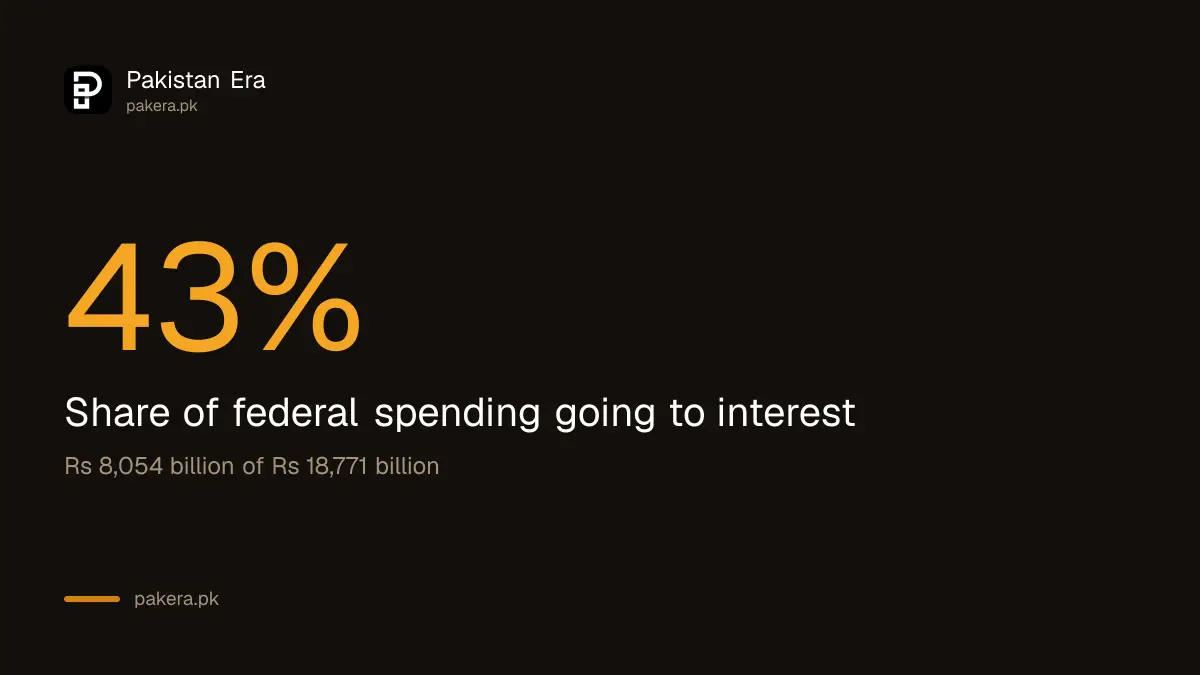
Pakistan's 2026-27 federal budget plans Rs 8,054 billion for interest, 43% of Rs 18,771 billion spending, with a 3.6% deficit. See the Budget in Brief figures.
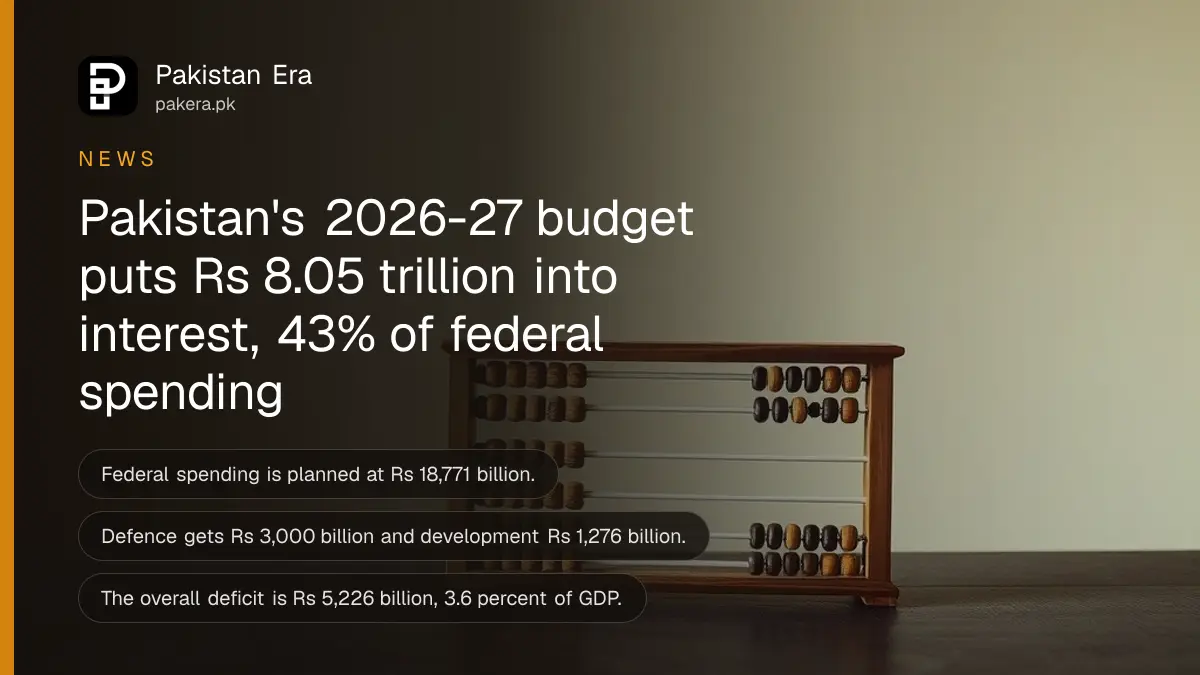
Pakistan's federal budget for 2026-27 sets aside Rs 8,054 billion, about Rs 8.05 trillion, for interest. That is 43 percent of the Rs 18,771 billion the federal government plans to spend. Defence gets Rs 3,000 billion and development only Rs 1,276 billion.
The figures come from the Finance Division's Budget in Brief, signed by the Finance Secretary on 12 June 2026. It is the plan as presented. We read it on 13 October 2026 and did not check later changes made when Parliament passed the Finance Act. The budget is for the federal government only. The provinces pass their own.
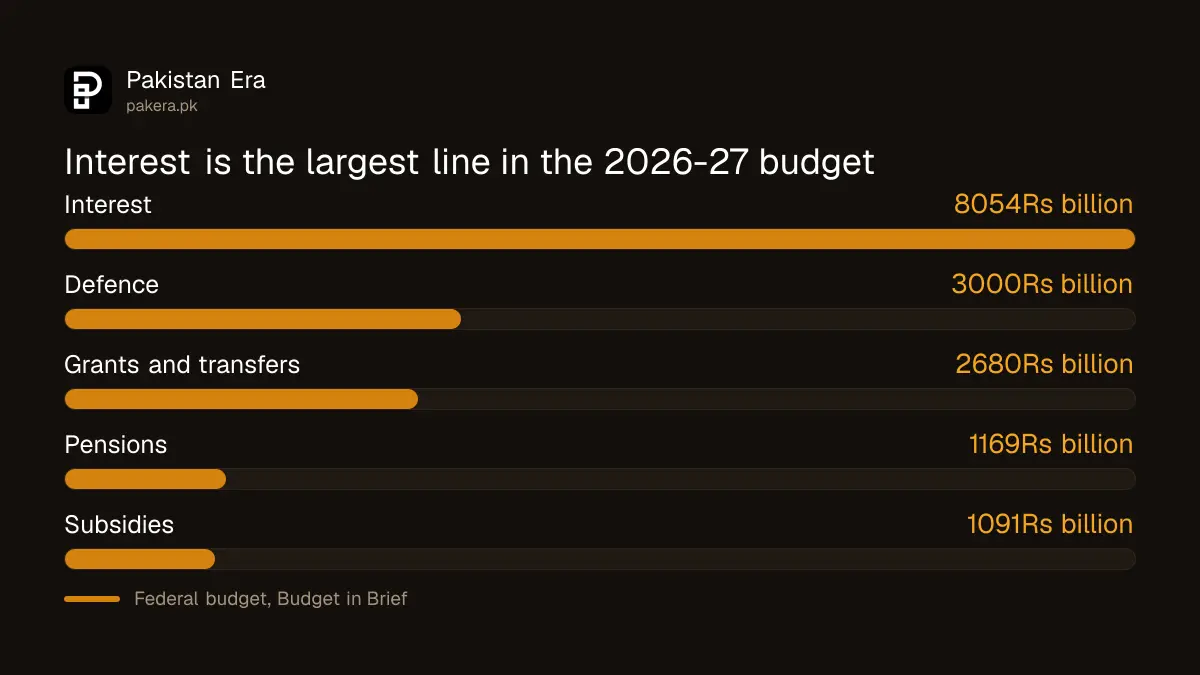
Interest is the largest line in the federal budget
Of every Rs 100 the federal government plans to spend in 2026-27, about Rs 43 goes to interest. Defence takes about Rs 16. Grants and transfers take about Rs 14. Development takes about Rs 7. These shares are our own arithmetic.
| Federal spending, 2026-27 | Rs billion | Share of total |
|---|---|---|
| Interest payments | 8,054 | 42.9% |
| Defence affairs and services | 3,000 | 16.0% |
| Grants and transfers | 2,680 | 14.3% |
| Pensions | 1,169 | 6.2% |
| Subsidies | 1,091 | 5.8% |
| Running of civil government | 1,071 | 5.7% |
| Development and net lending | 1,276 | 6.8% |
| Emergency provision and others | 430 | 2.3% |
| Total | 18,771 | 100% |
Interest eats 69 percent of what the federal government keeps
The government expects Rs 20,600 billion in gross revenue. It must pass Rs 8,848 billion of that to the provinces under the NFC Award. That leaves Rs 11,751 billion. Interest of Rs 8,054 billion is 68.5 percent of the remainder.
Domestic debt costs Rs 6,982.6 billion and foreign debt Rs 1,071.4 billion. The total is about 16 percent above the Rs 6,937 billion in the revised estimate for 2025-26. For how this compares with what the state actually paid last year, see the 2025-26 interest bill.
The plan needs Rs 7 trillion of financing
Spending of Rs 18,771 billion exceeds net revenue of Rs 11,751 billion by Rs 7,020 billion. That is the federal deficit. The budget pays for it mostly with domestic borrowing, Rs 6,046 billion in all.
| How the Rs 7,020 billion is financed | Rs billion |
|---|---|
| Government securities (banks and others) | 5,772 |
| National Savings Schemes, GP Fund and deposits | 274 |
| Net external financing | 813 |
| Privatisation proceeds | 161 |
| Total | 7,020 |
The provinces are expected to run a surplus of Rs 1,794 billion, which brings the overall fiscal deficit down to Rs 5,226 billion. On a GDP of Rs 143,604 billion that is 3.6 percent. The primary surplus is Rs 2,828 billion, 2.0 percent. How the sums will be borrowed is described in the FY2027 borrowing plan.
The budget compares with a lower base in 2025-26
The Budget in Brief shows three columns: the 2025-26 budget, the revised estimate and the 2026-27 plan. The revised figures for 2025-26 are labelled projections as of mid-May. They are not final accounts.
| Rs billion | Budget 2025-26 | Revised 2025-26 | Budget 2026-27 |
|---|---|---|---|
| Gross revenue | 19,278 | 18,076 | 20,600 |
| Net federal revenue | 11,072 | 10,485 | 11,751 |
| Federal spending | 17,573 | 15,642 | 18,771 |
| Overall fiscal deficit | 5,037 | 3,778 | 5,226 |
| Deficit, share of GDP | 3.9% | 3.0% | 3.6% |
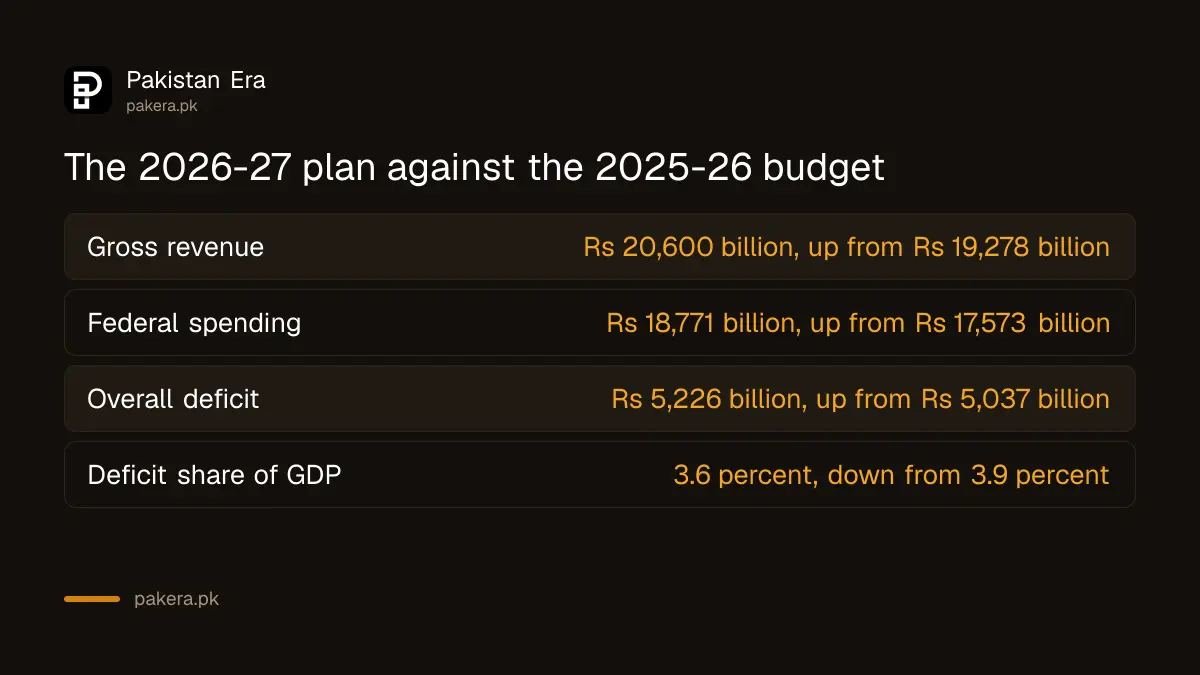
Planned spending is 20 percent above the revised 2025-26 figure. The final deficit for 2025-26 came in lower still, at 2.6 percent, as set out in the fiscal deficit report. The plan therefore starts from a better base than the May estimate assumed.
The tax collection target is Rs 15.26 trillion
The budget sets a Federal Board of Revenue target of Rs 15,264 billion. That is 17.6 percent above the revised Rs 12,983 billion for 2025-26. Non-tax revenue is planned at Rs 5,336 billion, slightly above the revised Rs 5,093 billion.
The plan therefore asks for much faster growth in tax than in other income. How the first quarter of the year went is in the FBR first-quarter collection report. The IMF has also set a primary surplus condition, as covered in what the IMF asked on 7 October. The budget plans 2.0 percent.
- Open the Finance Division page for Federal Budget 2026-27.
- Download the Budget in Brief.
- Read Table 1 for the totals and Table 3 for the comparison with last year.
- Read Table 10 for each spending line.
What this means for ordinary readers
A budget that spends 43 percent on interest leaves less for roads, health and schools. It also explains why the government keeps asking for more tax and why the IMF watches the primary surplus. We cannot say how the money will be used beyond what the document lists.
The budget is a plan. Actual spending can differ, as the 2025-26 numbers show.
Common questions
How much interest does Pakistan plan to pay in 2026-27?
Rs 8,054 billion, about Rs 8.05 trillion, in the federal Budget in Brief.
How big is the federal budget for 2026-27?
Total federal spending is Rs 18,771 billion, of which current spending is Rs 17,495 billion.
What is the planned deficit?
The overall fiscal deficit is Rs 5,226 billion, 3.6 percent of GDP. The federal deficit alone is Rs 7,020 billion.
How much goes to the provinces?
Rs 8,848 billion from the divisible pool and straight transfers.
How much is planned for development?
Rs 1,276 billion, made up of Rs 1,000 billion for the federal PSDP and Rs 276 billion for net lending.
Is this the final budget?
It is the budget as presented in June. We did not check changes made in the Finance Act.
How we verified this
What we checked, where we read it, and what we could not confirm.
Last checked on 13 October 2026, Pakistan time. We read Tables 1, 2, 3 and 10 of the Budget in Brief 2026-27 on the Finance Division website. The document is dated 12 June 2026. Percentages and comparisons marked as ours are our own arithmetic.
About the author

Global Affairs & Political Economy Writer
Muhammad Hatim is a book lover who started writing because he enjoys it. At Pakistan Era he writes about international relations, geopolitics and the global economy, with a particular interest in South Asia and the forces behind current events.