Pakistan's Fiscal Deficit Was Rs 3.31 Trillion, 2.6% of GDP, in 2025-26
Pakistan's 2025-26 fiscal deficit was Rs 3,313 billion, 2.6% of GDP, with a primary surplus of Rs 3,634 billion. We read the Finance Division table. Read more.
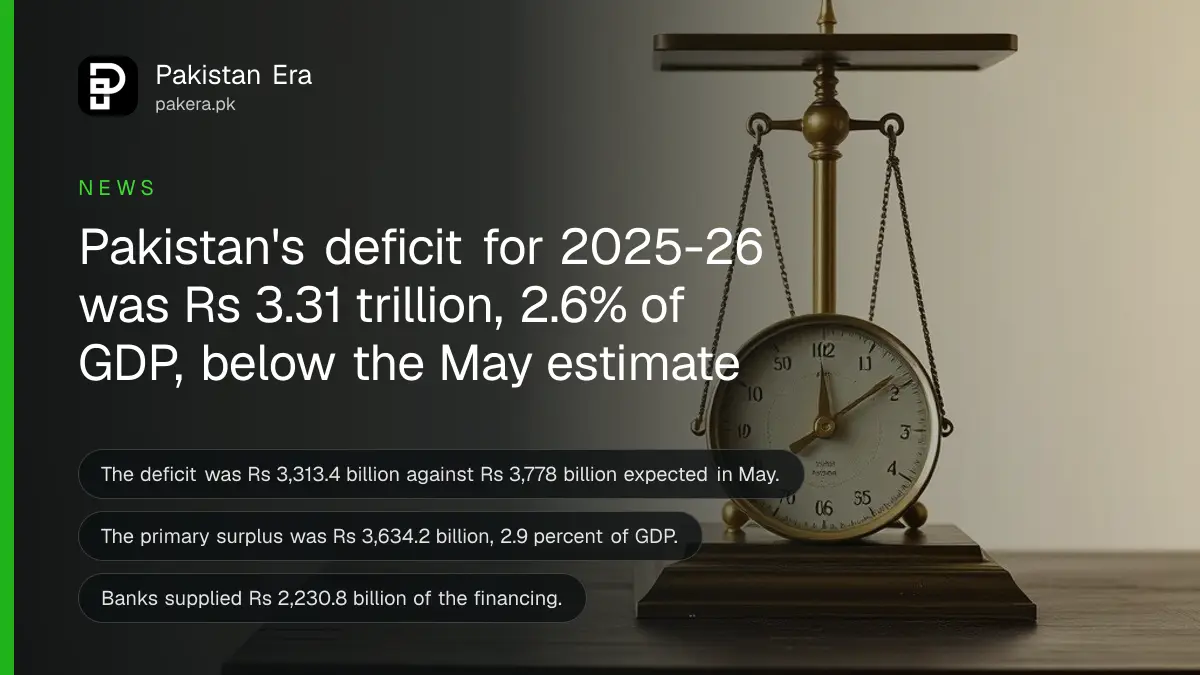
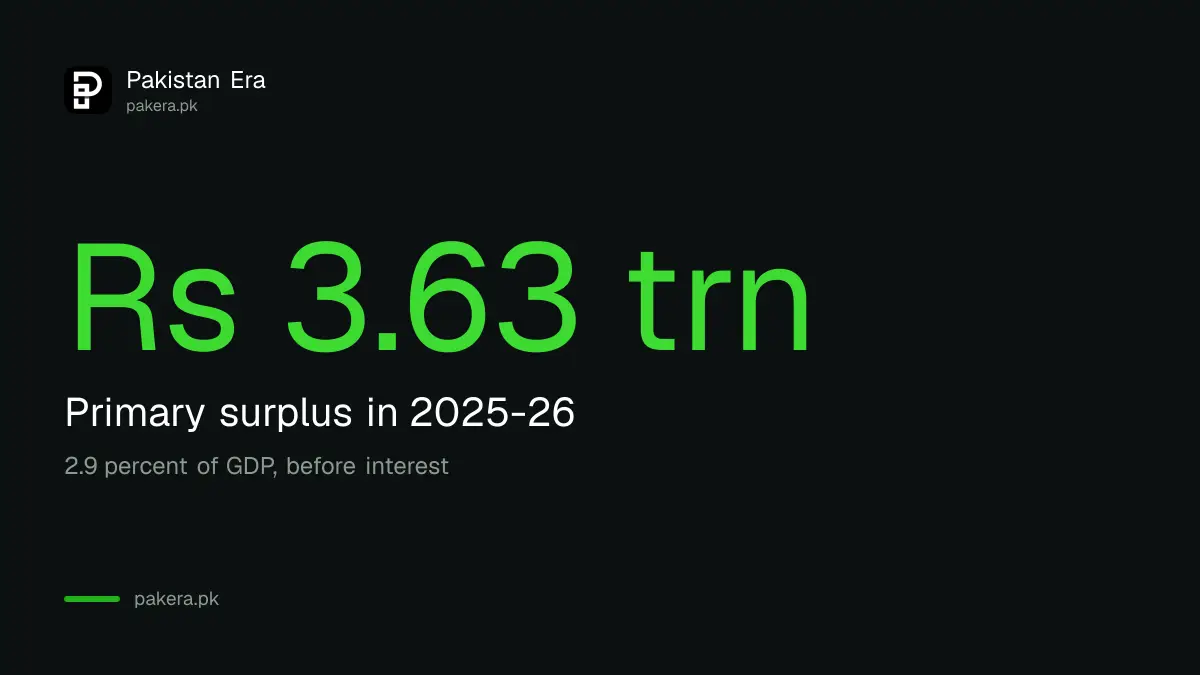
Pakistan's combined federal and provincial budget deficit for 2025-26 was Rs 3,313.4 billion, about Rs 3.31 trillion, or 2.6 percent of GDP. The Finance Division's provisional figures also show a primary surplus of Rs 3,634.2 billion, 2.9 percent of GDP. Both numbers are better than the government's own May estimate.
The fiscal deficit is the gap between what the state earned and what it spent in a year. The primary surplus leaves out interest payments, so it shows the balance on everything except debt costs. We downloaded and read the Finance Division's July to June table on 13 October 2026. The figures are marked provisional, so they may change when the final accounts come out.
The deficit closed at 2.6 percent of GDP
Total revenue was Rs 19,773.9 billion and total expenditure was Rs 23,087.4 billion. The difference is Rs 3,313.4 billion. The Finance Division divides it by a GDP of Rs 126,870 billion, which gives 2.6 percent.
| Item, July 2025 to June 2026 | Rs billion | Share of GDP |
|---|---|---|
| Total revenue | 19,773.9 | 15.6% |
| Total expenditure | 23,087.4 | 18.2% |
| Overall budget deficit | 3,313.4 | 2.6% |
| Primary surplus | 3,634.2 | 2.9% |
| Mark-up (interest) payments | 6,947.6 | 5.5% |
The expenditure line includes a negative "statistical discrepancy" of Rs 853.1 billion. That is an adjustment the table makes so that spending matches the financing figures. We report the total as printed.
The result beat both earlier official estimates
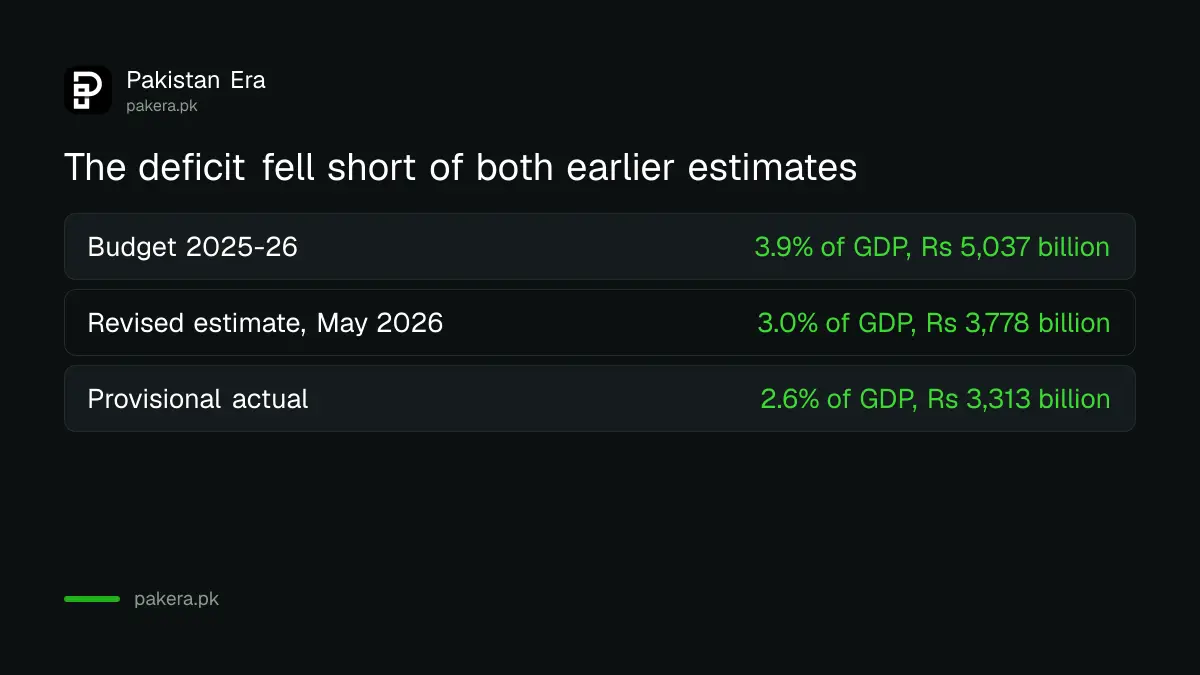
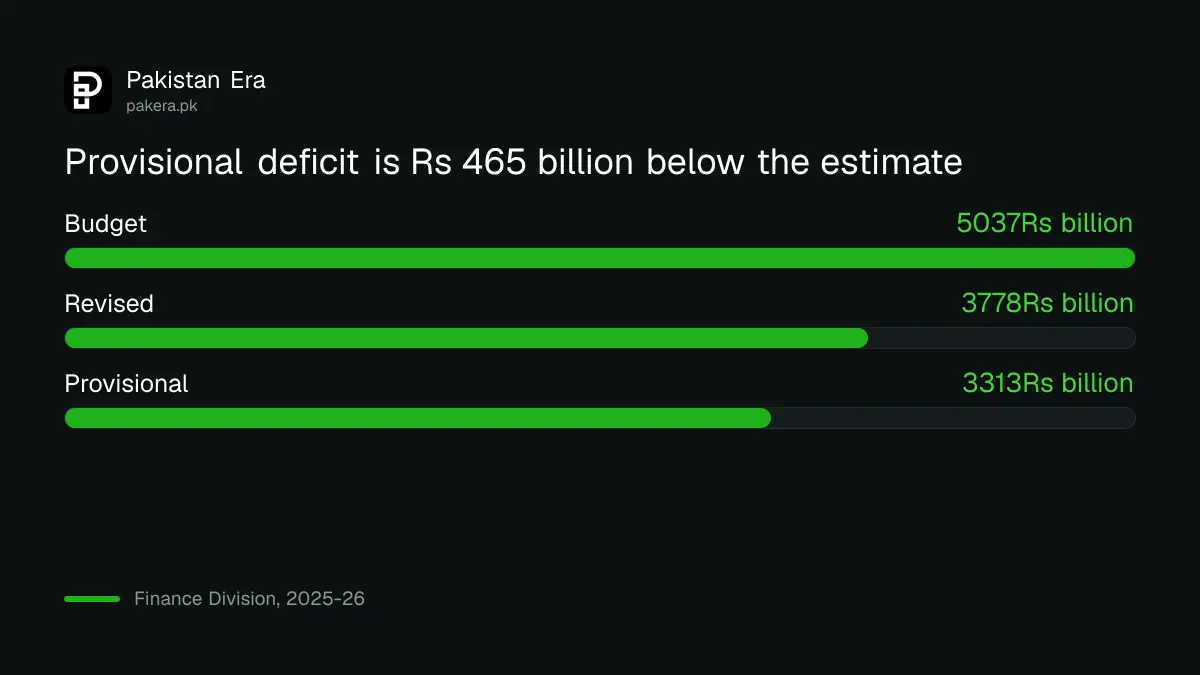
The 2025-26 budget aimed at a deficit of Rs 5,037 billion, 3.9 percent of GDP. The revised estimate in the Budget in Brief, dated May 2026, cut that to Rs 3,778 billion, 3.0 percent. The provisional actual is lower again.
Against the revised estimate, the deficit is Rs 464.6 billion smaller. The primary surplus is Rs 475 billion larger than the Rs 3,159 billion expected in May. This is our own subtraction of the two published sets of numbers.
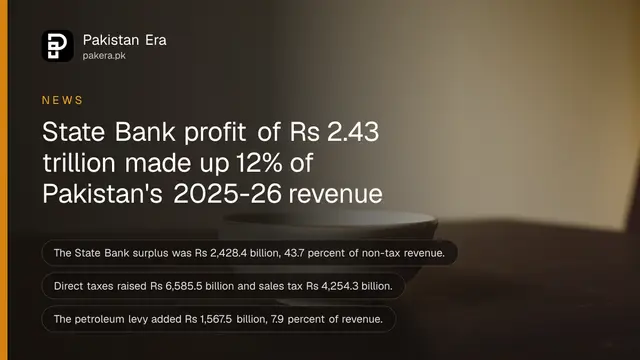
Some of the improvement came from revenue that was not part of normal tax collection. The same table shows a State Bank of Pakistan profit transfer of Rs 2,428.4 billion, which is written up in how much of last year's revenue came from the central bank.
Banks lent the state Rs 2.23 trillion to cover the gap
The deficit was financed from two sources. Net external financing was Rs 1,177.9 billion. Net domestic financing was Rs 2,135.5 billion, and almost all of it came from the banking system, which supplied Rs 2,230.8 billion.
| How the deficit was financed | Rs billion |
|---|---|
| External, net | 1,177.9 |
| Domestic, net | 2,135.5 |
| Of which banks | 2,230.8 |
| Of which non-bank sources | -99.3 |
| Total financing | 3,313.4 |
The negative non-bank figure means the state repaid more to non-bank lenders than it borrowed from them. Domestic financing also includes Rs 4.1 billion in privatisation proceeds.
For a reader with a bank loan or savings account, the point is simple. When banks lend heavily to the government, they have less room for private borrowers. The planned borrowing for the new year is set out in the FY2027 borrowing plan.
Interest cost still takes more than the whole deficit
The primary surplus is positive because the state earned more than it spent on everything except interest. Mark-up payments were Rs 6,947.6 billion, roughly twice the size of the primary surplus. The overall deficit is that gap: Rs 3,634.2 billion minus Rs 6,947.6 billion.
The IMF has asked Pakistan to keep a primary surplus of about 2 percent of GDP, as we covered in what the IMF asked on 7 October. The 2025-26 result of 2.9 percent was above that level.
How to read the fiscal table yourself
The table is public and takes five minutes to read. Use the steps below, and check the row names before you copy a number.
- Open the Finance Division website and choose "Pakistan Fiscal Operations".
- Open the July to June 2025-26 file.
- On Table 1, read "Overall Budget Balance" and "Primary Balance" in the last column.
- Check the unit at the top. It is "In Million of Pakistan Rupees", so divide by 1,000 for Rs billion.
- Read the GDP line at the bottom to see which GDP the percentages use.
Common questions
What was Pakistan's fiscal deficit in 2025-26?
It was Rs 3,313.4 billion, 2.6 percent of GDP, in the Finance Division's provisional consolidated table for July 2025 to June 2026.
What is a primary surplus?
It is revenue minus spending other than interest. Pakistan's was Rs 3,634.2 billion, so the state covered all non-interest costs and still had money towards interest.
Why is the deficit positive when the primary balance is also positive?
Interest payments are larger than the primary surplus. Interest was Rs 6,947.6 billion, so the overall balance is a deficit.
Does this include the provinces?
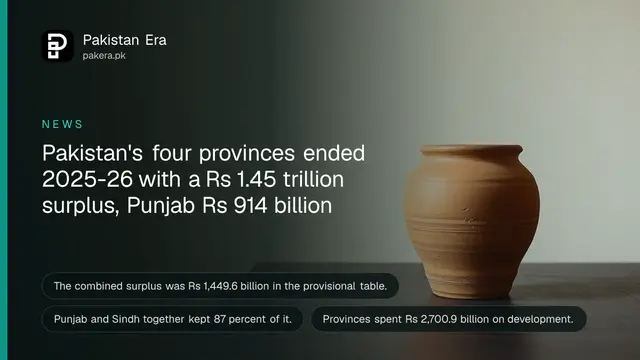
Yes. The table is consolidated, which means federal and provincial accounts are added together. The provinces ran a combined surplus that reduced the national deficit.
Are these final numbers?
No. The table is marked provisional. Final audited accounts can differ.
Does a smaller deficit lower prices?
Not directly. A smaller deficit means less new borrowing, which can ease pressure on interest rates and the rupee over time. It does not set shop prices.
How we verified this
What we checked, where we read it, and what we could not confirm.
Last checked on 13 October 2026, Pakistan time. We read the Finance Division's Pakistan Fiscal Operations page and its July to June 2025-26 table, and the Budget in Brief 2026-27 for the earlier estimates. The file shows a modified date of 13 August 2026, so this is not a same-day release. The differences from the May estimate are our own arithmetic.
About the author

Global Affairs & Political Economy Writer
Muhammad Hatim is a book lover who started writing because he enjoys it. At Pakistan Era he writes about international relations, geopolitics and the global economy, with a particular interest in South Asia and the forces behind current events.