What the IMF Asked of Pakistan on 7 October: 2% Primary Surplus, 2.8% on Health and Education, Timely Power Tariffs
The IMF staff deal of 7 October 2026 would release about US$1.2 billion. We read it: a 2.0% surplus, 2.8% health and education spending and power tariffs.
The IMF agreed a deal with Pakistan on 7 October 2026 that would release about US$1.2 billion. In return, Pakistan promised a primary surplus of 2.0 percent of GDP in FY27, health and education spending of 2.8 percent of GDP, and timely power tariff changes. The IMF Executive Board must still approve the deal.
Most news about this agreement stops at the money. This page reads what the IMF itself wrote about Pakistan's duties, in plain words, and says what each one can mean for a household. We read the IMF's press release on 13 October 2026.
The money is not released until the IMF Board votes
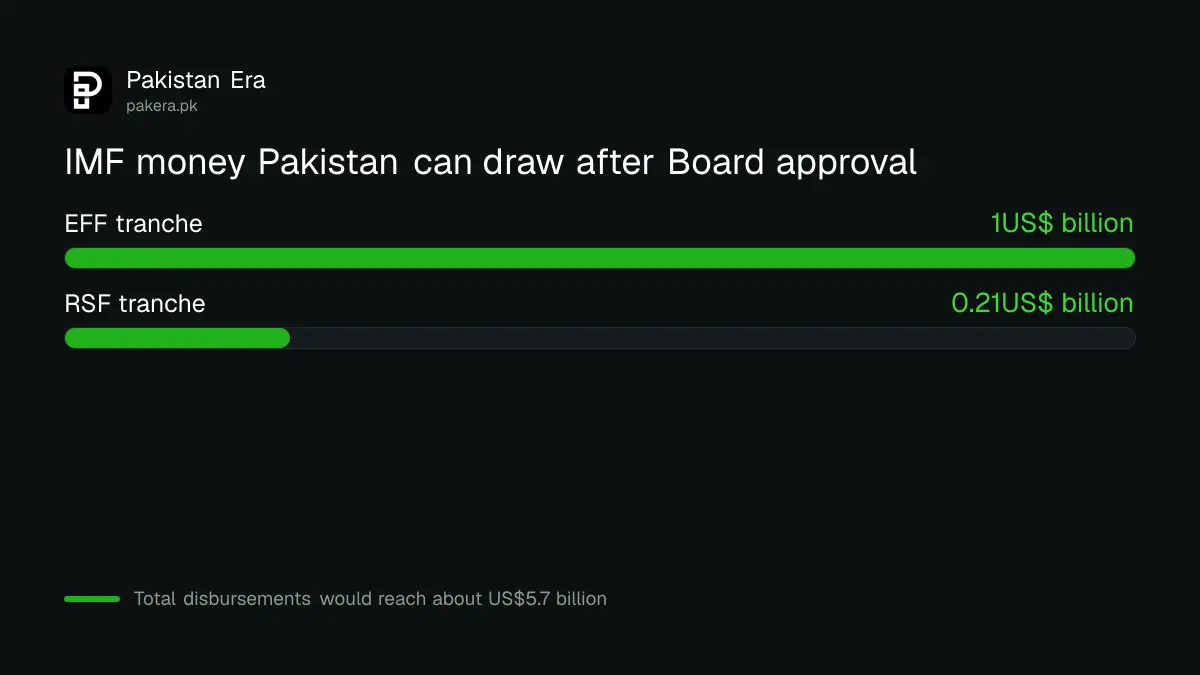
IMF staff and Pakistan agreed on the fourth review of the Extended Fund Facility (EFF) and the third review of the Resilience and Sustainability Facility (RSF). After Board approval, Pakistan can draw about US$1.0 billion under the EFF and about US$210 million under the RSF.
The IMF says total disbursements under the two arrangements would then reach about US$5.7 billion. The press release says the agreement is "subject to approval by the IMF Executive Board". It does not give a Board date, so we do not give one either.
The tranche size and the earlier steps are already explained in our report on the staff-level agreement for the 1.2 billion dollar tranche. How much has arrived so far is set out in how much IMF money Pakistan has received.
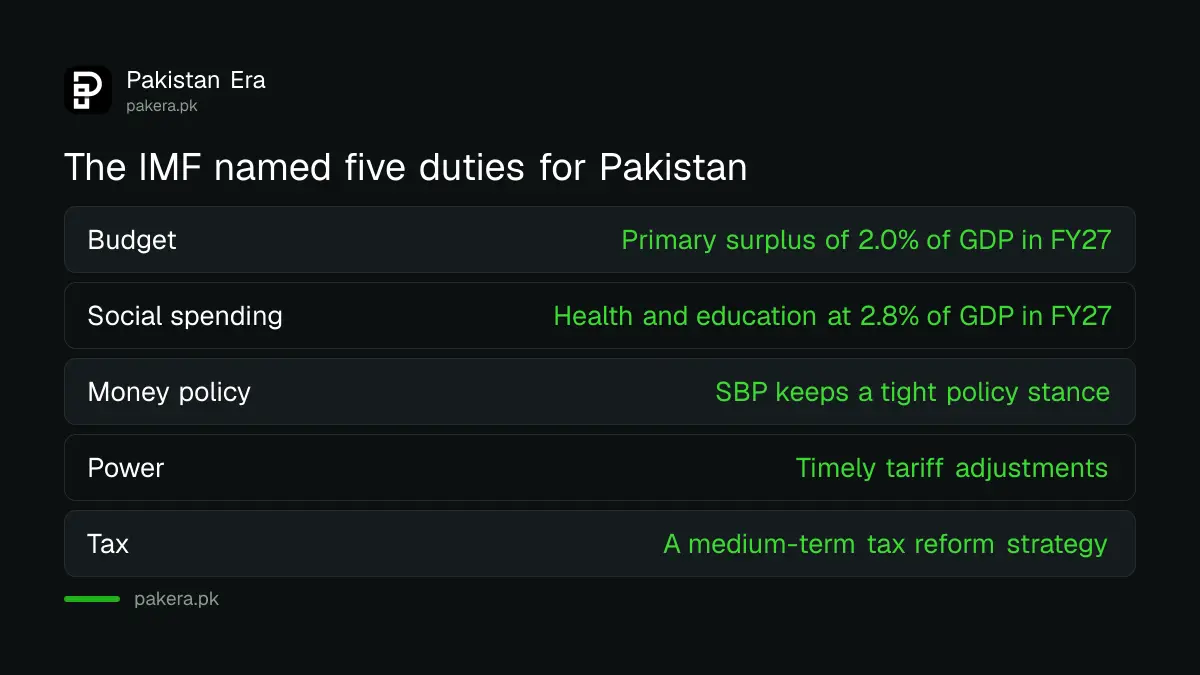
A 2 percent primary surplus means the budget must earn more than it spends before interest
The primary surplus is government revenue minus government spending, leaving out interest payments. A surplus means the state is not borrowing to run its day to day affairs. The IMF says Pakistan has committed to an underlying primary surplus of 2.0 percent of GDP in FY27.
For a household, this is the reason the budget leaves little room for tax cuts or new subsidies. Interest costs are already large, as shown in the public debt review for FY26. Any extra spending has to be paid for by higher revenue or by cuts elsewhere.
The IMF also lists revenue administration reforms: better risk-based audits, digital invoicing and the use of third-party data. In simple words, the tax office should find taxpayers using data rather than by raising rates on those already in the net.
Health and education spending is set at 2.8 percent of GDP
The IMF says Pakistan will increase health and education spending to 2.8 percent of GDP in FY27. It also mentions a planned rise in targeted cash transfers and better coverage and payment systems for them.
We could not find, on the pages we read, the FY26 starting point for this 2.8 percent, so we do not say how large the rise is. The IMF does not name the programme, but income support for poor families already runs through BISP. Power bill relief for poor homes is also being moved in that direction, as we explained in the plan to replace the electricity slab subsidy with BISP support.
The IMF wants power tariffs adjusted on time and the SBP to stay tight
On electricity, the IMF writes: "Timely tariff adjustments and cost-reducing reforms are essential to prevent renewed circular debt accumulation while protecting vulnerable consumers." That means regular tariff changes are part of the plan, not a surprise.
On money, it says the State Bank of Pakistan (SBP) "should continue maintaining appropriately tight policy stance to ensure inflation returns durably to the SBP's target range". A tight stance means interest rates stay high enough to slow price rises. This is why loans stay costly and why the next policy meeting matters. See the SBP meeting on 26 October.
The IMF adds that exchange rate flexibility should keep acting as a shock absorber, and that further reserve accumulation and a gradual opening of the foreign exchange regime will build resilience. On state companies, it lists "advancing privatization" and better governance and transparency.
The IMF numbers for growth, inflation and reserves
The press release gives a short list of numbers. They are the IMF's own estimates, so they can differ from figures in Pakistan's national accounts.
| Item | IMF figure | Period |
|---|---|---|
| Real GDP growth, first three quarters | 4 percent | FY26 |
| Real GDP growth, full year (estimate) | 3.6 percent | FY26 |
| Inflation | About 10.3 percent | September 2026 |
| Gross reserves | About US$21.5 billion | End September 2026 |
| Primary surplus (underlying) | 2.0 percent of GDP | FY27 commitment |
| Health and education spending | 2.8 percent of GDP | FY27 commitment |
The IMF full year growth estimate of 3.6 percent is not the same as the 3.70 percent in the national accounts. The difference and the source are explained in how to check Pakistan GDP growth on the PBS pages.
The September inflation figure of about 10.3 percent matches the CPI reading explained in the four Pakistan inflation numbers.
What to watch after this agreement
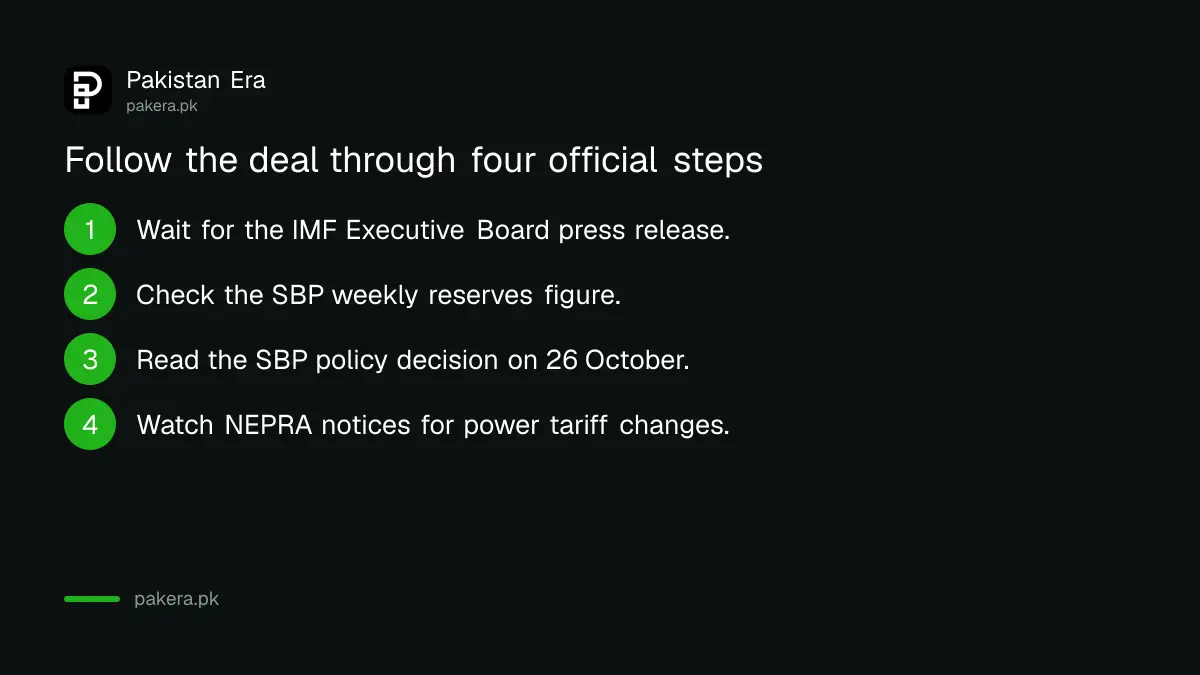
Four dates and documents tell you whether the deal turns into money and policy. Follow them in this order.
- The IMF Executive Board meeting on Pakistan. Watch the IMF news page for the Board press release, which will confirm the amount.
- The SBP weekly reserves figure after the money arrives. It is published on the SBP website every week.
- The SBP policy decision on 26 October 2026, which shows whether the tight stance continues.
- NEPRA notices on power tariffs and fuel charges, which show how the "timely tariff adjustments" are applied to bills.
Common questions
Has the IMF already paid Pakistan the US$1.2 billion?
No. The agreement of 7 October 2026 is at staff level. The money is released only after the IMF Executive Board approves it.
What is a primary surplus in simple words?
It is revenue minus spending, without counting interest payments. A surplus of 2.0 percent of GDP means the state earns more than it spends before paying interest.
Will electricity bills rise because of this agreement?
The IMF asks for timely tariff adjustments, but it does not name a new rate. Bill changes come from NEPRA decisions, so check NEPRA notices rather than assume.
Why does the IMF want the SBP to keep a tight policy?
It wants inflation to return durably to the SBP target range. High interest rates slow price rises but make loans costlier.
When will the IMF Board meet on Pakistan?
The press release gives no date. We checked the IMF page and did not find a Board date, so wait for the IMF announcement.
Where can I read the IMF statement myself?
The full text is the IMF press release on the 2026 Article IV consultation and the fourth EFF review. The link is in the sources section below.
How we verified this
What we checked, where we read it, and what we could not confirm.
Last checked on 13 October 2026, Pakistan time. We read the IMF's press release on the 2026 Article IV consultation and the staff-level agreement. The IMF page gives no Executive Board date, no list of structural benchmarks in the text we read, and no FY26 starting figure for health and education spending, so we do not state them. The GDP comparison uses the PBS figure already reported on this site.
About the author

Global Affairs & Political Economy Writer
Muhammad Hatim is a book lover who started writing because he enjoys it. At Pakistan Era he writes about international relations, geopolitics and the global economy, with a particular interest in South Asia and the forces behind current events.