Pakistan's Public Debt Falls to 68.3% of GDP, but Interest Still Eats Two Thirds of Revenue
Pakistan's public debt was Rs 86,715 billion, 68.3% of GDP, in June 2026. Interest took Rs 6,948 billion. What the Finance Ministry review means for your taxes.
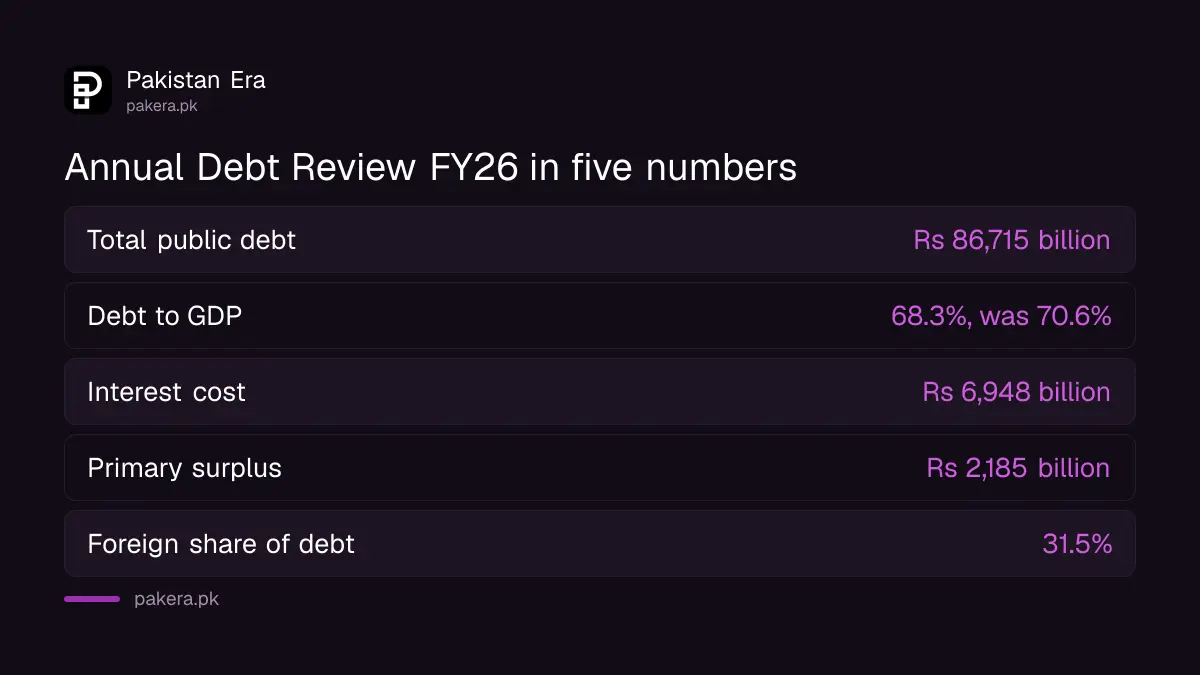
Pakistan's total public debt was Rs 86,715 billion at the end of June 2026, equal to 68.3 per cent of GDP, down from 70.6 per cent a year earlier. That is the Finance Ministry's own count, in its Annual Debt Review for FY2026. Interest costs fell 22 per cent to Rs 6,948 billion, but still took about two thirds of the federal government's net revenue.
The review appeared on the Finance Ministry's website at the end of September. A week later, on 7 October, IMF Managing Director Kristalina Georgieva warned that global public debt is "on track to soon exceed 100 percent of GDP". Pakistan sits well below that line. The problem here is different: not the size of the debt, but how much of every rupee of tax goes to paying interest on it.
Here is what the review says, what it means for your taxes and prices, and how to read the figures yourself.
Pakistan's public debt is Rs 86,715 billion, or 68.3 per cent of GDP
The Finance Ministry's Debt Management Office puts total public debt at Rs 86,715 billion at end June 2026, about $312 billion. Of that, Rs 59,441 billion is owed at home and Rs 27,274 billion abroad. Measured against the size of the economy, debt fell from 70.6 to 68.3 per cent of GDP.
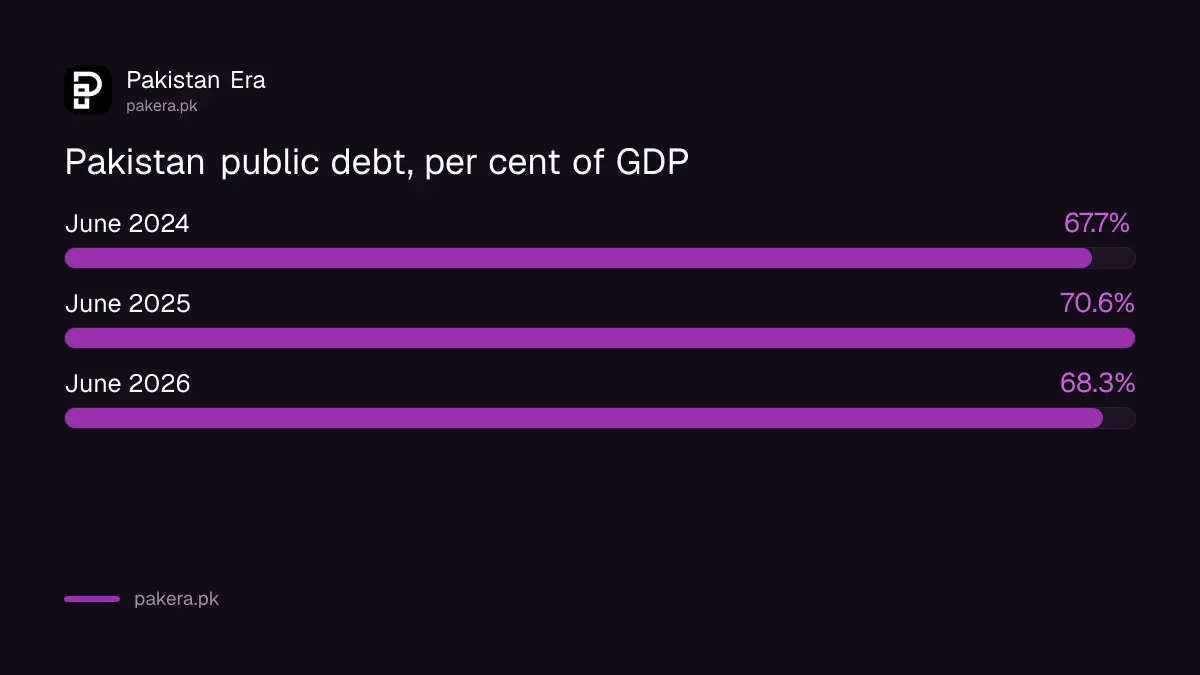
GDP is the total value of everything the economy produces in a year. The review puts it at Rs 126,870 billion for FY2026. Debt grew, but the economy grew faster, so the ratio came down.
| End of June | Total public debt (Rs billion) | Debt as % of GDP |
|---|---|---|
| 2024 | 71,246 | 67.7% |
| 2025 | 80,517 | 70.6% |
| 2026 | 86,715 | 68.3% |
The review also gives a second, smaller number. Under the Fiscal Responsibility and Debt Limitation Act, which nets off government deposits in banks, debt was Rs 77,168 billion, or 60.8 per cent of GDP. When you see two different debt figures quoted, this is usually why.
Spread across the 241.49 million people counted in the 2023 census, the total comes to about Rs 359,000 a person. That is our arithmetic, and a rough way to picture the scale, not a bill anyone receives.
Interest still takes two thirds of federal revenue
Interest cost fell from Rs 8,887 billion in FY2025 to Rs 6,948 billion in FY2026, a drop of 22 per cent, the review says. Net federal revenue was Rs 10,520 billion. So interest took about 66 rupees of every 100 the federal government kept after sharing with provinces.
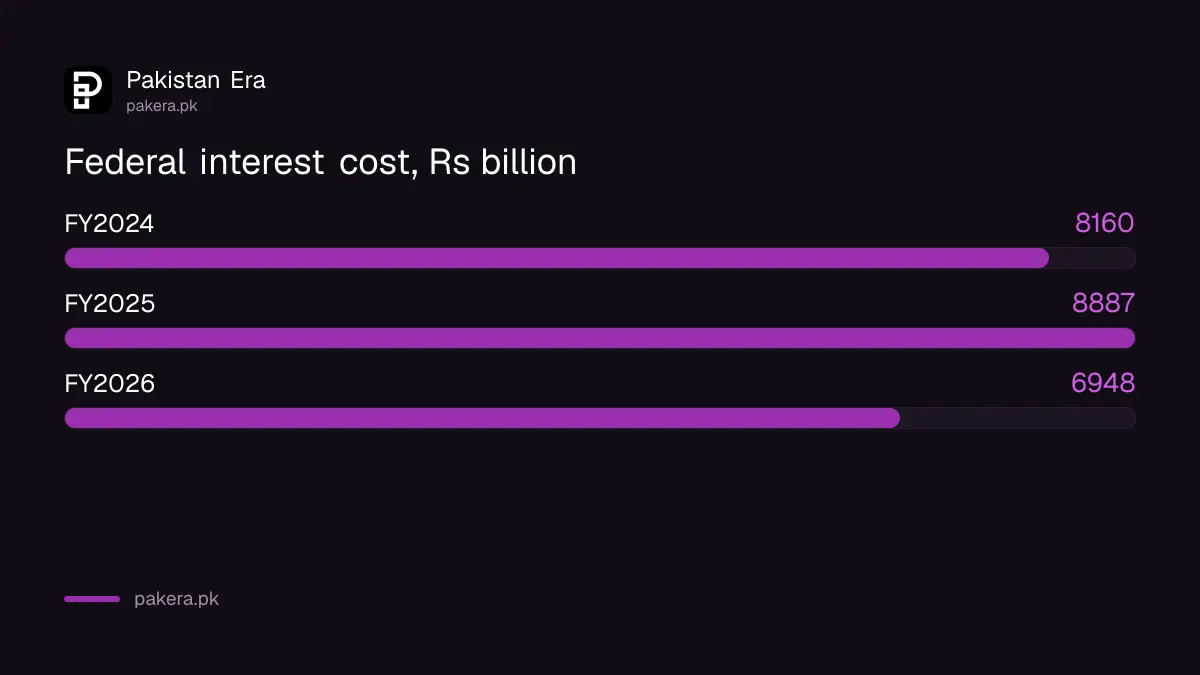
That share is the number that touches your life. Money spent on interest cannot go to schools, hospitals or fuel relief. It also explains why taxes on petrol, electricity and salaries stay high even when the economy improves.
The review credits two things for the lower bill: lower interest rates and better debt management. It reports Rs 2,924 billion of debt buybacks, where the government repays costly debt early. It also reports a primary surplus of Rs 2,185 billion. A primary surplus means revenue was larger than spending before interest is counted.
The overall federal deficit narrowed to Rs 4,763 billion, or 3.8 per cent of GDP, from Rs 7,089 billion. That is real progress, and the IMF staff cited Pakistan's strong policies when it agreed the latest review, as we reported on the $1.2 billion IMF agreement.
The oil shock pushed borrowing into short-term bills
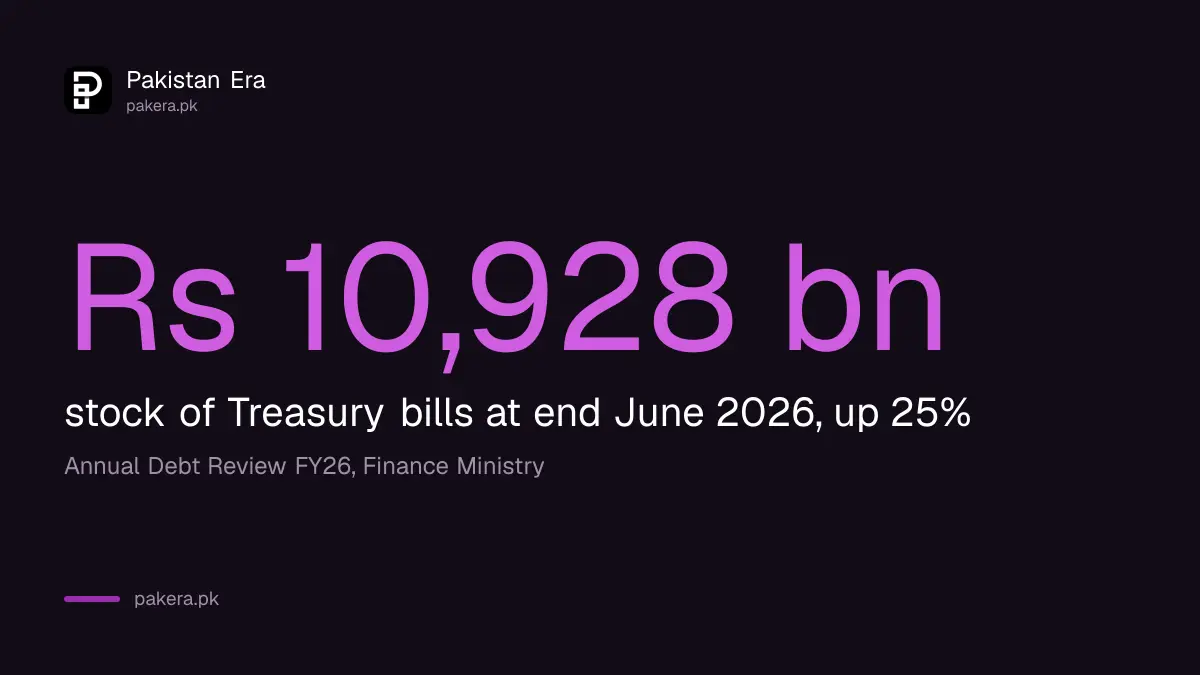
Treasury bills, the government's short loans of up to a year, grew 25 per cent to Rs 10,928 billion. The review says investors "favoured short tenors after the Iran war". Short debt has to be refinanced sooner, so changes in interest rates reach the budget faster.
The review also points to steps the other way. Floating-rate bonds, whose interest resets with market rates, fell from 43 to 37.2 per cent of the portfolio, the review says. The average time before domestic debt's rate resets is now 1.3 years. On foreign debt, short-term borrowing fell from 24 to 16 per cent.
Here is the link to your wallet. Higher oil pushed inflation to 10.3 per cent in September, by the Bureau of Statistics. If the State Bank keeps its rate high to fight that inflation, the interest bill stops falling. The next rate decision is due on 26 October, as set out in our look at the next SBP monetary policy meeting. Short-term borrowing has risen before, as we found in August when short-term debt grew four times faster than long-term debt.
Pakistan's debt is below the world average the IMF warned about
Georgieva said global public debt is near its highest level since the end of the Second World War and could soon pass 100 per cent of world GDP. Pakistan's 68.3 per cent is lower. But a lower ratio does not mean an easier position, because Pakistan collects far less tax than richer, more indebted countries.
The IMF's own April 2026 forecast, on its DataMapper, put Pakistan's government debt at 70.1 per cent of GDP for FY2026 and 67.1 per cent for FY2027. The IMF's measure differs a little from the Finance Ministry's, so the numbers do not match exactly. Both point the same way: slowly down.
Her advice to countries like ours was to "expand fiscal space and grow foreign exchange buffers". In plain words, keep room in the budget for a crisis and build up dollar reserves. The review reports that State Bank reserves reached $18.4 billion at end June 2026, against $9.4 billion two years earlier.
How to read the debt figures yourself
The Finance Ministry publishes the Annual Debt Review free as a PDF. It is eight pages and readable without an economics degree. These are the steps we used on 9 October.
- Open finance.gov.pk, the Finance Division's website.
- Find the link to "Annual Debt Review FY26", which is linked from the home page.
- Read the "Highlights" box on the first page for the main numbers.
- Check which definition a figure uses: "total public debt" (68.3 per cent) or the FRDLA definition (60.8 per cent).
- Compare interest expense with net federal revenue to see how much of the budget interest takes.
One small inconsistency is worth knowing. The highlights say debt rose 7.7 per cent, while a later page says 7 per cent. From Rs 80,517 billion to Rs 86,715 billion is 7.7 per cent on our arithmetic, so the highlight figure is the accurate one.
Common questions
How much is Pakistan's total public debt in 2026?
Rs 86,715 billion at the end of June 2026, about $312 billion, according to the Finance Ministry's Annual Debt Review FY26.
What is Pakistan's debt to GDP ratio?
68.3 per cent at end June 2026, down from 70.6 per cent a year earlier. Under the FRDLA definition it is 60.8 per cent.
How much does Pakistan pay in interest?
Rs 6,948 billion in FY2026, down 22 per cent from Rs 8,887 billion. That was about 66 per cent of net federal revenue, on our arithmetic.
How much of Pakistan's debt is foreign?
Rs 27,274 billion, or 31.5 per cent of total public debt. The rest, Rs 59,441 billion, is owed to lenders inside Pakistan.
What did the IMF say about global debt in October 2026?
Managing Director Kristalina Georgieva said on 7 October 2026 that global public debt is on track to soon exceed 100 per cent of GDP.
Does the debt figure include circular debt in power and gas?
The review does not discuss circular debt. It lists Rs 4,283 billion of government guarantees separately, and says about 56 per cent of them were issued for power sector companies.
How we verified this
What we checked, where we read it, and what we could not confirm.
Last checked 9 October 2026, about 4:00 am PKT. We read the Finance Ministry's Annual Debt Review FY26 (posted 30 September 2026), the IMF Managing Director's speech of 7 October 2026, and Pakistan's debt forecast on the IMF DataMapper. The per-person figure and the interest share of revenue are our own arithmetic.
About the author

Global Affairs & Political Economy Writer
Muhammad Hatim is a book lover who started writing because he enjoys it. At Pakistan Era he writes about international relations, geopolitics and the global economy, with a particular interest in South Asia and the forces behind current events.